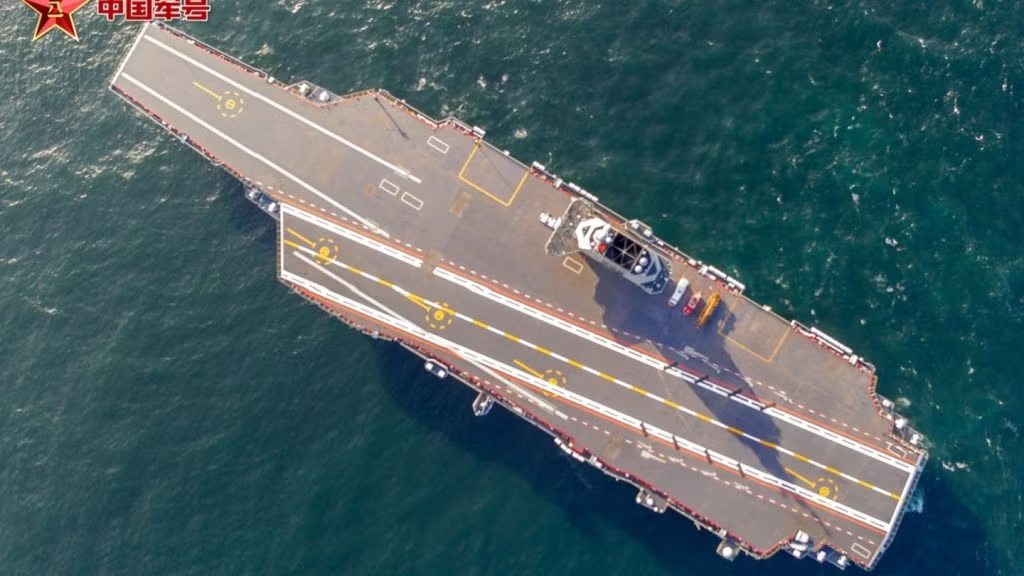
Aircraft carriers are more than warships.
They are floating airbases.
They are symbols of national power.
They are tools of diplomacy, deterrence, intimidation, and war.
They tell the world that a country does not need to fight only near its own coastline.
It can carry airpower across the ocean.
For decades, the United States dominated this world almost alone. Its nuclear-powered supercarriers became the strongest symbols of American military reach. Wherever a U.S. carrier strike group appeared, the message was clear: American power had arrived.
You May Also Like
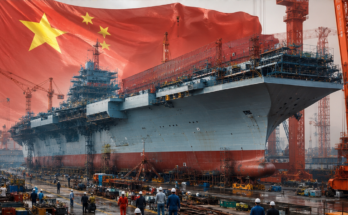
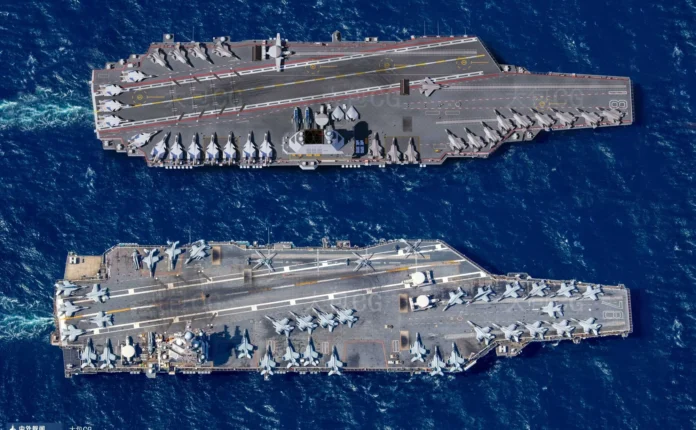
But now China is trying to change that story.
On November 5, 2025, China officially commissioned its third aircraft carrier, Fujian, into the People’s Liberation Army Navy. The ship’s entry into service marked a major milestone in Beijing’s effort to transform the PLAN from a coastal defense force into a true blue-water navy capable of operating far from home.
Fujian is not just another Chinese carrier.
It is China’s first catapult-assisted aircraft carrier.
It is China’s first carrier equipped with electromagnetic launch technology.
It is larger and more capable than Liaoning and Shandong.
It is designed to launch heavier aircraft with more fuel, more weapons, and more mission flexibility.
That makes Fujian the most important Chinese warship of its generation.
But there is a second truth: Fujian is advanced, but it is not yet equal to America’s most capable carriers.
It is conventionally powered, not nuclear-powered.
China is still building real carrier-operational experience.
Its air wing is still maturing.
Its ability to sustain long-range combat operations remains unproven.
So the question is not simply whether Fujian is powerful.
It is.
The real question is: how close has China come to challenging U.S. carrier dominance?
China’s Three-Carrier Era Has Begun
With Fujian’s commissioning, China officially entered its three-carrier era.
That alone is significant.
Only a small number of countries operate aircraft carriers, and even fewer possess multiple carriers. A carrier fleet gives a navy options. One carrier may be in maintenance, another in training, and another available for deployment. The more carriers a country has, the easier it becomes to maintain presence at sea.
China’s first carrier, Liaoning, began life as an unfinished Soviet-era vessel. It was purchased from Ukraine and rebuilt by China. Liaoning gave the PLAN a training platform — a way to learn how to operate aircraft from a carrier, train crews, develop procedures, and understand the enormous complexity of naval aviation.
China’s second carrier, Shandong, was built domestically but still followed the ski-jump design of Liaoning. It represented progress, but it remained limited by the same basic launch method.
Fujian is different.
It is larger.
It is more modern.
It is domestically designed and built.
Most importantly, it uses catapults instead of a ski jump.
That single change transforms what the ship can do.
China has moved from learning carrier operations to building a more serious power-projection platform.
Why Catapults Matter So Much
To understand why Fujian matters, you have to understand how aircraft leave an aircraft carrier.
China’s first two carriers use a ski-jump ramp. Aircraft accelerate down the deck and then launch upward from the curved ramp at the bow. This system is simpler and does not require catapult machinery, but it limits what aircraft can carry.
A ski-jump launch usually means aircraft must take off with less fuel or fewer weapons. That reduces range, payload, or both. It also makes it harder to launch larger support aircraft, such as fixed-wing airborne early warning aircraft.
Fujian uses a different system: CATOBAR.
CATOBAR stands for Catapult Assisted Take-Off But Arrested Recovery. In this system, aircraft are launched with the help of a catapult and then land using arresting wires.
This is a major step forward.
A catapult can launch heavier aircraft. That means fighters can take off with more fuel and weapons. It also allows the carrier to operate larger and more specialized aircraft, such as airborne early warning planes, which are crucial for detecting threats at long distances.
Fujian’s use of electromagnetic catapults is especially important. Instead of first using older steam catapult technology, China jumped directly to an electromagnetic system similar in basic concept to the technology used on America’s Ford-class carriers.
That is one of the most impressive parts of Fujian.
China did not simply copy its older carrier designs.
It made a technological leap.
EMALS: The Technology That Changes the Flight Deck
Fujian’s electromagnetic catapult launch system is one of its defining features.
Traditional steam catapults use steam pressure to launch aircraft. Electromagnetic catapults use electric power to accelerate aircraft more smoothly and with more control.
This can bring several advantages.
It can reduce stress on aircraft.
It can allow more flexible launch settings.
It can support a wider range of aircraft weights.
It can improve launch efficiency.
It can help launch heavier aircraft more reliably.
For China, this matters because its future carrier air wing will likely include multiple aircraft types: upgraded J-15 fighters, the new J-35 stealth fighter, and the KJ-600 airborne early warning aircraft.
The KJ-600 is especially important.
A carrier without a powerful airborne early warning aircraft is more limited. Helicopters can provide some radar coverage, but fixed-wing early warning aircraft fly higher, farther, and longer. They can detect enemy aircraft, missiles, and ships at greater distances.
That gives the carrier group more time to react.
For decades, U.S. aircraft carriers have benefited from aircraft like the E-2 Hawkeye. Fujian may allow China to field its own similar capability from a carrier deck.
That could dramatically improve the PLAN’s ability to operate farther from land-based air cover.
Fujian Compared With Liaoning and Shandong
Fujian is a major improvement over China’s first two carriers.
Liaoning is useful, but it is best understood as China’s training and learning carrier. It helped the PLAN understand carrier aviation from the inside. It allowed China to train pilots, deck crews, maintainers, command teams, and escorts.
Shandong improved on that foundation. It was built in China and gave the PLAN more experience operating a domestically produced carrier. But it still used a ski-jump system and remained limited in aircraft launch weight and support-aircraft options.
Fujian moves beyond both.
Its larger displacement gives it more room for aircraft, fuel, weapons, maintenance areas, and aviation operations. Its flat flight deck and catapults make it more similar in layout to Western-style carriers. Its electromagnetic launch system gives it a level of capability China’s earlier carriers simply do not have.
This matters because carrier power is not only about how many aircraft a ship can carry.
It is about what those aircraft can do when they launch.
A fighter taking off with more fuel can fly farther.
A fighter taking off with more weapons can hit harder.
An early warning aircraft can protect the fleet.
A tanker or support aircraft can extend operations.
A more flexible deck can generate more useful sorties.
Fujian is not just bigger.
It is smarter in how it can use aircraft.
How Big Is Fujian?
Fujian reportedly displaces over 80,000 metric tons at full load.
That makes it far larger than Liaoning and Shandong. It also makes it larger than many carriers operated by other countries.
For comparison, France’s Charles de Gaulle is much smaller. The United Kingdom’s Queen Elizabeth-class carriers are also smaller than Fujian. India’s carriers are smaller as well.
But Fujian is still smaller than America’s largest carriers.
The U.S. Navy’s Ford-class carriers displace more than 100,000 tons. They are nuclear-powered, extremely large, and built around decades of experience in carrier aviation, logistics, maintenance, and global operations.
Still, Fujian’s size is enough to make it one of the most powerful aircraft carriers outside the United States.
It is not a small regional carrier.
It is a serious blue-water platform.
Conventional Power: Fujian’s Biggest Limitation
Fujian’s most important limitation is propulsion.
It is conventionally powered, not nuclear-powered.
That means it does not have the same endurance advantages as U.S. nuclear-powered carriers. A nuclear carrier can operate for extremely long periods without needing to refuel its reactors. It still needs food, aviation fuel, weapons, maintenance, and crew support, but its propulsion endurance gives it major flexibility.
Fujian, by contrast, depends on conventional fuel.
That does not make it weak. Many powerful warships are conventionally powered. But it does create logistical limits. A conventionally powered carrier must rely more heavily on refueling and support ships during long-range operations.
For China, this matters because true blue-water operations require more than one impressive carrier.
They require a support system.
Tankers.
Supply ships.
Escorts.
Maintenance capacity.
Overseas access.
Experienced crews.
Reliable logistics.
Long-distance command and control.
The U.S. Navy has built that system over many decades. China is still building it.
So Fujian gives China more reach, but it does not instantly give China the global carrier power of the United States.
The Air Wing: The Real Test of Fujian
An aircraft carrier is only as powerful as the air wing it can operate.
This is one of the most important points.
A carrier without a mature air wing is just a large ship with a runway. The true power comes from the aircraft, pilots, maintainers, weapons, sensors, and flight-deck crews working together at high tempo.
Fujian is expected to operate several important aircraft types.
The J-15T is an upgraded carrier-based fighter adapted for catapult launches.
The J-35 is China’s new carrier-capable stealth fighter.
The KJ-600 is expected to provide airborne early warning and command support.
Together, these aircraft could transform China’s carrier airpower.
The J-35 is especially important because stealth fighters are central to modern air combat. If China can operate stealth fighters from Fujian, the PLAN would gain a much more dangerous aviation capability at sea.
The KJ-600 may be even more strategically important. A carrier needs to see beyond the horizon. Airborne early warning aircraft help detect enemy threats before they get close. They also support command and control of the air battle.
But all of this must be proven.
Launching aircraft in tests is one thing.
Operating a full air wing at sea for long periods is another.
Conducting night operations is another.
Generating high sortie rates is another.
Coordinating with escorts, submarines, aircraft, and satellites is another.
Fujian’s real test will not be its commissioning ceremony.
It will be years of training at sea.
Why the J-35 Matters
The J-35 could become the most important aircraft in Fujian’s future air wing.
China’s earlier carrier fighters were based on the J-15, a large aircraft derived from the Russian Su-33 design. The J-15 gives China a capable carrier fighter, but it is not stealthy. In a modern war against advanced opponents, stealth becomes a major advantage.
The J-35 is expected to give China a fifth-generation carrier fighter.
If successful, it could allow Fujian to launch stealth aircraft for air defense, strike missions, and operations against enemy ships or bases.
This would change the PLAN’s carrier role.
Instead of mainly defending the fleet and projecting limited airpower, Fujian could eventually support more advanced offensive and defensive missions.
But the J-35 must prove itself.
Carrier aviation is extremely demanding. A stealth aircraft must survive the stress of catapult launches and arrested landings. It must handle saltwater corrosion, tight hangar conditions, deck operations, maintenance challenges, and the brutal rhythm of carrier life.
The aircraft may be promising, but operational maturity will take time.
Why the KJ-600 May Be a Game-Changer
The KJ-600 may not look as exciting as a stealth fighter, but it could be one of the most important aircraft on Fujian.
Airborne early warning aircraft are the eyes of a carrier strike group.
They fly above the fleet and use radar to detect aircraft, missiles, and ships at long range. They help coordinate fighters and warn the carrier group of approaching threats.
Without this kind of aircraft, a carrier is more dependent on ship radar, helicopters, and land-based support.
With a fixed-wing early warning aircraft, the carrier can see farther and fight smarter.
This is one reason Fujian’s catapult system matters so much. A ski-jump carrier has difficulty operating heavy fixed-wing support aircraft like the KJ-600. A catapult carrier can do it.
If China successfully integrates the KJ-600, Fujian will become much more capable than Liaoning or Shandong.
This could be the difference between a carrier that mainly operates near friendly shores and one that can support more serious operations at distance.
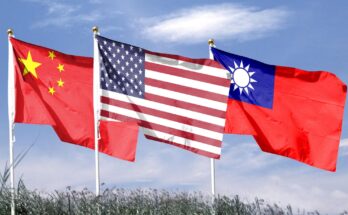
What Fujian Means for Taiwan
Fujian’s name itself is politically sensitive.
Fujian province sits across the Taiwan Strait from Taiwan. Naming China’s most advanced carrier Fujian naturally carries symbolism, whether Beijing says so directly or not.
For Taiwan, Fujian represents a growing challenge.
The carrier may not be the main weapon China would use in a Taiwan conflict. In such a scenario, land-based missiles, aircraft, ships, drones, cyber operations, and amphibious forces would all play major roles. Because Taiwan is close to mainland China, Beijing can rely heavily on land-based airpower.
But carriers still matter.
Fujian could help extend air cover beyond land-based aircraft.
It could support operations east of Taiwan.
It could complicate U.S. and allied planning.
It could help China project power into the Philippine Sea.
It could support blockade or pressure operations.
In a Taiwan crisis, a Chinese carrier operating on the far side of the island could create new problems for defenders.
It would not guarantee Chinese victory.
But it would add another layer to an already dangerous military equation.
What Fujian Means for the South China Sea
Fujian may also strengthen China’s position in the South China Sea.
China claims large parts of the South China Sea, overlapping with claims by the Philippines, Vietnam, Malaysia, Brunei, and Taiwan. The region is filled with strategic sea lanes, natural resources, reefs, artificial islands, and military outposts.
A more capable Chinese carrier gives Beijing another tool for projecting power in this region.
It can send a political message.
It can support air patrols.
It can train with naval escorts.
It can demonstrate presence.
It can pressure smaller neighbors.
It can complicate U.S. freedom-of-navigation operations.
The South China Sea is close enough to China that land-based aircraft already matter greatly. But a carrier gives China mobility and symbolism. It allows Beijing to show that it can bring airpower to sea, not only from coastal bases.
That matters in regional politics.
Sometimes the presence of a carrier is not about firing weapons.
It is about being seen.
U.S. Carriers Still Have Major Advantages
Fujian is impressive, but the United States still has major advantages.
The U.S. Navy has decades of experience operating large carrier strike groups around the world. It has nuclear-powered carriers, mature air wings, trained crews, advanced logistics, global bases, combat experience, and a deep culture of carrier aviation.
A U.S. carrier is not powerful only because of the ship itself.
It is powerful because of the system around it.
Escorts.
Submarines.
E-2D Hawkeye aircraft.
F/A-18E/F Super Hornets.
F-35C stealth fighters.
EA-18G Growler electronic attack aircraft.
Logistics ships.
Aerial refueling.
Global maintenance networks.
Joint command structures.
Allied bases.
The U.S. Navy has learned how to operate carriers through wars, crises, exercises, accidents, failures, and decades of constant deployment.
China is learning fast, but experience cannot be built overnight.
Fujian may narrow the gap in technology, but the operational gap remains significant.
The Ford-Class Comparison
The most direct comparison is with the U.S. Gerald R. Ford-class carrier.
The Ford class is larger, nuclear-powered, and designed around advanced systems such as electromagnetic aircraft launch, advanced arresting gear, improved weapons handling, and greater electrical power generation.
Like Fujian, the Ford class uses electromagnetic catapults. But the U.S. has already spent years testing, troubleshooting, deploying, and improving those systems.
That experience matters.
New technology often looks clean on paper and difficult at sea. The Ford program itself faced years of technical challenges. EMALS, weapons elevators, arresting gear, and other systems required long testing and correction.
This is important because Fujian may face similar growing pains.
A carrier is not proven by having advanced technology installed.
It is proven by using that technology reliably under real operational conditions.
China’s Shipbuilding Speed Is the Real Warning
Even if Fujian still has limitations, China’s shipbuilding speed is alarming to many observers.
The PLAN has grown rapidly. China is producing destroyers, frigates, submarines, amphibious ships, coast guard vessels, and support ships at a pace few countries can match.
Fujian is part of this larger trend.
China is not building one carrier in isolation. It is building an ecosystem of naval power. Carriers need escorts, logistics, shipyards, aircraft, pilots, sensors, satellites, and command networks. China is working across all of those areas.
This may be the most important point.
Fujian alone does not make China equal to the U.S. Navy.
But Fujian inside a rapidly expanding Chinese fleet is much more serious.
It shows that Beijing is building tools for long-term maritime competition.
Carrier Power Is About Training
The hardest part of carrier aviation is not building the ship.
It is operating the ship well.
Aircraft carrier operations are dangerous and complex. Launching and recovering aircraft from a moving flight deck at sea requires extraordinary coordination. Every deck crew member must know exactly what to do. Every pilot must be trained. Every aircraft must be maintained. Every launch and landing must follow strict procedures.
Night operations are even harder.
Bad weather makes it harder.
Combat stress makes it harder.
High sortie rates make it harder.
Aircraft damage makes it harder.
This is why carrier experience matters so much.
The U.S. Navy has built this experience over generations. China is compressing its learning process into a much shorter time.
That does not mean China cannot succeed.
It means the next stage of Fujian’s life is critical.
Commissioning is the beginning, not the end.
Is Fujian a Supercarrier?
Many people call Fujian a supercarrier because of its size and catapult system.
That term can be useful, but it should be used carefully.
Fujian is a large and advanced aircraft carrier. It is bigger than most non-American carriers and more capable than China’s previous ships. It has electromagnetic catapults and is designed for a serious air wing.
But in the strictest sense, U.S. supercarriers remain in a class of their own because of size, nuclear propulsion, air wing maturity, global logistics, and decades of operational experience.
So the safest answer is this:
Fujian is not equal to a U.S. Ford-class carrier, but it is the closest China has ever come to building a true supercarrier-style platform.
That alone is historic.
Why Fujian Matters Even Before It Is Fully Mature
Some analysts caution that Fujian may need years before it reaches full combat capability.
That is true.
But even before it becomes fully mature, it already matters.
It changes calculations in Washington, Tokyo, Taipei, Manila, Canberra, and New Delhi. It forces navies to plan for a future where China can operate more advanced carrier aviation. It signals Beijing’s intent to project power beyond its coastline.
Military platforms influence strategy before they reach their final form.
The existence of Fujian forces others to prepare.
That means more spending.
More surveillance.
More anti-ship weapons.
More submarine patrols.
More allied planning.
More air-defense investment.
More focus on carrier-killing missiles and long-range strike.
In that sense, Fujian is already shaping the battlefield of the future.
The Psychological Power of Fujian
Aircraft carriers are political weapons as much as military weapons.
When a carrier visits a port, it sends a message.
When it sails near disputed waters, it sends a message.
When it appears in exercises, it sends a message.
When it is shown on state television, it sends a message.
For China, Fujian is a symbol of national achievement.
It tells the Chinese public that the country is no longer weak at sea. It tells rivals that Beijing is building a navy capable of operating beyond the first island chain. It tells the world that China wants to be treated as a great maritime power.
This matters because national power is not only measured in missiles and engines.
It is also measured in confidence.
Fujian gives China a new symbol of confidence.
The Limitations China Still Faces
Despite its progress, China still faces major challenges.
First, it must prove Fujian’s electromagnetic catapult system is reliable in sustained operations.
Second, it must fully integrate its carrier air wing, including the J-35 and KJ-600.
Third, it must build enough experienced carrier pilots and deck crews.
Fourth, it must develop long-distance logistics for carrier strike group operations.
Fifth, it must protect the carrier against submarines, anti-ship missiles, aircraft, and drones.
Sixth, it must learn how to operate carriers in high-pressure conditions far from home.
These are not small challenges.
A carrier is one of the most complex military systems ever created. It brings together aviation, ship engineering, weapons handling, logistics, command and control, intelligence, air defense, undersea defense, and human endurance.
China has built the ship.
Now it must master the system.
The Bottom Line: How Advanced Is Fujian?
Fujian is very advanced compared with China’s previous carriers.
It is larger.
It has electromagnetic catapults.
It uses a CATOBAR launch-and-recovery system.
It can support heavier aircraft.
It can enable a more capable air wing.
It represents a major leap in Chinese naval aviation.
Compared with most aircraft carriers in the world, Fujian is one of the most impressive.
Compared with U.S. Ford-class carriers, it still lags in nuclear propulsion, operational experience, air-wing maturity, and global support infrastructure.
That is the balanced answer.
Fujian is not a copy of Liaoning or Shandong.
It is not just a propaganda ship.
It is a serious military platform that will make China’s navy more capable over time.
But it is also not yet proof that China has matched the U.S. Navy.
The carrier race is no longer one-sided.
But America still has the deeper carrier ecosystem.
Conclusion: A New Era of Chinese Naval Power
Fujian marks the beginning of a new chapter for China’s navy.
With this carrier, Beijing has moved beyond ski-jump designs and into the world of electromagnetic catapult aviation. That means heavier aircraft, better mission flexibility, and the potential for a much stronger carrier air wing.
For China, Fujian is a symbol of national ambition.
For Taiwan, it is a warning.
For the United States, it is a reminder that naval dominance cannot be taken for granted.
For the Indo-Pacific, it is another sign that the balance of power is changing.
The ship is not perfect.
It is not nuclear-powered.
It is not yet as proven as American carriers.
Its air wing still needs to mature.
Its crew must gain more experience.
But Fujian does not need to be perfect to matter.
It already changes the conversation.
China now has three aircraft carriers. Its newest one uses electromagnetic catapults. Its navy is growing. Its shipyards are fast. Its ambitions are clear.
The age of uncontested American carrier dominance is becoming more complicated.
Fujian is not the end of the story.
It is the warning shot.