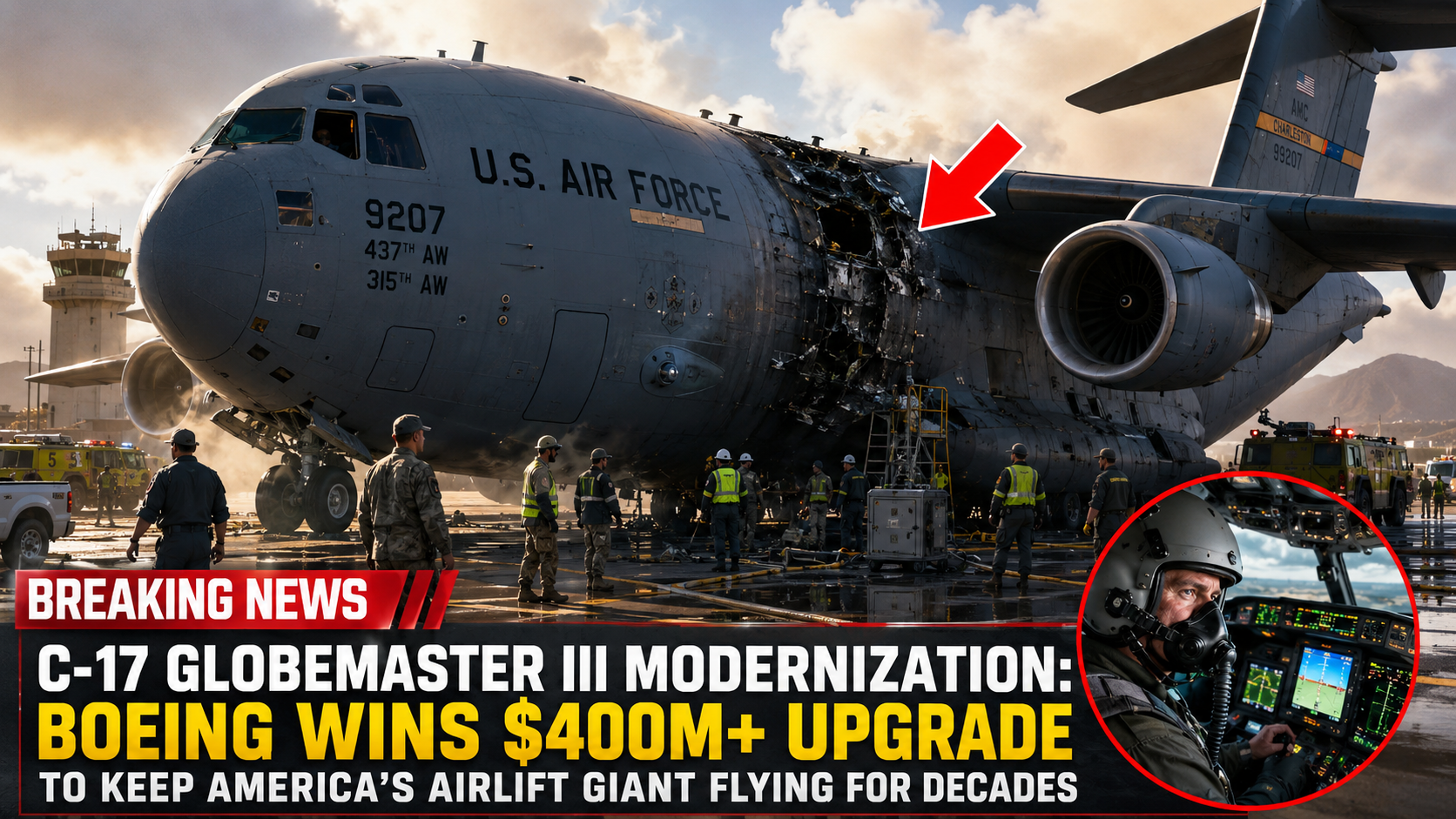
The aircraft that carries tanks, helicopters, troops, emergency supplies, and America’s global military power is not ready to leave the sky. Instead of retiring, the legendary C-17 Globemaster III is getting a major digital upgrade that could keep it flying deep into the second half of this century.
The C-17 Globemaster III has long been one of the most important aircraft in the U.S. military. It is not a fighter jet. It does not dominate headlines like the F-35, B-2 Spirit, or B-21 Raider. But when America needs to move heavy equipment across the world quickly, the C-17 is often the aircraft that makes it happen.
Now, the backbone of U.S. military airlift is preparing for a major modernization effort designed to keep it operational for decades to come.
Boeing has secured a U.S. Air Force contract to modernize the cockpit and avionics of the C-17A fleet, with related supplier work carrying an estimated lifetime value of more than $400 million. The effort is part of the Flight Deck Obsolescence and Technology Refresh program, a major upgrade aimed at solving one of the biggest problems facing older military aircraft: aging electronics.
You May Also Like

For the C-17, this is not just a simple update. It is a long-term survival plan.
The U.S. Air Force wants to keep the C-17 flying until at least 2075. That means an aircraft that first flew in 1991 could still be carrying troops, vehicles, helicopters, humanitarian supplies, and military cargo more than 80 years after its first flight.
That is extraordinary.
Why the C-17 Still Matters
The C-17 Globemaster III is one of the most flexible military transport aircraft ever built. It was designed to do something very difficult: carry heavy cargo across long distances, then land on short or rough runways close to the mission area.
That makes it different from many large cargo aircraft.
The C-17 can carry tanks, armored vehicles, helicopters, troops, pallets of supplies, medical evacuation equipment, and oversized military cargo. Even more importantly, it can deliver those loads into places where larger aircraft may not be able to operate.
In a major war, disaster response, evacuation, or emergency deployment, speed matters. The C-17 gives the U.S. military the ability to move power quickly. It can support combat operations, humanitarian missions, disaster relief, and allied defense commitments around the world.
That is why the aircraft remains so valuable even decades after entering service.
While stealth fighters and bombers often get the attention, military airlift is what keeps global operations alive. Aircraft like the C-17 move the equipment, people, weapons, and supplies that allow missions to continue. Without airlift, even the most advanced military force can become slow and limited.
The Problem: Old Cockpit Systems
The C-17 is still a powerful aircraft, but its cockpit systems are aging.
Many of the aircraft’s existing avionics were designed decades ago. Over time, older computers, displays, processors, and electronic components become harder to repair or replace. The problem is not always that the aircraft itself is weak. The problem is that the technology inside the cockpit can become outdated.
Some critical components, including mission computers and cockpit displays, are approaching the end of their support life. Spare parts for some of these systems are expected to become difficult to sustain in the coming years.
That creates a serious readiness problem.
If the aircraft is still structurally useful, but the cockpit electronics become too old to support, the entire fleet can face delays, maintenance problems, and higher costs. For an aircraft as important as the C-17, that risk is too big to ignore.
This is why the Air Force and Boeing are moving forward with a modernized flight deck.
America’s Billion-Dollar Ghost Weapons: Why the B-2 Spirit and Seawolf Submarine Became Too Advanced to Build in Large Numbers
What Boeing Will Upgrade
Under the modernization program, Boeing will design, manufacture, integrate, qualify, and certify a new flight deck for the C-17A.
The upgrade will replace critical avionics and mission-essential equipment with more modern systems. One of the most important parts of the plan is the use of Modular Open Systems Architecture, often called MOSA.
In simple words, MOSA allows the aircraft to receive future upgrades more easily.
Instead of redesigning the entire cockpit every time new technology is needed, the Air Force will have a more flexible system that can accept new capabilities faster and at lower cost. This is important because military technology changes quickly. Communications, navigation, mission planning, threat awareness, and digital systems all continue to evolve.
With a more open and modular design, the C-17 can stay relevant without needing a completely new aircraft.
This is not just about replacing old screens with new ones. It is about making the C-17 easier to upgrade for the future.
A Giant Built to Last
Boeing delivered 275 C-17A aircraft between 1993 and 2015. Of those, 222 went to the U.S. Air Force and 53 went to international partners.
Even though production ended in 2015, the aircraft remains in high demand. Allied nations also continue to operate the C-17 because of its rare combination of range, size, power, and runway flexibility.
The C-17 is powered by four engines and was built to perform both strategic and tactical airlift missions. It can fly across oceans, refuel in the air, land closer to the front line, unload heavy equipment, and support operations in difficult environments.
That is why replacing it is not easy.
A future successor, often discussed under next-generation airlift planning, is expected someday. But that aircraft is still years away. Until then, the C-17 remains too important to retire.
The Air Force’s decision to invest in modernization shows one clear message: the C-17 is still needed.
Flying Into the 2070s
Keeping the C-17 operational until 2075 would give the aircraft an unusually long military career.
By that time, the oldest C-17 airframes could be more than 80 years old. That may sound surprising, but long service lives are not unusual for successful military aircraft. The B-52 bomber is another example of an aircraft that has remained valuable across generations because of continuous upgrades.
The C-17 may now be following a similar path.
Instead of being replaced quickly, it is being modernized to serve longer. The aircraft’s basic design remains useful, but its digital systems need to keep up with modern demands.
This is the reality of today’s military aviation. Building a brand-new aircraft can take decades and cost billions. If an existing platform still works, upgrading it can be the smarter move.
For the C-17, the mission has not disappeared. In fact, the need for rapid global airlift may be more important than ever.
China’s Sixth-Generation Fighter Shock: Is Beijing Starting to Set the Pace in the Future of Airpower?
Why This Matters for U.S. Military Power
The world is becoming more unpredictable. Conflicts, humanitarian crises, natural disasters, and great-power competition all require fast movement of people and equipment.
A country may have advanced fighters, bombers, submarines, and missiles, but it still needs logistics. It still needs aircraft that can move supplies, weapons, vehicles, and troops across the planet.
That is where the C-17 remains essential.
It supports military readiness in Europe, the Pacific, the Middle East, and beyond. It helps allies. It moves emergency aid. It carries heavy equipment into places where speed and access can change the outcome of a mission.
This modernization program is not just about saving an old aircraft. It is about preserving one of the most important tools of American global reach.
Final Thoughts
The C-17 Globemaster III may not be the newest aircraft in the U.S. Air Force, but it remains one of the most valuable.
Boeing’s flight deck modernization program gives the aircraft a new path forward. By replacing aging avionics, solving future spare-parts problems, and introducing a more flexible digital architecture, the Air Force is preparing the C-17 for decades of continued service.
The message is clear: the Globemaster is not finished.
It carried America’s military power through the post-Cold War era, the wars in Afghanistan and Iraq, global humanitarian missions, and countless emergency deployments. Now, with a modernized cockpit and a new digital backbone, it may continue flying until 2075.
For an aircraft that first flew in 1991, that is more than a modernization story.
It is a statement of trust.
The C-17 is still the giant America depends on when the world needs heavy airlift fast — and with this upgrade, that giant may keep flying for another 50 years.




One Comment on “The C-17 Refuses to Retire: Boeing’s $400 Million Upgrade Could Keep America’s Heavy-Lift Giant Flying Until 2075”