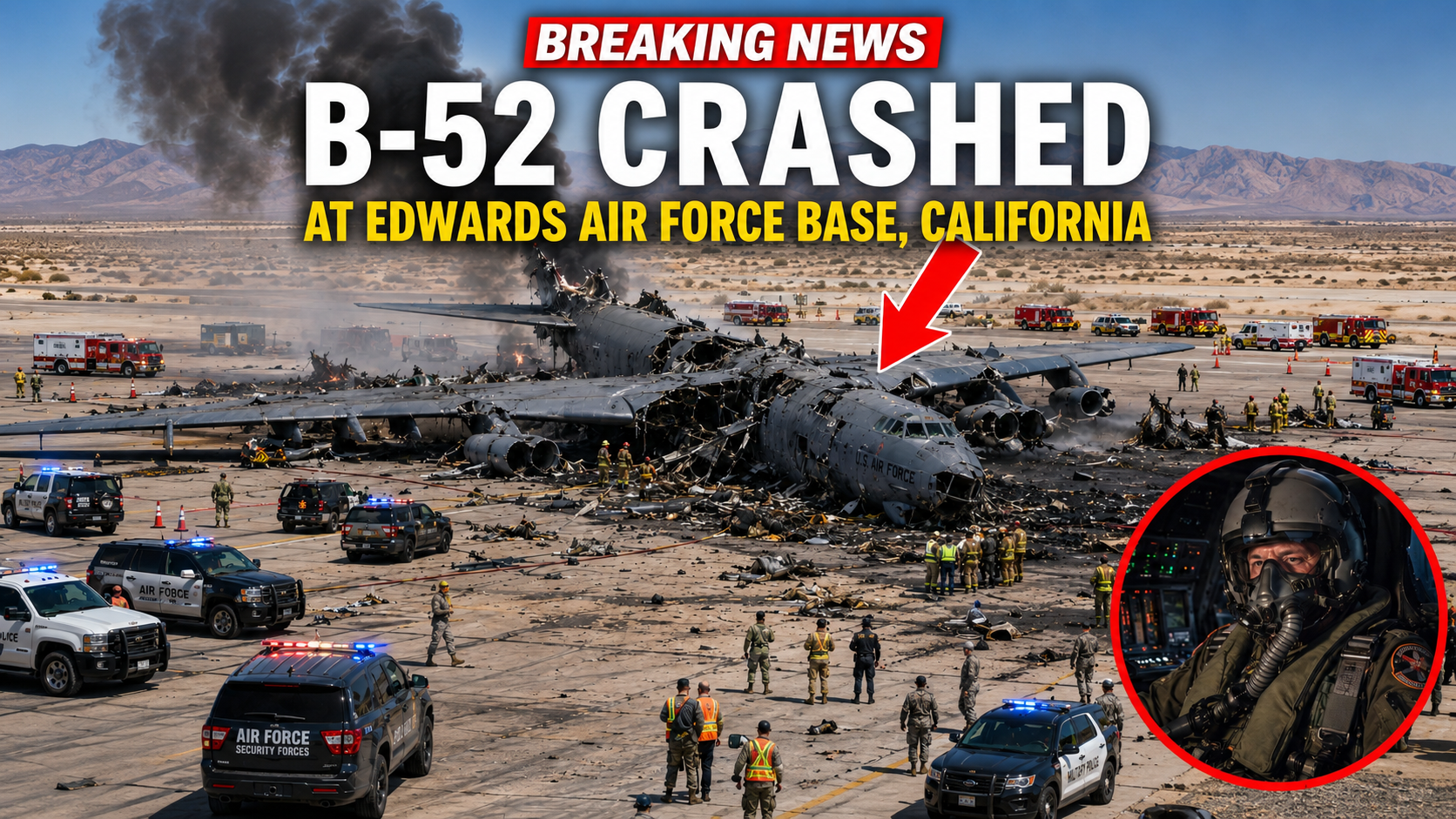
A U.S. Air Force B-52 Stratofortress crashed shortly after takeoff from Edwards Air Force Base in California, killing all eight people aboard and sending shockwaves through America’s military aviation community.
The aircraft went down during a routine test mission at Edwards, one of the most important flight-test centers in the United States. What began as another mission in the long life of America’s legendary bomber ended in fire, smoke, grief, and unanswered questions.
The crash happened shortly after takeoff at approximately 11:20 a.m. local time. Emergency crews rushed to the scene, but early indications from base officials made clear the accident was not survivable. The bomber crashed at the airfield, triggering a major emergency response and forcing officials to secure the area as investigators began the difficult process of determining what went wrong.
For many Americans, the B-52 is more than just an aircraft. It is a symbol of U.S. airpower, Cold War deterrence, long-range strike capability, and the endurance of a design that has served for generations. But this crash is a painful reminder that even the most iconic aircraft are flown, maintained, tested, and modernized by real people—pilots, engineers, weapons officers, contractors, and civilians whose work carries both purpose and risk.
You May Also Like
The eight people killed in the crash were later identified by Edwards Air Force Base as Col. Gregory Watson, Lt. Col. Gabriel Estrella, retired Lt. Col. Miles Middleton, Maj. Alexander Davis, Maj. Robert Dee, Maj. Brad Hovey, Jeromy Smith, and Christopher Rischar.
They were not just names attached to a military accident report. They were teammates, professionals, family members, fathers, colleagues, mentors, and servants of a mission larger than themselves.
The C-17 Refuses to Retire: Boeing’s $400 Million Upgrade Could Keep America’s Heavy-Lift Giant Flying Until 2075
What Happened at Edwards Air Force Base
According to official information released by Edwards Air Force Base, the B-52 Stratofortress was carrying eight people on a routine test mission when it crashed shortly after takeoff.
The aircraft had just lifted off when something went wrong. The crash occurred at Edwards Air Force Base, located in California’s Mojave Desert, a place known across aviation history as a center of experimental flight, aircraft testing, and military aerospace development.
Emergency personnel responded quickly. However, officials said the crash appeared to be unsurvivable. The crash site was secured, airfield operations were affected, and the investigation began.
The Air Force has not yet announced the cause of the crash. That is important. At this stage, any claim about exactly what caused the B-52 to go down would be speculation unless confirmed by investigators.
Military aviation investigations can take months. Investigators typically review aircraft maintenance records, flight data, crew communications, weather conditions, aircraft systems, engine performance, runway conditions, mission planning, and any available video or radar data. Because this aircraft was involved in a test mission, investigators may also look closely at any equipment or systems connected to the testing program.
For now, the central facts are clear: a B-52 crashed shortly after takeoff, eight people were aboard, all eight were killed, and the cause remains under investigation.
The Eight Lives Lost
The loss of the crew has become the heart of this tragedy. Edwards Air Force Base released the names after next-of-kin notifications were completed.
The fallen were:
Col. Gregory Watson, 53, a weapon systems officer and Boeing employee. He was also an Air Force reservist assigned to the 10th Air Force at Naval Air Station Joint Reserve Base Fort Worth.
Lt. Col. Gabriel Estrella, 40, a weapon systems officer assigned to the Air Force Operational Test and Evaluation Center, Detachment 5, at Edwards Air Force Base.
Retired Lt. Col. Miles Middleton, 50, a pilot and Boeing employee from Tehachapi, California.
Maj. Alexander Davis, 34, a weapon systems officer with the 419th Flight Test Squadron.
Maj. Robert Dee, 40, a pilot with the 419th Flight Test Squadron.
Maj. Brad Hovey, 35, a pilot with the 419th Flight Test Squadron.
Jeromy Smith, 32, a flight test engineer with the 419th Flight Test Squadron.
Christopher Rischar, 41, a flight test engineer and JT4 contractor.
Their roles show the nature of the mission. This was not simply a standard bomber flight with a normal operational crew. It involved test pilots, weapon systems officers, engineers, contractors, and mission specialists connected to the complex work of testing and modernizing an aircraft that has been flying for more than seven decades.
That is what makes this tragedy especially heavy for the Edwards community. Edwards is not just a base. It is a place where the future of aviation is tested. The people who fly there understand risk, but they also understand purpose. Every test mission is designed to collect knowledge, improve safety, validate systems, and prepare aircraft for the missions they may one day be called to perform.
But on this day, that mission ended in loss.
Trump’s New Air Force One: The Converted Qatari Jumbo Jet Turning America’s Presidential Plane Into a Political Storm
Why This B-52 Mission Mattered
The B-52 involved in the crash was reportedly supporting a modernization effort connected to radar upgrades.
That detail matters because the B-52 is not a relic sitting quietly in the background of America’s military. It remains an active and essential part of the U.S. bomber fleet. The Air Force has been working to keep the aircraft relevant for decades to come through upgrades to radar, engines, avionics, communications systems, weapons integration, and cockpit technology.
The B-52 first entered service in the 1950s. Yet today, it remains one of the most recognizable and important bombers in the world. Its basic design is old, but its mission has evolved. Over time, it has been adapted to carry modern weapons, support long-range strike missions, and serve as a visible symbol of American strategic power.
Modernization is the reason the B-52 is still flying. Without continuous upgrades, the aircraft would not be able to remain effective in a world of advanced air defenses, long-range missiles, electronic warfare, cyber threats, and rapidly changing military technology.
That is why test missions matter. Before a new system can be fully trusted, it must be tested. Before an upgrade can be fielded across a fleet, engineers and aircrew must understand how it performs in real flight conditions. That kind of work is demanding, technical, and sometimes dangerous.
The crew lost at Edwards was part of that world—the world of flight test, where aircraft are pushed, measured, analyzed, and improved.
The B-52: America’s Legendary Long-Range Bomber
The B-52 Stratofortress is one of the longest-serving combat aircraft in U.S. military history. Built by Boeing, the aircraft was originally designed during the Cold War to carry nuclear weapons and serve as a pillar of American deterrence.
Over the decades, it has carried out many different missions. It has flown conventional bombing missions, deterrence patrols, training flights, global power demonstrations, and test missions. Its value lies not in speed or stealth, but in endurance, payload, range, and adaptability.
The B-52 is a large, eight-engine, long-range bomber capable of carrying a wide variety of weapons. Its huge wings, long fuselage, and distinctive profile make it instantly recognizable. It can fly long distances, remain airborne for extended periods, and deliver large payloads against targets far from home.
The aircraft has survived because it can be upgraded. While many aircraft from its era have disappeared from active service, the B-52 has continued to evolve. New weapons, new sensors, new electronics, and new mission systems have allowed it to remain useful in modern warfare.
But age still matters. Keeping an older aircraft safe and effective requires constant attention. Maintenance, inspections, modernization, parts replacement, software upgrades, structural checks, and test programs are all part of keeping the B-52 alive.
That makes the Edwards crash even more significant. It happened at a time when the Air Force is trying to extend the life of the B-52 far into the future.
Edwards Air Force Base: Where Aviation History Is Made
Edwards Air Force Base is one of the most famous military aviation locations in the world. Located in the Mojave Desert, it has long been associated with test pilots, experimental aircraft, and major breakthroughs in flight.
The base is tied to some of the most important moments in aviation history. It is where high-speed flight, advanced aircraft testing, and aerospace innovation became part of America’s military identity. The dry lake beds and open desert airspace around Edwards have made it an ideal place for testing aircraft in conditions that would be difficult to find elsewhere.
Because of that legacy, Edwards is often called a place where the future of aviation is tested before the rest of the world sees it.
But that mission comes with risk.
Testing aircraft is different from routine operations. Test crews may fly aircraft with new systems, upgraded equipment, modified configurations, or experimental technology. The goal is to learn what works, what does not, and what must be improved before systems are used more widely.
The people who serve at Edwards understand that aviation progress is built on discipline, courage, and precision. They also know that every flight carries responsibility.
The B-52 crash is now part of that difficult history—a moment when the cost of military aviation testing became painfully real.
A Community in Mourning
The crash has deeply affected the Edwards community, the broader Air Force, Boeing, contractors, and the families of those lost.
In aviation, crews form strong bonds. Test missions require trust at every level. Pilots rely on engineers. Engineers rely on maintainers. Weapon systems officers rely on pilots. Contractors and military personnel work side by side. Everyone depends on everyone else.
When an aircraft is lost, the grief spreads far beyond the runway.
Families lose loved ones. Units lose teammates. Squadrons lose leaders. Young airmen lose mentors. Communities lose people who were part of daily life.
The eight people killed were connected to multiple parts of the military aviation world: active-duty service, reserve service, civilian engineering, defense contracting, and Boeing’s support role. Their deaths show how modern military aviation is a team effort involving uniformed personnel and civilians working together.
For readers outside the military, it can be easy to see aircraft as machines and missions as headlines. But behind every flight are human beings. Someone prepared the aircraft. Someone reviewed the systems. Someone briefed the mission. Someone sat in the cockpit. Someone waited at home.
That is the human weight of this crash.
The Investigation: What Comes Next
The investigation into the crash is ongoing. Officials have not released a final cause.
That means the public may have to wait months before a complete explanation is available. In serious military aviation accidents, investigators usually move carefully. They secure the site, recover evidence, examine wreckage, review aircraft systems, interview witnesses, analyze flight data, and reconstruct the final moments of the aircraft.
They may examine whether mechanical failure, flight control problems, engine issues, maintenance factors, test equipment, human factors, environmental conditions, or other causes played a role. They may also look at whether the aircraft’s modernization work had any connection to the accident.
But until investigators finish their work, no responsible report should claim a final cause.
This is especially important because aviation accidents are often complex. Rarely does one simple factor explain everything. A crash may involve a chain of events: technical issues, timing, aircraft behavior, crew response, and environmental conditions all interacting in seconds.
The purpose of the investigation is not only to determine what happened. It is also to prevent it from happening again.
That is one of the most important truths about aviation safety. Every accident investigation is a search for answers that can protect future crews.
Why the Crash Matters Beyond Edwards
This crash matters nationally because the B-52 remains central to U.S. military strategy.
The United States is investing heavily in its bomber force. The B-2 Spirit remains a stealth bomber. The B-21 Raider is being developed as the next-generation stealth bomber. The B-1B Lancer is nearing the later years of its service life. And the B-52, despite being the oldest design of the group, is expected to continue flying for decades.
That is remarkable.
The B-52 is not just surviving. It is being transformed. The Air Force has been working to give it new engines, new radar, improved electronics, and the ability to carry advanced weapons. In future years, upgraded B-52s may serve alongside the B-21 as part of America’s bomber force.
This is why a B-52 accident during a test mission is not just a local tragedy. It raises attention across the defense community. It touches questions about modernization, fleet age, safety, sustainment, and the demands placed on aircraft that were designed in another era but are still expected to operate in the modern battlefield.
At the same time, it is important not to jump to conclusions. One crash does not automatically mean the entire B-52 fleet is unsafe. Military aircraft are complex machines, and investigations must determine the specific circumstances of this accident.
Still, the tragedy will likely become part of a wider conversation about how the Air Force balances old aircraft, new technology, modernization pressure, and crew safety.
America’s Billion-Dollar Ghost Weapons: Why the B-2 Spirit and Seawolf Submarine Became Too Advanced to Build in Large Numbers
The Burden of Flying an Aircraft Built for Generations
The B-52 is often described with admiration because of its age. People call it legendary, timeless, unstoppable, and enduring. But behind those words is a serious challenge.
An aircraft that has served for generations must be constantly maintained and updated. Every system matters. Every inspection matters. Every upgrade must be tested. Every part must work with other parts, including systems that may have been designed decades apart.
Modernizing an old aircraft is not as simple as installing new technology. Engineers must make sure new systems communicate correctly with existing systems. They must verify electrical power, software integration, cockpit displays, radar performance, cooling, wiring, structural compatibility, and flight safety.
When the aircraft is as large and complex as a B-52, that work becomes even more demanding.
This is why test crews are so important. They are the bridge between engineering plans and operational reality. They take upgraded aircraft into the air and help determine whether the system is ready for broader use.
The crew lost at Edwards was part of that mission. Their work supported the future of the fleet. Their loss will be felt by everyone connected to the B-52 program.
A Symbol of Strength, Now Marked by Loss
For decades, the B-52 has represented strength. It has flown across oceans, appeared in military exercises, supported deterrence missions, and stood as a warning to adversaries. Its presence has often been used to send a message: the United States can project airpower across the globe.
But this week, the B-52 also represents grief.
The image of a massive bomber crashing shortly after takeoff is difficult to process. The aircraft is so large, so powerful, and so historically important that its loss feels bigger than a single aviation accident. Yet the real tragedy is not the aircraft. It is the people.
Aircraft can be replaced. Systems can be rebuilt. Programs can continue.
Lives cannot.
That is why the names of the eight fallen crew members must remain at the center of the story. They were the people behind the mission. They carried the responsibility of testing, flying, and supporting one of America’s most important aircraft.
Their final flight ended in tragedy, but their service was part of a larger mission that many Americans never see.
Respecting the Facts in a Breaking Story
In the age of social media, military accidents can quickly become surrounded by rumors. Videos, images, claims, and theories spread fast. Some may be accurate. Many may not be.
That is why this story must be handled carefully.
Here is what is known: a B-52 crashed shortly after takeoff from Edwards Air Force Base during a routine test mission. Eight people were aboard. All eight were killed. The aircraft was connected to testing work. The cause remains under investigation.
Here is what is not yet known: the exact technical failure or chain of events that caused the crash.
Until investigators release more information, the public should avoid treating speculation as fact. That includes claims about engine failure, pilot error, structural failure, modernization equipment, sabotage, or any other theory that has not been confirmed.
The families of the fallen deserve truth, not rumors. The crews still flying deserve answers, not guesses. The public deserves reporting that is strong, clear, and responsible.
The Legacy of the Fallen Crew
Every military aviation tragedy leaves behind two legacies.
The first is grief. Families mourn. Units gather. Flags are lowered. Friends remember conversations, missions, jokes, lessons, and moments that suddenly become priceless.
The second is learning. Investigators search for answers. Engineers review systems. Leaders examine procedures. Training may be adjusted. Aircraft may be inspected. Safety recommendations may follow.
That second legacy does not erase the pain, but it can give meaning to the loss. Aviation safety has always advanced through hard lessons. Each investigation has the potential to save future lives.
For the Edwards community, the names of the eight fallen crew members will not be forgotten. They were part of a mission that required courage, skill, and trust. They served in a world where the line between progress and danger can be narrow.
Their loss is a reminder that military aviation is not only about machines, power, and technology. It is about people willing to carry risk so that others can fly safer, fight better, and return home.
A Dark Day for American Airpower
The crash at Edwards Air Force Base is one of the most serious B-52 accidents in recent memory. It comes at a time when the aircraft remains deeply important to U.S. defense planning and is undergoing major modernization to remain operational for decades.
But beyond strategy, budgets, radar upgrades, and aircraft programs, this is a human tragedy.
Eight people boarded a B-52 for a mission. They did not return.
Their deaths will be felt across Edwards, the Air Force, Boeing, the defense testing community, and the families who now face an unimaginable loss.
The B-52 Stratofortress has been called many things over its long life: a Cold War icon, a strategic bomber, a flying fortress, a symbol of deterrence, and a workhorse of American airpower.
Today, it is also the center of mourning.
As investigators work to determine what happened, one truth is already clear: the people lost in this crash served in one of the most demanding corners of military aviation. Their mission was difficult. Their work mattered. Their sacrifice deserves to be remembered with honor.
Is America’s Global Power Beginning to Crack? How Donald Trump’s Second Term Could Reshape the World Order
Final Thought
The Edwards B-52 crash is more than a breaking-news headline. It is a story of service, risk, technology, and loss.
It reminds us that behind every aircraft are people. Behind every test flight are families. Behind every military mission are men and women who accept danger in the name of duty.
The investigation will continue. The questions will remain until the facts are known. But the memory of the eight people lost at Edwards should remain at the center of the story.
They were not just passengers on a bomber.
They were the mission.