
A new presidential aircraft has arrived at Joint Base Andrews, and it is already becoming one of the most talked-about planes in the world.
The U.S. Air Force announced that its new VC-25B “Bridge” aircraft has officially arrived at the Presidential Airlift Group and is beginning commissioning flights. These flights are the final test phase before the aircraft can be fully added to the active executive airlift fleet and used for presidential missions.
But this is not just another government aircraft.
The jet is a modified Boeing 747-8 that was gifted by Qatar and rapidly converted into an interim presidential transport platform. It is meant to serve as a temporary bridge while the United States waits for Boeing’s long-delayed next-generation VC-25B aircraft, the official future replacements for the current VC-25A presidential 747s.
You May Also Like
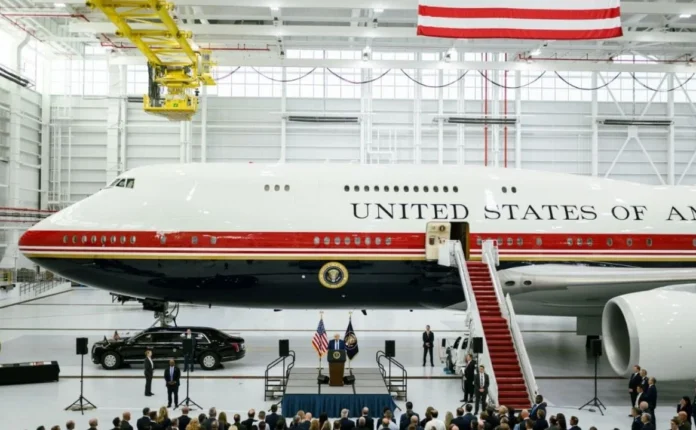
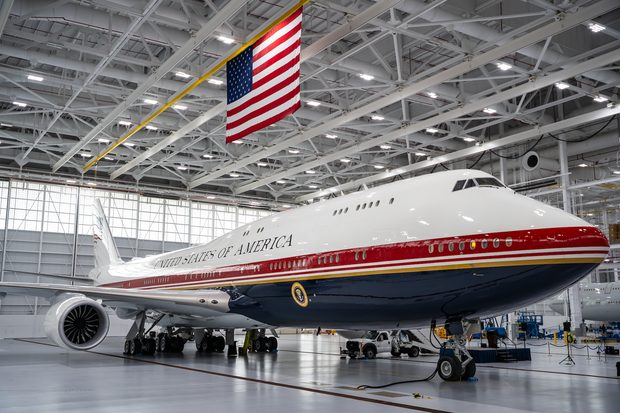
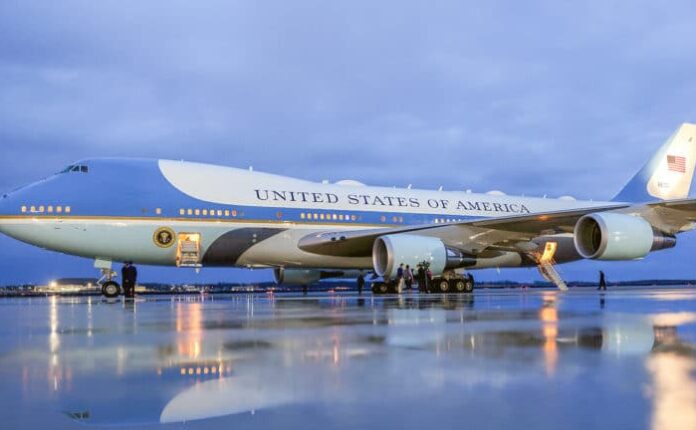
The aircraft also carries a major visual change. Instead of the famous light-blue-and-white livery associated with Air Force One for more than 60 years, the new bridge jet wears a bold red, white, dark blue, and gold color scheme favored by President Donald Trump.
That alone makes it historic. But the deeper story is much bigger than paint.
This aircraft sits at the center of several major issues: presidential security, Boeing delays, foreign-government gifts, political controversy, modernization pressure, and the future of America’s most recognizable aircraft.
A New Aircraft Joins the Presidential Airlift Group
The Presidential Airlift Group, based at Joint Base Andrews in Maryland, is responsible for operating the aircraft that transport the president of the United States, the vice president, senior officials, and other important government leaders.
The arrival of the VC-25B Bridge aircraft is a major moment for that unit. According to the Air Force, the jet will now begin commissioning flights. These flights are not normal test flights for publicity. They are a serious final evaluation process.
The purpose is to validate whether the aircraft can safely and securely transport the president. That includes checking mission systems, communications, security features, flight procedures, support protocols, and operational readiness.
The Air Force described the commissioning process as a kind of final exam. Once the aircraft completes this process successfully, it can be officially added to the executive airlift fleet.
That means the bridge aircraft could eventually operate alongside the current VC-25A aircraft and the C-32 fleet.
The C-32, based on the Boeing 757, is often used by the vice president, first lady, cabinet officials, and sometimes the president when a smaller aircraft is more practical. The VC-25A, based on the Boeing 747-200B, is the famous presidential aircraft most people think of when they hear the words “Air Force One.”
But technically, “Air Force One” is not the permanent name of a single airplane. It is the radio call sign used when the president is aboard any U.S. Air Force aircraft.
That means the new bridge jet becomes “Air Force One” only when the president is on board.
Why the U.S. Needed a Bridge Aircraft
The arrival of this aircraft is tied directly to delays in the official Air Force One replacement program.
The current VC-25A aircraft have served since the early 1990s. They are iconic, but they are aging. Maintaining older aircraft becomes harder and more expensive over time, especially when the aircraft are highly customized and must meet extraordinary security and communications requirements.
The United States already ordered two new Boeing 747-8-based VC-25B aircraft to replace the current VC-25As. Boeing received the contract in 2018 to modify, test, certify, and deliver the new presidential aircraft.
Originally, those planes were expected earlier. But the program has suffered repeated delays, technical challenges, cost growth, workforce issues, supply-chain problems, and the complexity of converting commercial 747-8 airframes into highly secure presidential command aircraft.
The first official Boeing-built VC-25B replacement is now expected around mid-2028. That delay created a gap.
The bridge aircraft is meant to fill that gap.
Instead of waiting years for the full replacement aircraft, the U.S. accepted and modified an available 747-8 aircraft to provide an interim solution. This gives the president a newer long-range aircraft while the formal VC-25B program continues.
In simple terms, the bridge jet is not the final Air Force One replacement. It is a temporary solution designed to keep presidential airlift modern, secure, and flexible while the real replacement program catches up.
The Qatar-Gifted 747 at the Center of the Story
One of the biggest reasons this aircraft has drawn attention is its origin.
The aircraft was gifted by Qatar. That has made the jet politically sensitive from the beginning.
Supporters of the move argue that accepting an available 747-8 and modifying it quickly was a practical decision. From their view, the current presidential 747s are aging, Boeing’s replacement program is delayed, and the president needs modern and reliable long-range transportation.
Critics see it differently. They have raised ethical and national security concerns about accepting such a valuable aircraft from a foreign government. Questions have been asked about influence, security risks, cost transparency, and whether a foreign-provided aircraft can be fully trusted after modification.
The Air Force and administration have argued that the aircraft has been modified to meet presidential transport requirements. Reports say L3Harris Technologies handled the rapid modification work, including security, communications, and defensive upgrades.
Still, the controversy has not disappeared. In fact, the jet’s arrival at Andrews may intensify public interest because the aircraft is no longer just a plan. It is now physically inside the presidential airlift system and beginning its final commissioning process.
What Makes a Presidential Aircraft Different?
A presidential aircraft is not simply a luxury jet.
It must function as an airborne command center. The president must be able to communicate securely with military leaders, government officials, allies, and emergency agencies from the air. The aircraft must support the president’s role as commander in chief, head of state, and chief executive.
That means presidential aircraft need specialized systems that ordinary commercial jets do not have.
They require secure communications. They require defensive protection. They require mission planning space. They require special power systems and redundancy. They require medical capability. They require secure work areas. They require support for staff, Secret Service personnel, military aides, communications teams, journalists, and crew.
The aircraft must be able to operate during crises. It must be able to keep the president connected during a national emergency, a military conflict, a terrorist attack, or a global diplomatic crisis.
That is why modifying a commercial 747 into a presidential aircraft is so difficult.
It is not enough to install nicer seats and paint it in patriotic colors. The aircraft must meet extremely demanding security, safety, connectivity, and survivability standards.
The New Look: A Major Break From History
For more than 60 years, dedicated Air Force One aircraft have been associated with the famous blue-and-white paint scheme introduced during the Kennedy era.
That livery became one of the most recognizable designs in aviation history. It represented American power, diplomacy, stability, and continuity. Around the world, people could identify Air Force One almost instantly.
The new bridge aircraft breaks from that tradition.
It wears a red, white, dark blue, and gold scheme associated with President Trump’s preferred design. Trump has said he wanted colors that better reflected the American flag and gave the aircraft a stronger, sleeker look.
This change is not just cosmetic. Aircraft paint schemes carry symbolism. The old Kennedy-era look was calm, presidential, and diplomatic. The new design is more aggressive, patriotic, and visually bold.
Supporters may see it as a modern and powerful update. Critics may see it as an unnecessary break from tradition.
Either way, the new look guarantees that this aircraft will stand out wherever it goes.
Trump’s Public Presentation of the Aircraft
President Trump held a public event at the presidential hangar facility at Joint Base Andrews to highlight the new aircraft. During the appearance, he praised the size, range, speed, engines, communications systems, luxury finishes, and new paint scheme.
He described the aircraft as a flying White House and said it had been transformed quickly on an accelerated timeline. He also thanked Qatar’s emir and emphasized the aircraft’s workmanship and appearance.
Trump also suggested that the older VC-25A aircraft may eventually be retired to museums, noting their long history and famous role in presidential travel since the George H.W. Bush administration.
However, there was also a point of confusion. Trump indicated that his return from the G7 summit had been the last planned trip aboard the VC-25A. But the Air Force had told reporters that the VC-25B Bridge aircraft would join the active executive airlift fleet alongside the existing VC-25A and C-32 aircraft.
That distinction matters. It suggests the older VC-25As may remain available for at least some period, even after the bridge jet enters service.
Presidential aircraft transitions are rarely instant. Because of security, maintenance, training, and mission requirements, multiple aircraft may remain in use during a transition period.
Boeing’s Delayed Replacement Program
The bridge aircraft exists largely because the official Boeing VC-25B replacement program has taken much longer than planned.
In 2018, Boeing received a $3.9 billion contract to convert two 747-8 aircraft into the next generation of presidential aircraft. These aircraft were intended to replace the two aging VC-25As.
But converting a 747-8 into a secure presidential aircraft is one of the most complex aviation modification jobs in the world.
The aircraft must include hardened and secure communications, defensive systems, advanced mission equipment, special interiors, presidential workspaces, medical support areas, staff spaces, classified systems, and military-grade reliability.
The program has been hit by delays and rising costs. Boeing has recorded major charges related to the program, and delivery has slipped years beyond the original target.
The bridge jet is a direct response to this delay. It gives the White House and Air Force a newer aircraft option before the official Boeing-built replacements are ready.
But it also highlights a larger problem: even America’s most important aircraft programs are not immune to schedule problems, contractor issues, cost growth, and the difficulty of integrating advanced systems.
Security Questions Remain Important
Because the aircraft came from Qatar, security questions will remain part of the story.
A presidential aircraft must be trusted completely. Every wire, system, communication device, sensor, panel, and component must be inspected, modified, certified, and protected. The concern is not only whether the aircraft can fly safely, but whether it can safely carry the president during sensitive missions.
That means U.S. specialists must be confident that the aircraft has been fully secured and that no foreign-origin risk remains hidden inside its systems or structure.
The Air Force has said the aircraft is being prepared and validated for presidential service. But critics will likely continue asking how much was changed, how much it cost, how deeply the aircraft was inspected, and whether the rapid timeline created additional risk.
Those questions are not unusual. Any aircraft used to transport the president deserves intense scrutiny.
A Flying Symbol of Power, Politics, and Pressure
Air Force One has always been more than an airplane.
It is a flying symbol of the presidency. It appears in moments of war, peace, tragedy, diplomacy, crisis, and celebration. It carries the president to summits, disaster zones, military bases, campaign events, state visits, and national ceremonies.
When Air Force One lands in another country, it sends a message before the president even steps off the aircraft.
That is why this new bridge jet is so important.
It represents American power, but it also represents political controversy. It represents modernization, but it also exposes delays in the official replacement program. It represents luxury and speed, but also raises serious questions about security, cost, and foreign gifts.
For supporters, the aircraft shows fast action and practical problem-solving. For critics, it shows blurred lines between diplomacy, politics, and national security.
For aviation watchers, it is one of the most unusual presidential aircraft stories in decades.
What Happens Next?
The next step is commissioning.
The aircraft must complete its commissioning flights and final validation process. Only after that can it be fully available for presidential missions.
If the process goes smoothly, the bridge aircraft could become part of the active executive airlift fleet and be used alongside existing aircraft. It may appear in high-profile events, official trips, and major national ceremonies.
The older VC-25A aircraft may remain in service during the transition, depending on Air Force needs and mission planning. The C-32 fleet will also continue to support executive airlift operations.
Meanwhile, Boeing’s official VC-25B replacement aircraft remain in progress, with delivery expected later. Those two aircraft are still supposed to become the long-term next-generation presidential 747s.
That means the bridge jet’s role is temporary, but still historic.
It may not be the final Air Force One replacement, but it could become one of the most famous interim aircraft in presidential aviation history.
Conclusion: A New Chapter for Air Force One
The arrival of the VC-25B Bridge aircraft marks a major moment for the future of presidential air travel.
It is a newer 747-8 platform. It has been modified for executive airlift. It carries a bold new paint scheme. It has entered the Presidential Airlift Group. And it is now beginning the final process that could allow it to carry the president of the United States.
But the aircraft is also surrounded by controversy.
It was gifted by Qatar. It was modified quickly. It arrived because Boeing’s official replacement program is delayed. It changes the visual identity of Air Force One. And it raises important questions about security, cost, foreign influence, and presidential symbolism.
Still, one fact is clear: America’s presidential airlift fleet is entering a new chapter.
For more than three decades, the VC-25A has been the face of Air Force One. Now, a new 747 has arrived to bridge the gap between the old aircraft and the future fleet.
Whether people see it as a smart temporary solution or a controversial political aircraft, the VC-25B Bridge jet is now part of the story.
And from this point forward, every flight it makes will be watched closely — not just by aviation enthusiasts, but by the world.