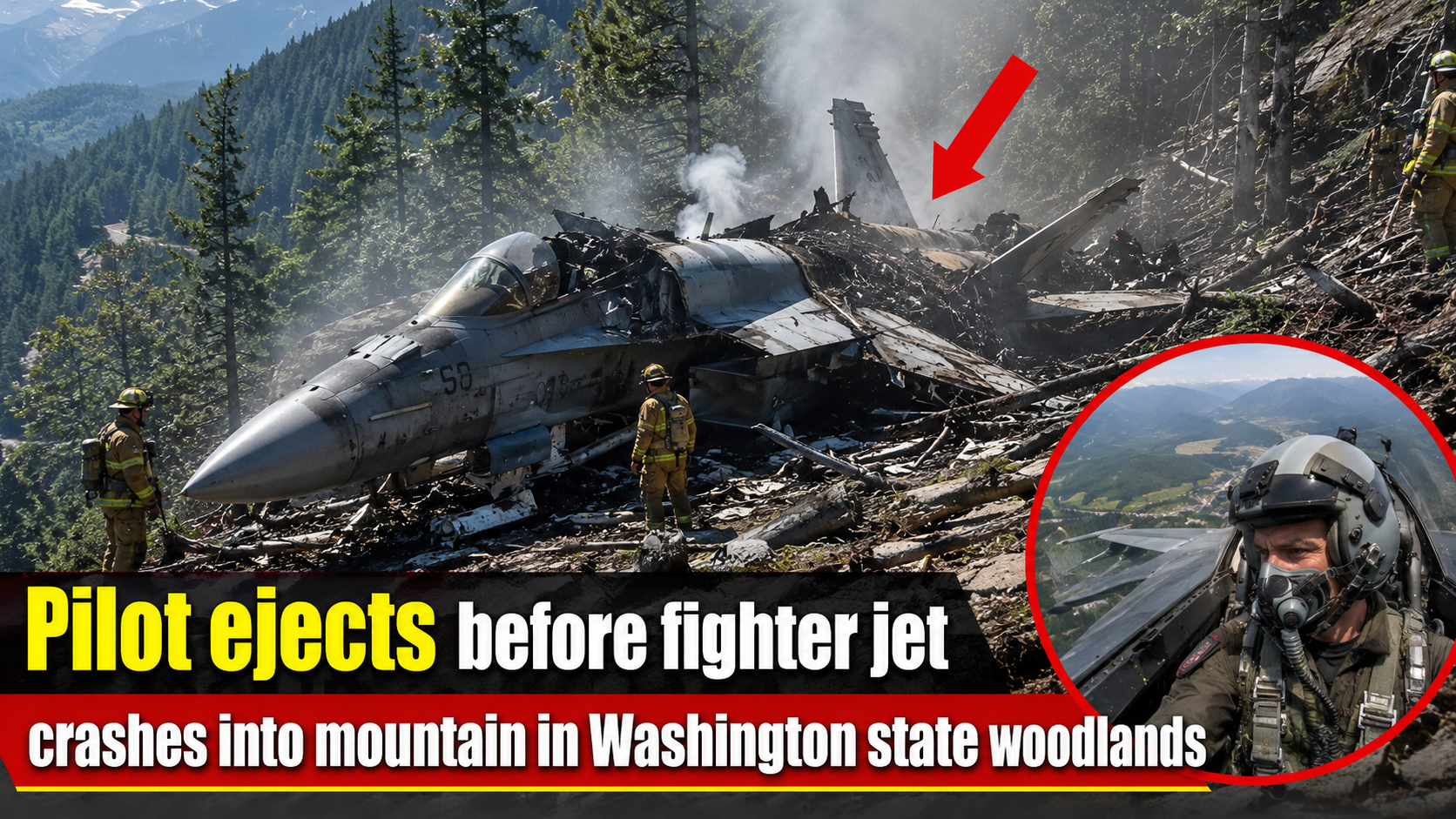
A routine training flight turned into a dramatic survival story after a Marine Corps fighter jet slammed into wooded mountain terrain near Rimrock Lake, sparking a wildfire and emergency response.
A U.S. Marine Corps fighter pilot survived a frightening aviation mishap after ejecting from an F/A-18 Hornet moments before the aircraft crashed into a mountain in Washington state.
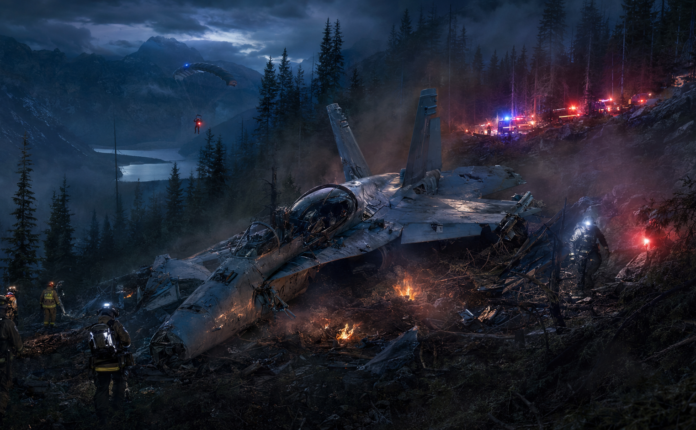
The crash happened near Rimrock Lake in Yakima County, a rugged area surrounded by forests, mountains, campgrounds, and remote terrain southeast of Mount Rainier. What began as a routine military training flight quickly turned into a tense emergency as the jet went down, smoke rose from the crash site, and firefighters rushed to contain a wildfire sparked in the aftermath.
Officials said the pilot ejected safely before impact and was later transported to a hospital with minor injuries. The aircraft, however, was destroyed.
For local residents, campers, emergency crews, and military aviation followers, the incident was a dramatic reminder of how quickly a normal training mission can turn into a life-or-death situation. One moment, a fighter jet was flying through Washington’s skies. The next, the pilot was descending under a parachute while the aircraft crashed into the mountain below.
You May Also Like
The cause of the crash remains under investigation.
A Training Flight Becomes an Emergency
The F/A-18 Hornet was conducting routine training when it experienced what military officials described as a non-fatal aviation mishap.
In military language, that phrase may sound simple. But behind it was a terrifying sequence of events.
The pilot had only seconds to react. Fighter jet emergencies happen fast, especially at low altitude or in mountainous terrain. A pilot must recognize the problem, assess whether the aircraft can be recovered, decide whether to continue trying to save the jet, and then make the final decision to eject.
Ejection is not a casual choice. It is violent, dangerous, and physically punishing. But when a fighter jet is no longer recoverable, the ejection seat becomes the pilot’s last chance to survive.
In this case, that system worked.
The pilot escaped the doomed aircraft and was later found and assisted by local authorities. Officials reported only minor injuries, a remarkable outcome considering the aircraft crashed into rugged terrain and sparked a fire.
The crash site was near Rimrock Lake, a scenic but remote part of Washington where dense woodland and mountain slopes can make emergency response difficult. The location added another layer of danger, not only for the pilot, but also for firefighters, campers, and local rescue teams.
America’s Sky Guardians: How U.S. Fighter Jets Still Shape the Future of Modern Warfare From the F-22 Raptor to the F-35 Lightning II, America’s fighter jets remain some of the most advanced and feared aircraft in the world.
Smoke, Fire, and a Fast Emergency Response
After the aircraft went down, a fire broke out in the area. Smoke rose from the wooded terrain, and emergency crews moved quickly to respond.
The Naches Fire Department, local law enforcement, and U.S. Forest Service resources were involved in the response. Helicopters and at least one engine were reported in the firefighting effort as crews worked to control the flames and protect the surrounding area.
Campers were evacuated from the area as a safety precaution. Officials urged the public to stay away from the crash zone while emergency crews worked and military authorities prepared to investigate.
That part of the story matters because the crash did not happen in an empty desert or on a controlled runway. It happened in a natural area where people may have been camping, hiking, driving, or spending time outdoors.
A military aircraft crash is dangerous even after impact. There may be burning fuel, debris, sharp metal, unexploded equipment, toxic materials, and unstable wreckage. For that reason, officials normally secure the area and prevent the public from getting too close.
Thankfully, there were no early reports of civilian deaths from the crash. The greatest immediate concern was the pilot’s condition, the fire, and the safety of people nearby.
The Aircraft: F/A-18 Hornet
The aircraft involved was an F/A-18 Hornet, one of the most recognizable fighter and attack aircraft in U.S. military aviation.
The F/A-18 is designed as a multi-mission fighter. That means it can perform both air-to-air and air-to-ground missions. In simple terms, it can fight enemy aircraft, support troops on the ground, strike targets, and operate in challenging weather and combat conditions.
The Hornet has served for decades with the U.S. Navy and Marine Corps. It became known as a flexible, reliable aircraft that could do many jobs instead of only one. That flexibility is one reason it remained important for so long.
For the Marine Corps, aircraft like the F/A-18 have been used to support Marines on the ground, provide air defense, conduct strike missions, and train pilots for demanding operational environments.
But even proven aircraft are not risk-free. Military jets are complex machines. They fly at high speeds, operate under demanding conditions, and require constant maintenance, training, and discipline.
That is why every crash is taken seriously.
Tragedy at Edwards: B-52 Crash Kills Eight and Shakes America’s Bomber Community A routine test mission turned into one of the darkest days in modern U.S. Air Force aviation.
Why Fighter Jet Training Is Dangerous
Many people think of military aircraft crashes only in the context of war. But training can be dangerous too.
In fact, pilots must train in realistic conditions because combat itself is dangerous. They must practice flying at different speeds, altitudes, weather conditions, and mission profiles. They must learn how the aircraft responds in difficult situations. They must be ready to make decisions under pressure.
Training is where pilots build the instincts needed to survive real missions.
But realistic training carries risk. Aircraft can suffer mechanical problems. Weather can change. Birds, terrain, visibility, system failures, or human factors can all become part of an emergency. In mountainous areas, pilots also face terrain challenges that require constant awareness and precision.
That does not mean training is reckless. It means military aviation is one of the most demanding professions in the world.
Every successful flight depends on pilots, maintainers, planners, air traffic controllers, commanders, and emergency crews all doing their jobs correctly. When something goes wrong, the margin for error can disappear quickly.
The Washington crash shows that even during routine training, danger is never far away.
The Pilot’s Decision to Eject
One of the most powerful parts of this story is the pilot’s ejection.
To the public, ejection may seem like simply pulling a handle and floating down with a parachute. In reality, it is one of the most extreme survival events a human body can experience.
A modern ejection seat is designed to launch a pilot out of the aircraft in a fraction of a second. The force can be brutal. Pilots can suffer back injuries, neck injuries, limb injuries, or other trauma. After leaving the aircraft, the pilot must separate from the seat, deploy or rely on parachute systems, land safely, and then survive until rescue arrives.
In wooded or mountainous terrain, landing can be dangerous. A pilot may come down into trees, rocks, steep slopes, water, or remote ground. The crash may also ignite a fire nearby, creating more danger after landing.
That is why the pilot’s survival is significant.
The ejection system, training, emergency response, and local recovery efforts all came together to prevent a fatal outcome. The aircraft was lost, but the pilot lived.
In aviation, that difference matters more than anything.
A Crash Near a Beautiful but Difficult Landscape
Rimrock Lake is known for outdoor recreation, forested scenery, and mountain surroundings. But the same beauty that attracts visitors can also make emergency response more difficult.
Mountain terrain can limit access. Roads may be narrow. Smoke can reduce visibility. Helicopters may be needed to reach areas that ground crews cannot easily access. Firefighters must think not only about the crash site, but also about wind, fuel, dry brush, trees, and the possibility of fire spreading.
In this case, firefighters moved quickly to suppress the blaze. Campers were evacuated, and the public was told to avoid the area.
The location also adds emotional weight to the story. A fighter jet crashing into a mountain is not only a military incident. It becomes a local emergency. It affects people who live nearby, travelers using the area, firefighters, sheriff’s deputies, forest crews, and families who may have been camping close to the lake.
For many people in Washington, the sound of military aircraft overhead may be familiar. But seeing smoke rise from the mountains after a crash is something no community wants to experience.
What Investigators Will Look For
The cause of the mishap is still under investigation. That means it is too early to say why the F/A-18 went down.
Military aviation investigations are careful and detailed. Investigators may examine the wreckage, maintenance records, weather conditions, flight path, communications, pilot actions, aircraft systems, engine performance, and any available video or witness reports.
They may also look at whether the aircraft had any warning signs before the crash, whether there were mechanical issues, whether terrain or environment played a role, and whether training procedures need to be reviewed.
The purpose of the investigation is not only to explain what happened. It is also to prevent another crash.
That is why responsible reporting must avoid speculation. Until investigators release official findings, no one should claim the crash was caused by pilot error, engine failure, weather, maintenance problems, or any other specific factor.
Aviation accidents are often complex. Sometimes they are caused by one major failure. Other times they result from a chain of smaller problems that combine at the wrong moment.
The public may want quick answers, but aviation safety depends on careful facts.
The C-17 Refuses to Retire: Boeing’s $400 Million Upgrade Could Keep America’s Heavy-Lift Giant Flying Until 2075
The Human Side of Military Aviation
This story is dramatic because of the crash, the fire, and the survival. But it is also a human story.
Behind every fighter jet is a pilot who has spent years training. Behind that pilot are families, squadron mates, maintainers, instructors, and commanders. Every flight carries responsibility, not only for the mission, but also for the people waiting on the ground.
Aviation communities understand this deeply. When a jet crashes, the first question is always the same: did the pilot make it?
In this case, the answer was yes.
That does not erase the seriousness of the accident. A fighter jet was lost. A fire was started. Emergency crews had to respond. An investigation is now underway. But the pilot’s survival gives this story a different ending than many aviation tragedies.
It is a story of danger, but also of survival.
It is a story of loss, but not the loss of life.
It is a reminder that training saves lives—not only training in how to fly, but training in how to respond when the aircraft can no longer be saved.
The Cost of Losing a Fighter Jet
An F/A-18 is not just another aircraft. It is a major military asset that represents years of engineering, maintenance, training, and operational investment.
When a fighter jet crashes, the financial cost is high. But the deeper cost is measured in readiness, investigation time, squadron impact, and the emotional burden placed on the aviation community.
Every mishap forces a unit to pause and ask difficult questions. Was there a mechanical issue? Was there a maintenance concern? Was the mission profile safe? Were all procedures followed? Is the rest of the fleet at risk? Should training continue as normal?
These are not easy questions. But they are necessary.
Military aviation is built on lessons learned from past incidents. Every crash, even a non-fatal one, becomes part of a larger safety picture. Investigators study what happened, leaders review findings, and future pilots may benefit from changes made afterward.
That is one reason why transparency matters. The public may not receive every technical detail, but aviation communities depend on honest investigation and safety improvement.
Trump’s New Air Force One: The Converted Qatari Jumbo Jet Turning America’s Presidential Plane Into a Political Storm
A Reminder After Previous Washington Aviation Tragedies
Washington state has seen other military aviation tragedies in recent years. The region’s mountainous terrain and training airspace have been part of military flight operations, but the environment can be unforgiving.
This latest crash will likely bring renewed attention to military training safety in the area. It may also remind many people of the risks faced by military aviators even during peacetime.
Peacetime training is not peaceful for the people in the cockpit. It can involve high speeds, difficult maneuvers, complex systems, and split-second decisions. Pilots train because the nation expects them to be ready. But readiness comes with risk.
That is why every successful ejection is both a relief and a warning.
It is a relief because a life was saved.
It is a warning because something went wrong badly enough that a pilot had to abandon the aircraft.
The Role of Local First Responders
The pilot’s survival also highlights the importance of local emergency responders.
When military aircraft crash away from a base, local agencies are often the first to reach the scene. Sheriff’s deputies, firefighters, emergency medical personnel, forest crews, and local volunteers may all become part of the response before military investigators arrive.
In the Rimrock Lake crash, local authorities helped locate and assist the pilot. Fire crews responded to the blaze. Campers were moved away from danger. Public safety messages went out quickly.
This type of coordination matters. A crash site can be chaotic. Smoke, fire, difficult terrain, worried witnesses, and limited access can make the first hours critical.
The fact that the pilot was recovered and the fire was addressed quickly shows how important local readiness is in remote areas.
Why the Story Captured Attention
This crash captured attention for several reasons.
First, the video and reports were dramatic. A fighter jet crashing into a wooded mountain area is a powerful image.
Second, the pilot survived. Survival stories naturally connect with people because they show how close disaster came.
Third, the crash involved a well-known military aircraft. The F/A-18 Hornet has a long history and remains familiar to aviation fans, veterans, military families, and the general public.
Fourth, the crash happened in a civilian outdoor area, not simply on a closed military range. That made the story feel closer to ordinary people.
Finally, the cause remains unknown. Whenever an advanced military aircraft crashes, people want to know why. But the answer will take time.
No Room for Rumors
In the hours after a military crash, rumors can spread quickly online. Some people may claim to know the cause. Others may share old footage, incorrect aircraft details, or dramatic theories.
That is dangerous.
Aviation accidents should be reported carefully, especially when the investigation is still open. The confirmed facts are serious enough without adding speculation.
What is known is this: a Marine Corps F/A-18 Hornet crashed near Rimrock Lake during routine training. The pilot ejected and survived with minor injuries. A wildfire started in the area. Campers were evacuated. Fire crews responded. The cause remains under investigation.
Anything beyond that must wait for official findings.
The pilot, the squadron, the local community, and the public deserve facts—not guesses.
A Survival Story Written in Seconds
The most powerful part of this incident may be the timeline.
In a matter of seconds, the pilot went from flying a high-performance military aircraft to making the final decision to eject. The jet continued toward the mountain. The ejection seat fired. The pilot separated from the aircraft. The Hornet crashed. Fire and smoke followed. Emergency crews responded.
That sequence shows how fast aviation emergencies unfold.
It also shows why pilots train for worst-case scenarios. A pilot may go years without needing to eject. But if that moment comes, there may be no time to think slowly. The body and mind must rely on training.
In this case, the pilot survived because the decision was made in time.
The aircraft could not be saved.
The pilot could.
Conclusion: A Close Call in Washington’s Mountains
The F/A-18 Hornet crash near Rimrock Lake was a serious military aviation mishap, but it did not become a fatal tragedy.
A Marine Corps pilot escaped with minor injuries after ejecting before the aircraft slammed into mountain terrain. The crash sparked a wildfire, forced evacuations, and brought emergency crews into a remote wooded area of Washington state.
The investigation will determine what went wrong. Until then, the story stands as a reminder of the risks of military aviation, the value of emergency training, and the importance of fast local response.
Fighter jets are powerful machines. They represent speed, strength, and national defense. But behind every aircraft is a human being making decisions under pressure.
On this day, one pilot faced disaster in the sky and survived.
The mountain took the jet.
The ejection seat saved the pilot.
And a routine training flight became a dramatic reminder that even in peacetime, military aviation carries real danger.