For more than two decades, the rise of China has transformed the balance of global military power.
Its navy has exploded in size.
Its shipyards now produce warships at astonishing speed.
Its missile forces have expanded dramatically.
Its technological ambitions are increasingly reshaping modern warfare.
And standing at the center of that transformation is one symbol above all others:
The aircraft carrier.
You May Also Like
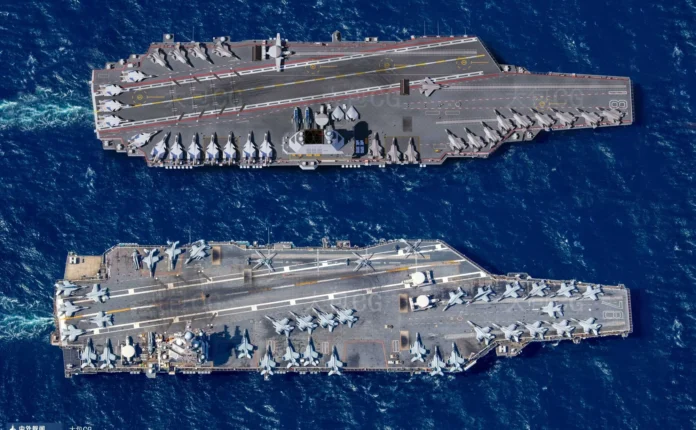
For rising powers throughout history, aircraft carriers have represented far more than military hardware. They symbolize industrial strength, technological confidence, national ambition, and the ability to project power far beyond national borders.
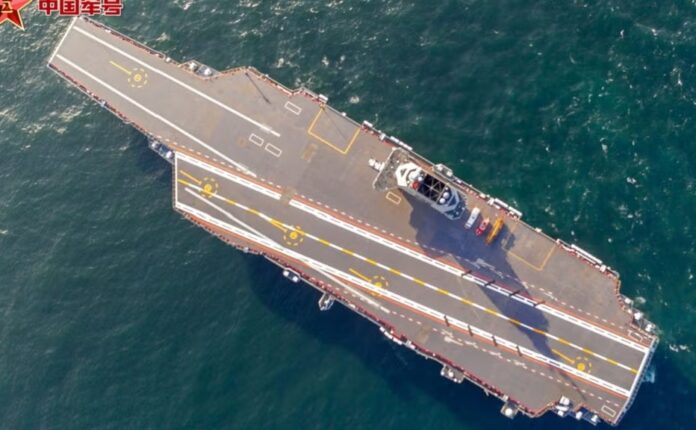
That is exactly why China’s newest and most advanced aircraft carrier — the Fujian — matters so much.
The Fujian is not just another warship.
It is Beijing’s declaration that China intends to become a true blue-water naval superpower capable of challenging the United States across the Pacific and eventually across the world.
At first glance, the carrier appears extraordinarily impressive.
It is massive.
Modern.
Advanced.
Sophisticated.
Equipped with electromagnetic catapults similar to those used on America’s newest supercarriers, the Fujian represents the most ambitious warship China has ever built.
Chinese state media celebrated it as proof that the country has entered the elite club of top-tier naval powers.
But beneath the excitement and patriotic headlines lies a more uncomfortable reality.
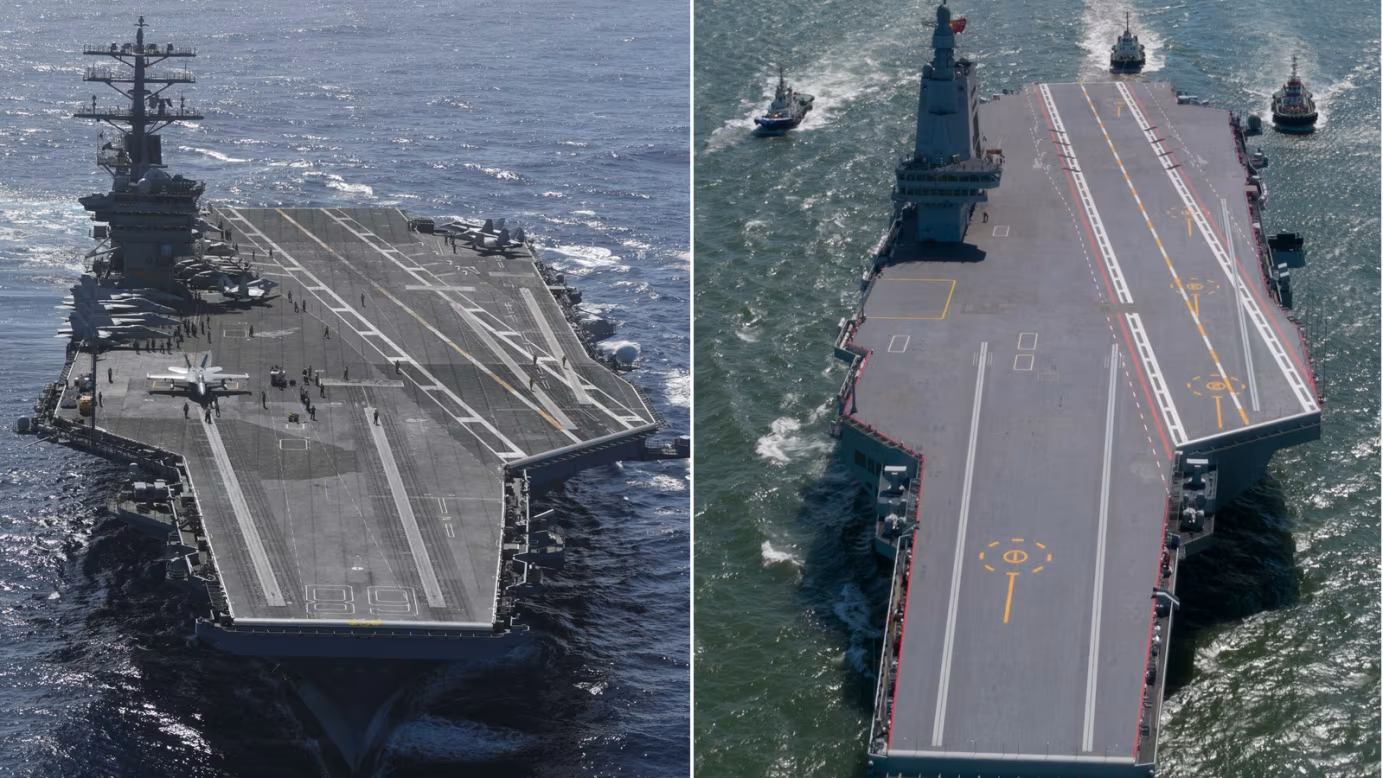
According to former American naval officers who studied the ship’s design, China’s newest carrier may suffer from a major operational weakness — one so serious that it could reduce combat flight operations to only around 60% of what a 50-year-old American carrier can achieve.
And that revelation exposes something deeper and far more important than simple engineering problems.
It reveals the brutal truth about aircraft carriers:
Building one is hard.
Mastering one is something entirely different.
The Illusion Of Power
Aircraft carriers are among the most complicated machines humanity has ever created.
To the public, they often appear simple enough: enormous floating airbases carrying fighter jets across the oceans.
But in reality, carriers are controlled chaos.
Thousands of sailors live and work inside moving steel cities at sea. Aircraft launch and land every few minutes on narrow decks while ships battle waves, storms, darkness, mechanical failures, and the constant danger of catastrophic accidents.
Every second of flight deck activity involves extraordinary risk.
One mistake can kill dozens of people instantly.
Fire.
Explosions.
Jet blasts.
Fuel leaks.
Arresting cable failures.
Mid-deck collisions.
Carrier operations are among the most dangerous peacetime military activities on Earth.
That is why American naval aviators often repeat an old saying:
“All carrier regulations are written in blood.”
The phrase means every safety procedure exists because somebody was once seriously injured or killed.
And that is where America’s enormous advantage becomes visible.
Because while China may now build carriers quickly, the United States possesses something much harder to manufacture:
Nearly a century of carrier warfare experience.
Why The Fujian Matters So Much
China’s first two aircraft carriers — the Liaoning and the Shandong — were important stepping stones.
But both relied on older “ski-jump” launch systems where aircraft essentially accelerate up a ramp and launch under their own power.
That method works.
But it comes with major limitations.
Aircraft launching from ski-jump carriers usually carry less fuel and fewer weapons because they must become airborne using their own engine thrust. That reduces combat range and striking power.
The Fujian changes that.
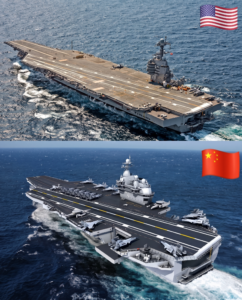
For the first time, China installed electromagnetic catapult launch systems — technology so advanced that only the U.S. Navy’s newest carrier class, the USS Gerald R. Ford, currently uses a comparable system.
Electromagnetic catapults allow heavier aircraft to launch faster with larger payloads and more fuel.
That dramatically improves combat effectiveness.
It means aircraft can strike farther targets, remain airborne longer, and carry heavier weapons loads.
In theory, this moves China much closer to true American-style carrier aviation capability.
At least in theory.
The Flight Deck Problem
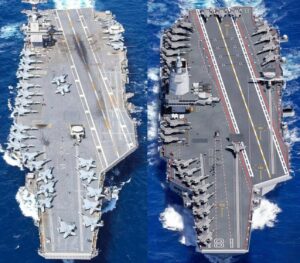
Former U.S. Navy officers Carl Schuster and Keith Stewart examined available images and footage of the Fujian’s deck configuration and identified what they believe is a major operational limitation.
The problem centers around the relationship between the carrier’s landing area and its catapult launch positions.
On American Nimitz-class carriers, the angled landing deck is designed carefully to maximize separation between landing aircraft and aircraft preparing for launch.
This allows simultaneous operations:
Jets can land while others launch.
That capability is absolutely critical during combat because it dramatically increases the pace of operations — what military planners call sortie generation rate.
The faster a carrier can launch, recover, refuel, rearm, and relaunch aircraft, the more combat power it generates.
According to the retired American officers, the Fujian’s flight deck geometry may severely limit that process.
The landing angle appears narrower than American carriers. The landing strip also extends farther toward the bow area where aircraft queue for catapult launches.
That creates congestion.
Aircraft landing on the deck may temporarily block catapult operations. Aircraft taxiing between elevators and launch positions may face greater collision risks.
As a result, China may need to slow operations significantly for safety reasons.
And in naval aviation, slower operations can become a major combat disadvantage.
Why 60% Matters In War
To ordinary readers, “60% operational capability” may not initially sound catastrophic.
But in carrier warfare, tempo is everything.
Aircraft carriers are not powerful simply because they carry fighter jets.
They are powerful because they sustain relentless air operations over time.
Every extra launch matters.
Every delayed recovery matters.
Every reduced sortie matters.
In a major Pacific conflict, even small operational inefficiencies could compound rapidly.
A carrier capable of generating fewer sorties per day delivers fewer strikes, weaker air defense coverage, slower response times, and reduced battlefield flexibility.
That matters enormously in modern naval warfare where missiles, submarines, drones, and aircraft operate simultaneously at incredible speed.
A slower carrier can quickly become an overwhelmed carrier.
America’s Massive Experience Advantage
China’s rise in shipbuilding has been extraordinary.
The country now possesses the world’s largest navy by ship count and continues launching advanced destroyers, cruisers, amphibious assault ships, and submarines at remarkable speed.
But aircraft carriers are different.
The United States has operated carriers continuously since World War II.
That means generations of accumulated institutional knowledge.
American naval aviators have trained for decades in:
- Night carrier landings
- Storm operations
- Combat launch cycles
- Large-scale fleet integration
- High-tempo combat aviation
- Carrier strike coordination
- Damage control under combat conditions
These are skills learned through experience — often painful experience.
Former naval aviator Keith Stewart explained this bluntly when discussing Chinese carrier development.
“Flying off a carrier in daylight and good weather is not too difficult,” he said.
“The hard part is landing on a nasty, rainy, windy night when the deck is moving violently, fuel is low, and fear starts taking over.”
That reality cannot be solved simply by building advanced ships.
It requires time.
Years.
Decades.
Possibly generations.
The Carrier Gap Is Bigger Than Numbers
China currently operates two active carriers, with the Fujian expected to join service soon.
The United States operates eleven nuclear-powered aircraft carriers.
But the true gap between the two navies goes far beyond simple numbers.
American carriers are part of a mature global combat ecosystem that includes:
- Nuclear submarines
- Long-range logistics
- Carrier strike groups
- Airborne early warning systems
- Combat-tested naval aviation doctrine
- Global basing infrastructure
- Decades of operational integration
China is progressing rapidly, but carrier warfare remains one of the most difficult military capabilities to master.
Building a carrier is engineering.
Operating a carrier efficiently during war is culture, doctrine, experience, and survival knowledge combined.
That distinction matters enormously.
Why China Is Still Dangerous
None of this means China should be underestimated.
Far from it.
The Fujian still represents a historic achievement for Chinese military industry.
Its electromagnetic launch system alone demonstrates enormous technological progress. Its construction reflects China’s growing industrial confidence and strategic ambition.
Even if its flight deck efficiency currently lags behind American carriers, China is learning rapidly.
And that may be the most important point.
Military power evolves through iteration.
America’s own carrier aviation history included accidents, failures, design flaws, deadly lessons, and decades of refinement.
China is now beginning that same journey.
Former officers believe China’s next-generation carrier — often referred to as the Type 004 — will likely incorporate lessons learned from the Fujian.
That means the Fujian may not represent the final destination.
It may be the training ground.
The stepping stone.
The experimental bridge between a regional navy and a future global carrier force.
The Real Meaning Of The Fujian
The story of the Fujian is ultimately not about whether one ship is better than another.
It is about something larger:
The return of great power naval competition.
For decades after the Cold War, the United States dominated the oceans almost uncontested. American aircraft carriers projected overwhelming power across the globe.
Now, for the first time in generations, another major power is attempting to challenge that dominance seriously.
And that challenge is reshaping the future of global security.
The Fujian may still lag behind American supercarriers in operational efficiency.
But its existence alone sends a message to the world:
China is no longer content to remain a coastal naval power.
It wants to compete across the Pacific.
Across Asia.
Across global trade routes.
And eventually, across the world.
The United States still possesses unmatched carrier experience, operational doctrine, and naval aviation expertise.
But history also teaches a dangerous lesson:
Great powers that underestimate rising rivals often regret it later.
The Fujian may not yet equal America’s legendary carriers.
But it represents something just as important:
China has entered the race.




China steals and replicate US ideas snd hardware.