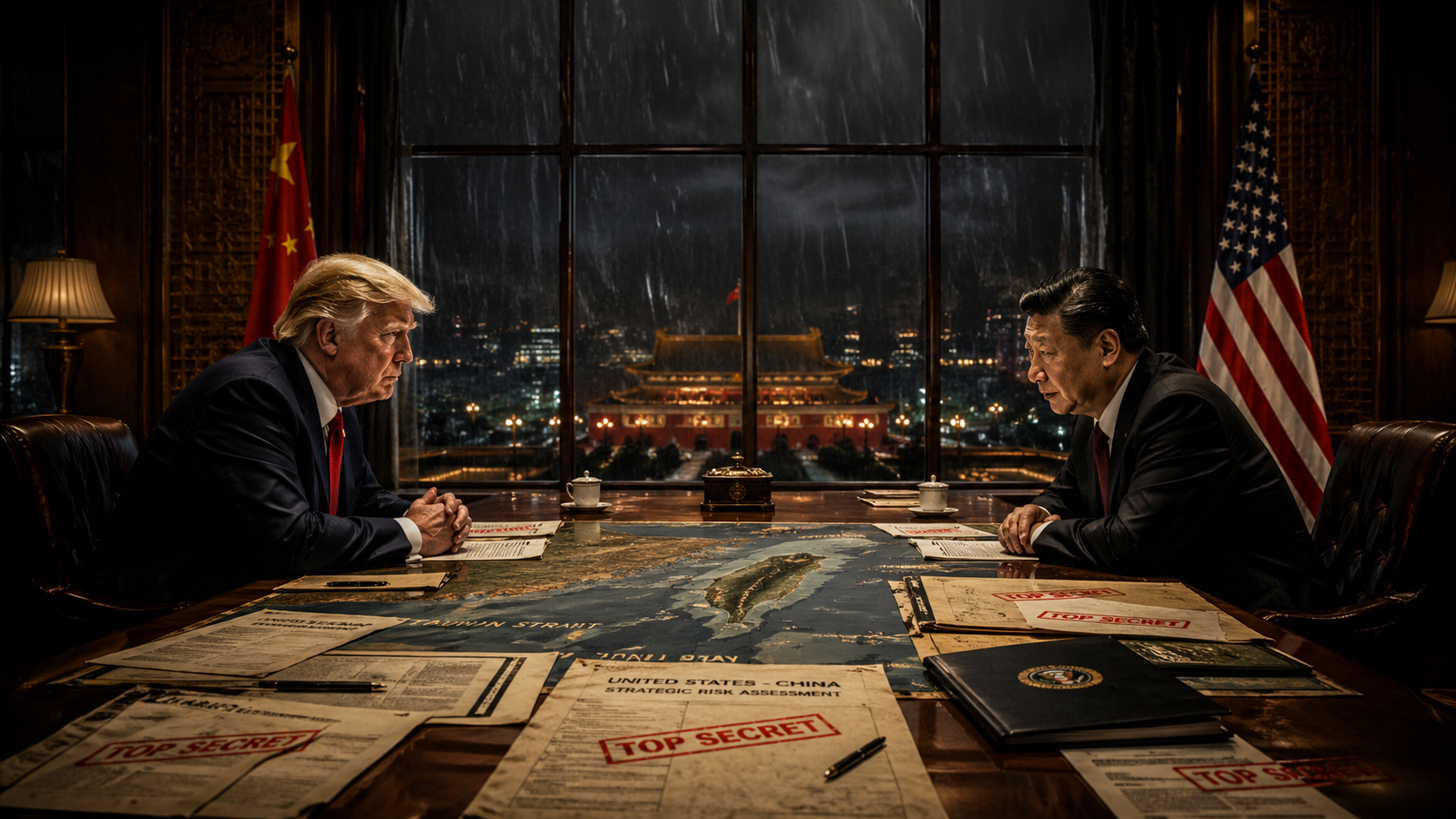
A fictional cinematic political drama inspired by global tensions surrounding Taiwan
“Nobody in the room expected Trump to say those four chilling words to Xi Jinping: ‘Taiwan is yours…’
What followed was a cold, tense, behind-closed-doors negotiation about war, power, betrayal, and the future of the world — a conversation so dangerous that even the translators stopped breathing.”
The rain poured heavily across Beijing like the sky itself sensed history was being rewritten. The flashing cameras outside the Great Hall of the People had finally disappeared. The smiling diplomats were gone. Security agents sealed the marble corridors. Giant red doors slowly closed with a deep echo that rolled through the silent building like thunder.
Inside the private negotiation chamber, two men remained seated across from each other beneath soft golden lights.
One represented the rising superpower of the East.
The other represented the unstable giant of the West.
You May Also Like
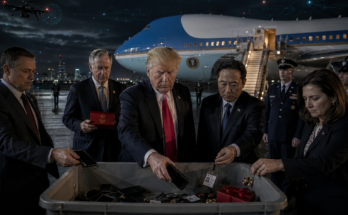
Between them sat a black folder stamped with one word:
TAIWAN
Xi Jinping sat perfectly still, his expression unreadable, his posture calm like a man who had spent decades mastering patience. Across from him, Donald Trump leaned back heavily in his chair, one hand on the table, the other adjusting his tie as if he were preparing for a business deal instead of a geopolitical confrontation that could decide the future of Asia.
For several long seconds, nobody spoke.
Only the ticking of an antique clock filled the room.
Then Xi finally broke the silence.
“You know why Taiwan is dangerous?” he asked quietly.
Trump smirked faintly.
“Because everybody wants it.”
Xi slowly shook his head.
“No,” he replied. “Because everybody thinks somebody else will back down first.”
Trump leaned forward slightly.
“And you won’t?”
Xi answered immediately.
“China has waited seventy years. We can wait longer. But we will never surrender our claim.”
Trump stared at him carefully.
He had spent years studying powerful men. Dictators. Presidents. Billionaires. Generals. He understood ego when he saw it. But Xi was different. Xi did not speak emotionally. He spoke like a man carrying the weight of centuries behind every sentence.
Trump rubbed the edge of the folder slowly.
“You know what’s funny?” Trump said. “Everybody acts like Taiwan is just about democracy. That’s the public story. But behind closed doors?” He tapped the folder. “This is about power.”
Xi nodded slightly.
“Power decides survival.”
Trump stood up and slowly walked toward the giant windows overlooking the glowing skyline of Beijing. Thousands of lights stretched endlessly into the night like a living machine.
“You built all this fast,” Trump admitted quietly. “Factories. Technology. Military. Trade. The whole world became dependent on China.”
Xi remained seated.
“And America became dependent on consumption.”
Trump laughed softly.
“You really think America’s weak?”
Xi answered calmly.
“I think America is divided.”
That answer lingered in the room.
Trump turned slowly.
“You think China isn’t?”
Xi’s face remained emotionless.
“When storms come,” Xi said, “China closes ranks. America argues on television.”
Trump smiled.
“That’s called freedom.”
Xi answered coldly.
“That is called instability.”
The atmosphere sharpened immediately.
Trump walked back toward the table and sat down heavily.
“You know what people misunderstand about me?” Trump asked.
Xi remained silent.
“They think I want war because I sound aggressive.” Trump pointed toward himself. “I don’t want war. War destroys business. War destroys markets. War destroys economies. Smart leaders avoid war.”
Xi studied him carefully.
“And yet America sends weapons to Taiwan.”
Trump shrugged.
“That’s deterrence.”
“That,” Xi replied, “is provocation.”
Trump shook his head.
“No. Provocation is sending warships around Taiwan every week.”
Xi’s voice became firmer.
“Taiwan belongs to China.”
Trump answered instantly.
“Taiwan governs itself.”
Xi leaned forward slightly.
“A temporary historical issue.”
Trump leaned closer too.
“Twenty-three million people don’t call themselves temporary.”
The translators glanced nervously at one another as the tension climbed higher.
Xi’s eyes narrowed slightly.
“You Americans believe history begins when America enters the conversation. China existed long before the United States was discovered.”
Trump smirked.
“And now the world speaks English, uses American dollars, and buys American weapons.”
Xi calmly responded:
“For now.”
Silence.
The rain outside became heavier.
One Chinese official quietly entered the room and placed updated military reports beside Xi before leaving again. Trump noticed immediately.
“You’re monitoring Taiwan right now, aren’t you?”
Xi did not deny it.
“The Taiwan Strait is always monitored.”
Trump picked up one paper from the table.
“Your jets crossed the median line again.”
Xi answered calmly.
“A line created by foreigners.”
Trump shook his head.
“You know what scares smaller countries?” he asked. “Big countries claiming maps matter more than people.”
Xi responded without hesitation.
“And you know what destroys nations? Weak leaders allowing separation piece by piece until there is nothing left.”
Trump leaned back.
“So this is personal for you.”
Xi’s voice became colder now.
“Taiwan is not personal. Taiwan is national destiny.”
The words felt heavier than before.
Xi stood slowly and walked toward a large painting hanging on the wall — an ancient Chinese landscape stretching across mountains and rivers.
“You see this?” Xi asked quietly. “Dynasties rose and fell protecting this civilization. Millions died defending unity. China remembers humiliation. Occupation. Division. Weakness.” He turned toward Trump. “Never again.”
Trump watched him carefully.
“And what if Taiwan doesn’t want reunification?”
Xi answered:
“People can be influenced temporarily. History cannot.”
Trump laughed softly.
“That’s the problem with powerful countries. They always think history belongs to them.”
Xi replied calmly.
“No. Powerful countries survive because they understand history.”
The clock continued ticking.
Then Trump suddenly became more serious.
“Let’s stop pretending,” he said quietly. “You think America uses Taiwan to contain China.”
“Yes.”
“And we think China wants Taiwan because controlling Taiwan breaks American influence in Asia.”
Xi nodded once.
“Correct.”
Finally, honesty had entered the room.
Trump opened the folder and spread several maps across the table.
Semiconductor factories. Shipping lanes. Naval routes. Missile ranges.
“Everybody talks about freedom,” Trump said, pointing at Taiwan. “But this island controls the future of technology. Chips. Artificial intelligence. Military systems. Cars. Phones. Data centers. Whoever dominates this region controls the next century.”
Xi slowly walked back to the table.
“Which is why China cannot permit permanent separation.”
Trump crossed his arms.
“And America can’t afford your dominance.”
Xi stared directly into Trump’s eyes.
“So we arrive at the truth.”
For several seconds neither man moved.
Finally Xi spoke again.
“Tell me honestly,” he said quietly. “If Taiwan declared independence tomorrow… would American soldiers die for it?”
Trump did not answer immediately.
The room became silent enough to hear rain striking the windows.
Then Trump finally said:
“Americans are tired of endless wars.”
Xi nodded slowly.
“That is what Beijing believes.”
Trump pointed a finger sharply.
“But don’t mistake exhaustion for weakness.”
Xi remained calm.
“And don’t mistake patience for fear.”
Trump smirked faintly.
“You know something? Most politicians would never survive a conversation like this.”
Xi actually smiled slightly.
“Because most politicians speak for headlines. Leaders speak for history.”
That sentence lingered heavily in the air.
Trump leaned back again.
“You know what really terrifies the world?” he asked.
Xi waited.
“Not missiles. Miscalculation.” Trump tapped the table. “One pilot gets nervous. One ship gets too close. One politician wants applause on television. Then suddenly economies crash, alliances activate, and millions of people pay for one stupid mistake.”
Xi nodded slowly.
“That is why discipline matters.”
Trump sighed.
“But nationalism makes discipline difficult.”
Xi’s expression hardened slightly.
“Nationalism built modern China.”
Trump laughed once.
“And nationalism built modern America too.”
The rain intensified outside.
Thunder rolled across Beijing.
Then Xi asked quietly:
“What would you tell Taiwan tonight?”
Trump looked down at the folder for several long seconds.
Then he finally spoke.
“I’d tell them not to play games they can’t survive.”
Xi watched carefully.
“And independence?”
Trump exhaled slowly.
“I’m not looking to have somebody go independent.”
Xi’s eyes narrowed slightly.
“Because?”
Trump answered coldly.
“Because I’m not interested in watching the Pacific explode.”
The room became deadly quiet.
Xi slowly sat back down.
“You understand the stakes better than many American politicians.”
Trump smirked.
“Most politicians never ran companies big enough to understand collapse.”
Xi replied calmly:
“And yet business cannot solve every historical conflict.”
Trump shrugged.
“No. But business teaches survival.”
Xi folded his hands.
“China also understands survival.”
Trump leaned forward again.
“You know what Taiwan really wants?” he asked.
Xi remained silent.
“They want dignity. Safety. Freedom. Stability. The same things ordinary people everywhere want.”
Xi answered immediately.
“And China wants unity, sovereignty, and national security.”
Trump nodded.
“So everybody thinks they’re defending something righteous.”
Xi replied softly:
“That is why conflicts become dangerous.”
For a moment, both men fell silent again.
The atmosphere no longer felt like a negotiation. It felt like two civilizations staring at each other across history itself.
Then Xi quietly asked:
“Do you know why China fears Taiwan independence so deeply?”
Trump raised an eyebrow.
“Tell me.”
Xi spoke slower now.
“Because separation spreads. Once a nation accepts fragmentation, weakness follows. Internal division becomes permanent. Enemies exploit uncertainty. Stability disappears.” He paused. “China remembers chaos.”
Trump nodded slightly.
“America remembers revolution.”
Xi replied:
“Then perhaps both nations were born from refusing submission.”
Trump smiled faintly.
“That might be the first thing we agree on tonight.”
The clock struck 2 AM.
The translators looked exhausted. The officials outside the doors remained silent. Even the rain seemed quieter now.
Then Trump suddenly said something unexpected.
“You know what’s funny? The media thinks leaders are superheroes.” He laughed softly. “Truth is, half the job is trying to prevent disasters caused by ego.”
Xi looked at him carefully.
“And the other half?”
Trump answered immediately.
“Convincing your own side not to do something stupid.”
For the first time that night, Xi laughed quietly.
A very small laugh.
But real.
Then Xi became serious again.
“If Taiwan formally crosses the line,” he said quietly, “China will act.”
Trump asked:
“No matter the cost?”
Xi answered:
“Some costs are greater if you do nothing.”
Trump looked toward the dark window again.
“You really believe reunification defines your legacy.”
Xi’s voice became almost philosophical.
“Every civilization has unfinished chapters. Leaders are remembered for whether they completed them… or failed them.”
Trump slowly nodded.
“And America’s unfinished chapter is staying on top.”
Neither man denied it.
Hours passed.
Trade was discussed. Military posturing. Cyber warfare. Economic sanctions. Semiconductor supply chains. Naval blockades. Artificial intelligence. Global alliances.
Every issue somehow returned to Taiwan.
Finally, near the end of the meeting, Trump stared at Xi for a long moment before quietly saying the words that would later haunt diplomats around the world:
“Taiwan is yours… if they don’t force the issue.”
Even the translators froze briefly.
Xi did not move.
“That,” Xi said quietly, “is not a small statement.”
Trump answered immediately.
“I’m saying I don’t want World War Three over politicians trying to look brave.”
Xi slowly nodded.
“Then perhaps peace still has a chance.”
Trump stood up.
“Peace only survives when everybody fears the alternative.”
Xi also stood.
“Then let us hope wisdom remains stronger than pride.”
The two leaders shook hands beneath the dim golden lights of the chamber while thunder echoed across Beijing.
Outside, the world slept peacefully.
Completely unaware that inside one quiet room, two powerful men had just debated the future of Taiwan… and possibly the future of the world itself.