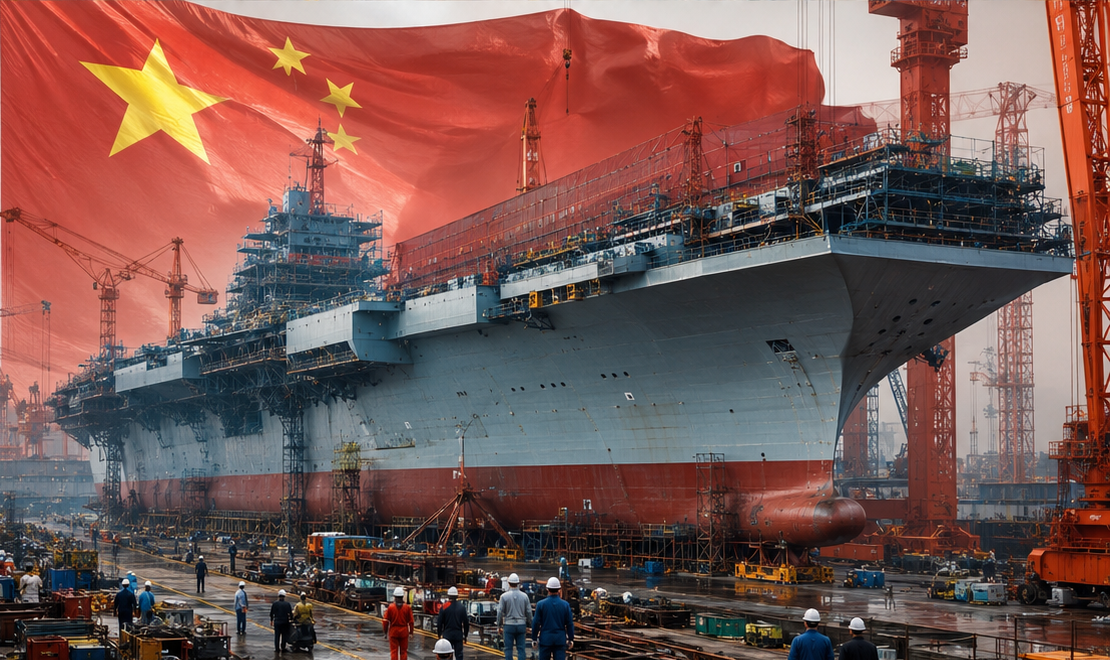
USS Gerald R. Ford vs China’s Fujian
Professor Amelia Carter
American naval engineer and former adviser to a U.S. defense research office. She believes the USS Gerald R. Ford is still the most advanced aircraft carrier ever built.
Professor Liang Wen
Chinese military technology professor and systems engineer. He argues that Fujian proves China is no longer just copying others, but building a modern carrier force with its own strategic purpose.
PROLOGUE — TWO GIANTS ON THE SEA
The auditorium was dark.
You May Also Like
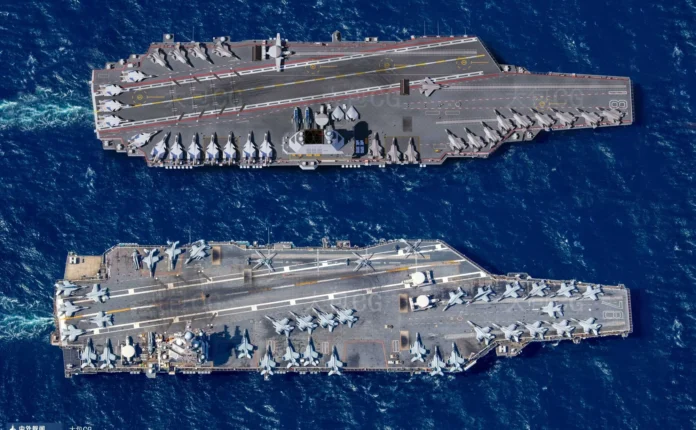
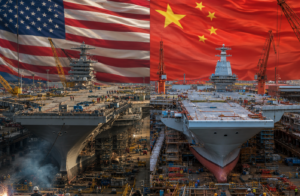
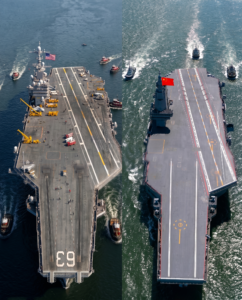
On the giant screen behind the stage, two aircraft carriers appeared side by side.
On the left:
USS Gerald R. Ford, CVN-78
America’s newest supercarrier class. Nuclear powered. Over 100,000 tons. The largest warship afloat. A symbol of U.S. naval dominance.
On the right:
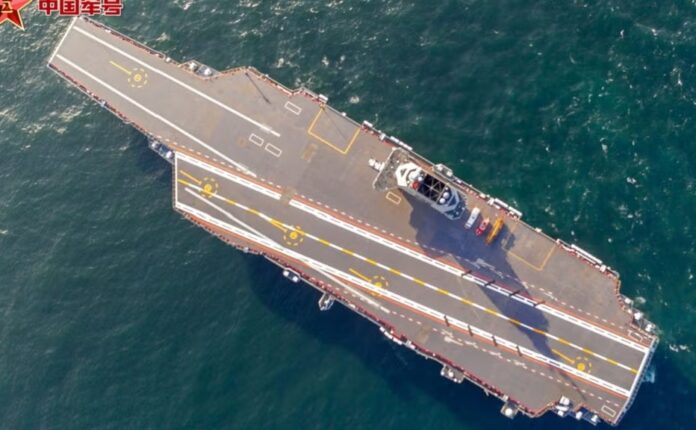
Fujian, Hull 18
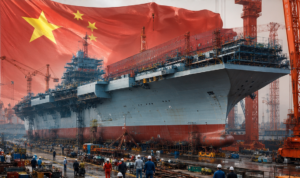
China’s third aircraft carrier. Over 80,000 metric tons. China’s first catapult-assisted aircraft carrier. Its first with electromagnetic catapults. The ship that announced China’s arrival into the modern carrier age.
The moderator stepped forward.
“Tonight, we ask a question that sounds simple but is actually explosive: did China copy America?”
A murmur moved through the hall.
“Or,” the moderator continued, “did China do what every rising naval power does—study the world’s strongest navy, absorb its lessons, and build a weapon for its own future?”
Professor Carter sat on the left side of the stage.
Professor Liang sat on the right.
Between them stood a model of the USS Gerald R. Ford and a model of Fujian.
The moderator looked at Carter.
“Professor Carter, opening statement.”
She stood.
“USS Gerald R. Ford is not just a ship. It is the result of more than a century of American carrier aviation experience. It is nuclear powered, massive, deeply integrated, and designed to operate a large air wing anywhere on Earth. Fujian is impressive, but it is still a newcomer.”
Then Professor Liang stood.
“Fujian is a newcomer, yes. But newcomers can be dangerous. China did not build Fujian to win a beauty contest against Ford. China built Fujian to change the balance of naval power in Asia.”
The room went quiet.
The debate began.
PART I — THE SHIPS THEMSELVES
1. Professor Carter: “Ford Is the King of Aircraft Carriers”
Professor Carter pointed to the screen.
“Let us begin with reality. USS Gerald R. Ford is larger, heavier, nuclear powered, and backed by decades of American carrier doctrine.”
She clicked the remote.
A fact panel appeared.
USS Gerald R. Ford — Key Facts
| Feature | USS Gerald R. Ford |
|---|---|
| Country | United States |
| Class | Ford-class aircraft carrier |
| Commissioned | 2017 |
| Propulsion | Nuclear |
| Displacement | More than 100,000 tons |
| Length | About 1,106 feet / 337 meters |
| Launch system | Electromagnetic Aircraft Launch System, EMALS |
| Recovery system | Advanced Arresting Gear, AAG |
| Strategic role | Global power projection |
Britannica describes USS Gerald R. Ford as a nuclear-powered U.S. Navy aircraft carrier commissioned in 2017, with displacement of more than 100,000 tons and length of 1,106 feet, making it the largest warship afloat. (Encyclopedia Britannica)
Carter turned toward Liang.
“Ford is not America’s experiment anymore. It is the lead ship of a new generation. Its nuclear reactors provide enormous endurance and electrical power. Its EMALS system replaces steam catapults. Its Advanced Arresting Gear supports current and future carrier aircraft.”
NAVAIR says EMALS is designed to launch current and future carrier air-wing platforms, from lightweight unmanned aircraft to heavy strike fighters, while using electromagnetic technology instead of traditional steam catapults. (navair.navy.mil) The U.S. Navy also describes Ford’s Advanced Arresting Gear as a system intended to recover both current and projected tailhook aircraft while reducing fatigue loads on aircraft. (allhands.navy.mil)
She paused.
“Ford is not merely big. It is a floating airbase, command center, logistics machine, and symbol of American global reach.”
Professor Liang smiled.
“Symbols can be powerful. But symbols can also become targets.”
The audience murmured.
2. Professor Liang: “Fujian Is China’s First True Modern Carrier”
Liang rose and pointed at the Chinese carrier.
“Before Fujian, China had Liaoning and Shandong. Those carriers used ski-jump launch systems. They were important, but limited. Fujian is different.”
A new panel appeared.
Fujian — Key Facts
| Feature | Fujian |
|---|---|
| Country | China |
| Hull number | 18 |
| Commissioned | November 5, 2025 |
| Propulsion | Conventional |
| Full-load displacement | Over 80,000 metric tons |
| Launch system | Electromagnetic catapults |
| Strategic role | Chinese power projection and naval aviation expansion |
China’s Ministry of National Defense states that Fujian was commissioned on November 5, 2025, is China’s first catapult-assisted aircraft carrier, has a full-load displacement of over 80,000 metric tons, and has electromagnetic catapult launch and recovery capabilities. (eng.mod.gov.cn)
Liang looked at Carter.
“Fujian is not China’s first aircraft carrier. But it is China’s first carrier that truly enters the same conversation as modern American supercarriers.”
Carter replied instantly.
“Same conversation, yes. Same level, no.”
Liang smiled.
“That is why we debate.”
He continued.
“The important point is not that Fujian equals Ford today. It does not. The important point is that China moved from a refurbished Soviet-style carrier to a domestically designed electromagnetic-catapult carrier in one generation. That speed matters.”
He clicked the remote.
A video still showed aircraft launching from Fujian.
In September 2025, China’s navy announced that the J-15T, J-35, and KJ-600 had completed electromagnetic catapult-assisted takeoff and arrested landing training aboard Fujian. (english.news.cn)
Liang said quietly:
“That is the moment China crossed a line. Before Fujian, China had carriers. After Fujian, China had modern carrier aviation.”
PART II — DID CHINA COPY AMERICA?
The moderator leaned forward.
“Now we reach the central question. Professor Carter, did China copy America?”
Carter answered without hesitation.
“Yes—but not in the childish way people think.”
Liang smiled.
“Interesting. Explain.”
1. Carter: “China Copied the American Carrier Formula”
Carter walked toward the two carrier models.
“Look at the design logic. Large flight deck. Catapult launch. Arrested recovery. Heavy aircraft. Airborne early warning. Stealth fighter ambitions. Power projection. This is the American carrier formula.”
She pointed to Ford.
“The United States proved that the aircraft carrier could become the center of naval power. Not battleships. Not cruisers. Not coastal defense ships. The carrier became the floating airbase that could influence events thousands of miles away.”
Then she pointed to Fujian.
“China saw this. China studied it. China understood that if it wanted a blue-water navy, it eventually needed carriers that could launch heavier aircraft with more fuel, more weapons, and better support aircraft.”
Liang interrupted.
“Studying is not stealing.”
Carter nodded.
“Correct. That is why I say Fujian is not a crude copy. But China clearly copied the strategic idea of American carrier power.”
She continued.
“Fujian’s most symbolic feature is electromagnetic catapults. America pioneered EMALS on Ford. China then introduced electromagnetic catapults on Fujian. That is not a coincidence.”
Liang answered.
“No, it is not coincidence. It is technological convergence.”
The audience reacted.
2. Liang: “Copying the Concept Is Not Copying the Ship”
Liang stood beside the Fujian model.
“When people say ‘China copied America,’ they often mean China had no creativity. That is too simple. Aircraft carriers obey physics. If you want to launch heavy aircraft from a flat deck, you need catapults. If you want to recover them, you need arresting gear. If you want more sortie generation, you need deck space, elevators, hangars, fuel, weapons handling, and command systems.”
He paused.
“Every serious carrier will look somewhat similar because the mission forces the shape.”
Carter replied.
“That is true. A large CATOBAR aircraft carrier will naturally resemble other CATOBAR carriers.”
Liang nodded.
“Exactly. CATOBAR means catapult-assisted takeoff but arrested recovery. The U.S. mastered this for decades. China wanted the same category of capability. So yes, Fujian looks American in concept because America created the gold standard.”
Then Liang leaned toward the audience.
“But Ford and Fujian are not the same ship.”
He raised his hand and counted.
“Ford is nuclear. Fujian is conventional. Ford is over 100,000 tons. Fujian is over 80,000 metric tons. Ford belongs to a navy with 11 aircraft carriers and decades of operational practice. Fujian belongs to a navy still learning carrier operations. Ford is built for global operations. Fujian is first built for regional and expanding far-seas power.”
The Associated Press reported that Fujian is China’s first fully domestically designed carrier and its first with electromagnetic catapults, but also noted that it is conventionally powered, smaller than U.S. nuclear carriers, and estimated to carry fewer aircraft than U.S. supercarriers. (AP News)
Liang looked at Carter.
“So I say: China copied the category, not the complete architecture.”
Carter smiled.
“That is a fair distinction.”
3. The Debate Gets Sharper
The moderator asked, “So is Fujian a copy?”
Carter answered:
“Fujian is a strategic imitation of the American supercarrier model.”
Liang answered:
“Fujian is a Chinese carrier built after studying the American model.”
Carter laughed.
“That sounds like the same thing with softer language.”
Liang replied.
“No. A copy tries to become the original. Fujian does not try to become Ford. Fujian tries to solve China’s military problem.”
Carter crossed her arms.
“And what is that problem?”
Liang answered:
“To push China’s naval airpower farther from its coast, support operations around Taiwan and the South China Sea, protect sea lanes, train carrier aviation, and prepare the Chinese navy for global competition.”
Carter replied:
“Then you admit the inspiration is American.”
Liang said:
“Of course. America is the teacher China never officially thanks.”
The audience laughed loudly.
Carter smiled.
“That may be the best line of the night.”
PART III — THE HEART OF THE SHIP: NUCLEAR POWER VS CONVENTIONAL POWER
The moderator turned to the next topic.
“Let us discuss propulsion. Ford is nuclear. Fujian is conventional. How important is that?”
Carter answered first.
“It is enormously important.”
1. Carter: “Nuclear Power Is Ford’s Deep Advantage”
Carter clicked the remote.
A graphic showed Ford crossing oceans without refueling.
“USS Gerald R. Ford can operate for extremely long periods without refueling its reactors. Its nuclear propulsion gives it endurance, speed flexibility, and massive electrical power. That matters for EMALS, sensors, future lasers, electronic warfare, command systems, and high-tempo operations.”
She turned toward Liang.
“Fujian may have electromagnetic catapults, but it is still conventionally powered. That means it must manage fuel differently. Its endurance and logistics burden are not the same as a U.S. nuclear carrier.”
Liang nodded.
“I agree. Ford has a major advantage in propulsion.”
Carter raised an eyebrow.
“You agree too easily.”
Liang replied.
“Because it is true. A scientist should not deny physics.”
The audience laughed.
Carter continued.
“Ford is not just a carrier. It is a nuclear-powered city at sea. That gives it strategic freedom.”
2. Liang: “Conventional Power Does Not Mean Weak”
Liang responded carefully.
“But conventional power does not make Fujian weak. China may have accepted conventional propulsion because it wanted to master catapult operations sooner, reduce technical risk, and build experience before moving to a future nuclear carrier.”
Carter nodded.
“That is plausible.”
Liang continued.
“Also, Fujian’s first mission is not to patrol the entire planet like an American carrier. Its first mission is to expand China’s reach in the Western Pacific and nearby seas. For that purpose, conventional propulsion is not fatal.”
He paused.
“Ford is a global sword. Fujian is a regional sword becoming a global sword.”
Carter answered.
“Good metaphor. But a global sword still outranges a regional sword.”
Liang said:
“For now.”
PART IV — EMALS: DID CHINA STEAL THE MAGIC?
The moderator smiled.
“Now the most controversial topic: electromagnetic catapults.”
The audience leaned forward again.
1. Carter: “EMALS Is America’s Technological Signature”
Carter pointed to Ford’s deck.
“EMALS is one of the defining features of the Ford class. It replaces steam catapults with electromagnetic launch technology. The promise is smoother launches, more precise control, less stress on aircraft, and the ability to launch a wider range of aircraft, including future drones.”
NAVAIR states that EMALS is designed to expand operational capability by launching current and future air-wing platforms, from lightweight unmanned aircraft to heavy strike fighters. (navair.navy.mil)
Carter continued.
“America paid the price of being first. The Ford program had problems, delays, cost overruns, and technical headaches. But being first is expensive. America climbed the mountain first.”
Liang replied.
“And China studied the footprints.”
The audience reacted.
Carter pointed at him.
“Exactly. China benefited from watching America struggle. That is why some Americans say China copied.”
Liang answered.
“Every second mover benefits from the first mover. That is not unique to China.”
2. Liang: “China’s EMALS Choice May Be More Daring Than People Think”
Liang stood.
“Here is the interesting part. China did not use steam catapults on Fujian. It jumped directly from ski-jump carriers to electromagnetic catapults. That is bold.”
Carter admitted:
“Yes. That is a major technological leap.”
Liang continued.
“Liaoning and Shandong use ski-jump ramps. Those ramps limit aircraft launch weight. Fujian’s catapults allow heavier aircraft, more fuel, more weapons, and most importantly, airborne early warning aircraft like the KJ-600.”
USNI reported that Fujian’s three electromagnetic catapults allow Chinese forces to sortie fighter jets with heavier payloads and larger aircraft, including the KJ-600 airborne early warning and command aircraft. (USNI News)
Liang turned to the audience.
“This is the real revolution. Fujian is not scary because it looks like Ford. Fujian is scary because it gives China the ability to operate a more complete carrier air wing.”
Carter nodded.
“I agree. A carrier without a proper airborne early warning aircraft is limited. Catapults change that.”
3. The Eye-Opening Point: EMALS Is Not Just a Launch System
Carter spoke slowly.
“Most people think a catapult is just a way to throw aircraft into the air. But EMALS is more than that. It affects the entire future of naval aviation.”
Liang continued.
“It affects drones.”
Carter added.
“It affects heavy aircraft.”
Liang added.
“It affects sortie generation.”
Carter added.
“It affects aircraft fatigue.”
Liang added.
“It affects how many kinds of aircraft a carrier can operate.”
The moderator smiled.
“For once, you agree.”
Carter said:
“Yes. Because this is the truth: the catapult is the gateway to a real carrier air wing.”
Liang finished:
“And Fujian has crossed that gateway.”
PART V — AIR WINGS: THE REAL WEAPONS OF THE CARRIERS
The moderator pointed at the models.
“An aircraft carrier is not dangerous because of the ship itself. It is dangerous because of the aircraft it carries. Compare the air wings.”
1. Carter: “Ford Has the Mature Air Wing”
Carter began.
“Ford’s advantage is not just the ship. It is the U.S. Navy carrier air wing system. The U.S. has F/A-18E/F Super Hornets, EA-18G Growlers, E-2D Advanced Hawkeyes, helicopters, logistics aircraft, and future F-35C integration across the carrier force.”
She continued.
“The key word is maturity. American carrier pilots, deck crews, maintainers, weapons handlers, and commanders have decades of experience. The choreography of a U.S. carrier deck is one of the most complex human-machine systems ever created.”
Liang nodded.
“Yes. Carrier aviation is not learned from books.”
Carter said:
“Exactly. It is learned through danger. Through night landings. Through storms. Through maintenance failures. Through deployments. Through mistakes. Through thousands and thousands of launches and recoveries.”
She paused.
“Fujian has new technology. Ford has institutional memory.”
2. Liang: “Fujian’s Air Wing Is the Beginning of China’s New Era”
Liang changed the screen.
Three Chinese aircraft appeared:
J-15T
J-35
KJ-600
Liang said:
“Fujian’s air wing matters because it shows China’s direction. The J-15T gives China a catapult-capable fighter. The J-35 suggests stealth carrier aviation. The KJ-600 gives China airborne early warning, which is essential for serious carrier operations.”
China’s navy announced in September 2025 that the J-15T, J-35, and KJ-600 had completed electromagnetic catapult-assisted takeoff and arrested landing training aboard Fujian. (english.news.cn)
Carter replied:
“Important, yes. But not yet equal to the U.S. Navy’s operational experience.”
Liang answered:
“I agree. But Fujian is a school as much as a weapon.”
The audience became silent.
Liang continued.
“Fujian will train China’s first generation of modern catapult carrier crews. It will teach China how to operate heavier aircraft. It will expose weaknesses in aircraft handling, deck layout, maintenance, sortie generation, and command rhythm. And those lessons will shape China’s next carrier.”
Carter narrowed her eyes.
“That is the most serious point you have made. Fujian may not be equal to Ford, but it may be the bridge to something more dangerous.”
Liang smiled.
“Exactly. Fujian is not the final answer. It is the classroom.”
PART VI — DECK DESIGN: COPY, COMPROMISE, OR DIFFERENT PHILOSOPHY?
The moderator asked:
“Some analysts argue Fujian’s deck layout may limit its flight operations compared with American carriers. Is that true?”
Carter answered:
“It may be. Public analysis has suggested Fujian’s catapult and elevator layout could create bottlenecks. American carriers benefit from decades of deck-layout evolution. Deck choreography is everything.”
USNI noted reporting that Fujian’s layout of catapults and elevators could impede flight operations compared with American Nimitz- and Ford-class carriers. (USNI News)
Liang replied:
“Maybe. But we should be careful. We do not yet have enough public operational data to judge Fujian’s real sortie rate.”
Carter agreed.
“That is fair.”
Liang continued.
“A carrier deck is not judged only by satellite photos. It is judged by operations: how fast aircraft are armed, fueled, moved, launched, recovered, repaired, and relaunched.”
Carter said:
“And this is where America has a huge advantage. Ford was designed to improve sortie generation and reduce crew workload, but even America had difficulty integrating new systems.”
The U.S. Defense Department’s FY2024 testing report says CVN-78 includes a new nuclear power plant to increase electrical capacity for ship systems, including EMALS and Advanced Arresting Gear, showing how deeply these new systems are integrated into the Ford design. (dote.osd.mil)
Liang said:
“Then America’s own struggle proves the challenge. Fujian will also face growing pains.”
Carter replied:
“Yes. But America has already survived many of those growing pains.”
Liang said:
“And China is beginning to.”
PART VII — EXPERIENCE: THE INVISIBLE OCEAN
The moderator asked:
“Which matters more: the ship or the sailors?”
Both professors answered:
“The sailors.”
The audience applauded.
1. Carter: “America Has Carrier Culture”
Carter spoke with emotion now.
“You cannot copy carrier culture overnight. You cannot download deck discipline. You cannot steal night landing experience. You cannot fake the instinct of crews who have spent generations operating carriers across the world.”
She pointed to Ford.
“America has used carriers in war, crisis, deterrence, disaster relief, air campaigns, and global deployments. The U.S. Navy knows what it means to keep an aircraft carrier alive far from home.”
Liang nodded.
“This is America’s deepest advantage.”
Carter looked surprised.
“You admit it?”
Liang replied.
“Of course. China can build ships quickly. But sea experience takes time.”
2. Liang: “But Experience Can Be Built Faster Than Before”
Liang continued.
“However, modern China can accelerate learning. It can use simulators, AI-assisted training, digital twins, shore-based carrier decks, intensive sea trials, and massive data collection.”
Carter replied:
“Simulation helps, but the ocean remains the ocean.”
Liang smiled.
“Yes. The ocean always has the final vote.”
The audience loved that line.
PART VIII — STRATEGIC PURPOSE: WHY EACH CARRIER EXISTS
The moderator said:
“Now tell us: what are these ships really for?”
1. Carter: “Ford Is Built for Global Command”
Carter answered.
“Ford is built for global power projection. It is designed to operate with destroyers, cruisers, submarines, logistics ships, satellites, aircraft, and allies. It can support deterrence in Europe, strike operations in the Middle East, crisis response in Asia, and presence missions anywhere.”
She paused.
“Ford says: America can arrive.”
2. Liang: “Fujian Is Built for China’s Breakout”
Liang replied.
“Fujian says something different. Fujian says: China will no longer remain close to shore.”
He pointed to the map.
“China’s earlier naval strategy was largely coastal defense and near-seas control. Now China wants far-seas protection, power projection, and the ability to operate beyond the first island chain.”
Carter interrupted.
“And Taiwan?”
Liang did not avoid the question.
“Of course Taiwan matters. Fujian is named after the Chinese province facing Taiwan. The symbolism is impossible to ignore. But Fujian is not only about Taiwan. It is also about the South China Sea, Indian Ocean routes, overseas interests, and China’s long-term ambition to become a blue-water navy.”
Carter replied:
“That is why the United States watches Fujian so closely.”
PART IX — WHO WOULD WIN: FORD OR FUJIAN?
The moderator finally asked the question many readers wanted.
“If USS Gerald R. Ford and Fujian were compared directly, who wins?”
Carter answered:
“Ford.”
Liang answered:
“In a direct carrier comparison, Ford is superior. But war is not a boxing match between two carriers.”
1. Carter’s Case for Ford
Carter listed her points:
“Ford has nuclear propulsion. Greater displacement. Larger potential air wing. More mature systems. A navy with decades of carrier experience. A global logistics network. Better operational history. A stronger alliance structure. And the U.S. Navy has multiple carrier strike groups, not just one modern carrier.”
The AP reported that the U.S. Navy still leads globally with 11 carriers, while Fujian brings China to three carriers. (AP News)
Carter said:
“Ford is the stronger individual carrier and belongs to the stronger carrier navy.”
2. Liang’s Case for Fujian
Liang replied:
“Fujian’s power is not that it beats Ford one-on-one. Fujian’s power is that it changes China’s naval future.”
He raised one finger.
“First, it gives China catapult carrier experience.”
Second finger.
“Second, it allows heavier aircraft and airborne early warning.”
Third.
“Third, it prepares China for future carrier classes.”
Fourth.
“Fourth, it forces U.S. planners to consider Chinese carrier aviation as a serious factor.”
Fifth.
“Fifth, it proves China can build large advanced carriers domestically.”
He looked at Carter.
“That is not small.”
Carter nodded.
“No, it is not small.”
PART X — THE COPY QUESTION RETURNS
The moderator returned to the key theme.
“After all this, let us ask again: did China copy the U.S.?”
Professor Carter answered first.
“Yes, China copied the American insight that a great power needs carriers able to launch heavy aircraft from catapults. China copied the strategic grammar of American naval aviation.”
Professor Liang answered:
“And China translated that grammar into Chinese.”
Carter smiled.
“That is poetic.”
Liang continued.
“China did not copy Ford bolt for bolt. Fujian is not nuclear. It is smaller. Its air wing is Chinese. Its mission is Chinese. Its operational context is Chinese. Its doctrine will be Chinese.”
Carter replied:
“But the inspiration is American.”
Liang said:
“The inspiration is American because America was successful. That is not shameful. That is how power evolves.”
Carter responded:
“Then perhaps the true question is not whether China copied America. The true question is whether China can master what it copied.”
The hall went silent.
Liang nodded slowly.
“Yes. That is the question.”
PART XI — THE PROFESSORS’ FINAL ARGUMENTS
Professor Carter’s Final Speech
“Ladies and gentlemen, do not be fooled by surface similarity. Aircraft carriers are not judged by photographs. They are judged by propulsion, air wing, sortie generation, maintenance, crew training, command systems, logistics, operational experience, and wartime survivability.”
She pointed to the Ford model.
“USS Gerald R. Ford remains the superior carrier. It is larger, nuclear powered, more deeply integrated into a global navy, and supported by the most experienced carrier aviation system in the world.”
Then she pointed to Fujian.
“But do not dismiss Fujian. That would be foolish. Fujian is the most important Chinese warship of the modern era. It is not equal to Ford, but it is the ship that moves China from symbolic carrier ownership to serious carrier aviation.”
She paused.
“So yes, China copied the American carrier model. But copying a great idea is not the same as mastering it. Ford is mastery. Fujian is ambition.”
Professor Liang’s Final Speech
Professor Liang stood slowly.
“America looks at Fujian and says: China copied us.”
He paused.
“China looks at Fujian and says: we learned.”
The audience became still.
“History is full of powers that learned from the leaders before them. The British learned from earlier naval powers. America learned from Britain. Japan learned from Britain and America. China studied the Soviet Union and the United States. This is not unusual. This is civilization.”
He walked toward the Fujian model.
“Fujian is not Ford. It does not need to be Ford. It is China’s bridge from coastal navy to blue-water navy. It is a training ground, a political symbol, a technological leap, and a warning.”
He turned to Carter.
“Ford is the king today. Fujian is the student. But the dangerous student is the one who knows he is still learning.”
FINAL VERDICT
Which carrier is more powerful today?
USS Gerald R. Ford is more powerful.
It is larger, nuclear powered, more mature, and part of the world’s most experienced carrier navy. It remains the most advanced aircraft carrier currently in service.
Is Fujian a copy of USS Gerald R. Ford?
Not exactly.
Fujian copies the American supercarrier concept, especially the idea that a great-power carrier should use catapults to launch heavier and more capable aircraft. Its use of electromagnetic catapults invites obvious comparison to Ford.
But Fujian is not a direct copy. It is conventionally powered, smaller, Chinese-built, and designed for China’s own strategic needs.
The best phrase is:
Fujian is not a photocopy of Ford. It is China’s answer to Ford.
What does Fujian prove?
Fujian proves that China has entered the modern carrier era. It proves China can build a large domestically designed carrier with electromagnetic catapults. It proves China wants more than coastal defense. It proves China is preparing for serious far-seas naval aviation.
What does Ford prove?
Ford proves that America still leads the world in carrier aviation. It shows the depth of U.S. nuclear naval engineering, carrier experience, aviation integration, and global power projection.
Final Ranking
| Category | Winner |
|---|---|
| Bigger carrier | USS Gerald R. Ford |
| Nuclear propulsion | USS Gerald R. Ford |
| Operational experience | USS Gerald R. Ford |
| Global power projection | USS Gerald R. Ford |
| Mature carrier air wing | USS Gerald R. Ford |
| Newest Chinese leap | Fujian |
| Fastest strategic learning curve | Fujian / China |
| Symbol of current dominance | USS Gerald R. Ford |
| Symbol of future challenge | Fujian |
Best Closing Lines
Professor Carter:
“Ford is the king of the sea because America has spent a century learning how to turn a ship into an air force.”
Professor Liang:
“And Fujian is dangerous because China has spent decades watching the king and learning where the throne is weak.”
Moderator:
“So did China copy America?”
Professor Carter:
“Yes. China copied the dream.”
Professor Liang:
“No. China studied the dream, then built its own door into it.”
Final narrator line:
USS Gerald R. Ford is still the ruler of carrier power. But Fujian is the moment China stopped watching from the shore and began sailing toward the throne.