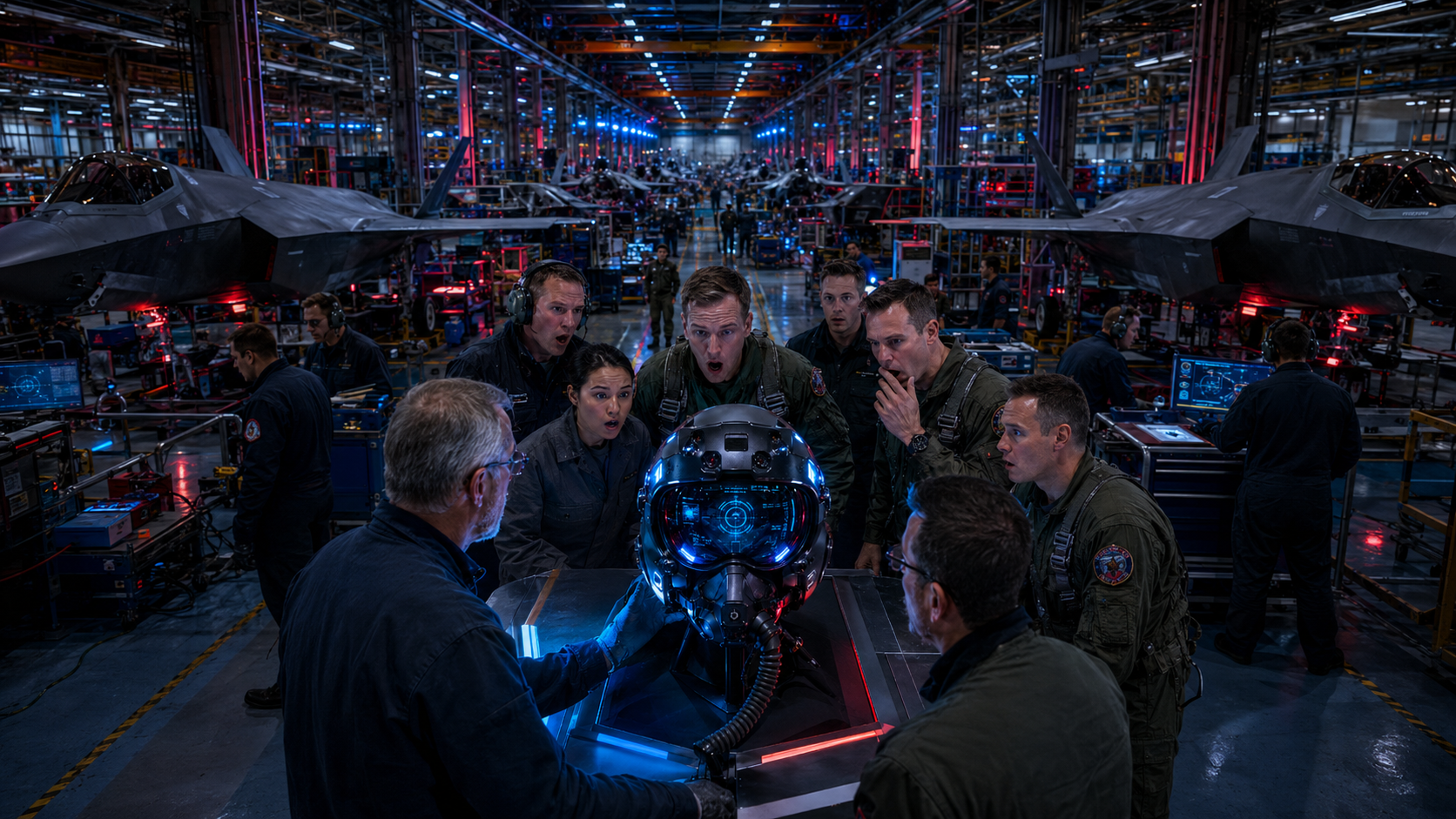
The Helmet That Made the Air Base Go Silent
The whole hangar laughed when Elias Ward asked why one F-35 helmet cost more than his mother’s house—until the helmet answered back.
The laughter started near the front row, where the officers stood with their arms folded and their polished boots reflecting the white hangar lights. Then it spread through the maintenance crew, through the visiting journalists, through the contractors in expensive suits, until the sound rose against the metal walls like a storm of knives.
Elias stood alone beside the display table.
On that table sat the F-35 Lightning II Helmet-Mounted Display System.
You May Also Like
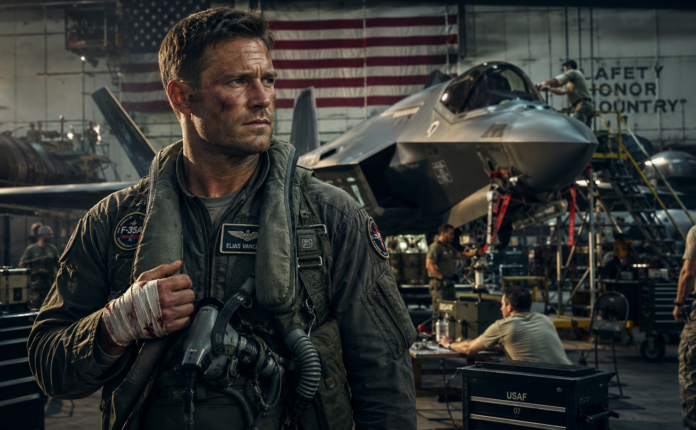
Black. Sleek. Cold. Beautiful.
It looked less like a helmet and more like something pulled from the future before humanity had permission to touch it. The curved visor reflected everyone in the room, but Elias could only see his own tired face in it—dark circles beneath his eyes, cracked lips, grease beneath his fingernails, and a sadness he had never learned how to hide.
Captain Rowan Voss smiled from the stage.
“Say it again,” Voss said into the microphone. “Louder this time. I want the generals to hear the question.”
Elias swallowed.
The hangar smelled of jet fuel, hot wiring, machine oil, and rainwater blown in from the runway. Outside, thunder rolled across Hawthorne Air Base, shaking the glass windows above the hangar doors.
“I asked,” Elias said quietly, “why the helmet costs four hundred thousand dollars.”
More laughter.
Someone behind him muttered, “Because it’s not a bicycle helmet, genius.”
A woman in a contractor badge covered her mouth.
Captain Voss stepped down from the stage, smiling wider.
“Mr. Ward,” he said, “you clean diagnostic benches and carry replacement cables. You do not question advanced military aviation systems.”
Elias felt his ears burn.
“I repair helmet interface ports,” he said.
Voss tilted his head.
“You replace wires when real engineers tell you to.”
A few officers chuckled.
Elias looked at the helmet again.
His father’s voice whispered in his memory.
Never let a man’s rank make you forget your own eyes.
But his father was gone now.
Dead after a failed training flight years earlier, before the F-35 program arrived at Hawthorne, before Elias had joined the base as a low-level avionics technician with one goal: to understand the machines that had taken his father from him.
Captain Voss raised the microphone.
“Ladies and gentlemen, today’s public debate was created to answer one question that civilians keep asking online: Why is the F-35 helmet so expensive? And now, apparently, our own support staff needs the same lesson.”
His eyes locked on Elias.
“So go ahead. Ask your full question.”
Elias’s hands curled into fists.
He wanted to walk away. He wanted to disappear between the tool carts and shadowed aircraft wings. That was his weakness. When men like Voss smiled, Elias became a boy again—standing at his father’s funeral while officers spoke in clean sentences about mechanical failure and unavoidable risk.
But something about that helmet had bothered him for three nights.
A flicker in the internal mapping system.
A hidden signal pulse.
A data trail that did not belong.
Elias lifted his chin.
“If it’s just a helmet,” he said, his voice shaking, “then no helmet should cost four hundred thousand dollars. But if it costs that much because it is a wearable supercomputer, because it connects the pilot’s eyes to the aircraft’s sensors, because it streams camera imagery into the visor and gives a virtual three-hundred-sixty-degree view, then why did someone disable one of its warning layers yesterday?”
The laughter stopped.
Not slowly.
All at once.
Captain Voss’s smile froze.
“What did you say?”
Elias heard the rain hit harder against the hangar roof.
“I said the helmet isn’t overpriced because it protects a head. It’s expensive because it carries the aircraft’s vision, targeting information, threat warnings, night imagery, flight data, and pilot interface in one custom-fitted system.”
He pointed at the helmet.
“And someone tampered with this one.”
The room went silent.
Then Voss laughed once.
A sharp, ugly sound.
“Careful, Ward.”
Elias turned toward him.
“I am being careful.”
“No,” Voss said softly. “You are being emotional.”
That word struck harder than the laughter.
Emotional.
That was what they had called him when he asked for his father’s accident file.
Emotional.
That was what they said when he questioned missing maintenance records.
Emotional.
That was what powerful men called the truth when it came from someone poor.
Voss stepped closer.
“You lost your father in aviation. We all respect that. But grief does not make you an expert.”
Elias’s throat tightened.
“My father taught me avionics before I learned to drive.”
“Your father crashed,” Voss said.
A gasp moved through the crew.
Elias went still.
Captain Voss lowered his voice, but the microphone caught every word.
“And now you’re trying to turn a helmet demonstration into some little revenge story.”
Elias stared at him.
For a moment, he could not breathe.
Then a voice came from the back of the hangar.
“Captain, that was unnecessary.”
Everyone turned.
Dr. Mara Ellison, chief systems engineer for the helmet integration team, walked forward with a tablet pressed against her chest. She was in her late forties, with silver at her temples and eyes that looked like they had spent too many nights reading data nobody else wanted to face.
Voss’s jaw tightened.
“Dr. Ellison, this is under control.”
“No,” she said. “It is not.”
Elias looked at her in surprise.
For weeks, Dr. Ellison had barely spoken to him except to ask for test reports. She was brilliant, distant, and impossible to impress. But now she stood beside him as if the whole room did not scare her.
I was supposed to fail the evaluation, but these traumatized dogs showed a room full of powerful men what loyalty looks like.
She looked at Elias.
“What did you find?”
Voss snapped, “Do not encourage this.”
Dr. Ellison ignored him.
“Elias. Tell me.”
Elias took a breath.
“The helmet’s sensor fusion layer showed a ghost delay during calibration. Not enough to fail the test. Just enough to shift the threat marker by a fraction of a second.”
A contractor frowned.
“That’s impossible.”
Elias turned toward him.
“It should be.”
Voss laughed again, but this time nobody joined him.
“Ghost delay? Threat marker? Listen to yourself.”
Elias walked to the display table and placed his hand near the helmet, not touching it.
“This helmet is custom-fitted to the pilot. Every angle matters. Every eye movement matters. It doesn’t just show pretty pictures. It tells the pilot where danger is before his body even understands it. If that data is late, even by a second—”
“A second is nothing,” Voss interrupted.
Dr. Ellison’s face hardened.
“In a fighter jet, a second is a lifetime.”
The words landed like thunder.
Outside, lightning flashed, turning the F-35 parked behind them into a silver beast with its canopy open and its nose pointed toward the storm.
Major Caleb Raines, the test pilot scheduled to fly that afternoon, stepped forward.
He was tall, calm, and already wearing his flight suit. His helmet bag hung from one hand.
“Elias,” Caleb said, “are you saying my helmet is unsafe?”
Elias looked at him.
Caleb had never mocked him. He was one of the few pilots who knew every mechanic’s name. Once, when Elias’s mother was sick, Caleb had quietly arranged for meals to be sent to the hospital.
Elias forced himself to answer.
“I’m saying someone made it look safe.”
The hangar erupted.
“Enough!” Voss shouted.
General Harlan Pierce, commander of Hawthorne Air Base, rose from the front row.
He had a face carved from discipline, with gray hair and cold eyes. When he spoke, every sound died.
“Mr. Ward,” the general said, “do you have proof?”
Elias looked at Dr. Ellison.
She looked back at him with a warning in her eyes.
This was the line.
Cross it, and there would be no going back.
Elias reached into his pocket and pulled out a small data drive.
Voss’s face changed.
Not much.
Just enough.
A tightening around the mouth. A blink too slow.
Elias saw it.
So did Dr. Ellison.
General Pierce held out his hand.
“Bring it here.”
Voss stepped forward.
“Sir, I strongly advise against entertaining unauthorized data pulled by a junior technician.”
Elias turned to him.
“How did you know it was pulled?”
Voss froze.
A murmur passed through the room.
Dr. Ellison whispered, “Oh, Rowan.”
The captain’s eyes flashed.
“You people are making a mistake.”
General Pierce’s voice turned cold.
“Captain, step back.”
Voss did not move.
For one terrible second, Elias thought the man might refuse a direct order.
Then Voss smiled.
“Of course, sir.”
Elias walked to the general and placed the drive in his palm.
His hands trembled.
Not because he was afraid of being wrong.
Because he was afraid of being right.
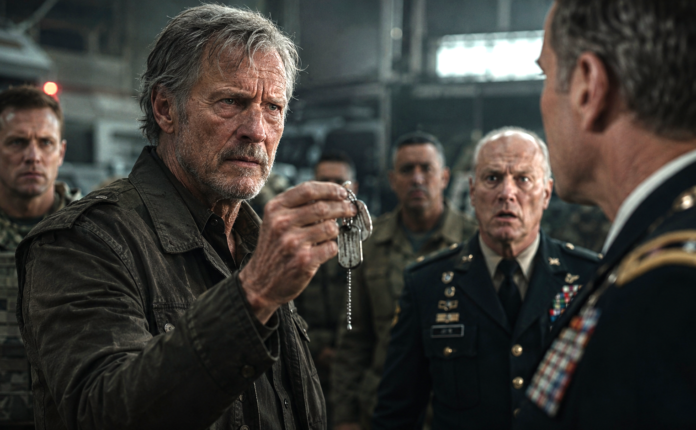
The display team connected the drive to the main screen. Lines of diagnostic data appeared above the stage. Numbers. Time stamps. Helmet response curves. Sensor latency records.
Most people in the hangar could not understand it.
But Dr. Ellison could.
Her face went pale.
She stepped closer to the screen.
“No,” she whispered.
General Pierce looked at her.
“Doctor?”
She tapped the screen.
“This is not a normal delay. The system was told to ignore the delay during self-check.”
Major Caleb Raines stared at the helmet.
“So it would pass inspection?”
Dr. Ellison nodded slowly.
“Yes.”
The contractor in the expensive suit shook his head.
“That would require access to restricted software.”
Elias looked across the room at Captain Voss.
“And command-level authorization.”
Everyone followed his gaze.
Voss’s smile vanished.
“You little rat.”
The words were quiet, but the microphone still picked them up.
Major Caleb stepped between Voss and Elias.
“Careful, Captain.”
Voss’s face twisted.
“You have no idea what you’re protecting.”
Caleb’s voice lowered.
“I’m protecting the man who may have just saved my life.”
Voss laughed bitterly.
“Saved your life? You think this is about safety?”
General Pierce stood.
“What is it about, Captain?”
Voss looked around the hangar.
At the journalists.
At the officers.
At the helmet.
At Elias.
For a moment, his polished mask cracked, and beneath it Elias saw something stranger than guilt.
Fear.
Then Voss said nothing.
Two security officers moved toward him, but before they could reach him, the emergency lights flashed red.
A siren screamed.
A voice came over the hangar speakers.
“Alert. Unauthorized aircraft system activation detected. F-35 bay three. Helmet interface link active.”
Every head turned toward the parked jet.
The canopy lights flickered.
The helmet on the table gave a soft electronic pulse.
Blue light shimmered across the visor.
Elias stepped back.
Major Caleb whispered, “That’s my aircraft.”
Dr. Ellison stared at her tablet.
“The helmet is receiving live data.”
General Pierce barked, “From where?”
She looked up.
“From the jet.”
The F-35’s internal screens glowed inside the cockpit.
No one was inside.
The hangar doors began to rumble open.
Wind and rain exploded into the building.
Technicians shouted.
A toolbox tipped over, spilling metal across concrete.
General Pierce roared, “Shut it down!”
“We can’t!” someone yelled. “System lockout!”
Captain Voss started laughing.
Not loudly.
Not happily.
Like a man watching a fire he had lit finally reach the ceiling.
Elias turned on him.
“What did you do?”
Voss’s eyes were wet now.
“You still don’t understand. That helmet is not expensive because it helps pilots see. It’s expensive because whoever controls what a pilot sees controls what a pilot believes.”
The words chilled the room.
Major Caleb grabbed Voss by the collar.
“What did you put in my aircraft?”
Voss smiled at him.
“A lesson.”
Security pulled Caleb away.
Dr. Ellison shouted, “The jet is receiving a false threat simulation. If it completes the cycle, it may trigger emergency taxi protocols.”
General Pierce went pale.
“In a closed hangar?”
“If the override believes the aircraft is under attack,” she said, fingers flying across her tablet, “it may attempt relocation.”
The F-35’s lights brightened.
The engine gave a low mechanical whine.
Everyone moved back.
Elias felt the vibration through the floor.
The monster was waking up.
“Cut power!” Pierce ordered.
“External power already disconnected!”
“Then kill the helmet link!”
Dr. Ellison looked at Elias.
“The helmet accepted the override because it thinks it’s connected to Major Raines.”
Caleb lifted his helmet bag.
“But my assigned helmet is right here.”
“No,” Elias said slowly.
Everyone looked at him.
He stared at the helmet on the display table.
“No, it’s not.”
Dr. Ellison’s eyes widened.
“What?”
Elias stepped toward the helmet.
“The shell is Caleb’s. The fit profile is Caleb’s. But the internal core was swapped.”
Voss’s face drained.
Elias pointed to the lower rim.
“There’s a tiny scratch near the left seal. I logged it two weeks ago on a decommissioned test helmet. This isn’t Major Raines’s operational core.”
Dr. Ellison checked the serial data.
Her mouth opened.
“He’s right.”
General Pierce turned to Voss.
“Why?”
Voss said nothing.
Elias moved closer to him.
“Was my father’s crash a helmet failure too?”
The room went dead silent.
Voss stared at him.
For the first time, the captain looked truly shaken.
“Don’t,” he said.
Elias’s voice broke.
“Answer me.”
Dr. Ellison whispered, “Elias…”
“No.” Tears filled his eyes, but he did not wipe them. “I have lived ten years with men telling me my father made a mistake. I watched my mother sell our house because nobody would release the full accident record. I took this job to understand what happened. So answer me.”
Voss looked toward General Pierce.
The general’s face was unreadable.
Then Voss smiled in pain.
“Your father saw something he wasn’t supposed to see.”
Elias felt the world tilt.
Major Caleb whispered, “What?”
Voss’s voice shook now.
“He was testing an early visual integration system. It showed him a false friendly marker. He reported it. Said someone had inserted a manipulation layer into the display system. He refused to sign the report.”
Elias could barely hear over his own heartbeat.
“And then?”
Voss looked down.
“And then his aircraft went down.”
Elias staggered backward.
Caleb caught his arm.
The hangar blurred. The lights. The jet. The helmet. The faces.
All his life, Elias had imagined the truth would heal him.
Instead, it opened a wound so deep he thought it might swallow him.
“My father didn’t crash,” he whispered.
Voss said nothing.
General Pierce’s voice came like stone scraping stone.
“Who ordered the cover-up?”
Voss looked at him.
Then at the journalists.
Then at the cameras still recording.
He laughed softly.
“You really want justice now, General?”
Pierce did not blink.
“Answer.”
Voss lifted his chin.
“Ask the man who signed the final accident summary.”
Every eye turned.
Slowly.
Terribly.
Toward General Pierce.
The commander’s face did not change.
But his hands tightened at his sides.
Elias stared at him.
“No,” Elias said. “No.”
Dr. Ellison covered her mouth.
Major Caleb took a step away from the general.
Pierce spoke calmly.
“Captain Voss is under emotional distress.”
Voss shouted, “You buried Ward’s father to protect the program!”
The hangar exploded into chaos.
Reporters shouted questions.
Officers moved toward the general.
Security hesitated, unsure whom to obey.
The F-35’s engine whine rose louder.
Dr. Ellison screamed, “We are out of time!”
Elias snapped back to the present.
The aircraft lurched slightly.
The nose wheel shifted.
If it moved forward, people would die.
Elias looked at the helmet.
The $400,000 mystery.
The wearable supercomputer.
The machine that could show a pilot the sky, the ground, the enemy, the aircraft, the unseen world around him.
And also the machine that could lie.
Dr. Ellison grabbed his sleeve.
“Elias, the false profile is locked in the helmet core. We can’t break it from outside.”
“What can break it?”
She stared at him.
“A real pilot authentication sequence.”
Caleb stepped forward.
“I’ll do it.”
Elias shook his head.
“No. It’s using a corrupted core. If you put that on, it may feed your eyes false data.”
Caleb looked at the F-35.
“If we do nothing, it kills people.”
Elias looked at the helmet.
Then at the cockpit.
Then at the storm outside.
His father had died inside a lie.
Elias would not let another man do the same.
“I can guide you,” he said.
Caleb frowned.
“What?”
Elias grabbed a maintenance headset.
“You wear it. I talk you through the manual visual reset. Don’t trust what you see unless I confirm it.”
Dr. Ellison said, “That reset is buried behind four diagnostic layers.”
“I know.”
“How?”
Elias looked at the general.
“My father’s old notebooks.”
For the first time, Pierce looked afraid.
Caleb placed a hand on Elias’s shoulder.
“Tell me what to do.”
Elias nodded.
“Do exactly what I say.”
The crew formed a path through the rain-swept hangar. Caleb grabbed the helmet from the table and ran toward the F-35. Elias followed with Dr. Ellison behind him, tablet in hand.
The wind was brutal near the open doors. Rain sprayed across Elias’s face. The engine sound grew louder, vibrating in his teeth.
“Nurse Stabbed 5 Times Protecting a Veteran’s K9 — 24 Hours Later, 200 Navy SEALs Arrived”
Caleb climbed the ladder and dropped into the cockpit.
Elias shouted through the headset, “Helmet on!”
Caleb pulled it over his head.
His voice crackled back.
“Display active.”
“What do you see?”
“A red threat marker inside the hangar.”
“There is no threat. Ignore it.”
“It’s showing movement near the fuel line.”
“False.”
“It says eject.”
Elias’s blood turned cold.
“Do not eject.”
Caleb breathed hard.
“It’s flashing emergency escape.”
“Caleb, listen to my voice. Not the helmet. My voice.”
There was a pause.
Then Caleb said, “I hear you.”
Elias closed his eyes for half a second.
“Open manual diagnostics. Lower left gaze hold. Three seconds.”
“Done.”
“Blink twice. Look center. Say override phrase.”
Caleb swallowed.
“Pilot confirms human visual priority.”
The cockpit lights flickered.
Dr. Ellison shouted, “First layer open!”
The jet rolled another inch.
People screamed and moved back.
Elias’s voice sharpened.
“Second layer. Look at the horizon line.”
Caleb said, “The helmet is showing the runway.”
Elias looked at the concrete wall ahead.
“There is no runway. It’s lying.”
“My body wants to follow it.”
“Then close your eyes.”
“What?”
“Close your eyes and listen.”
The hangar fell into terrible silence except for rain, engine whine, and Elias’s voice.
“Your father ever teach you to fly blind?” Elias asked.
Caleb gave a breathless laugh.
“No.”
“Mine taught me to fix radios in the dark.”
“That doesn’t help.”
“It does. Machines make noise when they lie.”
Caleb’s breathing slowed.
Elias watched the aircraft lights pulse.
“Now. Right-hand control. Manual sensor reset. Count two switches down.”
Caleb said, “Found it.”
“Hold.”
“Held.”
“Do not release until I say.”
The helmet flashed bright blue.
Dr. Ellison cried, “It’s fighting the reset.”
Voss, now restrained near the stage, shouted across the hangar.
“You can’t stop it! The ghost layer will keep rebuilding!”
Elias turned.
“What did you say?”
Voss’s eyes widened as he realized his mistake.
Elias whispered, “Rebuilding.”
He looked at Dr. Ellison.
“It’s not in the helmet only. It’s echoing from the aircraft memory.”
She stared at her tablet.
“Oh my God.”
“What?”
“There’s an old archived training file in the jet.”
Elias felt cold.
“My father’s file?”
She didn’t answer.
She didn’t have to.
The system that killed his father had been preserved, hidden, renamed, and now reused.
Elias spoke into the headset.
“Caleb, new plan.”
“I’m listening.”
“We need to force the system to compare the false layer with the original archived event.”
Dr. Ellison shook her head.
“That could expose everything.”
Elias looked at General Pierce.
“Good.”
Pierce stepped forward.
“Ward, shut that system down now.”
Elias stared at him through the rain.
“You don’t give orders to ghosts anymore.”
The general’s face hardened.
“You are finished on this base.”
Elias smiled sadly.
“I was finished the day you buried my father.”
Then he turned back to the jet.
“Caleb, access archived visual log. Search Ward flight incident.”
Dr. Ellison whispered, “Elias, it may show you the crash.”
His chest tightened.
“Then let it.”
Caleb’s voice came softly.
“I found it.”
The hangar’s main screen flickered.
A video feed appeared.
Grainy. Green-tinted. Shaking.
A pilot’s breathing filled the speakers.
Elias heard his father’s voice.
“Control, I have false friendly marker. Repeat, visual system is compromised.”
Elias’s knees nearly gave out.
His father sounded younger than memory.
Alive.
Urgent.
Then another voice replied from the recording.
“Continue test, Major Ward.”
General Pierce.
Younger, but unmistakable.
Elias heard people gasp.
The recording continued.
“I will not continue with corrupted vision,” Major Ward said. “I’m returning to base.”
A pause.
Then Pierce’s voice, colder.
“Negative. Complete the sequence.”
Major Ward answered, “My son is twelve years old. I promised him I’d come home. I’m not dying for a lie.”
Elias covered his mouth.
Tears slipped down his face.
On the screen, warning symbols flashed. The same ghost delay. The same false horizon. The same manipulated marker.
Then the recording cut to static.
A final line of text appeared.
FILE CLASSIFIED BY ORDER OF COL. HARLAN PIERCE.
The hangar went silent.
Even the storm seemed to pause.
Major Caleb’s voice broke through the headset.
“Elias… the system unlocked.”
Dr. Ellison shouted, “Threat layer collapsing!”
The F-35’s engine whine faded.
The lights dimmed.
The nose wheel stopped.
The beast slept.
For three seconds, no one moved.
Then security officers surrounded General Pierce.
Pierce did not resist.
He only looked at Elias with empty eyes.
“You don’t understand what we were protecting.”
Elias walked toward him.
His boots splashed through rainwater on the concrete.
“What were you protecting?”
Pierce’s lips trembled.
“The future.”
Elias shook his head.
“No. You were protecting your name.”
Pierce looked away.
Elias’s voice cracked, but it carried through the entire hangar.
“My father protected the future when he refused to let pilots fly blind inside a beautiful lie.”
The journalists’ cameras flashed.
Captain Voss stood in handcuffs now, his face wet with rain or tears.
Elias turned to him.
“Why did you help them?”
Voss looked broken.
“My brother was on the contractor team. If the old file came out, everyone involved would fall. They told me it was history. They told me no one would get hurt again.”
Elias stepped closer.
“And when Caleb almost did?”
Voss shut his eyes.
“I panicked.”
“You humiliated me to hide it.”
“Yes.”
“You used my father’s death against me.”
Voss’s voice fell apart.
“Yes.”
For a moment, Elias wanted to hate him forever.
He wanted revenge. Not justice. Revenge.
He wanted Voss to feel the years his mother cried quietly at the kitchen sink. He wanted Pierce to wake every night hearing Major Ward’s final transmission. He wanted the whole world to know that poor boys with grease under their nails could still see what powerful men tried to bury.
A Sergeant Humiliated Her in the Mess Hall —Then Her Navy SEAL Dragon Tattoo Froze the Military Base…
But then Major Caleb climbed down from the cockpit, removed the helmet, and walked toward him.
He placed the helmet in Elias’s hands.
The visor reflected Elias’s face again.
Only this time, he did not see a humiliated technician.
He saw his father’s son.
Caleb said quietly, “You saved everyone.”
Elias shook his head.
“My father did.”
Dr. Ellison stepped beside him.
“And you finished what he started.”
General Pierce was led past them.
He stopped once.
“Ward.”
Elias looked at him.
Pierce’s voice was barely human.
“I am sorry.”
Elias stared at the man who had stolen ten years from his family.
The apology was too small.
Too late.
Too weak.
But Elias had learned something in that storm-filled hangar.
Justice was not the same as healing.
Justice could expose the truth.
Healing had to be chosen afterward.
Elias said, “Tell that to my mother. On camera. Under oath.”
Pierce lowered his head.
“I will.”
Three months later, Hawthorne Air Base held a ceremony in the same hangar.
This time, there was no laughter.
The F-35 stood polished beneath soft white lights. Rows of pilots, engineers, mechanics, journalists, and families filled the floor. At the front sat Elias’s mother, Clara Ward, wrapped in a navy-blue shawl, her hands trembling around a folded photograph of her husband.
Elias stood beside her in a clean suit that still felt strange against his skin.
Dr. Ellison took the stage.
“Today,” she said, “we honor Major Daniel Ward, whose courage protected pilots long after his voice was silenced.”
Clara began to cry.
Elias held her hand.
Dr. Ellison continued.
“We also recognize Elias Ward, whose integrity exposed a hidden failure, prevented a deadly incident, and restored honor to a name that should never have been stained.”
The room rose to its feet.
Applause thundered through the hangar.
Elias looked down, overwhelmed.
His mother squeezed his hand.
“Stand straight,” she whispered. “Your father is watching.”
Elias laughed through tears.
“I’m trying.”
Major Caleb approached with a wooden case. Inside was not a medal at first glance, but a small piece of the old corrupted helmet core, sealed behind glass.
Caleb said, “This belongs to your family. Not as a symbol of the lie. As proof that the truth survived it.”
Elias touched the glass.
For years, he had wanted one answer.
Why did his father die?
Now he had it.
But he also had something greater.
His father had not died as a failure.
He had died telling the truth.
Clara looked at the case and whispered, “Daniel came home.”
Elias put his arm around her.
“Yes,” he said. “He finally did.”
Later, when the ceremony ended and the crowd thinned, Elias walked alone to the display table where the new helmet rested.
The F-35 Lightning II helmet still cost roughly four hundred thousand dollars.
People still debated that number.
Some called it waste.
Some called it wonder.
But Elias understood what most people did not.
It was expensive because it was not just a helmet.
It was a pilot’s second sight.
A wearable supercomputer.
A bridge between human courage and machine intelligence.
It could show the pilot the world outside the aircraft, through cameras, sensors, warnings, and invisible streams of data. It could turn darkness into vision, danger into symbols, confusion into awareness.
But in the wrong hands, it could also become a mask for lies.
Dr. Ellison joined him.
“You’re quiet,” she said.
Elias smiled faintly.
“I used to think machines were the dangerous part.”
“And now?”
He looked across the hangar at the pilots laughing with mechanics, at his mother speaking with Caleb, at the place where truth had finally broken through rank and fear.
“Now I think machines only reveal what people put inside them.”
Dr. Ellison nodded.
“We’re creating a new oversight team. Independent diagnostics. Human review. No hidden layers. No silent files.”
Elias glanced at her.
“Why are you telling me?”
She smiled.
“Because I want you to lead it.”
He blinked.
“Me?”
“You saw what others ignored.”
“I’m not an officer.”
“No.”
“I don’t have a fancy degree.”
“No.”
“I was humiliated in front of everyone.”
Dr. Ellison’s smile softened.
“And you still told the truth.”
Elias looked at the helmet.
For a moment, he saw the boy he used to be, standing at a funeral, angry at the sky.
Then he saw the man he had become, standing in the same world, no longer asking permission to matter.
“What would the job be called?” he asked.
Dr. Ellison handed him a folder.
“Director of Pilot Vision Integrity.”
Elias laughed softly.
“My father would say that sounds too important.”
“What would he tell you to do?”
Elias looked toward his mother.
Then at the helmet.
Then at the runway beyond the hangar doors, glowing gold beneath the evening sun.
“He would tell me to make sure every pilot sees the truth.”
Dr. Ellison held out her hand.
“Then do it.”
Elias shook her hand.
Outside, an F-35 lifted into the sky, its engine roaring like thunder across the base. The sound rolled through Elias’s chest, no longer a reminder of loss, but of restoration.
His mother came to stand beside him.
“Are you happy?” she asked.
Elias watched the jet climb into the clouds.
“I don’t know,” he said honestly. “But I’m free.”
Clara rested her head on his shoulder.
“That’s a beginning.”
The aircraft disappeared into sunlight.
And for the first time in ten years, Elias did not feel like the sky had stolen something from him.
He felt like it had finally given something back.
Justice had not erased the humiliation.
It had transformed it.
The laughter that once crushed him had become the silence that honored him.
The helmet that once hid a secret had become the instrument that revealed the truth.
And the son of a forgotten pilot became the man who made sure no one would ever again be forced to fly inside a lie.




2 Comments on “They Laughed at the Poor Mechanic Who Questioned a $400,000 F-35 Helmet—Then the Truth Made the Entire Air Base Go Silent”