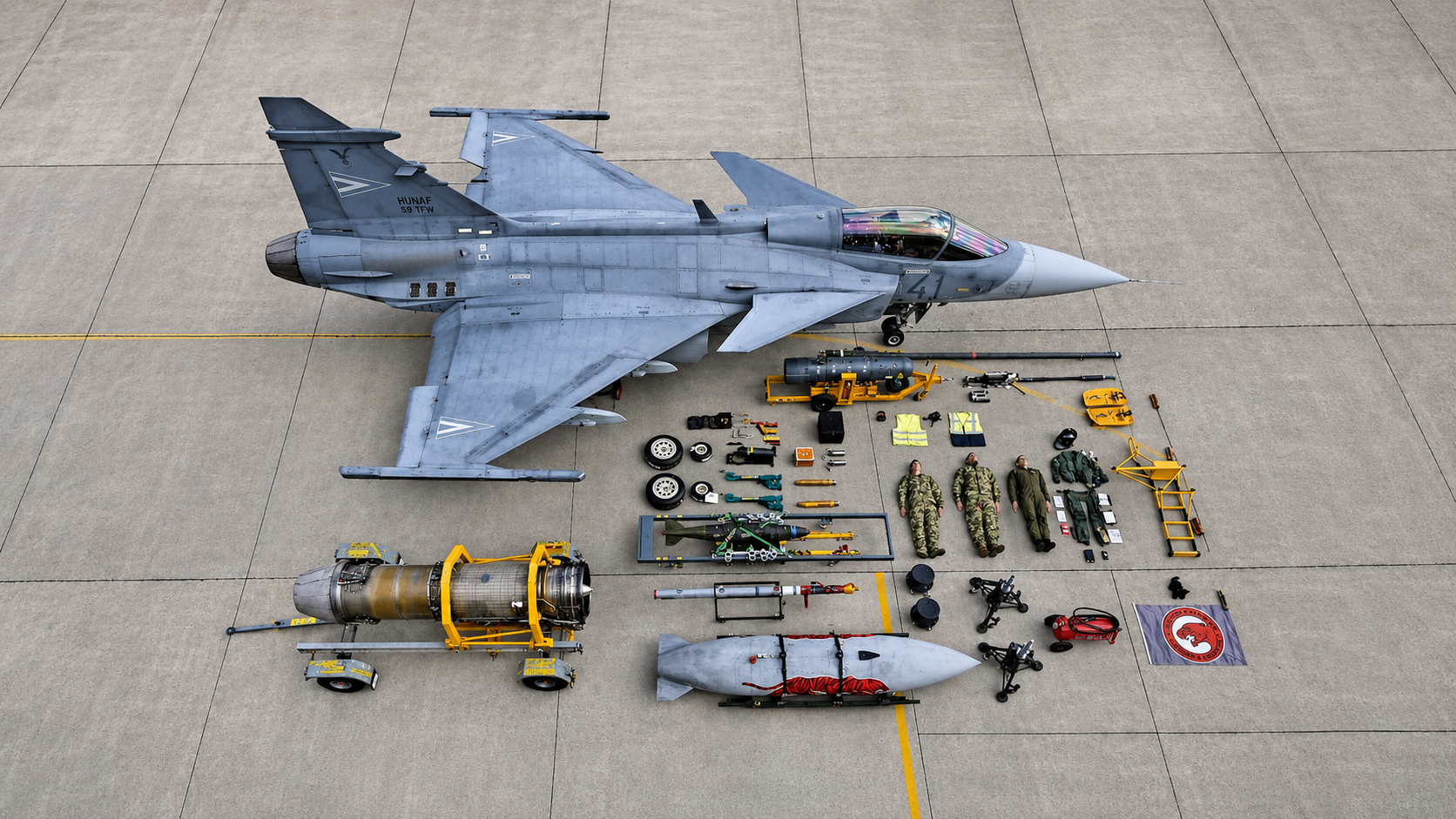
How the Saab JAS 39 Gripen Became One of the World’s Most Flexible and Cost-Efficient Fighters
In modern air combat, size does not always decide who wins.
Some fighter jets are famous because they are massive. Some are famous because they are stealthy. Some dominate headlines because of their price tag, speed, or futuristic appearance.
But the Saab JAS 39 Gripen became famous for a different reason.
It was built to be smart.
You May Also Like

The Gripen is not the biggest fighter in the sky. It is not the most expensive. It is not designed to look intimidating by size alone. Instead, it was created around a very Swedish idea: a fighter jet should be powerful, practical, affordable to operate, easy to maintain, and ready to fight even when large air bases are under threat.
That is what makes the Gripen special.
It is a lightweight, highly versatile multirole fighter that can perform air defense, interception, ground attack, maritime strike, reconnaissance, and electronic warfare support. It can carry modern missiles, precision bombs, anti-ship weapons, sensor pods, and targeting systems depending on the mission.
In simple words, the Gripen is not built to do only one job.
It is built to adapt.
And in today’s dangerous world, adaptability may be one of the most important weapons any fighter can have.
A Fighter Designed for Real-World War
The Gripen was not designed only for beautiful airshow performances.
It was designed for survival.
Sweden developed the Gripen with a clear understanding that in a major conflict, big air bases could become early targets. Runways might be damaged. Hangars might be attacked. Fuel systems could be destroyed. Command centers could be disrupted.
So Sweden built a fighter that could keep fighting even when the normal system breaks down.
The Gripen can operate from short runways and road bases. It can be refueled and rearmed quickly. It does not need a huge maintenance army around it to remain useful. Its design philosophy is based on speed, simplicity, and readiness.
That is why many aviation observers respect the Gripen.
It is not just a jet.
It is a complete combat concept.
Instead of depending only on large protected air bases, the Gripen can be dispersed across smaller locations. Instead of waiting hours for turnaround, it was designed for fast rearming and refueling. Instead of being locked into one mission, it can change roles depending on what the situation demands.
This is why the Gripen is often called a practical fighter for modern nations.
It gives air forces power without demanding the same level of cost and infrastructure required by some larger fighters.
The Meaning of “JAS”: One Jet, Three Missions
The name JAS 39 Gripen tells you exactly what the aircraft was built to do.
In Swedish, “JAS” stands for:
Jakt — fighter or air-to-air combat
Attack — strike or air-to-ground mission
Spaning — reconnaissance
That means the Gripen was designed from the beginning as a multirole aircraft.
It can intercept enemy aircraft.
It can attack ground targets.
It can perform surveillance and reconnaissance.
It can defend airspace.
It can support naval operations.
It can carry weapons from different suppliers.
It can be upgraded as threats change.
That flexibility is one of its greatest strengths.
A smaller country may not be able to afford separate aircraft for air superiority, bombing, reconnaissance, and maritime strike. The Gripen gives operators a single platform that can cover many missions.
In modern warfare, where budgets are tight and threats are unpredictable, this matters.
The Gripen is not only about raw power.
It is about giving commanders options.
The Gripen’s Weapon Load: Small Jet, Serious Punch
At first glance, the Gripen may look smaller than many other modern fighters.
But do not confuse small size with weakness.
The Gripen can carry a wide variety of weapons depending on the variant and mission. Earlier Gripen C/D models are known for having eight hardpoints, while the newer Gripen E has ten. These hardpoints allow the aircraft to carry air-to-air missiles, air-to-ground weapons, anti-ship missiles, fuel tanks, electronic warfare equipment, targeting pods, and reconnaissance pods.
This is where the Gripen becomes dangerous.
It can be configured for different missions very quickly.
For air defense, it can carry beyond-visual-range missiles and short-range dogfight missiles. For strike missions, it can carry laser-guided bombs, precision weapons, and stand-off missiles. For naval warfare, it can carry anti-ship missiles. For reconnaissance, it can carry advanced sensor pods.
This means one Gripen squadron can perform several different types of missions without needing several different types of aircraft.
That is a major advantage for countries that need flexibility.
The Internal Cannon: The Gripen’s Close-Range Bite
The single-seat Gripen variants can carry the 27 mm Mauser BK-27 revolver cannon.
In an era of long-range missiles and advanced radar, some people may think a cannon is old-fashioned. But fighter pilots and aircraft designers still understand its value.
Missiles are powerful, but they are limited. They can miss. They can be jammed. They can run out. Rules of engagement may sometimes require visual identification before firing. In close combat, a cannon can still matter.
The BK-27 gives the Gripen a close-range weapon for air combat and certain ground-attack situations.
It is not the main weapon of the aircraft, but it remains part of the fighter’s combat identity. It gives the Gripen another layer of flexibility when the fight becomes close and fast.
Two-seat variants, such as the Gripen D and Gripen F, are generally focused on training, conversion, and specialized mission roles, so they do not carry the same internal cannon setup as the single-seat versions.
That detail shows something important about the Gripen family: every version has a purpose.
Air-to-Air Combat: Built to See First and Strike First
In modern aerial warfare, the most dangerous fight may happen before pilots can even see each other.
This is called beyond-visual-range combat.
The Gripen was built for this kind of fight.
Depending on the variant and customer configuration, the Gripen can carry advanced BVR missiles such as the MBDA Meteor and the AIM-120 AMRAAM. These weapons allow the aircraft to engage enemy aircraft at long distances.
The Meteor is especially important to the Gripen’s modern reputation.
It is considered one of the most advanced air-to-air missiles in Western service. Its ramjet-powered design gives it strong energy performance over long ranges, making it extremely dangerous against enemy aircraft that try to escape after being targeted.
For a relatively small fighter like the Gripen, carrying Meteor changes the equation.
It means the Gripen does not need to be the biggest aircraft in the battle to be a serious threat. With the right missile, radar, datalink, and tactics, it can challenge larger and more expensive fighters.
This is one reason many analysts describe the Gripen as a fighter that punches above its weight.
Short-Range Missiles: When the Fight Gets Close
Beyond-visual-range missiles are important, but air combat can still become close and violent.
That is where short-range missiles come in.
The Gripen can carry within-visual-range missiles such as IRIS-T and AIM-9 Sidewinder, depending on the operator and integration package.
These missiles are designed for close-range engagements where speed, maneuverability, pilot awareness, and rapid targeting are critical.
The IRIS-T, in particular, gives the Gripen a modern dogfight weapon with high maneuverability and advanced infrared guidance. When combined with modern helmet-mounted sights and strong situational awareness, short-range missiles make the Gripen dangerous in close combat.
This gives the aircraft a balanced air-to-air capability.
It can fight at long range.
It can fight at close range.
It can defend national airspace, intercept intruders, escort friendly aircraft, and respond quickly to threats.
Air-to-Ground Strike: Precision Over Brute Force
The Gripen is not only an air-defense fighter.
It can also attack ground targets.
Depending on configuration, the Gripen can carry precision-guided bombs, unguided bombs, missiles, and stand-off weapons. Weapons such as laser-guided bombs allow it to strike targets with accuracy while reducing the need for large bomb loads.
This is important because modern warfare is not only about dropping the most bombs.
It is about hitting the right target with the right weapon at the right time.
The Gripen can support ground forces, attack military infrastructure, strike enemy positions, and perform precision missions against selected targets.
Its ability to carry targeting pods helps make this possible. These pods allow pilots to identify, track, and guide weapons onto targets. In modern combat, the aircraft is not just a bomb carrier. It is also a sensor platform.
That is what makes the Gripen effective.
It combines weapons with information.
Maritime Strike: A Serious Threat at Sea
One of the Gripen’s most important roles is maritime strike.
For countries with long coastlines, island territories, or important sea lanes, this matters greatly.
The Gripen can be equipped with anti-ship missiles such as the RBS-15 family. These weapons are designed to attack enemy warships at sea, giving the Gripen a strong naval strike role.
This is especially important for smaller nations that may not have large aircraft carriers or huge fleets.
A fighter like the Gripen can help protect coastlines, threaten hostile naval movements, and support maritime defense.
In a crisis, this gives commanders more options.
Enemy ships cannot only worry about submarines, coastal missile batteries, or surface vessels. They also have to worry about fast fighter aircraft carrying anti-ship weapons.
That makes the Gripen a valuable part of a layered defense system.
Stand-Off Weapons: Hitting Without Getting Too Close
Modern air defenses are becoming more dangerous.
Radar systems are improving. Surface-to-air missiles are getting longer range. Electronic warfare is becoming more complex. This means fighter aircraft may not always be able to fly directly over a target.
That is why stand-off weapons matter.
Stand-off missiles allow aircraft to launch from a safer distance, reducing the risk to the pilot and aircraft. The Gripen can be configured to use stand-off weapons depending on the country, variant, and integration package.
This ability increases the Gripen’s survivability.
It allows the aircraft to strike targets without always entering the most dangerous part of enemy airspace.
In modern war, this is extremely important.
Survival is not only about speed or maneuverability. It is about using sensors, weapons, range, electronic warfare, and tactics together.
The Gripen was built for that kind of flexible combat environment.
Targeting and Reconnaissance Pods: The Eyes of the Fighter
Weapons are only useful if the pilot can find and identify the target.
That is why targeting pods and reconnaissance pods are essential.
The Gripen can carry advanced sensor pods such as LITENING targeting pods or reconnaissance pods depending on operator configuration. These systems help the aircraft detect, identify, track, and attack targets.
A targeting pod can help guide laser-guided bombs. It can give the pilot a clearer view of the battlefield. It can help confirm targets before weapons are released.
A reconnaissance pod can help collect intelligence, monitor enemy movement, and support commanders with valuable battlefield information.
This is where the Gripen’s multirole identity becomes clear.
It is not just a missile truck.
It is a fighter, sensor platform, strike aircraft, and reconnaissance asset in one.
The Gripen E: The Newer, More Powerful Version
The Gripen E is the newest major version of the Gripen family.
It was developed to handle more advanced threats and offer greater capability than earlier models. It has more hardpoints, more internal fuel, improved sensors, stronger electronic warfare systems, and modern avionics.
The Gripen E is designed for countries that need a fighter capable of facing more complex air-defense environments and more advanced enemy aircraft.
It can carry a powerful air-to-air loadout, including multiple Meteor missiles, while still using advanced sensor and electronic warfare systems to support the mission.
This makes the Gripen E especially attractive to nations that want modern fighter capability without the cost and complexity of some heavier platforms.
It is not trying to be the largest fighter in the world.
It is trying to be one of the smartest.
The Gripen F: Two Seats, More Mission Flexibility
The Gripen F is the two-seat version of the Gripen E family.
Two-seat fighters are often used for training, but they can also support complex missions where a second crew member helps manage sensors, weapons, electronic warfare, or mission coordination.
This can be useful in high-pressure environments.
Modern air combat is not simple. Pilots must manage radar, datalinks, communications, weapons, defensive systems, navigation, and threats at the same time. In some missions, having a second crew member can increase workload management and tactical effectiveness.
The Gripen F gives air forces another option.
It keeps the modern Gripen E-series capability while adding the advantages of a two-seat cockpit.
Why Countries Choose the Gripen
Countries do not choose fighter jets only because of performance.
They also consider cost, maintenance, training, infrastructure, political relationships, weapons flexibility, local industry, and long-term support.
This is where the Gripen becomes very competitive.
It is known for lower operating costs compared with many larger fighters. It is designed for easier maintenance. It can operate from dispersed bases. It can integrate weapons from different suppliers. It offers modern performance without forcing every customer into the same expensive model.
For many air forces, this matters.
A fighter jet that is too expensive to fly regularly becomes a problem. A fighter that cannot be maintained easily becomes less useful. A fighter that requires huge infrastructure may not fit a country’s defense strategy.
The Gripen’s strength is that it tries to balance capability with practicality.
It is a fighter built not only for combat, but also for real-world budgets.
Thailand and the Gripen: A Regional Example
Thailand is one of the countries that has operated Gripen fighters, and the Royal Thai Air Force has continued to show interest in the platform.
The Gripen is especially relevant in Southeast Asia because the region has complex airspace, maritime security concerns, and a need for flexible defense systems.
For a country like Thailand, a fighter such as the Gripen can support air defense, maritime awareness, quick reaction alert missions, and networked operations with other systems.
The Gripen’s ability to work with airborne surveillance aircraft and datalink networks gives it more value than just the aircraft itself.
That is an important point.
Modern air power is not only about one jet flying alone.
It is about networks.
A fighter connected to radar, airborne early warning aircraft, ground command systems, and other assets becomes much more dangerous than a fighter operating by itself.
Networked Warfare: The Gripen’s Hidden Strength
One of the Gripen’s most important advantages is its focus on information.
In modern combat, the pilot who has better information often has the advantage. Knowing where the enemy is, where friendly forces are, which threats are active, and which weapon is best for the situation can decide the fight before a missile is launched.
The Gripen was designed with networked warfare in mind.
It can share data, receive information, and operate as part of a larger defense system. This gives pilots better situational awareness and helps commanders use the aircraft more effectively.
That is why the Gripen should not be judged only by size or engine power.
Its real strength comes from how it connects sensors, weapons, pilots, and command systems.
In simple words, the Gripen is dangerous because it helps pilots make faster and smarter decisions.
Fast Turnaround: Back in the Fight Quickly
A fighter aircraft is only useful when it can fly.
During a conflict, air forces must launch, recover, refuel, rearm, repair, and launch again. If an aircraft takes too long to prepare between missions, its value is reduced.
The Gripen was designed for quick turnaround.
This means it can return from a mission, be serviced rapidly, and go back into the air. That feature fits Sweden’s defense strategy, where aircraft may need to operate from dispersed bases or road runways during wartime.
Quick turnaround is not as glamorous as missile range or top speed, but it is extremely important.
Wars are not won only by the aircraft that looks best on paper.
They are won by aircraft that can keep flying.
The Gripen was built with that reality in mind.
Road Base Operations: Sweden’s Unique Fighter Philosophy
One of the Gripen’s most famous features is its ability to operate from road bases.
This comes from Sweden’s Cold War defense planning. Sweden understood that in a major war, large air bases could be attacked quickly. To survive, fighter aircraft needed to disperse and operate from roads, smaller strips, and hidden locations.
The Gripen was built for this concept.
It can take off and land on shorter runways than many larger fighters. It can be maintained by smaller crews. It can be refueled and rearmed quickly in the field.
This gives the Gripen a special kind of survivability.
Instead of surviving only through stealth or speed, it survives through mobility, dispersion, and readiness.
That is a very different approach from many other fighter programs.
And it is one reason the Gripen remains respected by military professionals.
Not a Stealth Fighter — But Still Hard to Ignore
The Gripen is not a fifth-generation stealth fighter like the F-35.
It does not rely on full stealth shaping as its main survival method. Instead, it uses a mix of speed, electronic warfare, sensor fusion, datalinks, tactics, missile range, and operational flexibility.
This is important because not every country needs or can afford a fifth-generation stealth fleet.
Some countries need a fighter that can defend airspace, operate affordably, carry modern weapons, and remain upgradeable for years.
That is where the Gripen fits.
It is not trying to be the F-35.
It is trying to offer a different solution: a highly capable, flexible, cost-conscious fighter that can stay relevant through smart upgrades and modern weapons.
The Gripen’s Real Power: Flexibility
The Gripen’s greatest strength is not one weapon.
It is not one missile.
It is not one sensor.
Its greatest strength is flexibility.
A Gripen can be configured for air defense in the morning, maritime strike later, and reconnaissance on another mission. It can carry missiles for long-range air combat, bombs for precision attack, or pods for intelligence gathering.
This makes it valuable for countries that need one aircraft to cover many roles.
In a world where threats change quickly, that flexibility is powerful.
A fighter that can adapt is harder to make obsolete.
A fighter that can accept new weapons and systems remains useful longer.
A fighter that can operate from roads and smaller bases remains dangerous even when the enemy tries to destroy its infrastructure.
That is the Gripen’s secret.
It is not just a fighter.
It is a flexible combat system.
Why the Gripen Punches Above Its Weight
The phrase “punches above its weight” is often used for the Gripen because it captures the aircraft’s identity perfectly.
It is smaller than many competitors.
It is usually cheaper to operate than many heavy fighters.
It is not marketed as a stealth super jet.
It does not depend on brute force alone.
But with the right missiles, sensors, datalinks, tactics, and support systems, it becomes a very serious combat aircraft.
It can threaten larger fighters with long-range missiles.
It can defend airspace with speed and readiness.
It can attack ships with anti-ship missiles.
It can support ground forces with precision weapons.
It can collect intelligence with reconnaissance pods.
It can survive by dispersing across road bases.
That is why the Gripen has gained loyal supporters around the world.
It proves that smart design can matter as much as size.
The Fighter Built for Nations That Think Strategically
The Gripen is especially attractive for nations that think carefully about defense strategy.
A country does not only need powerful aircraft. It needs aircraft that fit its geography, budget, threat environment, maintenance capacity, and political partnerships.
For a small or medium-sized country, buying the most expensive fighter may not always be the smartest choice.
The better question is:
Can the aircraft fly often?
Can it be maintained locally?
Can pilots train regularly?
Can it operate if main bases are attacked?
Can it carry modern weapons?
Can it connect with national defense systems?
Can it be upgraded over time?
The Gripen was designed to answer many of those questions with yes.
That is why it remains one of the most interesting fighters in the world.
Final Thought: The Small Fighter With a Big Message
The Saab JAS 39 Gripen is not famous because it is the largest fighter jet in the sky.
It is famous because it proves that modern air power is not only about size.
It is about readiness.
It is about flexibility.
It is about smart weapons.
It is about networked information.
It is about quick maintenance.
It is about survival when air bases are under attack.
It is about giving pilots the tools to act faster than the enemy.
The Gripen is a fighter built for real-world combat, real-world budgets, and real-world pressure.
It may be lightweight, but it is not weak.
It may be smaller than many rivals, but it carries serious weapons.
It may not be a stealth fighter, but it is smart, adaptable, and dangerous.
That is why the Gripen has earned its reputation as one of the most practical and capable multirole fighters in the world.
In the end, the Gripen’s message is simple:
You do not need to be the biggest fighter in the sky to become one of the hardest to defeat.