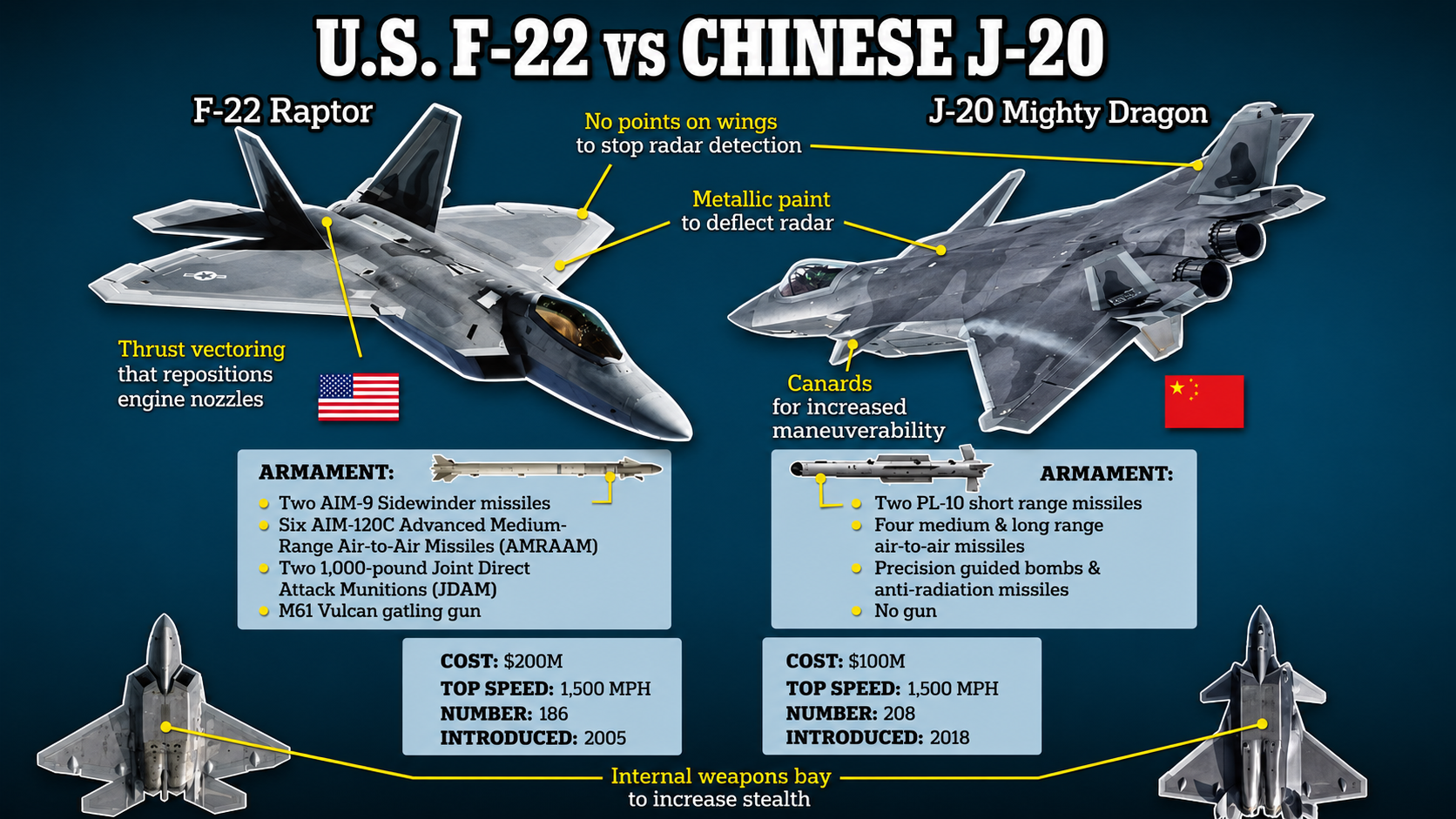
In the world of modern air combat, few comparisons are more intense than the American F-22 Raptor and China’s J-20 Mighty Dragon.
One is widely regarded as the most dominant air-superiority fighter ever built. The other represents China’s dramatic rise from a country that once depended heavily on foreign aircraft designs to a power now fielding hundreds of advanced stealth fighters.
But the real story is not just about speed, range, or price. It is about something much bigger.
It is about America’s pursuit of perfection versus China’s pursuit of scale.
You May Also Like
It is about quality versus quantity.
It is about innovation versus imitation.
And it is about how the balance of air power in the Pacific is changing faster than many people expected.
The F-22 Raptor: America’s Untouchable Predator
The F-22 Raptor entered U.S. Air Force service in 2005 and quickly became a symbol of American air dominance. It was not designed to be “just another fighter.” It was designed to enter hostile skies, detect the enemy first, strike first, and leave before the enemy even understood what happened.
The Raptor combined stealth, speed, agility, advanced sensors, and supercruise capability into one terrifying machine. Its mission was simple: dominate the sky.
Unlike many fighters that need afterburners to maintain supersonic speed, the F-22 can cruise at supersonic speed without burning fuel at an extreme rate. This gives it a major advantage in combat because it can move fast, conserve energy, and control the battle before an opponent can react.
The aircraft’s agility is also legendary. Thanks to thrust-vectoring engines, the F-22 can perform extreme maneuvers that most fighters cannot match. In close-range dogfights, this matters. In beyond-visual-range combat, its stealth and sensors matter even more.
But the F-22 also came with a major problem: cost.
The aircraft was extremely expensive to develop, build, operate, and maintain. The U.S. Air Force originally wanted far more Raptors, but production ended after only 187 operational aircraft were built. Today, the total inventory is even smaller when training, testing, maintenance, and availability are considered.
That limited number is the F-22’s greatest weakness.
It may be the most dangerous fighter in the sky, but there are not many of them.
The J-20 Mighty Dragon: China’s Long-Range Stealth Challenger
China’s J-20 Mighty Dragon officially entered service in 2017. Its arrival shocked many observers because China had reached operational stealth fighter status much faster than expected.
The J-20 is a large twin-engine stealth fighter designed for long-range missions. Unlike the F-22, which was built primarily around air superiority and extreme agility, the J-20 appears to be designed around reach, missile carriage, and regional power projection.
Its estimated range of around 3,400 km gives it an advantage over the F-22’s roughly 3,000 km range. That extra range matters, especially in the vast distances of the Pacific region.
The J-20 does not need to be the most agile fighter in the world to be dangerous. Its role may be different. It can threaten tankers, surveillance aircraft, command-and-control planes, and other high-value assets that support U.S. and allied air operations.
In other words, the J-20 may not be designed to fight like the F-22. It may be designed to change the battlefield before the F-22 even arrives.
That is what makes it serious.
The Copycat Controversy: Did China Copy U.S. Stealth Technology?
One of the most controversial parts of the J-20 story is the accusation that China benefited from stolen U.S. military technology.
For years, U.S. officials and defense analysts have raised concerns that Chinese cyber espionage targeted American defense programs, including stealth aircraft programs such as the F-22 and F-35. Reports have claimed that hackers stole large amounts of design and electronics data related to advanced U.S. aircraft.
China has denied many of these accusations, calling them groundless. But the controversy has not disappeared.
The J-20’s rapid development, combined with visible design similarities to Western stealth aircraft, has fueled the debate. Some analysts point to the aircraft’s nose design, shaping, stealth features, and general configuration as signs that China may have learned from American technology.
However, it is important to be fair: the J-20 is not a direct copy of the F-22.
The aircraft is larger. It uses canards. It appears optimized for longer-range missions. Its design philosophy is different. It is not simply an F-22 painted in Chinese colors.
But the bigger question is not whether China copied every part. The bigger question is whether stolen or studied foreign technology helped China shorten the development timeline.
That is where the concern becomes serious.
If a country can steal, study, adapt, and mass-produce technology that took another country decades and billions of dollars to develop, the battlefield changes. Innovation still matters, but speed and scale begin to matter just as much.
That is exactly the challenge the United States now faces.
Agility vs Range: Two Different Combat Philosophies
The F-22 and J-20 reflect two different ways of thinking about air combat.
The F-22 is built like a predator. It is fast, stealthy, agile, and deadly in air-to-air combat. It was designed to kill enemy aircraft and survive in the most dangerous airspace on earth.
The J-20 is built more like a long-range hunter. It is large, stealthy from key angles, and able to carry long-range missiles. Its goal may be to push enemy aircraft, tankers, and radar planes farther away from the battlefield.
This difference matters because modern air combat is not always about dramatic dogfights. It is often about who sees first, who shoots first, who has more missiles, who has better support aircraft, and who can operate closer to the fight.
The F-22 likely remains superior in close-range maneuverability and mature stealth performance. But the J-20’s range and growing numbers create a different kind of danger.
A small number of elite aircraft can dominate a limited fight. But a large number of capable stealth fighters can stretch an enemy’s defenses across an entire region.
That is China’s strategy.
Production Scale: America Stopped, China Accelerated
This may be the biggest difference between the two aircraft.
The United States stopped building the F-22 years ago. The production line is closed. Only 187 were built. Restarting production would be extremely difficult and expensive.
China, however, continues to build the J-20.
Open-source estimates suggest the J-20 fleet has already passed 200 aircraft and may continue expanding quickly. That means China is not just trying to build a symbolic stealth fighter. It is building a real stealth force.
This is where the comparison becomes uncomfortable for the United States.
The F-22 may be better aircraft-for-aircraft. But the J-20 may become more available in greater numbers.
In a real conflict, numbers matter. Aircraft need maintenance. Pilots need rest. Bases can be attacked. Some jets will be unavailable. A fleet of 187 does not mean 187 are ready to fight at the same time.
China understands this.
Instead of building the perfect fighter in small numbers, it appears to be building a capable fighter in growing numbers. That approach may not win every one-on-one comparison, but it can create pressure across a massive theater like the Indo-Pacific.
Cost: The Price of Perfection
The F-22’s unit cost is often listed around $150 million, depending on how the cost is calculated. Some estimates go much higher when research, development, and lifetime sustainment costs are included.
The J-20 is often estimated around $120 million per aircraft, though exact costs remain difficult to confirm because China does not release the same level of public budget detail as the United States.
Still, the general point is clear: the F-22 was a high-cost, high-performance aircraft produced in limited numbers. The J-20 appears to be a lower-cost stealth fighter produced at a growing pace.
That does not automatically make the J-20 better. But it does make it strategically important.
War is not only about who has the best machine. It is also about who can build enough machines, maintain them, replace losses, and keep pressure on the enemy.
The F-22 represents technological excellence.
The J-20 represents industrial momentum.
The Real Question: Who Wins in a Fight?
Many people want a simple answer: F-22 or J-20, who wins?
The honest answer is: it depends.
In a one-on-one fight, the F-22 likely has major advantages in agility, stealth maturity, pilot training, and combat systems. It was built from the beginning to be the ultimate air-superiority fighter.
But modern air combat is rarely one-on-one.
The J-20 would likely operate with Chinese radar networks, long-range missiles, electronic warfare, ground-based air defenses, and other aircraft. The F-22 would operate with U.S. and allied support systems, tankers, AWACS aircraft, satellites, and other fighters.
The real battle would not be F-22 versus J-20 alone.
It would be system versus system.
America’s advantage is experience, training, combat integration, stealth maturity, and advanced doctrine.
China’s advantage is geography, production speed, missile range, and growing numbers close to its own region.
That makes the J-20 dangerous even if it is not equal to the F-22 in every category.
Why the F-22 Still Matters
Even though production ended, the F-22 remains one of the most feared aircraft in the world.
Its combination of stealth, speed, sensor fusion, and maneuverability makes it a nightmare for enemy pilots. It can penetrate contested airspace, hunt enemy fighters, and protect other aircraft.
The Raptor also sends a political message. When the United States deploys F-22s to a region, the message is clear: American airpower is present, ready, and serious.
But time is moving.
The F-22 is aging. Its numbers are limited. Its replacement will come through next-generation programs, but those will take time, money, and political will.
Meanwhile, China is not waiting.
Why the J-20 Should Not Be Underestimated
The biggest mistake would be to dismiss the J-20 as merely a “copycat jet.”
Even if China benefited from stolen technology or foreign design lessons, the J-20 is now a real aircraft in real service with real strategic impact.
It gives China something it did not have before: a stealth fighter fleet capable of challenging U.S. and allied operations in the Pacific.
It may not be as refined as the F-22. It may not match the Raptor in close combat. It may still face challenges with engines, stealth coatings, sensors, or pilot experience.
But China is improving quickly.
And when a country can produce more aircraft, test more aircraft, train more pilots, and upgrade its designs year after year, the gap can close.
That is why the J-20 matters.
Final Verdict: America Built the Legend, China Built the Warning
The F-22 Raptor remains one of the greatest fighter aircraft ever created. It is a masterpiece of American engineering and a symbol of air dominance.
But the J-20 Mighty Dragon is a warning.
It shows that China has learned, adapted, and scaled its military aviation industry faster than many expected. Whether through innovation, imitation, cyber espionage, or a combination of all three, China has built a stealth fighter force that cannot be ignored.
The F-22 is still the sharper blade.
But the J-20 is becoming the larger storm.
And in the next air war, victory may not belong only to the aircraft with the best performance on paper. It may belong to the nation that can combine technology, numbers, production, training, and strategy into one overwhelming force.
The sky is no longer owned by one power alone.
The battle for air dominance has entered a new era.