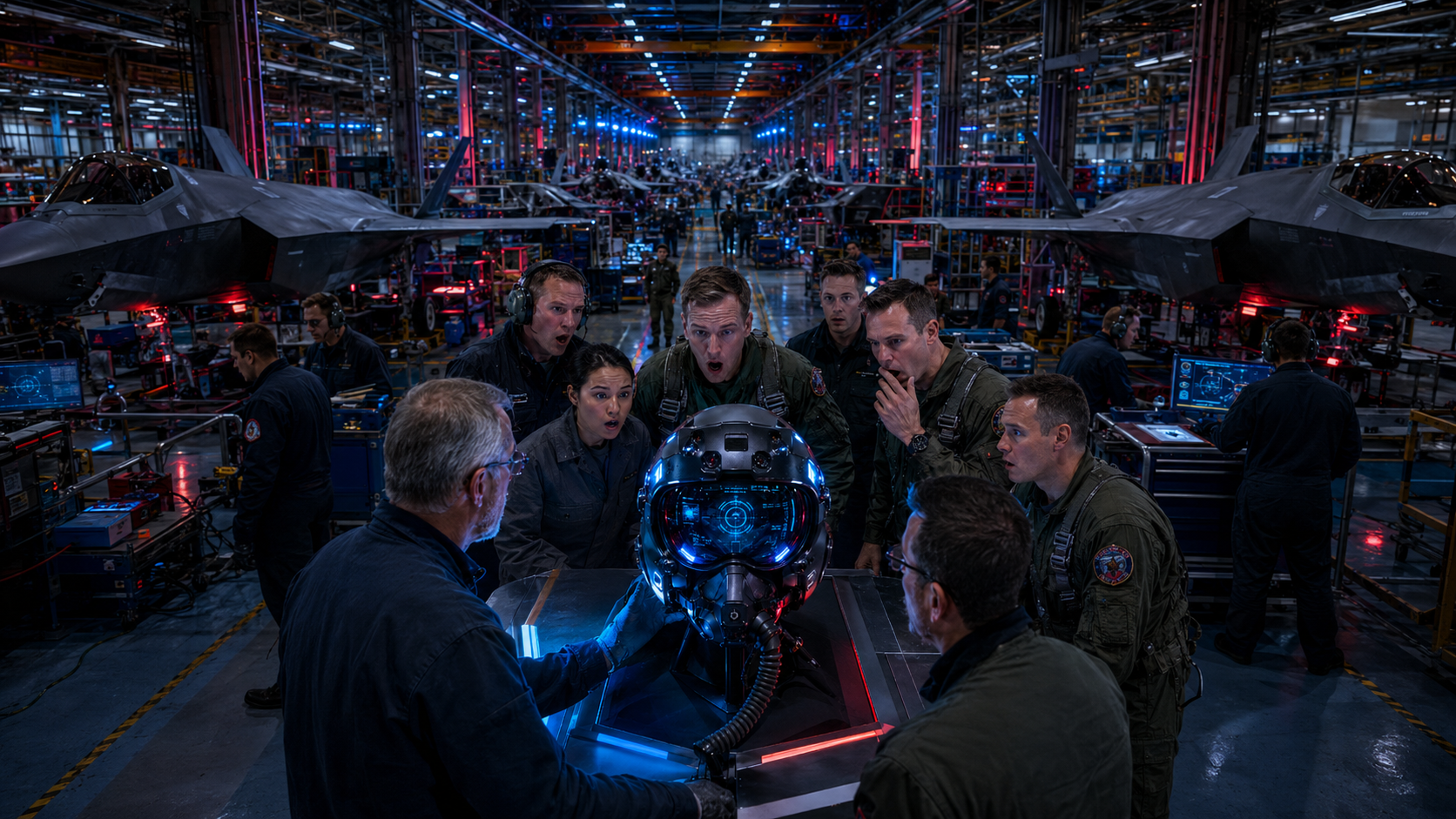
The helmet sealed around his head like a judgment. Cold pressure hugged his temples. The visor glowed faintly, filling his eyes with symbols, numbers, thermal lines, and ghostly outlines from the aircraft’s hidden cameras. Around him, the hangar at Blackridge Special Air Force Base disappeared and returned at the same time.
He could see forward.
He could see left.
He could see right.
You May Also Like
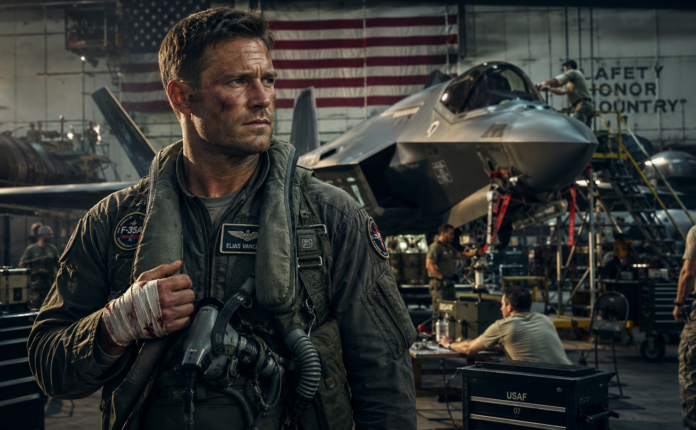
Then the system stitched the images together and gave him what pilots called the impossible view.
A virtual 360-degree world.
The $400,000 Helmet-Mounted Display System was custom-fitted to one pilot. Built by brilliant engineers, shaped with terrifying precision, and designed to turn the pilot into part of the jet itself. It streamed real-time imagery from the F-35’s cameras directly to the eyes, letting a pilot look through the aircraft as if the metal skin had become transparent.
But JakeSon was not inside an aircraft.
He was standing in a locked test hangar.
And the voice he had just heard belonged to Captain Elias Mercer, a pilot who had died three months earlier.
JakeSon ripped the helmet off.
His breath came hard. Sweat rolled down the back of his neck. The hangar lights buzzed overhead. Somewhere outside, thunder rolled across the desert.
Colonel Rusk stared at him from behind the observation glass.
“What happened?” Rusk asked through the speaker.
JakeSon swallowed.
“Nothing.”
Lieutenant Kara Vance, the systems engineer assigned to him, stepped closer.
“JakeSon,” she said quietly, “your heart rate just jumped to one hundred seventy.”
“I said nothing happened.”
Across the hangar, Major Drake Fallon laughed under his breath.
“Of course nothing happened,” Fallon said. “The man panicked before the jet even started.”
JakeSon turned toward him.
Fallon stood tall, clean, polished, confident. His flight suit looked untouched by dust, fear, or failure. A silver watch gleamed on his wrist. His smile was the kind of smile that had never been denied anything.
“Say that again,” JakeSon said.
Fallon stepped forward.
“You heard me. Or maybe you didn’t. Maybe that old concussion messed with your hearing too.”
The room went silent.
Kara’s eyes flicked toward JakeSon.
“Drake,” she warned.
Fallon lifted both hands.
“What? We’re all thinking it. Blackridge is not a rehab center. We are testing the most advanced fighter interface in the world. We don’t need a charity case shaking inside a helmet.”
JakeSon’s hands curled into fists. His left hand trembled first. It always did when he was angry. He hated that. He shoved it behind his back.
Colonel Rusk’s voice cut through the speaker.
“Enough.”
Fallon looked up at the glass.
“With respect, sir, why is he even here?”
Rusk did not answer immediately.
JakeSon looked at the floor.
Because the same question had been eating him alive for months.
Before the accident, he had been one of the best test pilots at Blackridge. Not the loudest. Not the most decorated. But calm. Precise. Reliable. The kind of man who could land on instruments during a sandstorm while younger pilots cursed and prayed over the radio.
Then came the crash.
A training F-35 went down near Dry Valley. JakeSon survived, but the blast slammed his head against the canopy frame. Doctors called it trauma. Command called it recovery. Fallon called it weakness.
Since then, JakeSon had suffered migraines, shaking hands, and bursts of noise inside his mind that came without warning. He remembered fire. He remembered Elias Mercer screaming over comms. Then nothing.
Elias had not survived.
And JakeSon had spent three months wondering why he had.
Kara touched his arm.
“Take five,” she said.
“I’m fine.”
“You’re lying.”
He looked at her.
She didn’t smile. Kara never smiled when something mattered.
“You heard something, didn’t you?” she whispered.
JakeSon looked toward the observation glass. Rusk was still watching.
“No.”
Kara lowered her voice.
“JakeSon, I built part of that interface. Helmets don’t scare men unless they show them something.”
He looked at the helmet sitting on the metal stand. Its black visor reflected him like a stranger.
“It didn’t show me something,” he said.
Kara waited.
“It spoke.”
Her face changed.
“What did it say?”
JakeSon’s throat tightened.
“Don’t trust the tower.”
Kara went pale.
Before she could respond, the hangar doors rumbled.
Two military police officers entered with clipped steps.
Colonel Rusk’s voice came again.
“JakeSon Walker, step away from the helmet.”
JakeSon turned slowly.
“What is this?”
Rusk appeared from the side entrance now, no longer behind glass. His face was hard, but his eyes looked tired.
“You are temporarily removed from Project Glassfire.”
Fallon’s smile widened.
JakeSon stared at Rusk.
“Because my heart rate spiked?”
“Because the system recorded an unauthorized audio anomaly during your test.”
Kara stepped forward.
“Sir, anomalies are why we test.”
Rusk ignored her.
JakeSon’s voice dropped.
“You heard it too.”
No one answered.
Fallon crossed his arms.
“Maybe the broken pilot is hearing ghosts.”
JakeSon looked at him.
“Maybe the ghost is trying to warn us.”
Fallon’s smile disappeared.
For one second, only one, JakeSon saw something behind Fallon’s eyes.
Fear.
Then it was gone.
The officers moved toward JakeSon.
Kara stepped between them.
“Colonel, you cannot remove him without reviewing the raw feed.”
Rusk looked at her.
“The raw feed has already been classified.”
“It happened thirty seconds ago.”
“It is classified.”
Kara’s jaw tightened.
JakeSon felt the room tilting. Not from injury. From suspicion.
“Who classified it?” he asked.
Rusk did not answer fast enough.
JakeSon looked past him toward the control booth.
“The tower?”
Rusk’s silence answered.
That night, JakeSon sat alone in the barracks, staring at his shaking hand.
Rain tapped the window. Wind pushed dust against the glass. Every sound felt too sharp. He pressed his palm against his knee until the tremor stopped.
His phone buzzed.
Unknown number.
He opened it.
A message appeared.
Mercer didn’t crash. He was erased.
JakeSon stood so fast the chair fell backward.
Another message came.
Hangar 7. Midnight. Come alone.
He typed back.
Who is this?
The reply came instantly.
Someone who wants to live.
“Get in the Cockpit, Janitor,” the Captain Laughed—Then Mina Ran the F-16 Checklist Like a Ghost from the Past”
At 11:58 p.m., JakeSon crossed the base under a sky split by distant lightning. Blackridge looked different at night. The proud aircraft silhouettes became sleeping predators. Red lights blinked on communication towers. Security trucks moved slowly along the fences.
Hangar 7 had been sealed after Mercer’s death.
JakeSon found the side door unlocked.
Inside, the air smelled of dust, old fuel, and burnt insulation.
“Hello?” he called.
A voice answered from the dark.
“You came.”
Kara stepped into the thin light, holding a laptop against her chest.
JakeSon exhaled.
“You scared me.”
“I scared you? You’re the one walking into a dead pilot’s hangar at midnight.”
“You sent the message?”
“Yes.”
“Mercer didn’t crash?”
Kara looked toward the covered shape in the center of the hangar.
“No.”
JakeSon followed her gaze.
Under a gray tarp sat wreckage. Not a full aircraft. Pieces. Panels. Sensor housings. A section of cockpit frame. Burned carbon fiber.
His stomach tightened.
“That’s Elias’s jet.”
“What was left of it,” Kara said.
JakeSon approached slowly.
“I was told the wreckage was transferred to Nevada.”
“It was supposed to be.”
He looked at her.
“Why is it still here?”
“Because someone needed time to remove something.”
Kara opened the laptop. Lines of data filled the screen.
“After you heard the voice today, I pulled an old backup from the helmet integration logs. Mercer’s helmet recorded his last flight.”
JakeSon frowned.
“They told us the helmet memory was destroyed.”
“They lied.”
She pressed play.
Static cracked from the laptop speakers.
Then Mercer’s voice filled the hangar.
“Tower, this is Glassfire Two. I’m getting false terrain mapping. Repeat, false terrain mapping.”
Another voice replied, calm and official.
“Glassfire Two, maintain heading.”
JakeSon leaned closer.
Mercer sounded tense.
“Negative. My HMDS is showing a ridge at twelve o’clock, but visual says open air. My feed is compromised.”
The tower voice responded.
“Glassfire Two, you are disoriented. Trust instruments.”
Mercer cursed under his breath.
“JakeSon, do you see this?”
JakeSon’s knees weakened.
His own voice came through next, younger by only three months but sounding like another life.
“Elias, I see your drift. Pull east.”
Mercer shouted, “Tower is overriding my display!”
The audio dissolved into alarms.
Then Mercer screamed.
Then silence.
JakeSon stepped back, breathing hard.
Kara closed the laptop slightly.
“JakeSon?”
He pressed both hands against his head.
“I don’t remember that.”
“You were hit by the blast.”
“No. I don’t remember telling him to pull east.”
Kara’s eyes softened.
“Your flight recorder was damaged.”
JakeSon shook his head.
“No. They told me I gave him the wrong correction. They told me I sent him into the ridge.”
Kara stared at him.
“Who told you that?”
JakeSon looked toward the hangar door.
“Fallon.”
A metallic sound echoed behind them.
Both turned.
Major Fallon stood near the entrance with two security officers.
“Well,” Fallon said, “that is unfortunate.”
Kara snapped the laptop shut.
Fallon tilted his head.
“Did you really think classified data could be copied without triggering an alert?”
JakeSon stepped in front of Kara.
“What did you do to Mercer?”
Fallon laughed, but his face had gone cold.
“You still don’t get it, do you? Mercer found the flaw. You survived the flaw. That made both of you dangerous.”
Kara’s voice shook.
“What flaw?”
Fallon looked at the covered wreckage.
“Not a flaw. A feature.”
JakeSon’s blood turned cold.
Fallon stepped closer.
“The HMDS sees everything. Every angle. Every heat signature. Every hidden aircraft. Every movement around the jet. Beautiful technology. But imagine if someone could feed it a lie.”
Kara whispered, “Synthetic imagery.”
Fallon smiled.
“Exactly.”
JakeSon’s voice was low.
“You hacked the helmet.”
“I tested battlefield deception.”
“You killed him.”
Fallon’s jaw clenched.
“Mercer refused to cooperate.”
“And me?”
“You were supposed to die beside him.”
The words hit JakeSon harder than any explosion.
Kara took a step back.
Fallon looked at JakeSon’s trembling hand.
“But you lived. Weak. Confused. Easy to discredit.”
JakeSon stared at him.
“You let me believe I killed my friend.”
Fallon’s face hardened.
“You were useful broken.”
Something in JakeSon cracked. Not loudly. Not like rage. More like a chain breaking underwater.
He moved before the officers expected it.
He grabbed Kara’s wrist.
“Run.”
They sprinted between aircraft parts as Fallon shouted behind them.
“Stop them!”
A shot cracked into the hangar wall.
Kara gasped.
JakeSon shoved her behind a stack of crates.
“This way!”
They burst through a maintenance corridor and out into the rain. Sirens wailed across the base. Floodlights snapped on one by one.
Kara panted beside him.
“Where do we go?”
JakeSon looked across the runway.
In Hangar 3, under armed guard, sat the F-35 assigned to Project Glassfire.
He looked at Kara.
“You said the helmet recorded Mercer’s last flight.”
“Yes.”
“Can it broadcast?”
Her eyes widened.
“To the command theater, if linked through the jet.”
“Then we show everyone.”
Kara stared at him as rain ran down her face.
“You haven’t flown since the crash.”
“I’m not flying to prove I’m strong.”
“Then why?”
JakeSon looked toward the dark tower.
“I’m flying because Elias died telling the truth.”
They reached Hangar 3 through a drainage tunnel half-filled with cold water. JakeSon’s boots slipped on wet concrete. His head pounded. His vision blurred.
Kara grabbed his arm.
“Your migraine?”
“I’m fine.”
“You keep saying that when you’re not.”
He stopped.
For the first time, he did not hide his shaking hand.
“I’m terrified,” he said.
Kara’s expression softened.
“Good.”
He almost laughed.
“Good?”
“Fear means you understand what matters.”
A guard passed outside the tunnel.
Kara waited until his footsteps faded.
“JakeSon, listen to me. Your weakness was never the tremor. It was believing their version of you.”
He looked at her.
“They made me feel like surviving was shameful.”
“You survived because someone had to finish the truth.”
The words settled deep in him.
They entered Hangar 3 through a service hatch. The F-35 stood in the center like a dark blade. Rainwater glittered on its gray skin. Its canopy reflected the emergency lights flashing outside.
Kara climbed the access ladder and opened the cockpit.
JakeSon stared at the aircraft.
For months, he had dreamed of fire. Of Elias screaming. Of Fallon’s voice saying, “You gave the wrong call.” Of his own hands shaking so badly he could not hold a cup.
Now the jet waited like a question.
Kara looked down.
“JakeSon.”
He climbed.
Inside the cockpit, the familiar smell hit him first: rubber seals, heated electronics, oxygen lines, metal, and memory.
Kara handed him the helmet.
His fingers trembled around it.
Fallon’s voice exploded over the hangar speakers.
“Walker! Step away from the aircraft!”
JakeSon lowered himself into the seat.
Kara connected the data module.
“Helmet link is live,” she said.
“Can you broadcast?”
“I need ninety seconds.”
Outside, boots thundered.
Colonel Rusk’s voice came over the radio.
“JakeSon, do not start that aircraft.”
JakeSon pressed the helmet over his head.
The visor came alive.
The world widened.
He could see the hangar doors in front of him.
He could see the armed men behind the jet.
He could see Fallon running in from the side entrance.
He could see Colonel Rusk standing near a command vehicle, face pale under the rain.
Then the dead pilot’s voice returned.
“Don’t trust the tower.”
JakeSon whispered, “I hear you, Elias.”
Kara’s voice came through the internal channel.
“Data upload in progress.”
Fallon shouted from below.
“Pull him out!”
JakeSon locked the cockpit.
The canopy began to close.
Kara jumped down from the ladder just before it sealed.
Fallon slammed his fist against the aircraft.
“You pathetic coward!”
JakeSon looked down through the helmet’s 360-degree feed. Fallon’s angry face appeared beneath him, distorted by rain.
JakeSon spoke into the radio.
“Major Fallon, why did Mercer say the tower was overriding his display?”
Fallon froze.
Rusk’s voice cut in.
“JakeSon, this channel is open.”
“I know.”
Kara’s broadcast hit the command theater.
Across Blackridge, screens flickered.
In the operations room, officers turned toward the main display as Mercer’s final flight log appeared. The audio played. The tower orders. The false terrain. Mercer’s panic. JakeSon’s real correction.
They Slapped the Wrong Woman in a Bar — She Was the Navy SEAL Legend Nobody Knew…
Then came another file.
Kara had found more than one recording.
Fallon’s voice filled every speaker on the base.
“If Mercer reports the synthetic overlay, terminate the test.”
Another voice asked, “And Walker?”
Fallon answered, “If he survives, we blame him.”
In the cockpit, JakeSon closed his eyes.
The truth had a sound.
It sounded like silence breaking.
Outside, Fallon stumbled back.
“That’s fabricated!” he shouted. “That’s not me!”
Kara stood in the rain, holding up the laptop.
“Digital signature verified.”
Colonel Rusk walked slowly toward Fallon.
His voice shook, not with fear, but with fury.
“Major Fallon, stand down.”
Fallon looked around. The soldiers who had been aiming at JakeSon now aimed at him.
“You don’t understand,” Fallon said. “This was bigger than me. Command wanted results. They wanted invisible war. I gave them what they asked for.”
Rusk’s face tightened.
“You gave them a dead pilot.”
Fallon pointed at the F-35.
“And he gave you weakness! He gave you trauma! I gave you the future!”
JakeSon opened the canopy.
Rain entered the cockpit in cold drops.
He removed the helmet and looked down at Fallon.
“No,” JakeSon said. “You gave the future a lie.”
Fallon’s mouth twisted.
“You think this makes you powerful?”
JakeSon climbed down slowly. His legs shook. His head burned. His hand trembled openly now, visible to everyone.
He stood in front of Fallon.
“For months, I thought power meant never shaking,” JakeSon said. “Never breaking. Never admitting pain.”
Fallon laughed bitterly.
“And now?”
JakeSon stepped closer.
“Now I know power is standing in the truth while you shake.”
Fallon had no answer.
The military police took him by the arms.
As they dragged him away, he shouted, “You’ll never fly again, Walker! They’ll never trust a damaged man in a fifth-generation fighter!”
JakeSon watched him go.
Then Colonel Rusk approached.
For a long moment, neither man spoke.
Rain ran off Rusk’s cap.
Finally, the colonel said, “I failed you.”
JakeSon’s jaw tightened.
“Yes, sir. You did.”
Rusk nodded slowly.
“I believed the report.”
“You believed the easy version.”
Rusk lowered his eyes.
“I did.”
JakeSon looked toward Hangar 7, where the wreckage of Elias Mercer’s aircraft waited in the dark.
“Elias died trying to warn us.”
Rusk’s voice softened.
“And you finished what he started.”
Kara walked over, soaked and exhausted.
“The broadcast reached Pentagon review channels before Fallon’s people could block it,” she said. “The evidence is out.”
JakeSon let out a breath he felt he had been holding for three months.
“What happens now?”
Rusk looked at the aircraft, then back at him.
“Now we clean the rot out of this base.”
Weeks later, Blackridge looked different.
Not because the hangars changed.
Not because the runway was repaved.
Not because Fallon disappeared into a military prison awaiting trial.
It looked different because JakeSon no longer walked through it like a guilty man.
At Elias Mercer’s memorial, the sky was clear. Rows of pilots stood at attention. The wind moved softly across the flags. Elias’s wife, Mara, stood near the front holding the hand of their little boy.
JakeSon approached her after the ceremony.
For a moment, he could not speak.
Mara looked at him with tired eyes.
“I heard the recording,” she said.
JakeSon swallowed.
“I’m sorry I didn’t remember sooner.”
She shook her head.
“You remembered when it mattered.”
Her son looked up at him.
“Were you my dad’s friend?”
JakeSon knelt so they were eye level.
“Yes,” he said. “He was braver than any man I knew.”
The boy looked toward the jets lined along the runway.
“Did he fly high?”
JakeSon’s voice cracked.
“Higher than fear.”
Mara covered her mouth, tears shining in her eyes.
The boy reached out and touched JakeSon’s trembling hand.
“Your hand shakes.”
JakeSon looked at it.
For once, he did not pull away.
“Yes,” he said gently. “Sometimes it does.”
“Are you scared?”
JakeSon smiled, but tears blurred his eyes.
“Sometimes.”
The boy nodded like this made perfect sense.
“My dad said brave people can be scared.”
JakeSon looked up at Mara.
She whispered, “He did say that.”
That evening, JakeSon returned to Hangar 3.
The F-35 waited under soft maintenance lights. Its gray body looked almost peaceful.
Kara stood beside the ladder, holding the helmet.
“They refitted it,” she said.
JakeSon raised an eyebrow.
“For who?”
Kara smiled faintly.
“For you.”
He stared at the helmet.
“I thought I was grounded.”
“You were.”
“And now?”
“Now Colonel Rusk says Project Glassfire needs a pilot who understands what happens when technology forgets humanity.”
JakeSon looked at the helmet’s black visor.
For months, it had represented everything he feared. Pressure. Judgment. The machine that had exposed his weakness.
Now it looked different.
Not like a weapon.
Like a witness.
He took it from Kara.
“What if I’m not ready?”
Kara leaned against the ladder.
“Then say it.”
He looked at her.
“I’m not ready.”
She nodded.
“Good. Honest men can be trained. Liars destroy bases.”
JakeSon laughed softly.
It was the first real laugh he had felt in months.
He climbed into the cockpit.
The canopy stayed open. The aircraft remained silent.
He put on the helmet.
The visor lit up.
The world widened again.
Forward.
Left.
Right.
Behind.
Above.
Below.
All around him.
For a second, he expected the dead voice.
But there was only wind moving through the hangar doors.
Then Kara’s voice came through the channel.
“How does it feel?”
JakeSon looked through the aircraft’s eyes.
He saw the runway stretching into gold sunset.
He saw mechanics working near another jet.
He saw the memorial flag in the distance.
He saw his own reflection in the visor, not whole, not perfect, but present.
“It feels clear,” he said.
Kara’s voice softened.
“That’s a good start.”
JakeSon placed one hand on the controls.
It still trembled.
But now he understood something he wished he had known sooner.
Weakness was not the opposite of power.
Sometimes weakness was the doorway to the truth.
Sometimes the broken man saw what the proud man missed.
Sometimes the one they mocked became the only one brave enough to look through the helmet and face what everyone else was afraid to see.
And on that quiet evening at Blackridge Special Air Force Base, JakeSon Walker did not become powerful because he stopped shaking.
He became powerful because he stopped hiding.
Justice had come.
Elias Mercer’s name was cleared.
A corrupt officer was exposed.
A dangerous secret was pulled out of the dark.
And JakeSon, the pilot they called weak, finally understood why he had survived.
Not to live in shame.
Not to carry another man’s guilt.
But to become the eyes that truth needed.
The helmet had not chosen the strongest man.
It had chosen the honest one.
And that made all the difference.