The Old Veteran Who Returned With the Truth
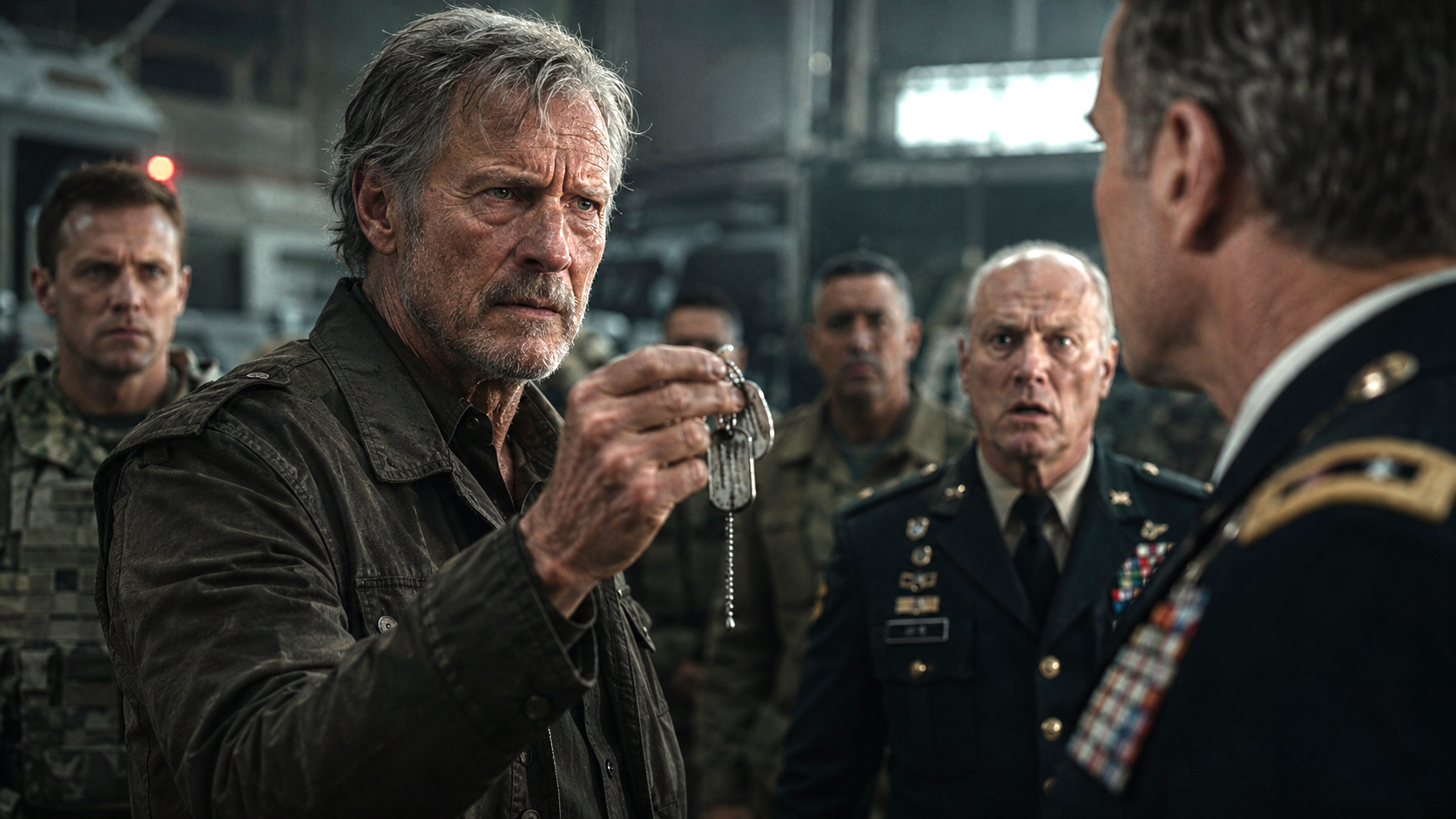
The old veteran did not come to Fort Ashford for revenge.
At least that was what Sergeant Elias Walker told himself when his rusted pickup rolled through the main gate under a pale morning sky.
The military base looked the same and completely different. Same tall flag snapping in the wind. Same smell of diesel, cut grass, gun oil, and morning coffee. Same young soldiers walking fast with clean boots and serious faces.
But everything else had changed.
You May Also Like
Elias had changed.
His back bent when he stepped out of the truck. His left hand trembled when he reached for his cane. His gray hair moved in the wind like smoke. The scars on his neck looked old, pale, and forgotten, but the pain behind his eyes was still alive.
The guard at the gate looked at his invitation.
“Veterans Honor Ceremony,” the young soldier read. “Sergeant Elias Walker?”
Elias nodded.
The soldier looked up. “You served in Operation Iron Valley?”
Elias’s jaw tightened. “A long time ago.”
“My grandfather talked about that mission,” the soldier said. “He said the men who came back were legends.”
Elias gave him a tired smile.
“Not all of us came back as legends, son.”
The soldier did not understand. He saluted anyway.
Elias slowly returned the salute.
For a moment, his hand was steady.
Then he drove inside.
They Laughed at the Poor Mechanic Who Questioned a $400,000 F-35 Helmet—Then the Truth Made the Entire Air Base Go Silent
The ceremony hall stood near the parade ground, decorated with flags, gold ribbons, framed photographs, and polished brass signs. Veterans in dark suits stood around laughing with officers. Families held flowers. News cameras waited near the stage.
Today, the Army was honoring Colonel Marcus Vane.
A decorated war hero.
A respected commander.
A man America believed had saved thirteen soldiers in the mountains of Kandahar thirty years ago.
A man Elias Walker knew as a traitor.
Elias stopped at the entrance when he saw the giant banner across the hall.
HONORING COLONEL MARCUS VANE — COURAGE, SACRIFICE, LEGACY
His fingers tightened around the handle of his cane until his knuckles turned white.
A woman beside him whispered, “Sir, are you all right?”
Elias stared at the banner.
“No,” he said softly. “But I came anyway.”
The woman blinked. “Are you family?”
Elias looked at the smiling portrait of Colonel Vane.
“I was.”
Inside the hall, Marcus Vane stood surrounded by officers, reporters, and admirers. He was still tall, still handsome in the way powerful men remained handsome by believing the world owed them respect. His silver hair was perfectly combed. His dress uniform was covered with ribbons.
And on his chest, near his heart, hung the medal Elias had earned with blood.
Elias felt the old wound open again.
A voice behind him said, “You should not be here.”
Elias turned.
Major Daniel Cross stood with two military police officers behind him. Cross had a square jaw, cold eyes, and the nervous anger of a man protecting someone more powerful than himself.
Elias smiled faintly.
“Major Cross,” he said. “You look like your father.”
Cross stepped closer. “My father died because of your mistake.”
Elias breathed in slowly.
“Your father died because someone sold our route to the enemy.”
Cross’s lips curled. “Careful, old man.”
Elias leaned on his cane. “I stopped being careful after I buried twelve brothers.”
Cross lowered his voice. “This ceremony is not for you.”
“No,” Elias said. “It’s for a lie.”
One of the military police officers shifted uncomfortably.
Cross noticed and snapped, “Stand still.”
Then he turned back to Elias.
“You were cleared to attend as a courtesy. Do not make a scene.”
Elias looked past him toward Colonel Vane, who was laughing for the cameras.
“I made no scene when they stripped my rank.”
Cross frowned.
“I made no scene when they blamed me for the ambush.”
Cross’s expression hardened.
“I made no scene when my wife stopped answering the phone because every newspaper called me a coward.”
Elias’s voice dropped.
“But today, I might.”
The $400,000 F-35 Helmet Rejected Every Pilot Except the Broken Man They Mocked
Cross stepped into his path. “Try it, and I will have you removed.”
Elias looked into the young major’s eyes.
“Your father’s name was Thomas Cross.”
The major froze.
Elias continued, “He carried a picture of you in his helmet. You were six months old. He talked about teaching you how to fish when he got home.”
Cross’s mouth opened slightly.
Elias leaned closer.
“The night he died, he asked me to tell you he was not afraid.”
For the first time, Cross looked less like an officer and more like a son.
Then he swallowed the feeling and buried it.
“My father would be ashamed you used his name.”
Elias nodded slowly.
“Maybe. Or maybe he has been waiting thirty years for someone to speak for him.”
Across the hall, Colonel Marcus Vane finally saw Elias.
His smile disappeared for half a second.
Only half a second.
Then it returned, wider than before.
He walked over with open arms.
“Well,” Vane said loudly, “Sergeant Walker. I never expected to see you here.”
The nearby officers turned. Cameras shifted. People whispered.
Elias did not move.
Vane stopped in front of him and lowered his voice, still smiling.
“You look old.”
Elias looked at the medal on Vane’s chest.
“You look decorated.”
Vane chuckled. “History has a way of rewarding the right men.”
Elias’s eyes lifted. “History is written by the men who survive.”
Vane’s smile thinned. “And sometimes by the men smart enough to stay quiet.”
The two old soldiers stared at each other while the room continued breathing around them.
A young female captain approached. Her name tag read REYES.
“Colonel Vane,” she said, “the press is ready.”
Vane did not look away from Elias.
“Captain, please escort Sergeant Walker to the back row. Somewhere comfortable.”
Elias smiled.
“Get in the Cockpit, Janitor,” the Captain Laughed—Then Mina Ran the F-16 Checklist Like a Ghost from the Past
“The back row. You always did like putting better men behind you.”
Captain Reyes glanced sharply at Elias.
Vane’s jaw tightened.
“Careful,” Vane whispered.
Elias reached into his coat pocket.
Vane’s eyes flickered down.
For the first time that morning, fear touched the colonel’s face.
Elias saw it.
And that small fear fed something dangerous inside him.
The ceremony began with music.
The Army band played. Boots struck the floor. Families stood. Flags were carried down the aisle. Colonel Vane sat on stage beside generals, senators, and commanders.
Elias sat in the last row, just as ordered.
Captain Reyes sat beside him, not because she wanted to, but because Major Cross told her to watch him.
For fifteen minutes, speeches filled the room.
“Honor.”
“Sacrifice.”
“Leadership.”
“Unshakable courage.”
Every word landed on Elias like dirt thrown onto a grave.
Captain Reyes leaned toward him.
“Sergeant Walker,” she whispered, “what happened between you and Colonel Vane?”
Elias kept his eyes on the stage.
“He left men to die.”
Reyes went still.
“That is a serious accusation.”
“He did worse than leave them.”
“What could be worse?”
Elias turned to her.
“He sent them there.”
Reyes’s face changed.
Before she could speak, the announcer called Vane’s name.
The room rose in applause.
Colonel Marcus Vane walked to the podium with a humble smile, one hand over his decorated chest.
“Thank you,” he said. “I accept this honor not for myself, but for the men who never came home.”
Elias’s cane creaked under his grip.
Vane continued, “Thirty years ago, in the mountains, we were ambushed by a force waiting for us. We lost good men that night. Brave men. Men I still see when I close my eyes.”
Elias whispered, “Liar.”
Captain Reyes looked at him.
On stage, Vane placed a hand on his heart.
“There was confusion. There was fear. There were mistakes made by men under pressure.”
His eyes moved to the back row.
“To forgive the failures of others is part of leadership.”
People nodded.
Elias slowly stood.
Captain Reyes whispered, “Sir, please sit down.”
Elias did not sit.
Vane saw him.
The old veteran’s voice cut through the hall.
“Say their names.”
The room fell silent.
Vane smiled tightly. “Sergeant Walker, this is not the time.”
Elias stepped into the aisle.
“You said you see them when you close your eyes. Say their names.”
Major Cross rose from the side wall.
“Sergeant, sit down.”
Elias ignored him.
Vane’s smile vanished.
“Do not do this.”
Elias walked slowly down the aisle, cane striking the floor.
“Say Thomas Cross.”
Major Cross stiffened.
Elias kept walking.
“Say James Moreno. Say Isaac Bell. Say Andrew Keane. Say Luis Alvarez. Say Peter Han. Say Robert Mills.”
The hall was frozen.
Vane gripped the podium.
Elias stopped halfway down the aisle.
“You stood in the briefing tent and changed the route.”
Vane’s voice turned sharp. “That is enough.”
“You told command the northern road was clear.”
“Enough.”
“But you knew it wasn’t.”
Gasps moved through the room like wind through dry leaves.
Vane pointed at him.
“This man was investigated. He failed his unit. He froze during the ambush.”
Elias flinched, but he did not look away.
Vane leaned into the microphone.
“Sergeant Walker has carried guilt for decades, and I forgive him. But I will not allow him to poison this day.”
Elias’s lips trembled.
“You forgive me?”
“Yes,” Vane said. “I do.”
Elias laughed once.
It was not a happy sound.
It was broken glass.
“You stole my medal. You stole my brothers. You stole my life. And now you forgive me?”
Major Cross shouted, “Remove him.”
Two military police officers moved down the aisle.
Captain Reyes stood suddenly.
“Wait.”
Cross glared at her. “Captain, stand down.”
Reyes looked at Elias. “Do you have proof?”
The hall went completely quiet.
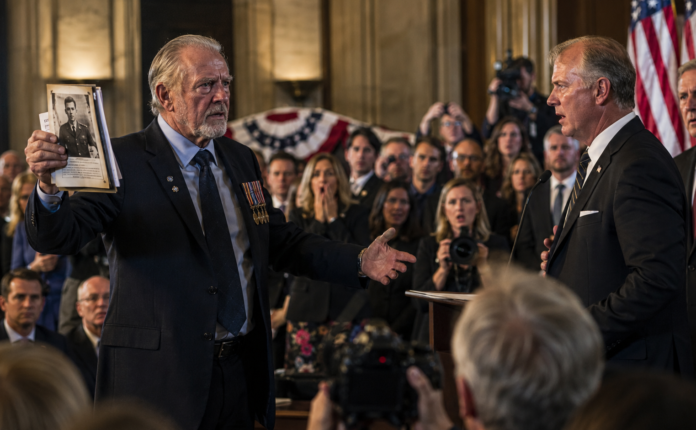
Elias reached into his coat and pulled out a small black recorder, cracked along one side, wrapped in clear plastic.
Vane’s face turned pale.
Elias held it up.
“This came from Staff Sergeant Moreno’s field recorder.”
Vane swallowed.
Elias looked at him.
“You remember Moreno, don’t you? He recorded everything. Said memories lied, but machines didn’t.”
Vane whispered, “That was destroyed.”
Elias smiled sadly.
“No. It was buried.”
Captain Reyes stepped closer. “Buried where?”
Elias’s eyes filled with tears.
“With Moreno.”
A heavy silence filled the hall.
Elias pressed a button.
Static scratched through the speakers because Captain Reyes, without asking permission, had already grabbed the microphone cable and connected the recorder to the hall system.
Major Cross shouted, “Captain Reyes!”
She looked at him.
“My father served in uniform,” she said. “If there is truth here, sir, I want to hear it.”
The recorder hissed.
Then came voices from thirty years ago.
Gunfire cracked in the background.
The B-2 Spirit Was Worth $2 Billion—But the Truth Hidden Inside It Cost Even More
A young Elias shouted, “Vane, command says the eastern pass is compromised!”
Another voice answered, younger but unmistakable.
Marcus Vane.
“Stick to the northern route.”
Moreno’s voice coughed. “Colonel, northern route is exposed!”
Vane snapped, “I said move.”
Another soldier shouted, “They’re waiting for us!”
Then came chaos.
Gunfire.
Men screaming.
Metal tearing.
Someone crying for his mother.
The room listened in horror.
Then Vane’s voice came again, low and close.
“Package is delivered. Repeat, package is delivered. Payment confirmed?”
Elias closed his eyes.
The hall went cold.
A second unknown voice answered through radio static.
“Confirmed. Pull your officers back before impact.”
Moreno shouted, “Sir, what package?”
There was a crack of a pistol.
A body fell.
The recorder captured Elias screaming.
“Moreno!”
Vane’s voice was calm.
“Walker, you did not hear that.”
Young Elias shouted, “You shot him!”
Vane replied, “And if you want your wife to live long enough to see morning, you will remember this ambush as your failure.”
The recording stopped.
No one moved.
Not the generals.
Not the reporters.
Not the families.
Not Major Cross, whose face had drained of all color.
Colonel Vane stood at the podium as if the floor had vanished beneath him.
Elias lowered the recorder.
His voice was quiet.
“There. I said their names. The machine said yours.”
Vane stepped back.
“This is fabricated.”
A general rose from his chair. “Colonel Vane.”
Vane turned quickly. “General, with respect, this is an old man’s revenge. Digital manipulation. Grief. Confusion.”
Elias shook his head. “It is not digital.”
Captain Reyes picked up the recorder. “It is original tape hardware, sir.”
Major Cross stared at Vane.
“My father died in that ambush.”
Vane looked at him. “Daniel—”
“Did you sell the route?”
Vane’s mouth opened, but no words came.
Cross walked toward the stage.
“Did you sell my father?”
Vane’s face twisted.
“I saved what could be saved.”
Cross’s eyes filled with tears.
“That is not an answer.”
Vane suddenly lost the mask.
“You think war is clean?” he shouted. “You think medals are made from truth? Command wanted results. Contractors wanted access. Intelligence wanted a back channel. That valley was lost before we ever stepped into it.”
A Staff Sergeant Ordered Her Off The Flight Line—The Tower Radioed “NIGHTHAWK” And Pilots Stood –
Elias stared at him.
“You traded soldiers for a promotion.”
Vane pointed at him.
“I traded doomed men for a future.”
A woman screamed from the audience, “My son was there!”
Another man shouted, “You murderer!”
Military police moved toward the stage.
Vane backed away.
“You all sit here pretending you understand sacrifice. I carried this country through fire while weak men cried about honor.”
Elias walked forward slowly.
“Honor is not what you say when cameras are on.”
Vane’s chest rose and fell.
Elias stopped at the foot of the stage.
“Honor is what you do when no one will ever know.”
Vane looked at the recorder.
Then at Elias.
His voice dropped.
“You should have stayed silent.”
Elias nodded.
“I did.”
His eyes shone with thirty years of grief.
“I stayed silent when my wife, Clara, asked me why men were throwing rocks through our window. I stayed silent when she packed her suitcase and said she could not live with a coward. I stayed silent when my son changed his last name. I stayed silent at every grave because you promised to kill them if I spoke.”
The hall listened without breathing.
Elias stepped closer.
“But Clara died last winter.”
Vane blinked.
“My son has children who do not know my face.”
Elias lifted his chin.
“And last month, a flood washed open Moreno’s grave in New Mexico. His daughter found the recorder sealed in his field pouch.”
Captain Reyes whispered, “His daughter?”
Elias nodded.
“She mailed it to me with one sentence.”
He pulled a folded paper from his pocket.
His hands shook as he opened it.
“She wrote, ‘My father died with the truth. Please do not die with it too.’”
Several people in the hall began to cry.
Major Cross turned away, covering his mouth.
Vane whispered, “You cannot undo the past.”
Elias looked at him.
“No. But I can stop you from being honored for it.”
The general stepped forward.
“Colonel Marcus Vane, you are relieved of all ceremonial authority pending formal investigation.”
Vane laughed bitterly.
“You think this ends with me? There were others.”
The general’s face hardened.
“Then you will name them.”
Vane looked around the hall and realized no one was coming to save him.
For thirty years, his uniform had protected him.
Now it looked like a costume.
The military police climbed the stage.
Vane tried one last time.
“Elias.”
The old veteran did not answer.
Vane’s voice cracked.
“We were friends.”
Elias looked at him, and the pain on his face was worse than anger.
“No,” he said. “Friends do not leave friends under fire.”
The officers took Vane by the arms.
As they led him away, he passed Major Cross.
Cross stared at him with wet eyes.
“My father trusted you.”
Vane said nothing.
Cross stepped closer and whispered, “I hope his name keeps you awake.”
Vane was taken out through the side doors.
The room remained silent long after he was gone.
Then the general walked down from the stage and approached Elias.
“Sergeant Walker,” he said carefully, “why did you never come forward before?”
Elias looked exhausted now. Older than before.
“Because fear can wear a uniform too, sir.”
The general lowered his eyes.
Captain Reyes held the old recorder like a sacred object.
Major Cross stood in the aisle, unable to look at Elias.
Finally, he walked over.
For a moment, neither man spoke.
Then Cross said, “You knew my father?”
Elias nodded.
“I held his hand.”
Cross’s lips trembled. “Did he suffer?”
Elias’s eyes softened.
“Yes.”
The answer struck Cross hard.
Elias placed a hand on his shoulder.
“But not alone.”
Cross broke.
The proud major covered his face and wept in the middle of the hall, in front of soldiers, cameras, and strangers.
Elias held him like a father.
“I hated you,” Cross whispered.
“I know.”
“I blamed you my whole life.”
“I know.”
Cross pulled back, ashamed. “I am sorry.”
Elias shook his head.
“You were a son looking for someone to blame. I was a man too broken to defend myself.”
Cross looked toward the stage.
“What happens now?”
Elias looked at the flags.
“Now the dead get their names back.”
The ceremony was stopped.
Then restarted.
Not for Colonel Marcus Vane.
For the men of Iron Valley.
Chairs were rearranged. The banner was taken down. A new flag was brought forward. Officers made calls. Reporters whispered into cameras. Families moved to the front rows, many crying before a single word was spoken.
Elias sat alone near the stage, his cane across his knees.
Captain Reyes approached him with a small box.
“Sergeant Walker,” she said, “the commanding general would like you to stand with the families.”
Elias shook his head. “No. I came to return what was stolen, not to stand under lights.”
Reyes smiled sadly.
“Sir, with respect, you have been in the dark long enough.”
He looked at her.
She offered her hand.
For the first time that day, Elias accepted help without shame.
When he stepped onto the stage, the whole hall rose.
Not with the empty applause given to powerful men.
This sound was different.
It began slowly, like rain on a roof.
Then grew.
Soldiers stood straighter. Veterans lifted shaking hands. Families cried openly. Major Cross stood in the front row, saluting with tears running down his face.
Elias looked overwhelmed.
“I don’t deserve this,” he whispered.
The general heard him.
“Yes,” the general said quietly. “You do.”
At the podium, the general faced the room.
“Today, the United States Army acknowledges a grave failure. For thirty years, Sergeant Elias Walker carried a false accusation that should never have been placed upon him. For thirty years, fallen soldiers were denied the full truth of their sacrifice.”
He turned to Elias.
“Sergeant Walker, on behalf of this command, and with humility before the families present, we restore your honor publicly.”
Elias swallowed hard.
The general opened the small box.
Inside was a medal.
Not Vane’s.
The original record had been found. The recommendation had been signed thirty years ago by men who died before it could be processed. It had been buried under lies, sealed files, and fear.
The general lifted it.
“For courage under fire, for shielding wounded soldiers, for refusing to abandon his unit, and for preserving the truth at great personal cost, Sergeant Elias Walker is hereby recognized before this command.”
Elias’s lips trembled.
Captain Reyes whispered, “Stand tall, Sergeant.”
Elias straightened as much as his old body allowed.
The general pinned the medal to his suit.
For a second, Elias was not old.
He was young again.
Smoke in his eyes. Blood on his hands. Brothers shouting around him. A promise burning in his chest.
Then he heard applause.
Real applause.
Thunderous applause.
A little boy from the front row walked up with a folded American flag.
Major Cross followed behind him.
“This is my son,” Cross said. “His name is Thomas.”
Elias stared at the child.
The boy held out the flag.
“My dad said you knew my grandpa.”
Elias knelt slowly, pain flashing across his face.
“Yes,” he said. “I did.”
“Was he brave?”
Elias’s voice broke.
“He was one of the bravest men I ever knew.”
The boy looked at the medal on Elias’s chest.
“Are you brave too?”
Elias looked at the families, the soldiers, the flag, and the empty place where Vane’s banner had hung.
Then he looked back at the child.
“I was afraid for a very long time.”
The boy frowned. “But you still came.”
Elias smiled through tears.
“Yes,” he said. “I still came.”
The boy nodded seriously, as if that explained everything.
Then he saluted.
Elias returned it.
This time, his hand did not shake.
Outside, the wind moved across Fort Ashford’s parade ground. The flag lifted high against the sky. News cameras captured the moment, but no camera could fully hold what happened in that room.
A stolen name had been returned.
A traitor had been exposed.
A son had learned the truth about his father.
And an old veteran who had lived thirty years under the weight of shame finally stood in front of everyone, honored not because he wanted revenge, but because justice had waited long enough.
When Elias walked out of the hall, Major Cross walked beside him.
“Sergeant,” Cross said quietly, “where will you go now?”
Elias looked at the road beyond the gate.
For thirty years, he had lived like a ghost.
Now, for the first time in decades, the world felt open.
“I think,” Elias said, touching the medal on his chest, “I’ll go meet my grandchildren.”
Cross smiled through tears.
“And after that?”
Elias looked back at the ceremony hall, where families were still speaking the names of the dead.
“After that,” he said, “I’ll visit my brothers.”
He paused.
“But this time, I won’t apologize.”
Cross nodded.
“No, sir.”
Elias’s eyes lifted to the flag.
“This time, I’ll tell them we won.”
And as the old veteran walked slowly across the base, every soldier nearby stopped what they were doing.
One by one, they turned toward him.
One by one, they saluted.
Elias Walker kept walking, his cane striking the pavement like a drumbeat.
Not broken.
Not forgotten.
Not defeated.
Honored in front of everyone.