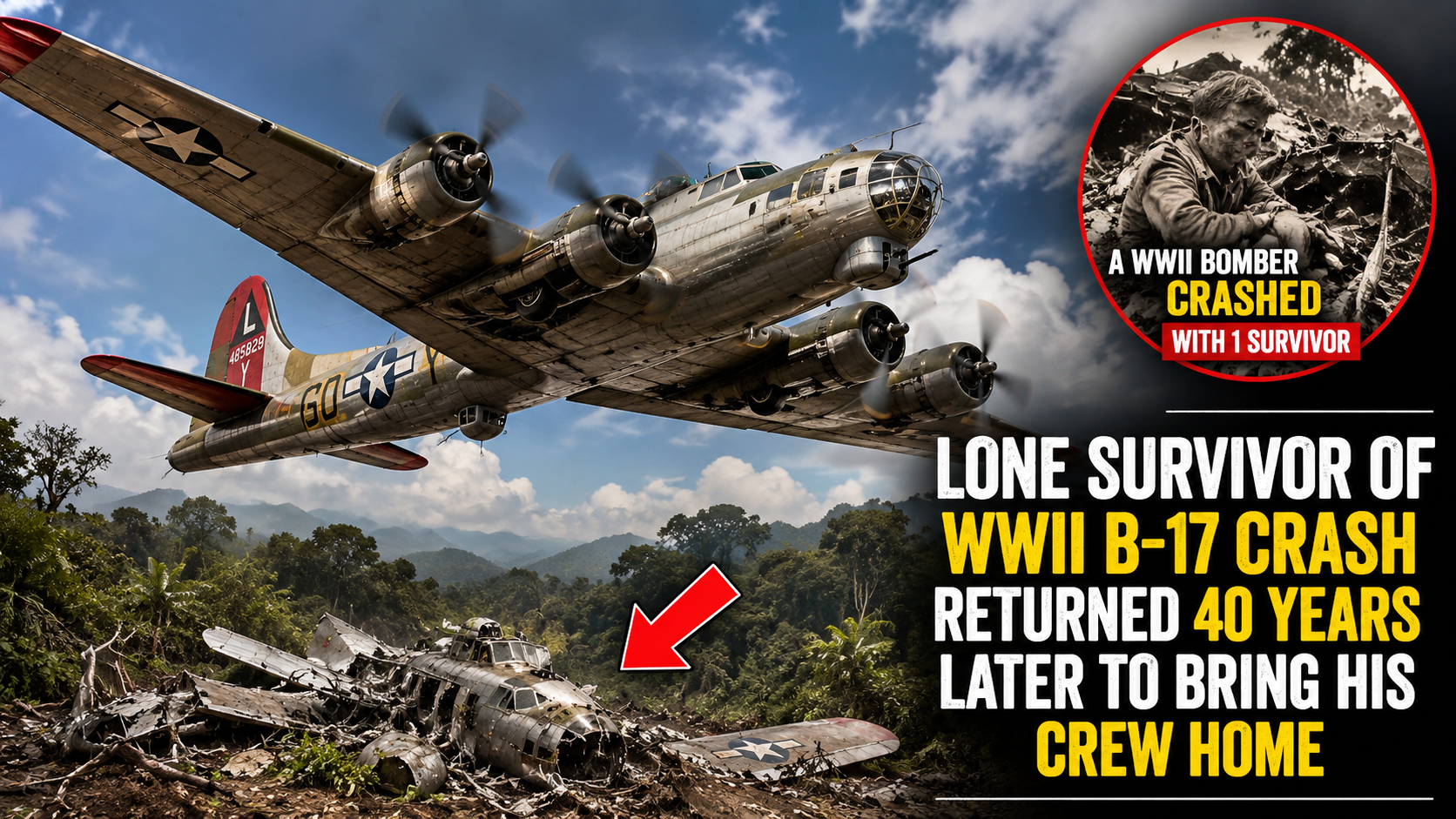
A World War II bomber crashed deep in the Papua New Guinea jungle, killing nine crewmen and leaving only one survivor. Decades later, that survivor returned to the same jungle — not for revenge, not for glory, but to bring his brothers home.
In June 1943, U.S. Army Air Force 2nd Lt. Jose L. Holguin was serving as navigator aboard a B-17E Flying Fortress known as “Naughty But Nice.” The bomber was flying a dangerous combat mission over the Pacific when it was attacked by a Japanese night fighter.
Moments later, the aircraft was falling out of the sky.
The B-17 lost power, spun out of control, and crashed into the dense jungle of New Britain Island, near Papua New Guinea. Nine of the ten men aboard were killed.
You May Also Like

Holguin somehow survived.
Badly injured, with a broken jaw and serious back injuries, he crawled away from the wreckage alone. Around him was only jungle, darkness, pain, and silence. His crew was gone. His aircraft was destroyed. Rescue was nowhere in sight.
But Holguin kept moving.
For days, and possibly weeks, he struggled through the jungle with almost no food and no real medical care. Eventually, local villagers found him near a village called Arumbum. They gave him food, cared for him as best they could, and helped keep him alive.
Those villagers did more than save a wounded American airman. They became part of a story of loyalty, memory, and sacrifice that would continue for decades.
Holguin’s suffering did not end there.
Because his injuries were too serious for the villagers to treat, he was eventually turned over to Japanese forces. He became a prisoner of war at the Rabaul Prisoner Compound, where he received no proper medical care. Later, he was moved to Tunnel Hill POW Camp, where conditions were even worse.
During interrogations, the Japanese showed him a page from his own flight log. That proved they had reached the wreckage of the B-17 and recovered material from the crash site.
Holguin survived captivity until September 1945, when he was rescued by the Australian Navy. Out of many prisoners held in the area, only a small number made it out alive.
He returned home to the United States, but part of him never truly left the jungle.
The faces of his nine crewmen stayed with him.
Their names, their voices, and the final moments aboard “Naughty But Nice” remained in his memory. He had lived when they did not. And for Holguin, survival came with a mission.
He wanted to find them.
He wanted to bring them home.
The B-17 “Naughty But Nice” had already lived a dramatic life before its final flight. Built by Boeing in Seattle, the bomber arrived in Hawaii on December 7, 1941, the day of the Pearl Harbor attack. It later served in the Pacific, flying dangerous missions from Australia and Papua New Guinea.
By June 1943, the aircraft was flying out of Port Moresby. On the night of June 25, it joined a group of bombers assigned to strike Vunakanau Airfield near Rabaul.
After the bombing run, “Naughty But Nice” remained in the area longer than the rest of the formation, helping confuse enemy radar. That decision placed the crew in terrible danger. A Japanese night fighter attacked, damaging the bomber again and again.
The crew prepared to bail out, but the aircraft went into a spin before most of them could escape.
Holguin was thrown from the open nose hatch and managed to deploy his parachute before the bomber slammed into the jungle below.
He was the only one who survived.
After the crash, Japanese forces visited the wreck site, removed intelligence material, and buried some remains in a shallow grave. American search missions failed to find the lost bomber.
Years passed.
The jungle slowly swallowed the wreckage.
The world moved on.
But Holguin did not forget.
In 1949, local citizens found the crash site again and some remains were recovered, but they could not be identified at the time. Those remains were later buried as unknown at the National Memorial Cemetery of the Pacific in Honolulu.
For many families, the loss remained unfinished.
Then, in 1982, nearly 40 years after the crash, Holguin made an extraordinary decision. He paid for his own trip back to Rabaul to search for the wreckage and the remains of his crew.
It was not an easy journey.
The crash site was remote, difficult to reach, and hidden by thick jungle. But Holguin had something stronger than a map. He had memory. He had determination. And he still had the help of local people who remembered the wounded American airman from decades earlier.
On his first trip back, Holguin met a local woman who had helped care for him after the crash in 1943. For him, it was not just a reunion. It was a living connection to the moment his life had been saved.
On later trips, local villagers helped guide him to the wreckage of “Naughty But Nice.”
Piece by piece, the lost bomber began to reappear from the jungle.
And with it came the painful purpose of Holguin’s return: recovering the remains of his fellow crewmen.
After decades of waiting, the remains of all nine fallen airmen were eventually recovered, identified, and returned to the United States. They were sent home to their families and honored with military burials.
For their loved ones, it meant something words can barely express.
A missing son was no longer forgotten in a jungle.
A husband, brother, or father was no longer just a name on a military report.
The crew of “Naughty But Nice” finally came home.
Pieces of the B-17 were also recovered, including the cockpit section, which now rests in a local museum. The bomber’s famous nose art, painted in orange letters with the name “Naughty But Nice,” remains a powerful reminder of the men who flew her and the mission from which they never returned.
Holguin’s story is not only a war story.
It is a story about memory.
It is about the bond between crewmen who trusted each other in the sky. It is about the guilt and burden carried by survivors. It is about the kindness of villagers who saved a stranger. And it is about one man who refused to let time erase the men who died beside him.
Many people survive war by trying to forget.
Jose Holguin survived by remembering.
For nearly 40 years, he carried the weight of that crash. He remembered the aircraft spinning through the night. He remembered the jungle. He remembered the men who never crawled away.
And when he finally had the chance, he went back.
Not as a young navigator.
Not as a prisoner.
Not as a victim.
He returned as the last living witness of a crew that deserved to be found.
In the end, Holguin’s greatest mission did not happen in the sky. It happened decades later, on the ground, in the same jungle where everything had been lost.
He went back for his brothers.
And because he did, nine American airmen were finally brought home.




One Comment on “Lone Survivor of WWII B-17 Crash Returned 40 Years Later to Bring His Crew Home”