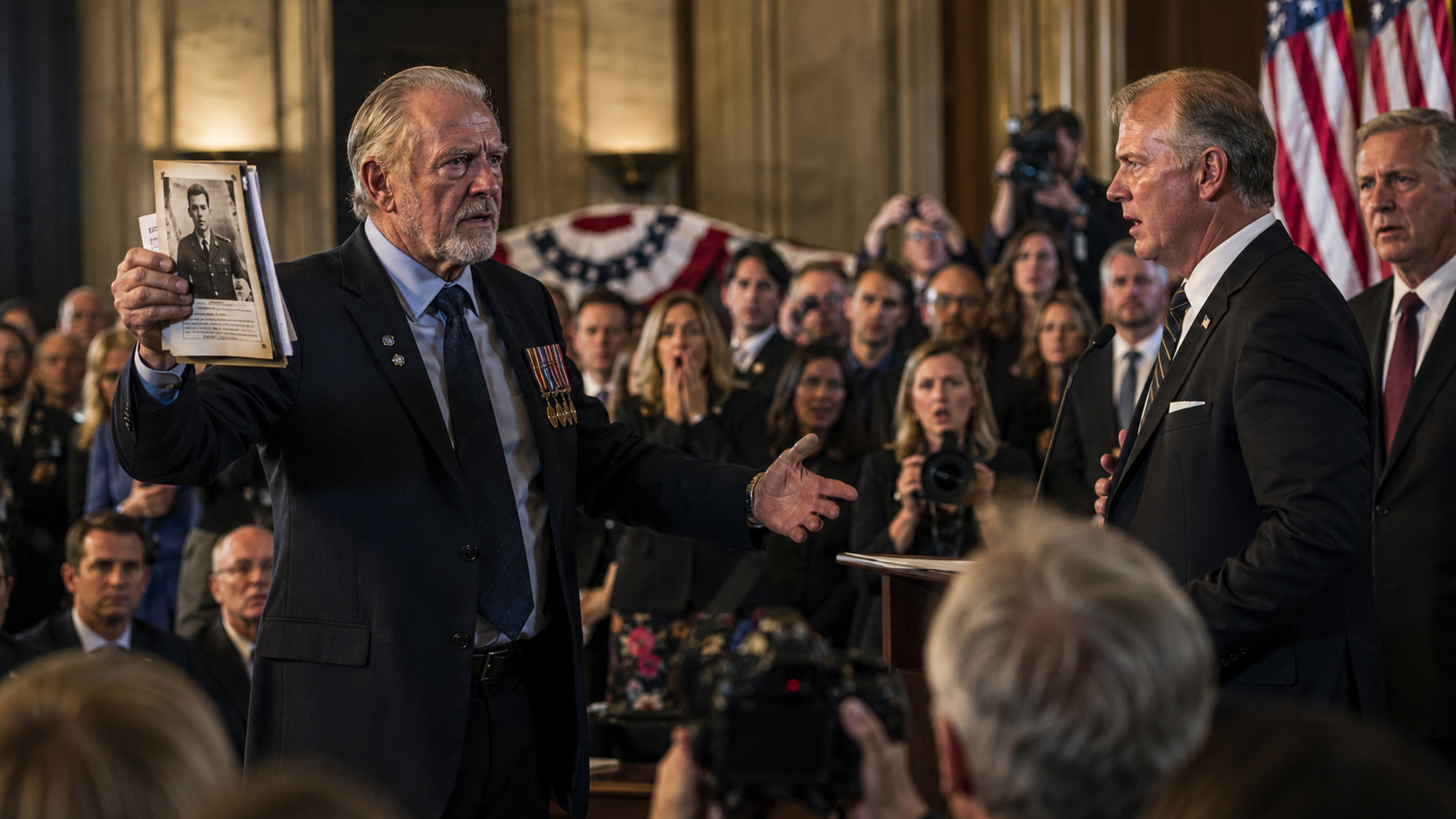
The old veteran stood on the stage with trembling hands and said, “Before you honor this man, ask him where he buried my brother.”
The whole hall froze.
A thousand people sat beneath the bright lights of the Veterans Memorial Auditorium. American flags hung from the ceiling. Cameras blinked red from the back of the room. A brass band sat silent with their instruments resting on their knees.
At the center of the stage stood General Marcus Vale, polished, powerful, and smiling only seconds earlier. His silver hair was perfect. His uniform carried medals that caught the light like small pieces of fire.
You May Also Like



But when the old man spoke, the general’s smile disappeared.
The old veteran’s name was Elias Boone.
He was seventy-eight years old. His back was bent, his left hand shook from nerve damage, and he walked with a dark wooden cane carved with the names of dead soldiers. His suit was old. His shoes were cracked. His medals were not shiny. They hung over his heart like memories too heavy to carry.
The mayor leaned toward the microphone.
“Mr. Boone,” he said carefully, “this is not the time.”
Elias looked at him.
“It was never the time when I was poor. It was never the time when I was grieving. It was never the time when I was begging men like you to listen.”
The audience whispered.
General Vale stepped forward.
“Elias,” he said, voice smooth as oil, “you’re confused.”
Elias turned slowly.
“No, Marcus. I was confused for forty years. Tonight I finally understand.”
A woman in the front row covered her mouth.
The general’s jaw tightened.
“Security,” he said.
Two guards moved toward the stage.
Elias lifted his cane.
“One more step,” he said, “and the whole world will hear the recording without your pretty speech first.”
The guards stopped.
The general stared at him.
“What recording?”
Elias smiled sadly.
“The one you killed Caleb for.”
Forty years earlier, Elias Boone had been a young soldier with strong arms, clear eyes, and a younger brother who followed him everywhere.
Caleb Boone was not Elias’s brother by blood. He was the boy Elias’s mother had taken in after Caleb’s parents died in a factory fire. Caleb was small, nervous, always hungry, and always carrying a notebook.
The General Smiled at the Ceremony Until the Dead Soldier’s Voice Came Through the Speakers
“You write too much,” Elias used to tell him.
Caleb would grin. “And you talk too little.”
“What are you writing now?”
“Things people pretend not to see.”
“That sounds dangerous.”
“Truth usually is.”
They joined the Army two years apart. Elias became the quiet soldier everyone trusted. Caleb became the radio operator with a camera hidden in his bag and questions always burning in his eyes.
Their unit deployed to a remote mountain base overseas during a cold, ugly conflict that people back home barely understood. The base smelled of diesel, wet sandbags, gun oil, and fear. At night, wind moved through the tents like ghosts.
Captain Marcus Vale was their commanding officer.
Even then, Vale was handsome, confident, and ambitious. Men saluted him quickly. Reporters loved him. Officers above him called him the future of the Army.
Elias did not trust him.
One night, Caleb sat beside Elias near a barrel fire, rubbing his hands for warmth.
“You ever notice Captain Vale never looks scared?” Caleb asked.
Elias watched sparks rise into the dark.
“Some men hide fear better than others.”
“No,” Caleb said. “That’s not it. He looks excited.”
Elias turned.
“About what?”
Caleb lowered his voice.
“About things going wrong.”
Elias stared at him.
“What did you see?”
Caleb pulled a folded paper from his jacket.
“Supply routes. Missing fuel. Ammunition numbers that don’t match. Medicine shipped in, but never reaching the field hospital.”
Elias frowned.
“You stole records?”
“I copied records.”
“That is still a good way to get court-martialed.”
Caleb leaned closer.
“Vale is selling supplies.”
Elias’s stomach tightened.
“To who?”
Caleb’s eyes moved toward the dark hills.
“To the same people shooting at us.”
The fire cracked between them.
Elias whispered, “You better be wrong.”
“I want to be.”
“Who else knows?”
Caleb hesitated.
“Sergeant Nolan.”
Elias grabbed his arm.
“You told Nolan?”
“He said he could help.”
“Nolan works for Vale.”
Caleb went pale.
Before Elias could say more, a voice came from behind them.
“Beautiful night for secrets.”
Captain Vale stepped into the firelight.
Caleb shoved the paper into his jacket.
Vale smiled.
“Relax, boys. I’m not your enemy.”
Elias stood slowly.
“No, sir.”
Vale’s eyes rested on Caleb.
“You’ve been very busy, Private Boone.”
Caleb’s lips parted.
Vale stepped closer.
“Curiosity is a useful thing. Until it becomes disloyalty.”
Caleb swallowed.
“I don’t know what you mean, sir.”
Vale looked at Elias.
“Your brother has imagination.”
Elias did not blink.
“My brother has a conscience.”
For a moment, Vale’s face changed. The charm slipped away. Something cold looked out.
“Conscience,” Vale said softly, “gets men killed.”
Two nights later, Caleb disappeared.
The official report said he died during an enemy ambush near Ridge 14. The report said his body was not recoverable. The report said Captain Marcus Vale led a brave rescue attempt under fire.
The report was a lie.
Elias knew because he had heard Caleb scream from inside the old communications bunker behind camp.
The Boy at the Fountain Looked Just Like His Daughter — Then He Asked One Question That Changed Everything
He had tried to enter.
Sergeant Nolan blocked him with a rifle.
“Move,” Elias said.
Nolan shook his head.
“Orders.”
“My brother is in there.”
“No, Boone. Your brother is already gone.”
Elias heard a crash inside. Then Caleb’s voice, broken and desperate.
“Eli! Don’t trust—”
A gunshot cut him off.
Elias lunged.
Nolan slammed the rifle into his face.
The world spun. Blood filled Elias’s mouth. He remembered Vale stepping out of the bunker, wiping his hands with a cloth.
“Private Boone died in an ambush,” Vale said.
Elias tried to rise.
Vale crouched beside him.
“And if you ever say different, your mother receives two folded flags instead of one.”
Elias stared up at him through blood and dirt.
“What did you do?”
Vale leaned close.
“What winning men do.”
When Elias returned home, no one believed him.
His mother died with Caleb’s folded flag beside her bed.
The Army closed the case.
Marcus Vale became a hero.
Elias became the bitter veteran who drank too much, shouted at officials, and carried a story no one wanted.
That was his wound. Not only grief. Not only rage.
His deepest pain was that he had failed to save Caleb.
And his blind spot was worse: he believed silence was punishment. He believed carrying pain alone proved love.
For forty years, he lived in a small house near the railroad tracks. Every morning, he raised the flag. Every evening, he lowered it. He worked as a mechanic until his hands became too damaged. Then he repaired clocks for neighbors who paid him in pies, soup, and sometimes nothing.
His only friend was Ruth Bell, a retired nurse who lived next door and refused to let him disappear.
One rainy morning, Ruth knocked on his door carrying two coffees.
Elias opened it wearing a faded Army sweater.
“You look terrible,” Ruth said.
“Good morning to you too.”
“You ate breakfast?”
“Coffee is breakfast.”
“Coffee is a cry for help in a cup.”
He stepped aside.
Ruth walked in and looked at the wall of old photos. Caleb’s picture sat in the middle, young forever, smiling with a radio headset around his neck.
Ruth’s voice softened.
“You talked to him again last night?”
Elias looked away.
“Didn’t know walls had ears.”
“Walls don’t. Lonely men do.”
He sat at the kitchen table.
Ruth placed coffee in front of him.
“You got a letter.”
He frowned.
“What letter?”
She slid an envelope across the table.
The seal read: Veterans Memorial Committee.
Elias opened it slowly.
His face darkened.
Ruth leaned forward.
“What is it?”
“They’re honoring Marcus Vale.”
Ruth’s mouth tightened.
“When?”
“Saturday.”
“Will you go?”
Elias laughed without humor.
“To watch them clap for him?”
“To look him in the eye.”
“I did that once. My brother still died.”
Ruth touched his hand.
“Elias.”
He pulled away.
“Don’t.”
“You cannot keep bleeding in private and call it loyalty.”
His jaw trembled.
“You weren’t there.”
“No,” Ruth said softly. “But I am here.”
Before Elias could answer, someone knocked.
Three hard knocks.
Elias opened the door.
A young woman stood on the porch in a dark raincoat. She had Caleb’s eyes.
Elias gripped the doorframe.
The woman spoke first.
“Are you Elias Boone?”
“Who are you?”
“My name is Nora.”
“Do I know you?”
She swallowed.
“No. But you knew my father.”
Elias felt the room tilt.
“Who was your father?”
Her voice shook.
“Caleb Boone.”
For several seconds, the rain was the only sound.
Elias whispered, “That’s impossible.”
Nora reached into her coat and pulled out a small metal box.
“My mother told me to give this to you if anything happened to her.”
Elias backed away.
“Your mother?”
“Her name was Lien. She worked at the village clinic near your base.”
Elias sat down before his legs gave out.
Ruth came beside him.
Nora placed the box on the table.
“My mother died last month,” she said. “Before she passed, she told me my father was not killed in an ambush. She said he was murdered by his own commander.”
Elias looked at the box.
His fingers shook so badly Ruth opened it for him.
Inside was a dog tag, blackened at the edges.
BOONE, CALEB.
Under it was a small cassette tape.
Elias could not breathe.
Nora whispered, “My mother said Caleb hid it before they took him.”
Elias picked up the tape as if it were alive.
“What’s on it?”
Nora looked at him.
“The truth.”
They found an old cassette player in Elias’s garage.
It took three tries before the tape turned.
Static hissed.
Then Caleb’s voice filled the room.
Breathless. Young. Terrified.
“If anyone finds this, my name is Private Caleb Boone. Captain Marcus Vale is selling fuel, medicine, and ammunition to enemy contacts through Sergeant Nolan. I recorded the exchange. I have names. If I disappear, it was not an ambush.”
“Nurse Stabbed 5 Times Protecting a Veteran’s K9 — 24 Hours Later, 200 Navy SEALs Arrived”
Elias covered his mouth.
Caleb’s voice continued.
“Eli, if you hear this, I’m sorry. I should have listened. Tell Mama I wasn’t scared.”
The tape clicked.
Then another voice appeared.
Marcus Vale.
“You should have stayed a radio boy, Caleb.”
Caleb shouted, “You’re killing our own men!”
Vale answered calmly, “I’m building a career.”
There was a struggle. A chair fell. Caleb cried out.
Then Vale said the words that haunted the room.
“Dead heroes don’t testify.”
The tape ended with a gunshot.
Ruth began crying.
Nora stood frozen, both fists pressed against her stomach.
Elias did not cry. He only stared at the machine, his face empty.
Ruth whispered, “Elias?”
He stood.
“Saturday.”
Nora wiped her tears.
“What?”
“Vale receives his award Saturday.”
Ruth shook her head.
“You need lawyers. Reporters. Protection.”
Elias picked up his cane.
“No. I need witnesses.”
Nora stepped closer.
“I’m coming with you.”
“No.”
“He was my father.”
“And I already lost him.”
Nora’s eyes flashed.
“You lost a brother. I lost a father I never got to meet.”
Elias flinched.
She stepped closer.
“My mother lived poor and afraid because of that man. She changed towns every year. She never married. She kept a bag packed by the door. Do not tell me to stay safe while the man who did this gets applause.”
Elias looked at her.
For the first time, he saw Caleb not as a memory, but as a future stolen from a living person.
He whispered, “You have his fire.”
Nora answered, “Then stop trying to bury it.”
Saturday arrived cold and bright.
The Veterans Memorial Auditorium was filled before sunset. Outside, flags snapped in the wind. News vans lined the street. Soldiers in dress uniforms guided guests through metal detectors.
Elias wore his old dark suit. Ruth pinned his medals to his chest. Her fingers were gentle, but her eyes were worried.
“Your hands are ice,” she said.
“Old pipes freeze.”
“You’re afraid.”
He looked at her.
“I’ve been afraid for forty years.”
“Then why go?”
Elias looked toward Nora, who stood by the window holding Caleb’s dog tag.
“Because fear kept the wrong man alive.”
Inside the auditorium, people turned when Elias entered.
Some recognized him.
“That’s Boone,” one man whispered.
“The crazy one?”
“He still talks about that old case.”
Nora heard them and spun around.
“Say it louder,” she snapped. “Let him hear your courage.”
Elias touched her shoulder.
“Save it.”
“For who?”
“For the stage.”
They sat near the back.
On stage, Mayor Collins welcomed the crowd.
“Tonight,” he said, “we honor a true American legend, General Marcus Vale.”
Applause exploded.
Vale stepped out slowly, smiling, waving, soaking in love he had stolen from dead men.
Elias’s knuckles turned white around his cane.
Nora leaned close.
“Are you okay?”
“No.”
“Do you want to leave?”
He looked at her.
“I wanted to leave forty years ago.”
The ceremony dragged on. Speeches praised Vale’s courage, leadership, sacrifice, and honor.
Each word felt like dirt thrown onto Caleb’s grave.
Then a large screen played a tribute video. Young Marcus Vale appeared in old footage, standing at the mountain base. Elias saw himself in the background for half a second. Young. Strong. Unknowing.
Then Caleb appeared.
Only for a moment.
Smiling beside the radio tent.
Elias made a sound like his chest had cracked.
Nora grabbed his hand.
“That’s him?”
Elias nodded, tears finally filling his eyes.
“That’s my boy.”
When the mayor invited Vale to accept the Lifetime Valor Medal, everyone stood.
Everyone except Elias.
Vale began his speech.
“My fellow Americans,” he said, “service is not about glory. It is about truth, sacrifice, and doing what is right when no one is watching.”
Elias stood.
His chair folded loudly behind him.
People turned.
Ruth whispered, “Elias.”
He stepped into the aisle.
A security guard approached.
“Sir, please sit down.”
Elias kept walking.
“Sir.”
Nora stood and followed.
The guard grabbed Elias’s arm.
Nora snapped, “Take your hand off him.”
Vale stopped speaking. His eyes found Elias. A flicker of fear crossed his face, then vanished.
The Secret Protectors: The K-9 Heroes Who Carried Courage Through History
“Well,” Vale said into the microphone, “Elias Boone.”
The room murmured.
Vale smiled for the cameras.
“My old comrade. Ladies and gentlemen, Mr. Boone has carried heavy memories from war. We honor his service.”
Elias climbed the stage steps slowly.
The mayor rushed forward.
“This is not part of the program.”
Elias took the spare microphone from the podium.
“It is now.”
Awkward laughter moved through the hall.
Vale’s voice lowered.
“Do not do this.”
Elias looked at him.
“I heard Caleb scream.”
Vale’s face hardened.
“You heard battle.”
“I heard murder.”
The laughter died.
Mayor Collins raised his hands.
“Mr. Boone, please. This is a family event.”
Elias turned to the crowd.
“My family is dead because men like him made murder sound like service.”
Vale spoke sharply.
“He is unstable. Everyone here knows it.”
Elias reached into his pocket and pulled out Caleb’s dog tag.
The screen camera zoomed in.
The blackened metal glinted under the stage lights.
Elias said, “This belonged to Private Caleb Boone. My brother. The man General Vale said died in an ambush.”
Vale whispered, “Where did you get that?”
Nora stepped onto the stage.
“From my mother.”
Vale stared at her.
For the first time all night, he looked old.
Nora held the tape in her hand.
“My name is Nora. I am Caleb Boone’s daughter.”
The crowd gasped.
Elias turned to the technician booth.
“Play it.”
The mayor shouted, “Cut the sound!”
But Ruth, sitting near the aisle, stood and blocked the technician’s path with surprising strength.
“You sit down, young man,” she said to the assistant reaching for the controls. “I patched soldiers with half their faces gone. I am not afraid of your little badge.”
The cassette recording had been copied to a digital file that morning. Nora had sent it to a local journalist who owed Ruth a favor. It was ready.
The auditorium speakers crackled.
Then Caleb’s voice came alive.
“If anyone finds this, my name is Private Caleb Boone…”
The room became stone.
As the recording played, Vale’s face changed from denial to rage to panic.
When the gunshot sounded, someone in the audience sobbed.
Nora’s lips trembled. Elias held his cane so tightly his hand shook.
The tape ended.
No one clapped. No one moved.
Then Elias spoke.
“You gave yourself medals for a war you used as a marketplace. You sold medicine while wounded boys screamed. You sold ammunition to men who fired it back at us. And when Caleb found out, you murdered him.”
Vale stepped back.
“That recording is fake.”
Nora lifted another envelope.
“My mother kept letters. Dates. Names. Payment codes. Photos of Sergeant Nolan meeting your contact outside the clinic.”
Vale looked at the mayor.
“Do something.”
The mayor did not move.
A journalist near the front shouted, “General Vale, did you order the killing of Private Caleb Boone?”
Another shouted, “Did the Army reopen this case?”
The hall erupted.
Vale suddenly grabbed Elias by the lapel.
“You bitter old fool,” he hissed. “You think truth matters now? Everyone who could testify is dead.”
Elias looked at the microphone clipped near Vale’s chest for the broadcast.
“You still forget when you’re being recorded.”
Vale released him.
The audience heard everything.
Police moved toward the stage.
Vale backed away, breathing hard.
“You don’t understand,” he shouted. “We were losing control. Men die in war. Supplies move. Deals happen. I did what powerful men told me to do.”
Elias whispered, “Caleb was nineteen.”
Vale snapped, “Caleb was a problem!”
The words echoed through the auditorium.
A thousand witnesses heard the confession.
Nora covered her mouth, tears running down her face.
Elias looked at Vale, and for one moment, revenge stood in front of him like an open door. He could strike him. Push him. Humiliate him the way grief had humiliated him for forty years.
But Caleb’s voice seemed to rise in his memory.
Truth usually is dangerous.
Elias lowered his cane.
“No,” he said softly. “You don’t get my violence. You only get my testimony.”
Police placed Vale in handcuffs.
As they led him away, he looked back at Elias.
“You think this heals you?”
Elias’s eyes filled with tears.
“No. But it frees him.”
The crowd parted as Vale was taken down the aisle. No applause followed him now. Only silence. Heavy. Honest. Final.
Nora stepped closer to Elias.
“I wish my mother could see this.”
Elias looked at her.
“She did more than see it. She carried it to us.”
Nora handed him Caleb’s dog tag.
“Keep it.”
He shook his head.
“No. It belongs with you.”
“He was your brother.”
Elias closed her fingers around it.
“And your father.”
Ruth climbed the stage and wiped her eyes with a tissue.
“Well,” she said, voice shaking, “that was not boring.”
Elias laughed once, broken and soft.
Then the mayor, pale and sweating, approached the microphone.
“Ladies and gentlemen, due to these serious allegations—”
Nora turned on him.
“Allegations?”
The mayor froze.
“You heard a confession,” she said. “You saw evidence. You watched him admit Caleb was a problem. Say the word.”
The mayor swallowed.
“Crime.”
Nora stepped closer.
“Again.”
“A crime,” he said.
Elias watched her, amazed.
For forty years, he had believed he was the last piece of Caleb left in the world.
He had been wrong.
Outside the auditorium, rain began falling.
Reporters crowded around Elias, Nora, and Ruth.
“Mr. Boone, how long have you waited for this night?”
Elias looked at the cameras.
“Too long.”
“Do you feel revenge?”
He stared toward the police car where Vale sat behind glass.
“No.”
“What do you feel?”
Elias turned to Nora.
“Responsible.”
That night, the country saw the recording. Veterans came forward. Families contacted investigators. Old reports were opened. Names were uncovered. Marcus Vale’s shining career collapsed in hours.
But the final twist came three days later.
Elias was sitting in his kitchen when Nora arrived with a folder from her mother’s belongings.
“There’s something else,” she said.
Elias looked up.
“More evidence?”
“No.”
She sat across from him, eyes wet.
“My mother wrote this before she died.”
Elias took the letter.
His hands trembled as he unfolded it.
Dear Elias,
Caleb loved you more than anyone. But there is one truth I kept because I was afraid it would destroy you. Caleb was not killed immediately after the gunshot on the tape. He survived long enough for me to reach him. He made me promise two things. First, to protect our child. Second, to tell you that he forgave you.
Elias stopped reading.
His breath caught.
Nora reached across the table.
“Keep going.”
He forced his eyes back to the page.
He said, “Tell Eli he did not fail me. Tell him I hid the tape because he taught me courage. Tell him not to spend his life standing at my grave.”
The letter slipped from Elias’s hand.
For forty years, he had punished himself for not saving Caleb.
For forty years, he had believed Caleb died calling for him.
Now he knew Caleb died freeing him.
Elias covered his face and sobbed, not like a soldier, not like a witness, but like a brother who had finally been allowed to grieve.
Nora came around the table and held him.
Ruth stood in the doorway, crying silently.
After a long time, Elias whispered, “He forgave me.”
Nora said, “He loved you.”
Outside, the old flag in Elias’s yard moved gently in the wind.
One week later, Elias returned to the Veterans Memorial Auditorium. This time there were no cameras, no speeches, no politicians.
Only him, Nora, Ruth, and a small bronze plaque placed near the entrance.
PRIVATE CALEB BOONE
He told the truth when silence was safer.
Elias stood before it and raised his shaking hand in one final salute.
Nora stood beside him.
“Uncle Elias?” she said softly.
He looked at her, surprised by the word.
“Yes?”
She slipped Caleb’s dog tag around his neck.
“I think he would want us both to carry it.”
Elias held the tag against his chest.
For the first time in forty years, it did not feel like a weight.
It felt like a heartbeat.
And as they walked away, Ruth looked back at the empty stage where a criminal had once smiled like a hero.
“Elias,” she said.
“Yes?”
“You know the strangest part?”
“What?”
She smiled through tears.
“You didn’t destroy him.”
Elias looked at Nora, then at Caleb’s name shining on the wall.
“No,” he said quietly. “The truth did.”
But that night, when Elias returned home, he found one last envelope waiting under his door.
No stamp. No name.
Inside was an old photograph.
Caleb stood beside a young nurse named Lien, smiling with one hand over her stomach.
On the back, written in Caleb’s handwriting, were seven words that made Elias drop into his chair:
If I don’t come home, find our child.
Elias stared at the words until dawn.
Because suddenly he understood the final truth.
Caleb had not only left behind evidence.
He had left behind family.
And Elias, the old veteran who thought his life had ended forty years ago, realized his brother’s last mission had just begun.