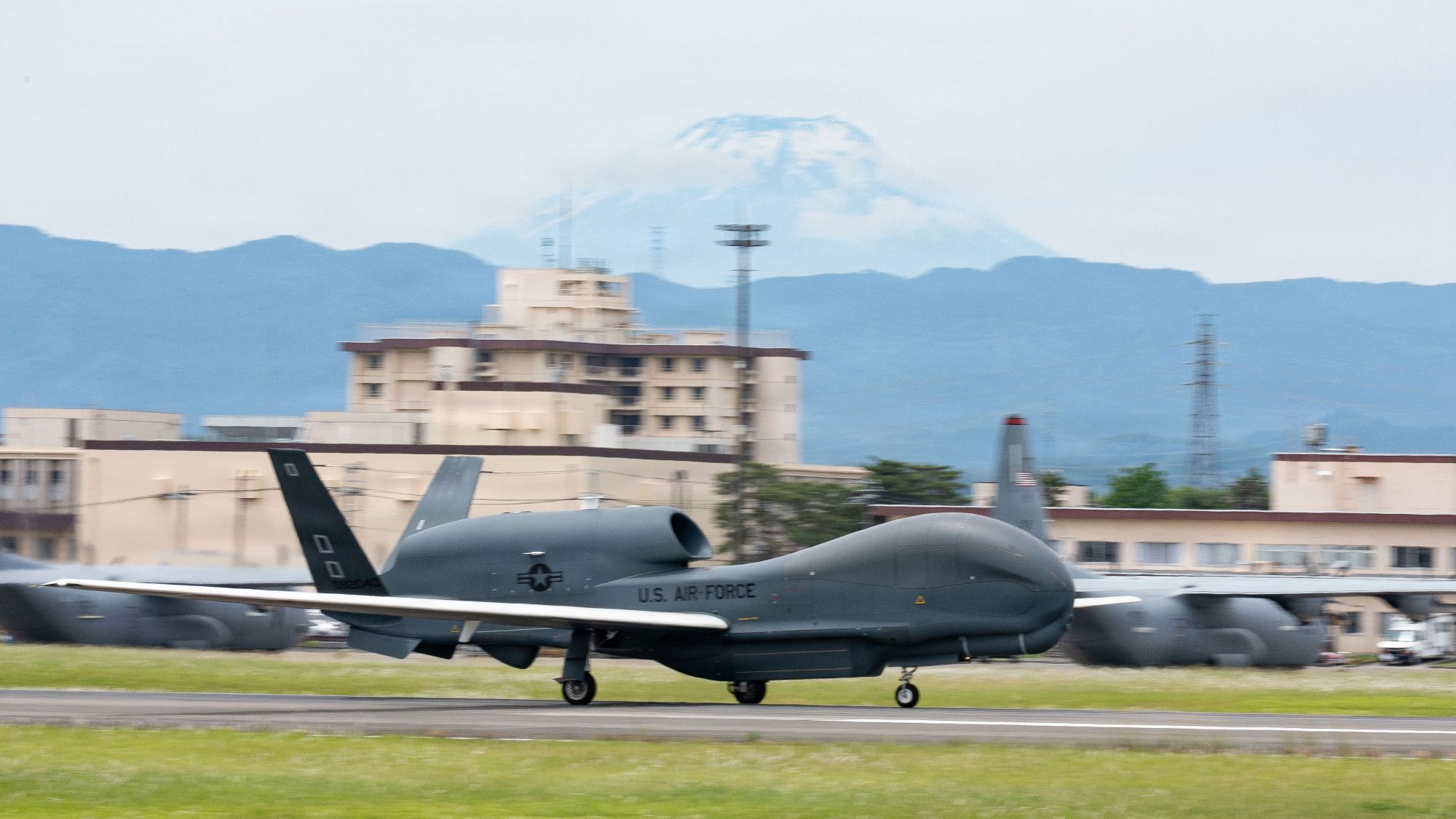
The U.S. Air Force has made a quiet but important move in the Pacific.
Its RQ-4B Global Hawk surveillance drones, long based at Andersen Air Force Base in Guam, have permanently relocated to Yokota Air Base in Japan.
At first, this may sound like a simple basing decision.
A few aircraft moved from one American base to another.
A reconnaissance unit changed its home.
Support personnel shifted closer to Japan.
You May Also Like

But in the Western Pacific, nothing involving long-range surveillance is simple anymore.
This move matters because the RQ-4B Global Hawk is not an ordinary aircraft. It is a high-altitude, long-endurance, remotely piloted reconnaissance platform designed to watch huge areas for long periods of time. It can fly at extreme altitude, stay airborne for more than a full day, and provide commanders with intelligence, surveillance, and reconnaissance over wide geographic areas.
In simple words, the Global Hawk is one of America’s eyes in the sky.
And now, that eye is moving closer to one of the most contested regions on Earth.
The aircraft operated by the 4th Reconnaissance Squadron have moved from Guam to Yokota Air Base, where they had already deployed regularly during typhoon season. This time, however, the move is permanent.
The official explanation includes weather and readiness. Yokota’s location in Japan’s Kanto region offers more favorable conditions during typhoon season than Guam, where storms can disrupt operations.
But the strategic meaning is much bigger.
The U.S. wants persistent intelligence coverage in the Pacific. It wants better support for American and allied forces. It wants more reliable reconnaissance near Japan, Taiwan, the East China Sea, the South China Sea, and the wider First Island Chain.
This is not just a relocation.
It is a signal.
America is watching the Pacific more closely.
From Guam to Japan: A Permanent Change
For years, Global Hawks based at Andersen Air Force Base in Guam would move seasonally to Yokota Air Base during typhoon season.
That temporary movement made sense. Guam sits farther east in the Western Pacific and is more directly exposed to powerful tropical storms. During certain months, typhoons can threaten aircraft, damage facilities, interrupt flying schedules, and force aircraft to shelter or evacuate.
Yokota, located in western Tokyo, offers more favorable weather conditions during that period.
So the Global Hawk’s presence in Japan was not new.
What is new is permanence.
The U.S. Air Force has now shifted the RQ-4B Block 40 aircraft and support personnel from Guam to Japan as a permanent basing decision. The aircraft arrived in late May 2026, and the official announcement followed in mid-June.
The aircraft are assigned to the 4th Reconnaissance Squadron, a geographically separated unit connected to the 319th Reconnaissance Wing.
This means Yokota is no longer just a temporary storm-season refuge.
It is becoming a regular home for one of the most important surveillance platforms in the region.
That changes the rhythm of U.S. reconnaissance operations in the Pacific.
Instead of moving away from Guam only when weather requires it, the Global Hawks can now operate from Japan as part of a more persistent theater-wide ISR posture.
Why Yokota Air Base Matters
Yokota Air Base is already one of the most important U.S. military installations in Japan.
It hosts the 374th Airlift Wing and serves as a major airlift hub for U.S. forces in the Western Pacific. The base supports transport, contingency operations, humanitarian missions, and coordination with U.S. Forces Japan and the Japan Self-Defense Forces.
Adding a permanent Global Hawk presence gives Yokota another layer of strategic importance.
Airlift moves people and equipment.
Reconnaissance gathers information.
Together, they support the larger mission of readiness in the region.
Yokota’s location is important because Japan sits near the center of several major security concerns.
To the southwest is Taiwan.
To the west is China.
To the northwest are the East China Sea and the Korean Peninsula.
To the south are the sea lanes running toward the Philippines and the South China Sea.
To the east is the wider Pacific network connecting Japan, Guam, Hawaii, and the continental United States.
From this position, Global Hawks can support intelligence collection over large areas and feed information to commanders who need to understand what is happening in real time.
In a region where aircraft, ships, missiles, drones, and submarines are constantly moving, information becomes power.
That is why basing matters.
What the RQ-4B Global Hawk Does
The RQ-4B Global Hawk is a remotely piloted aircraft built for intelligence, surveillance, and reconnaissance.
It is not an attack drone.
It does not carry bombs.
It does not fire missiles.
Its weapon is information.
The Global Hawk flies high above most weather and above normal air traffic. From that altitude, it can scan large areas, collect imagery, detect movement, and provide commanders with near-real-time information.
The aircraft is designed for long missions. It can stay airborne for more than 30 hours, allowing it to watch a region for extended periods without needing frequent replacement by other aircraft.
That endurance is one of its biggest advantages.
A manned reconnaissance aircraft must consider crew fatigue. Fighter aircraft have shorter endurance. Satellites are powerful, but they follow orbital paths and may not always be overhead when needed. Smaller drones may not have the range or altitude needed for theater-wide coverage.
The Global Hawk fills a special role.
It can loiter.
It can watch.
It can map.
It can track.
It can support commanders during peace, crisis, disaster, or war.
That is why it is valuable in the Pacific.
Block 40: Watching Moving Targets
The aircraft involved in the Yokota relocation are RQ-4B Block 40 Global Hawks.
The Block 40 version is especially important because it carries advanced radar designed to support wide-area surveillance and moving-target tracking.
This gives commanders more than still imagery.
It can help detect movement across land and large regions. It can support tracking of vehicles, activity patterns, and operational changes. It can provide intelligence for joint forces and allied partners.
In a crisis, that kind of capability can be critical.
If military vehicles begin moving near a coastline, commanders want to know.
If air-defense systems shift position, commanders want to know.
If unusual activity appears near a contested area, commanders want to know.
If a disaster hits and roads, bridges, or infrastructure are damaged, commanders want to know.
Global Hawk can help provide that picture.
That is why ISR platforms are often among the first assets commanders want during a crisis. Before deciding what to do, leaders need to understand what is happening.
The Global Hawk exists to answer that question.
Why Weather Is a Serious Military Issue
The official reason for moving the Global Hawks permanently includes weather.
That may sound ordinary, but in military operations, weather can decide readiness.
Guam is a critical American military hub, but it is also vulnerable to typhoons. Powerful storms can force aircraft to relocate, delay missions, disrupt maintenance, and put personnel and equipment at risk.
For a reconnaissance aircraft designed to provide persistent coverage, interruptions matter.
If a drone cannot launch because of storm conditions, commanders lose coverage.
If aircraft must evacuate from a base, operations become more complicated.
If maintainers and ground crews are fighting the weather, readiness suffers.
Yokota’s position in Japan’s Kanto region gives the unit a more stable operating environment during the months when Guam faces greater storm risk.
That means more reliable operations.
In the Pacific, reliability matters because the region is huge. Distances are enormous, bases are spread out, and aircraft availability can be difficult to replace quickly.
Moving Global Hawks to a location with better seasonal weather is not just convenient.
It improves operational persistence.
The Strategic Message Behind the Move
Even though weather is an official reason, the broader strategic message is clear.
The U.S. wants stronger, more persistent ISR coverage in the Western Pacific.
That matters because the region is becoming more dangerous.
China’s military has expanded rapidly. Its navy is larger and more active. Its air force is flying more frequently near Taiwan and Japan. Its missile forces threaten bases and ships across the region. Its coast guard and maritime militia operate around disputed waters. Beijing continues to press claims in the South China Sea and East China Sea.
At the same time, Taiwan remains one of the most dangerous flashpoints in the world.
Japan is increasing defense spending and strengthening its military posture.
The Philippines is expanding security cooperation with the United States.
Australia, South Korea, and other partners are watching China’s rise closely.
The U.S. is restructuring forces to survive and operate across dispersed locations.
In that environment, the side that sees first may act first.
That is why reconnaissance matters.
A Global Hawk flying high above the region can help build a picture of military activity before a crisis becomes a war.
The First Island Chain Problem
The First Island Chain is one of the most important strategic concepts in the Pacific.
It refers to the chain of islands running from Japan through Taiwan and the Philippines toward Borneo. For China, this chain is both a barrier and a battlefield. For the United States and its allies, it is a defensive line, a surveillance zone, and a key area for containing military movement.
Many of China’s most sensitive regional concerns sit near or inside this zone.
Taiwan lies at the center.
Japan’s southwest islands stretch toward Taiwan.
The East China Sea includes disputes around the Senkaku Islands.
The Philippines faces pressure in the South China Sea.
U.S. forces rely on bases and access points throughout the region.
That makes surveillance across the First Island Chain extremely important.
The Global Hawk’s relocation to Japan helps support this broader watch posture. It does not mean the aircraft will only focus on China, and it does not mean every mission is tied to a crisis. But the strategic geography is impossible to ignore.
Japan is closer than Guam to many of the region’s most important flashpoints.
That is why a permanent move to Yokota carries weight.
Guam Still Matters
The move does not mean Guam is becoming unimportant.
In fact, Guam remains one of the most critical U.S. military locations in the Pacific.
It hosts Andersen Air Force Base, naval facilities, bomber deployments, air-defense planning, logistics support, and other missions central to U.S. operations in the region. Guam is also being heavily discussed in U.S. missile-defense and base-hardening plans because it would be a major target in any high-end Pacific conflict.
Guam is America’s forward fortress in the Western Pacific.
But that importance also creates vulnerability.
China’s missile forces are designed to threaten U.S. bases across the region, including Guam. Typhoons add another challenge. The combination of military risk and weather risk means the United States needs flexibility.
Moving the Global Hawks to Japan does not erase Guam’s role.
It spreads capability.
It places some ISR assets closer to allied infrastructure and weather-favorable conditions while Guam continues to support other major missions.
In modern military planning, dispersion is survival.
Japan’s Role Is Growing
The relocation also highlights Japan’s growing role in regional security.
Japan is no longer just a host for U.S. forces. It is becoming a more active defense partner.
Tokyo has increased defense spending, acquired long-range strike capabilities, strengthened cooperation with the United States, and expanded its own surveillance and intelligence capabilities.
Japan also operates its own RQ-4B Global Hawk aircraft, based at Misawa Air Base. That means both the United States and Japan now have Global Hawk capability in the country, strengthening the overall ISR network supporting defense of Japan and regional stability.
This is important because Japan faces multiple security pressures.
China’s air and naval activity has increased.
North Korea continues missile development.
Russia remains active in Northeast Asia.
Taiwan’s security directly affects Japan’s southwest islands.
Japan needs persistent awareness, and so does the U.S.-Japan alliance.
The permanent U.S. Global Hawk presence at Yokota adds another layer to that shared watch.
The Human Side: Airmen and Families
Military moves are not only about aircraft.
They involve people.
The 4th Reconnaissance Squadron’s relocation means airmen, support personnel, maintainers, operators, and families are affected. A permanent move is different from a temporary deployment. It changes housing, schooling, base support, family life, local relationships, and long-term unit culture.
The squadron commander thanked Guam and Andersen Air Force Base for hosting the Global Hawk mission for the past 16 years and said Yokota was the right location for current and future operations while supporting the quality of life of airmen and families.
That detail matters.
A unit can only operate well if its people are supported. High-end military capability depends on mechanics, avionics technicians, launch crews, pilots, sensor operators, communications specialists, intelligence personnel, and families who carry the burden of overseas service.
Behind every drone mission is a team.
The Global Hawk may fly without a person onboard, but it does not operate without humans.
How Remote Operations Work
One of the most interesting parts of Global Hawk operations is how the aircraft is controlled.
The system uses a launch and recovery element at the deployed location and a mission control element that can operate from elsewhere. Personnel at the aircraft’s base handle takeoff and landing. After that, mission control can be transferred to operators at a distant location.
For the 4th Reconnaissance Squadron’s RQ-4B operations, launch and recovery are conducted at the deployed location, while mission control can be handled by crews connected to Grand Forks Air Force Base in North Dakota.
This arrangement shows how modern airpower is changing.
The aircraft may be in Japan.
The mission crew may be in the United States.
The intelligence may support commanders across the Pacific.
The data may feed into joint and allied networks.
This is not traditional aviation.
It is networked warfare.
The Global Hawk is a flying sensor connected to a global system of operators, analysts, commanders, and decision-makers.
Why ISR Is the First Step in Deterrence
People often think deterrence means weapons: missiles, fighters, submarines, bombers, and warships.
But deterrence also depends on information.
A country is less likely to act aggressively if it believes it is being watched. A military is less likely to move secretly if it knows its movements may be detected. A crisis is easier to manage if commanders can distinguish between routine activity and real preparation for attack.
That is why ISR is so important.
Surveillance can reduce surprise.
Surveillance can warn allies.
Surveillance can reveal deception.
Surveillance can support diplomacy.
Surveillance can prevent commanders from making decisions blindly.
In the Pacific, where distances are vast and military movements can happen quickly, persistent ISR becomes one of the foundations of deterrence.
The Global Hawk helps provide that foundation.
It cannot stop a war by itself.
But it can help leaders see one coming.
China Is Watching Too
The United States is not the only country studying this move.
China will notice.
Beijing watches U.S. base movements, aircraft deployments, reconnaissance activity, and alliance decisions closely. A permanent Global Hawk presence in Japan will likely be seen as part of the broader U.S. effort to strengthen surveillance near China’s eastern approaches.
Chinese officials may criticize the move as militarization or containment. They may argue that U.S. reconnaissance flights increase tension. They may increase their own patrols or surveillance in response.
But from the U.S. and allied perspective, the move is defensive and stabilizing.
The argument is simple: in a region with growing military pressure, better awareness reduces uncertainty.
Both sides will interpret the same aircraft differently.
That is normal in strategic competition.
For Washington and Tokyo, the Global Hawk is an ISR tool supporting a free and open region.
For Beijing, it may look like another American sensor watching China’s military rise.
The PACOM Name Change
The Global Hawk relocation also comes at a time when the United States has restored the name U.S. Pacific Command, or USPACOM, after years of using the name U.S. Indo-Pacific Command.
The official explanation says the restoration honors the command’s historical legacy. The command also stated that its area of responsibility remains the same, stretching from the waters off the U.S. West Coast to the western border of India, and that its mission remains unchanged.
Still, names carry meaning.
The Indo-Pacific label had emphasized the connection between the Indian Ocean and Pacific Ocean and highlighted India’s growing role in U.S. strategy. Returning to the older Pacific Command name may be seen by some as symbolic, even if the official mission and geography remain the same.
For this article, the key point is caution.
The Global Hawk move should not be treated as caused by the name change. The relocation was officially tied to weather, readiness, and persistent reconnaissance needs. But both developments show that America is adjusting how it presents and organizes its Pacific strategy.
One change is operational.
The other is symbolic.
Together, they show a region in motion.
Why This Move Matters for Allies
For U.S. allies in the region, the Global Hawk relocation sends an important message.
It shows that the United States is not only talking about Pacific security. It is repositioning assets, adjusting basing, and improving persistence.
Japan benefits directly because the aircraft are now based on Japanese territory and support the alliance’s regional awareness.
Other partners may benefit indirectly.
The Philippines, Australia, South Korea, and Taiwan all care about what the United States can see, understand, and respond to in the region. Better ISR coverage can support joint planning, crisis warning, disaster response, and broader regional stability.
In a future emergency, information from platforms like Global Hawk could help identify threats, support evacuation planning, guide humanitarian aid, or inform military decisions.
That is why reconnaissance aircraft matter even when they are unarmed.
They make everyone else smarter.
Humanitarian Missions Matter Too
The Global Hawk is often discussed in military terms, but it has also supported humanitarian and disaster-relief operations.
After the 2011 earthquake and tsunami in Japan, U.S. forces launched Operation Tomodachi to support disaster response. Global Hawk imagery helped provide information about damaged areas and supported awareness during one of Japan’s worst modern disasters.
This is an important part of the story.
A high-altitude surveillance aircraft can help during war, but it can also help after earthquakes, tsunamis, typhoons, floods, and other disasters.
Japan is located in a disaster-prone region. Earthquakes, tsunamis, and severe storms are real risks. A platform that can provide wide-area imagery in all weather and at long range can support both military and civilian crisis response.
This gives the Global Hawk a dual value.
It strengthens deterrence.
It also supports disaster awareness.
That makes its presence in Japan more than a pure military move.
The Limitations of the Global Hawk
The Global Hawk is powerful, but it is not invulnerable.
Its greatest defense is altitude and distance. It flies high, but advanced air-defense systems can still threaten high-altitude aircraft under certain conditions. In a major war against a sophisticated enemy, the Global Hawk would need careful mission planning.
It is also unarmed.
It cannot defend itself with missiles.
It cannot shoot back.
It cannot fight like a combat aircraft.
Its value depends on where it flies, what it collects, how quickly the data is processed, and how well commanders use the information.
There is also the issue of cost. Large, high-end drones are expensive to operate and maintain. They require trained crews, ground stations, secure links, spare parts, and protected bases.
So the relocation to Japan does not solve every problem.
It improves posture.
But like every military move, it comes with trade-offs.
The Bigger Picture: A Pacific Built on Sensors
The future of military competition in the Pacific will not be decided only by ships and aircraft.
It will be decided by sensors.
Satellites.
Drones.
Radars.
Submarines.
Undersea sensors.
Signals intelligence.
Cyber tools.
Maritime patrol aircraft.
Space-based tracking systems.
Ground stations.
Allied data-sharing networks.
The Global Hawk is one piece of that larger sensor web.
In a region as vast as the Pacific, no single platform can see everything. The challenge is to connect many systems together so commanders can build a useful picture.
That is what the United States and its allies are trying to do.
They are building a network that can detect movement, track threats, support targeting, and reduce surprise.
The Global Hawk’s move to Yokota fits inside that larger effort.
It is about being present.
It is about being persistent.
It is about seeing farther and sooner.
Why the Move Feels Like a Warning
The relocation may not have been announced with dramatic language, but it still feels like a warning.
The Pacific is becoming more contested.
China is more active.
Taiwan remains under pressure.
Japan is rearming.
The Philippines is strengthening defense ties with Washington.
Guam is being hardened.
U.S. forces are spreading out.
Drones and sensors are becoming more important.
Against that backdrop, moving Global Hawks permanently to Japan looks like part of a larger shift.
America is preparing for a region where warning time may be short and visibility may decide the first stage of a crisis.
In that kind of world, a high-flying surveillance aircraft becomes more than a drone.
It becomes a strategic asset.
Conclusion: The Eye Has Moved Closer to the Front
The permanent relocation of the RQ-4B Global Hawks from Guam to Yokota Air Base is one of those military moves that may not dominate headlines but carries deep strategic meaning.
Officially, the move improves weather resilience, supports typhoon-season readiness, and strengthens persistent reconnaissance in the theater.
But strategically, it places one of America’s most important ISR platforms closer to the heart of the Western Pacific security challenge.
The Global Hawk is unarmed, but it is powerful.
It does not drop bombs, but it shapes decisions.
It does not fight like a fighter, but it helps commanders understand the fight.
It does not carry a pilot, but it depends on a global team of airmen, operators, analysts, and maintainers.
From Yokota, the RQ-4B can support U.S. and allied forces in a region where the need to see first is becoming more urgent every year.
Guam remains vital.
Japan is becoming even more important.
The First Island Chain is under pressure.
China is watching.
America is watching back.
The Global Hawk’s move tells a simple story:
In the Pacific, the next crisis may begin long before the first missile is fired.
It may begin with movement.
And whoever sees that movement first may hold the advantage.