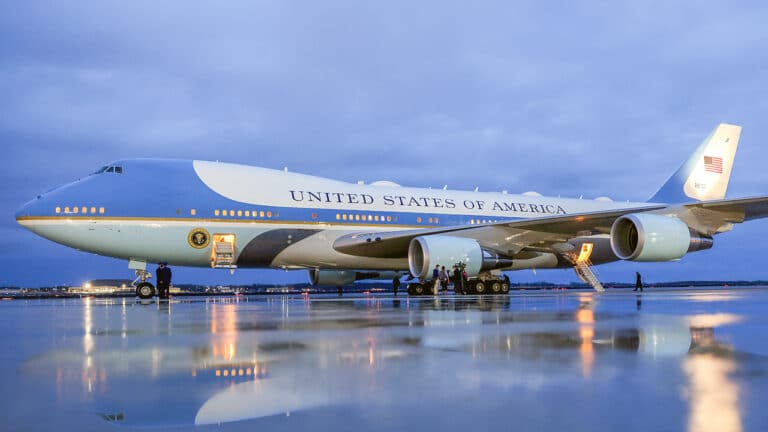
For more than three decades, it has been one of the most recognizable aircraft in the world.
A massive Boeing 747 painted in white and blue.
The words “United States of America” across its side.
The American flag on its tail.
The presidential seal near the front door.
When it landed overseas, the world knew exactly what it meant.
The President of the United States had arrived.
You May Also Like
But now, one of America’s most iconic presidential aircraft may have reached the end of its Air Force One story.
After President Donald Trump returned from the 2026 G7 Summit in France, White House officials posted emotional farewell messages about VC-25A tail number 29000, the Boeing 747-200B that had just carried the president home to Joint Base Andrews.
The messages were not formal retirement orders. They were not an official Air Force press release. But the tone was unmistakable.
One post called it “The Last Ride.”
Another thanked the aircraft after 35 years of service.
For aviation watchers, military historians, and Americans who grew up seeing Air Force One as a symbol of national power, the message felt clear: the legendary jet may have just completed its final scheduled presidential mission.
If true, it marks the end of an era.
Not just for one aircraft.
But for the classic blue-and-white Air Force One image that has represented American power since the early 1990s.
Air Force One Is Not Actually One Plane
Before going deeper, it is important to understand one key fact.
“Air Force One” is not the name of a specific aircraft.
It is a call sign.
Any U.S. Air Force aircraft carrying the president uses the call sign “Air Force One.” If the president flies on a C-32A, that aircraft becomes Air Force One. If the president flies on a VC-25A, that aircraft becomes Air Force One.
But in the public imagination, “Air Force One” usually means the two large Boeing 747-200B aircraft operated by the Presidential Airlift Group at Joint Base Andrews.
Those two aircraft are tail numbers 28000 and 29000.
They are officially known as VC-25A aircraft. They entered service during the presidency of George H.W. Bush and have carried every president since.
For decades, they have been flying White Houses.
They are not ordinary passenger jets. They are military aircraft specially configured for presidential transport, secure communications, staff operations, press travel, medical support, and crisis management.
When Americans think of Air Force One, this is the aircraft they imagine.
And now, one of them may be saying goodbye.
The Aircraft at the Center of the Farewell
The aircraft in question is tail number 29000, sometimes written in aviation tracking circles as 92-9000.
It is one of two VC-25A aircraft built from the Boeing 747-200B platform.
The aircraft entered service in 1990 and has spent roughly 35 years carrying American presidents, senior officials, staff, journalists, Secret Service personnel, and military crews around the world.
It has flown across oceans.
It has landed in foreign capitals.
It has carried presidents to summits, funerals, crises, campaigns, and historic meetings.
It has been guarded by Air Force crews, maintained by specialists, and watched by millions.
The VC-25A is more than a plane. It is part of the presidency itself.
Every time it touches down, cameras turn toward it.
That is why the farewell messages mattered.
When White House communications officials posted emotional tributes after the aircraft returned from Europe, aviation observers immediately understood the possible meaning.
This may not have been just another trip.
It may have been the final chapter of 29000’s presidential flying career.
“The Last Ride”
After the aircraft landed at Joint Base Andrews following the G7 Summit trip, Steven Cheung, Assistant to the President and White House Director of Communications, posted a short but powerful farewell message.
The post included the phrase: “Well done, good and faithful servant.”
Then came the line that caught everyone’s attention:
“The Last Ride.”
Dan Scavino, White House Deputy Chief of Staff, also posted a tribute, saying he had been fortunate to fly around the world on the iconic aircraft for five and a half years out of its 35 years serving U.S. presidents.
He thanked “Air Force One 2900.”
That was enough to start serious speculation.
Was this simply emotional language after an important trip?
Was the aircraft being retired immediately?
Was it being moved into a backup role?
Was it being prepared for museum transfer?
Would it fly again without the president?
Would it remain in the fleet for contingency missions?
At the time, the exact answer was not fully clear from official Air Force statements.
But President Trump later indicated that the outgoing presidential 747 had made its final trip and would eventually be placed in a museum.
If that happens, it will close a remarkable chapter in American aviation history.
A Plane That Served Through History
The VC-25A fleet entered service at the end of the Cold War.
The world was changing fast.
The Soviet Union was collapsing.
America was becoming the world’s dominant superpower.
Global diplomacy was entering a new era.
Presidential travel was becoming more visible than ever.
The VC-25A was built for that world.
It was designed to take the president anywhere, anytime, while maintaining command, communications, security, and symbolic power.
Over the decades, aircraft 29000 and 28000 carried presidents through some of the most important events in modern history.
They flew during wars in the Middle East.
They supported diplomatic visits to Europe and Asia.
They carried presidents to NATO summits, G7 meetings, state visits, and crisis conferences.
They became symbols during moments of national tragedy and global uncertainty.
One of the most significant moments connected to tail number 29000 came on September 11, 2001.
After the terrorist attacks, the aircraft was part of the emergency presidential movement that day, as security threats and national command concerns shaped the route back to Washington.
That history makes the aircraft more than metal.
It is a witness to the American presidency.
Why the VC-25A Fleet Is Aging
The current VC-25A aircraft entered service more than three decades ago.
For a commercial-style aircraft, that is already a long life. For a presidential aircraft with specialized systems, constant security requirements, and global mission demands, age becomes a serious issue.
The aircraft are carefully maintained, but they are still old.
Parts become harder to support.
Maintenance becomes more demanding.
Systems require updates.
Aircraft reliability becomes a bigger concern.
Modern communications and security needs continue to grow.
Earlier in 2026, one of the presidential 747s was forced to return to Joint Base Andrews after a technical issue on a planned trip. President Trump then continued the journey on a smaller C-32A aircraft.
That incident highlighted what many officials already knew: the VC-25A fleet remains iconic, but it is showing its age.
For normal passengers, a technical issue is inconvenient.
For a president, it is a national-security and continuity problem.
The presidential aircraft must be ready. It must be reliable. It must support secure communications. It must carry the president, staff, press, and security personnel across continents with minimal risk.
That is why replacing the aging aircraft has become urgent.
The Problem: The New Air Force One Is Late
The long-term replacement for the VC-25A fleet is the VC-25B.
These aircraft are based on the Boeing 747-8 platform. They are larger, newer, and intended to become the next generation of presidential aircraft.
But the program has faced major delays.
The United States acquired two 747-8 aircraft and contracted Boeing to convert them into presidential aircraft. That conversion is extremely complex.
A presidential aircraft is not just a luxury jet.
It must include secure communications.
It must support national command functions.
It must carry staff, press, security, and support teams.
It must include defensive systems.
It must meet strict military and security standards.
It must be reliable during routine travel and national emergencies.
That kind of work takes time.
The VC-25B program has slipped behind schedule, with delivery now expected around 2028. That delay created a gap between the aging VC-25A fleet and the official long-term replacement.
Into that gap came one of the most controversial solutions in presidential aviation history:
The Qatar-donated bridge aircraft.
The VC-25 Bridge Aircraft
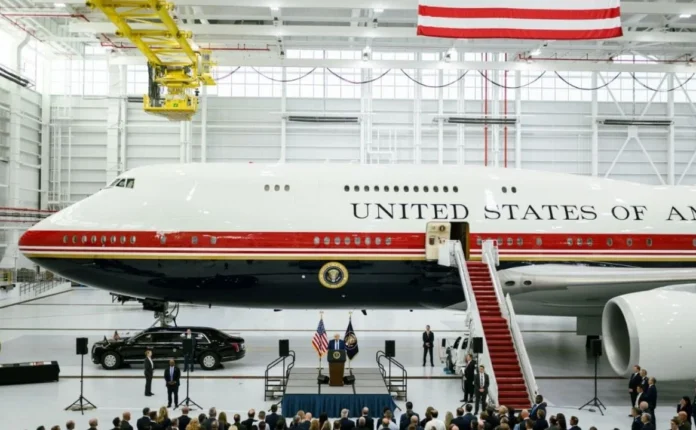
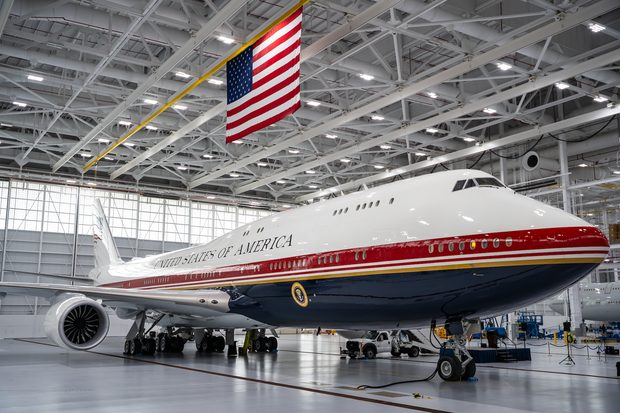
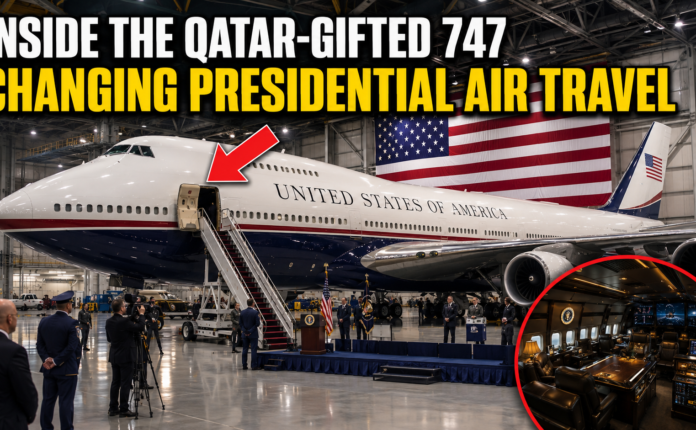
President Trump’s administration accepted a Boeing 747-8 aircraft from Qatar to serve as a temporary presidential aircraft while the official Boeing-built VC-25B replacements remain delayed.
This aircraft has been referred to as a “VC-25 bridge” aircraft.
The term “bridge” means temporary. It is meant to fill the gap between the current aging aircraft and the future official replacements.
But this bridge aircraft is not just an aviation solution. It is also a political controversy.
The aircraft was gifted by Qatar.
It has been rapidly modified for presidential use.
It received a bold new red, white, dark blue, and gold paint scheme.
It reflects Trump’s preferred style.
It is expected to serve until the delayed Boeing-built aircraft are ready.
To supporters, this is practical.
They argue that the current Air Force One aircraft are old, Boeing’s replacements are late, and America needs a modern presidential aircraft now.
To critics, the aircraft raises difficult questions about ethics, foreign influence, security, cost, and whether a presidential aircraft should ever originate as a gift from a foreign government.
The bridge aircraft is therefore more than a plane.
It is a symbol of the transition between the old Air Force One era and a new, more politically charged one.
Why the Qatari Jet Is Controversial
The idea of accepting a luxury aircraft from a foreign government immediately triggered criticism.
The aircraft has been described as being worth hundreds of millions of dollars. Critics argue that such a gift raises serious concerns under rules designed to prevent foreign influence over U.S. officials.
Trump dismissed the criticism, arguing that it would be foolish to reject a useful aircraft when America needs it.
The Pentagon and administration officials have said the aircraft was accepted in accordance with federal rules and regulations. Still, the political questions remain.
Why would a foreign government provide such an expensive aircraft?
What does Qatar gain from the arrangement?
Can the U.S. fully secure a foreign-owned jet for presidential use?
How much will the conversion cost taxpayers?
Will the aircraft be used only during Trump’s term?
What happens to it afterward?
Even if the aircraft is legally accepted by the U.S. government and not personally owned by Trump, the appearance of the arrangement remains sensitive.
Presidential aircraft are symbols of national sovereignty.
That is why the source of the aircraft matters.
Security Questions Around the Bridge Aircraft
Converting a foreign aircraft into a presidential aircraft is not simple.
Before the president can fly aboard it, the aircraft must be inspected and modified to meet strict safety and security requirements.
That includes secure communications, anti-eavesdropping measures, defensive systems, and protection against potential hidden vulnerabilities.
Experts have raised concerns that because the bridge aircraft was modified quickly, it may not include every advanced feature planned for the future VC-25B.
Some observers have speculated that the bridge aircraft may be used first for domestic trips or ceremonial appearances, while the older VC-25A or C-32A aircraft continue handling certain international or high-security missions.
That has not been fully confirmed as a permanent rule.
But the speculation shows the central concern: presidential aircraft do not simply need to fly. They must support the commander in chief in all circumstances.
The current VC-25A aircraft are known quantities. They have been operated, maintained, and secured by the Air Force for decades.
The bridge aircraft must prove itself.
The New Paint Scheme
One of the most visible changes in this transition is the paint scheme.
The classic Air Force One look dates back to the Kennedy era. Its light blue and white design became one of the most recognizable liveries in the world. It projected calm, authority, and continuity.
Trump has long wanted a different look.
The bridge aircraft carries a bold red, white, dark blue, and gold color scheme. The look is more aggressive, more patriotic in tone, and more closely aligned with Trump’s personal design preference.
To supporters, the new design looks strong and modern.
To critics, it looks too political and too connected to Trump’s personal brand.
That debate is not really about paint.
It is about national symbols.
Air Force One belongs to the presidency, not one president. But every president leaves a mark on the office. Trump’s new color scheme is one of the most visible marks he has tried to make.
If the bridge aircraft leads the July 4 flyover, millions of Americans may see that new image for the first time.
July 4 and the 250th Anniversary
The bridge aircraft may soon become part of America’s 250th anniversary celebrations.
Trump has spoken about a massive July 4 flyover in Washington, D.C., describing it as one of the biggest in American history. The new aircraft is expected to play a major role, possibly as a centerpiece of the event.
There has also been speculation in Washington, D.C., describing it as one of the biggest in American history. The new aircraft is expected to play a major role that Trump could use the bridge aircraft for a visit to Mount Rushmore in South Dakota on July 3, connected to the anniversary celebrations.
These plans matter because they turn the aircraft into more than transportation.
They turn it into a public symbol.
A new presidential aircraft flying over the nation’s capital during the 250th anniversary of American independence would be a powerful image.
Supporters will see strength, patriotism, and renewal.
Critics may see political theater and personal branding.
Either way, the aircraft will be impossible to ignore.
What Happens to Tail Number 29000?
The central question remains: what happens now to VC-25A 29000?
There are several possibilities.
It could be formally retired from the Air Force.
It could be transferred to a museum.
It could remain in a backup role temporarily.
It could be used for non-presidential missions before final retirement.
It could be preserved for ceremonial or historical reasons.
Trump has indicated the aircraft’s final trip has taken place and that it will eventually go to a museum.
That would be fitting for a jet with such historical weight.
The United States has preserved several former presidential aircraft in museums, allowing the public to walk through the spaces where presidents traveled, worked, and made decisions.
If 29000 joins that tradition, it will become a museum piece with extraordinary history.
But until official final details are fully clear, the safest wording is that 29000 appears to have completed its final scheduled mission as Air Force One and is moving toward the end of its presidential service.
What About Tail Number 28000?
The other VC-25A, tail number 28000, remains important.
Reports indicate that 28000 has been going through major maintenance and is expected to remain part of the presidential airlift picture.
If 29000 is retired or moved out of primary service, 28000 may help carry the remaining load alongside the bridge aircraft and smaller C-32A aircraft.
This creates a complicated transition period.
The old VC-25A fleet is aging.
The official VC-25B replacement jets are delayed.
The bridge aircraft is new and controversial.
The C-32A remains useful but smaller and less capable than a 747.
The Air Force must manage all of these options carefully.
Presidential travel cannot stop while aircraft programs catch up.
The president still needs to fly.
The staff still needs to move.
The press still travels.
The Secret Service still plans.
Allies still host summits.
Crises still happen.
That is why this transition matters so much.
Why Air Force One Matters So Deeply
Air Force One is not just transportation.
It is a symbol of continuity.
Presidents change. Parties change. Policies change. But Air Force One has represented the enduring power of the office.
When the aircraft lands overseas, it tells allies and rivals that America has arrived. When it appears on television during a crisis, it reminds the public that the presidency continues. When it flies over national events, it becomes part of American identity.
That is why people care about this aircraft.
It is not because they are obsessed with tail numbers.
It is because Air Force One is tied to national memory.
It has carried presidents into history. It has flown during war and peace. It has become part of the visual language of American power.
To see one of these aircraft possibly take its final ride is emotional, even for people who do not follow aviation closely.
It feels like the end of a familiar chapter.
The Human Side of the Final Flight
Behind every Air Force One mission is a large team.
Pilots.
Flight engineers.
Maintenance crews.
Communications specialists.
Security personnel.
Cooks.
Medical staff.
Logistics teams.
Secret Service agents.
Press staff.
White House aides.
The aircraft may be famous, but it does not serve by itself.
For 35 years, thousands of people have kept VC-25A 29000 ready for presidential duty. They have maintained it through long nights, foreign trips, emergency planning, and high-pressure operations.
When White House officials wrote farewell messages, they were not only saying goodbye to metal and engines.
They were honoring the people and memories attached to the aircraft.
That is why the phrase “good and faithful servant” resonated.
The aircraft served quietly, powerfully, and dependably for decades.
A Transition Filled With Uncertainty
The timing of this possible farewell is unusual.
America is not simply replacing one old aircraft with one new official aircraft.
Instead, it is moving through a messy transition.
One old VC-25A may be leaving.
Another old VC-25A may continue.
A donated bridge aircraft is arriving.
The official Boeing-built VC-25B aircraft are delayed.
The paint scheme is changing.
Security questions remain.
Cost questions remain.
Political controversy surrounds the Qatari jet.
That makes this one of the most complex moments in Air Force One history.
The retirement of an aircraft is usually straightforward.
This time, it is part of a larger political and aviation drama.
The old Air Force One is fading.
The new bridge aircraft is arriving.
The official replacement is still years away.
The result is a story filled with symbolism, uncertainty, and debate.
Supporters See a Needed Upgrade
Trump’s supporters argue that the transition is necessary.
They say the VC-25A fleet is old, maintenance problems are increasing, and Boeing’s official replacement program is late. From their perspective, accepting the bridge aircraft gives the president a newer, more modern aircraft sooner.
They also like the symbolism.
The red, white, dark blue, and gold aircraft fits Trump’s image of American power. It looks bold. It looks strong. It looks different from the past.
Supporters may see the farewell to 29000 as natural and overdue.
After 35 years, even a legendary aircraft must eventually step aside.
Critics See a Troubling Shift
Critics see the transition differently.
They worry that the Qatari bridge aircraft creates ethical problems. They question the cost of conversion. They worry about security. They dislike the idea of a foreign-origin aircraft becoming part of presidential travel.
Some also see the new paint scheme as too political.
To them, Air Force One should represent the presidency and the country, not a single president’s taste.
They may also question whether rushing a bridge aircraft into service is wise when the current VC-25A fleet, despite its age, was built specifically for presidential missions.
For critics, the end of 29000’s service is not just a retirement.
It is part of a risky and controversial change.
The Legacy of VC-25A 29000
However people feel about the politics, the aircraft itself has earned respect.
VC-25A 29000 served through multiple administrations. It carried Democrats and Republicans. It represented the United States under different presidents, different crises, and different eras.
It was not partisan.
It was presidential.
That is the important distinction.
The aircraft belonged to the office, not the man aboard it. Its mission was not to serve a party, but to carry the president of the United States safely and securely wherever the nation required.
That is why its possible final mission matters.
It reminds Americans that institutions outlast individuals.
The jet’s service crossed political eras. Its retirement comes during a deeply divided time, but its legacy belongs to the whole country.
Conclusion: The End of the Classic Air Force One Era
VC-25A 29000 may have just completed its final scheduled mission as Air Force One.
If so, it closes a remarkable 35-year chapter in presidential aviation.
This aircraft carried presidents across the world.
It represented American power on foreign runways.
It served during crisis and ceremony.
It became part of the visual identity of the presidency.
It helped define what millions of people imagine when they hear the words “Air Force One.”
Now, as America prepares for a temporary Qatari bridge aircraft and waits for the delayed Boeing-built VC-25B replacements, the old blue-and-white 747 is moving toward history.
The transition is not clean.
It is controversial.
It is political.
It is expensive.
It is filled with unanswered questions.
But beneath all the debate is a simple truth:
An aircraft that served American presidents for 35 years deserves recognition.
Whether 29000 flies again in backup service or heads directly toward a museum, its place in history is secure.
It was more than a plane.
It was a flying White House.
It was a command post in the sky.
It was a symbol of American power.
And if this truly was its last ride, then one of the most famous aircraft in the world has earned its farewell.
Suggested Hashtags
#AirForceOne #VC25A #SAM29000 #Boeing747 #DonaldTrump #PresidentialAircraft #USAirForce #JointBaseAndrews #AviationNews #DefenseNews #WhiteHouse#MilitaryAviation #AirPower #AmericanHistory #G7Summit #VC25B #QatarJet #PresidentialTravel #AircraftRetirement #USPolitics