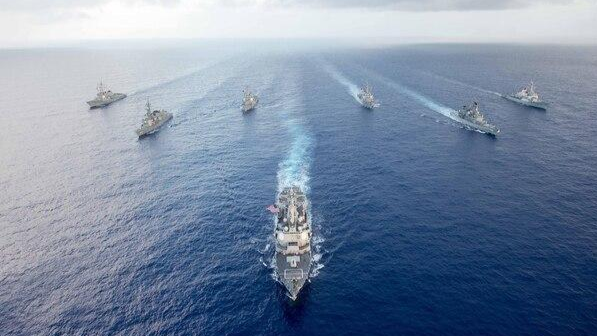
WATERS NEAR GUAM — A Fleet United by Purpose
The vast blue waters surrounding Guam became the stage for one of the most impressive demonstrations of allied naval cooperation in the Indo-Pacific this week as warships from the United States Navy and the Japan Maritime Self-Defense Force sailed side by side in a large-scale military exercise designed to strengthen readiness, interoperability, and regional security.
Against a backdrop of endless ocean and clear Pacific skies, some of the world’s most advanced warships maneuvered together with remarkable precision.
Guided-missile destroyers cut through rolling seas.
Helicopters launched from flight decks.
You May Also Like
Radar systems scanned hundreds of miles of airspace.
Combat information centers operated around the clock.
And hundreds of sailors from two nations worked shoulder-to-shoulder in pursuit of a common goal.
Preparing for the future.
Protecting stability.
Strengthening one of the world’s most important military alliances.
More Than a Training Exercise
Military officials emphasized that the operation was far more than a routine exercise.
It was a demonstration of trust.
A demonstration of shared commitment.
And a demonstration of how quickly allied naval forces can integrate when facing complex challenges.
As geopolitical competition continues to shape the Indo-Pacific region, military planners increasingly view multinational cooperation as essential for maintaining security and ensuring freedom of navigation across critical sea lanes.
Exercises near Guam have long served as a proving ground for combined operations.
This latest event reinforced a simple but powerful reality:
Modern security depends on partnerships.
No nation operates alone.
And success increasingly depends on the ability of allies to function as a unified force.
The Strategic Importance of Guam
At the center of the exercise stood Guam, one of the most strategically significant locations in the Pacific Ocean.
Often referred to as America’s western gateway to the Indo-Pacific, Guam serves as a critical hub for naval operations, logistics, aviation assets, and rapid-response capabilities.
Its geographic position allows forces to project power across vast distances while supporting operations throughout the region.
Military experts frequently describe Guam as a cornerstone of Pacific security architecture.
From this island, aircraft, ships, submarines, and support forces can rapidly respond to emerging challenges.
That is precisely why exercises conducted in the surrounding waters attract significant international attention.
What happens near Guam often serves as a glimpse into the future of allied operations throughout the Pacific.
Destroyers at the Front Line of Readiness
Among the most visible participants were advanced guided-missile destroyers from both navies.
These warships represent decades of technological innovation and maritime warfare expertise.
From a distance, they appeared calm and steady.
Inside, however, every compartment buzzed with activity.
Commanding officers coordinated maneuvers.
Navigation teams monitored routes.
Engine rooms generated enormous power.
Weapons specialists practiced responses to evolving scenarios.
Radar operators tracked simulated aircraft, surface vessels, and missile threats.
Every sailor understood that readiness is built through repetition.
Every drill mattered.
Every scenario offered lessons that could one day save lives.
For young sailors participating in the exercise, it represented an opportunity to operate alongside trusted allies while gaining valuable real-world experience.
For veteran crews, it was another step in strengthening relationships forged over decades of cooperation.
The Silent Threat Beneath the Waves
One of the most demanding portions of the exercise focused on anti-submarine warfare.
Unlike visible surface ships, submarines operate hidden beneath the ocean’s surface, making them among the most difficult military threats to locate and track.
Finding a submarine requires patience, technology, and teamwork.
Throughout the exercise, crews deployed sophisticated sonar systems designed to detect even the faintest underwater signatures.
Helicopters launched carrying specialized sensors.
Maritime patrol assets searched vast sections of ocean.
Command centers exchanged information in real time.
Every sonar contact was analyzed.
Every signal evaluated.
Every possible threat investigated.
Military leaders described anti-submarine warfare as one of the most technically challenging missions in modern naval operations.
Success depends not only on equipment but also on coordination between multiple platforms and nations.
Exercises like these help ensure that when challenges emerge, allied forces can respond together as a seamless team.
Eyes on the Sky
The ocean was not the only battlefield being simulated.
Throughout the exercise, sailors also trained for complex air-defense operations.
Modern naval warfare unfolds at extraordinary speed.
A hostile aircraft or incoming missile can appear with little warning.
In those moments, seconds matter.
Radar operators practiced identifying multiple airborne targets approaching from different directions.
Combat systems teams calculated defensive responses.
Commanders evaluated threat priorities and coordinated actions across the fleet.
The exercise tested not only technology but also human decision-making under pressure.
The ability to share information quickly and accurately can determine mission success.
That capability becomes even more important when multiple allied forces operate together.
Helicopters Bridge Sea and Sky
Above the fleet, helicopters became a vital part of the operation.
Launching from the decks of moving warships, aircrews conducted reconnaissance, anti-submarine patrols, search-and-rescue simulations, and maritime surveillance missions.
The sight was impressive.
Rotors spinning.
Flight crews coordinating takeoffs.
Aircraft lifting into the Pacific sky.
Pilots navigating between ships operating dozens of miles apart.
These operations required extraordinary precision and teamwork.
Every successful launch and landing represented countless hours of training and preparation.
For observers, the helicopters symbolized the exercise’s broader purpose:
Connecting capabilities.
Connecting forces.
Connecting allies.
The Human Element Behind the Steel
While advanced ships and sophisticated technology often capture headlines, military leaders repeatedly emphasized that the most important component of the exercise was not the hardware.
It was the people.
Throughout the operation, American and Japanese sailors trained together, shared expertise, exchanged tactics, and built relationships that transcend language and geography.
Meals were shared.
Professional knowledge was exchanged.
Friendships were formed.
Trust was strengthened.
These human connections are often invisible to the public.
Yet they become critical during real-world operations.
When sailors know and trust one another, coordination becomes faster.
Communication becomes smoother.
And combined missions become more effective.
A Message Heard Across the Indo-Pacific
Military analysts noted that the exercise also carried significant symbolic value.
At a time when global security challenges continue to evolve, demonstrations of allied unity send powerful signals throughout the region.
The message was not one of aggression.
It was one of preparedness.
One of partnership.
One of commitment.
The exercise highlighted the enduring strength of the U.S.-Japan alliance and reinforced a shared determination to maintain regional stability through cooperation and readiness.
For decades, the alliance has served as one of the foundations of Indo-Pacific security.
This latest operation demonstrated that the partnership continues to grow stronger with every passing year.
Looking Toward the Horizon
As the exercise entered its final phase, warships steamed across the Pacific in coordinated formations.
Helicopters returned to their flight decks.
Lookouts scanned distant horizons.
And sailors reflected on days of demanding training.
Behind them stretched thousands of miles of ocean.
Ahead of them lay an uncertain future.
Yet one thing remained clear.
The alliance endures.
The partnership remains strong.
And both nations continue preparing together for whatever challenges tomorrow may bring.
Because in the vast waters of the Pacific, strength is not measured solely by the size of a fleet.
It is measured by the trust between those who sail together.
And near Guam, that trust was on full display.
A steel alliance.
Forged through cooperation.
Strengthened through training.
And carried forward by generations of sailors committed to a safer and more secure future.