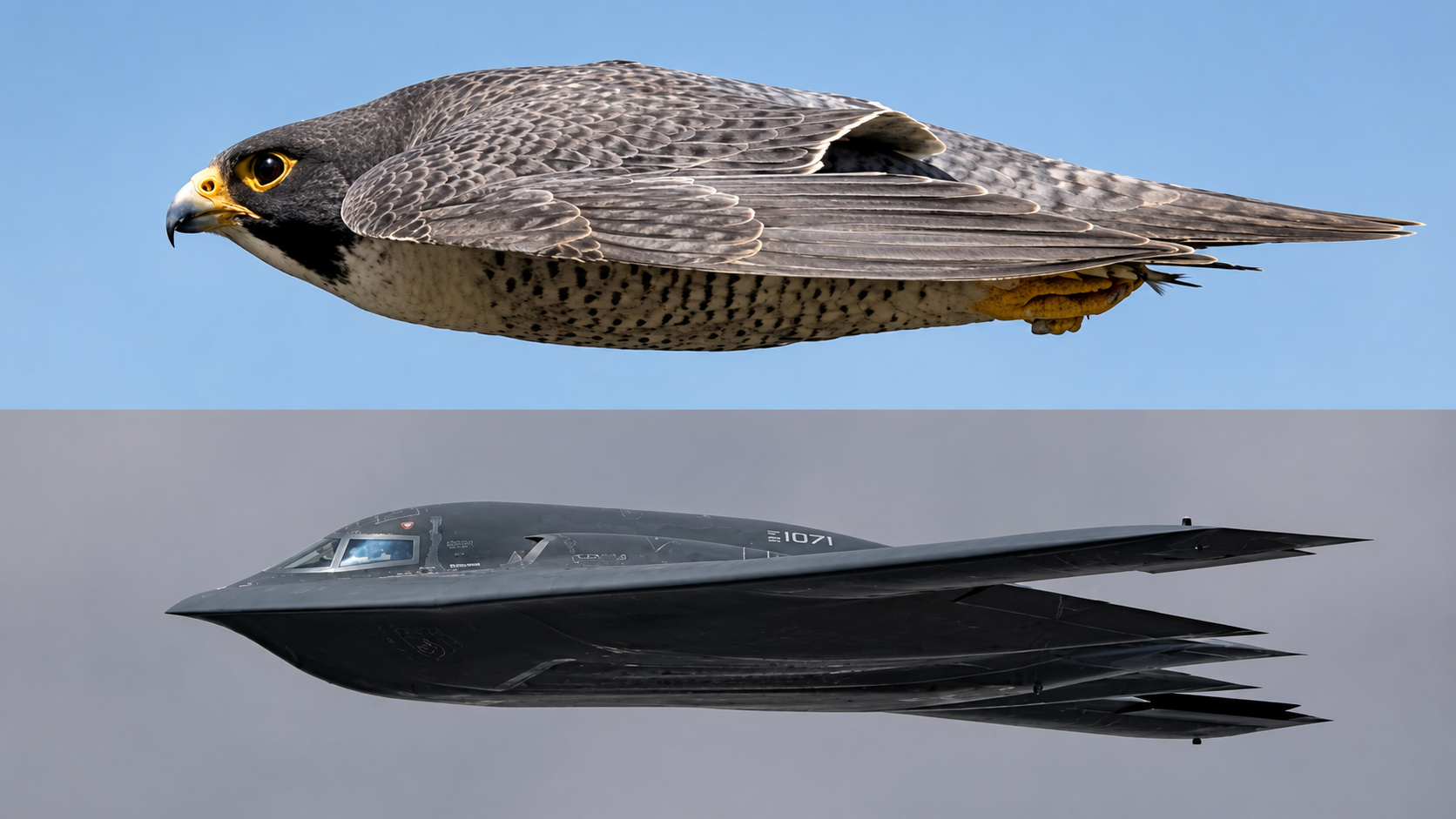
Nature, Stealth, and the Shape of Speed
At first glance, the B-2 Spirit stealth bomber looks less like a traditional aircraft and more like a shadow moving across the sky.
It has no obvious tail. Its body blends smoothly into its wings. From a distance, it can look almost unreal—silent, flat, dark, and mysterious. For decades, the B-2 has been one of the most recognizable military aircraft in the world, not only because of its power, but because of its strange and unforgettable shape.
That shape has led many people to ask one fascinating question:
Was the B-2 Spirit based on the peregrine falcon?
You May Also Like
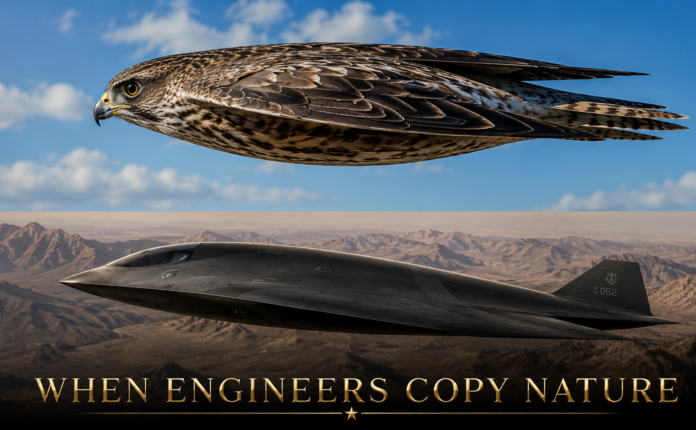
The answer is not simple.
There is no widely confirmed official evidence showing that the B-2 was directly copied from the peregrine falcon. The bomber was designed around advanced stealth requirements, flying-wing aerodynamics, radar reduction, and long-range military performance. But the comparison between the B-2 and the peregrine falcon is still powerful—and easy to understand.
Both are built around the same idea: move through the air with maximum efficiency.
The peregrine falcon is one of nature’s most incredible flyers. When it dives toward prey, its body becomes narrow, sharp, and controlled. Its wings fold close. Its profile becomes sleek. Every part of its body seems designed to cut through the air with speed and precision.
The B-2 Spirit, in a completely different world of engineering, follows a similar visual language. Its smooth flying-wing shape reduces drag and helps manage how it appears to radar. Like the falcon, it does not waste shape. Every line has a purpose.
That is why the comparison captures people’s imagination. Even when engineers build machines with computers, wind tunnels, classified materials, and decades of research, nature often seems to have solved similar problems first.
The Peregrine Falcon: Nature’s High-Speed Hunter
The peregrine falcon is famous for speed. During a hunting dive, called a stoop, it can reach extreme speeds that make it one of the fastest animals on Earth.
But speed alone is not what makes the peregrine remarkable.
The true miracle is control.
A bird diving at such high speed must manage air pressure, balance, stability, vision, and timing. It cannot simply fall from the sky. It must aim, adjust, brake, turn, and strike with incredible accuracy.
Its body is shaped for this mission. Its pointed wings reduce drag. Its compact form helps it slice through the air. Its feathers help control airflow. Its eyes remain focused on the target. Its body becomes a living aircraft.
That is why aviation fans often compare the peregrine falcon to advanced aircraft. The falcon is not only fast—it is efficient, disciplined, and deadly precise.
The B-2 Spirit represents a different kind of flight. It is not designed to dive like a falcon or chase prey through the sky. It is a strategic bomber designed to travel long distances, penetrate defended airspace, and avoid detection. But the visual connection remains strong: both the falcon and the B-2 show how powerful a smooth, controlled shape can be in the air.
The B-2 Spirit: A Flying Wing Built for Stealth
The B-2 Spirit was not created to look beautiful. It was created to survive.
Its design is centered on stealth. Traditional aircraft have tails, vertical stabilizers, engine shapes, and sharp angles that can reflect radar energy back toward enemy sensors. The B-2’s flying-wing design reduces many of those obvious radar-reflecting features.
Instead of looking like a normal bomber, the B-2 looks like one continuous wing.
This design helps the aircraft in several ways. It improves aerodynamic efficiency, supports long-range flight, and contributes to its low-observable profile. Its special materials, coatings, and classified technologies work together to reduce radar, infrared, visual, acoustic, and other signatures.
That is why the B-2 became a symbol of modern air power. It was not just another bomber. It was a statement: the future of warfare would not only be about speed or firepower, but also about who could be seen—and who could remain invisible.
The B-2’s shape is part of that mission. Its smooth curves and blended body are not random. They are part of an engineering philosophy where every surface matters.
In that sense, the B-2 does share something with the peregrine falcon: both are shaped by the demands of survival in the air.
Was It Really Based on a Falcon?
This is where the story becomes important.
Many social media posts and online discussions claim that the B-2 was modeled after the peregrine falcon. The idea is attractive because the two shapes look connected. The falcon’s folded-wing dive and the B-2’s sweeping flying-wing profile both suggest speed, control, and aerodynamic efficiency.
But based on public information, it is more accurate to say this:
The B-2 was not officially proven to be based on the peregrine falcon, but it shares aerodynamic ideas that nature also demonstrates through birds like the peregrine.
That distinction matters.
The B-2 came from military engineering, stealth research, flying-wing aircraft history, and the work of companies like Northrop. Flying-wing designs existed long before the B-2. Engineers had been exploring tailless aircraft for decades because removing the fuselage and tail could improve efficiency and reduce drag.
The B-2 took that concept and pushed it into the stealth age.
The peregrine falcon, meanwhile, is a natural example of streamlined flight. It shows how a living creature can use body shape, wing position, and airflow control to achieve extreme performance.
So the best way to understand the connection is not as a direct copy, but as a powerful example of how nature and technology sometimes arrive at similar solutions.
Nature builds through evolution. Engineers build through design.
Both must obey the laws of physics.
Why Nature Keeps Inspiring Military Technology
The idea of learning from nature is called biomimicry.
Biomimicry means studying plants, animals, and natural systems to solve human problems. It is not science fiction. It is already used in engineering, architecture, robotics, materials science, medicine, and transportation.
Birds have inspired aircraft. Fish have inspired submarine shapes. Shark skin has inspired surface designs that reduce drag and bacterial buildup. Insects have inspired drones. Lotus leaves have inspired self-cleaning materials.
Why?
Because nature has spent millions of years testing designs.
A bird that cannot fly efficiently wastes energy. A leaf that stays wet and dirty may struggle to survive. A predator that cannot move quickly may go hungry. A prey animal that cannot escape may disappear.
Nature is a brutal testing ground. Weak designs fail. Efficient designs survive.
That is why engineers pay attention.
The peregrine falcon is a perfect example of natural aerodynamic success. Its shape is not decorative. It is functional. Its body is built around performance.
The B-2 Spirit is also functional. Its shape is not for style. It is for stealth, range, and mission success.
Different origins. Similar lesson.
Shape matters.
The Lotus Leaf: Another Example of Nature’s Hidden Engineering
The original question also mentions lotus leaves, or lily pads, and how their surfaces stay clean and dry.
This is another famous example of biomimicry.
Lotus leaves appear smooth from a distance, but under magnification, their surfaces contain tiny microscopic and nanoscopic structures. These structures make it difficult for water to spread across the leaf. Instead, water forms droplets, rolls away, and carries dirt with it.
This is often called the “lotus effect.”
Scientists and engineers have studied this natural process to develop self-cleaning surfaces, water-repellent coatings, and materials that resist dirt and moisture.
The lesson is simple but powerful: nature often hides advanced engineering in plain sight.
A falcon diving through the sky teaches us about speed and control. A lotus leaf teaches us about surface protection. A bird wing teaches us about lift. A fish body teaches us about movement through fluid. Even a tiny insect wing can teach engineers about stability and maneuvering.
The world around us is full of designs that humans are still trying to understand.
Why the B-2 Still Feels Like Something From the Future
Even decades after its introduction, the B-2 Spirit still looks futuristic.
Most aircraft from earlier generations are easy to identify as machines of their time. They have visible tails, cockpits, engines, and familiar airplane shapes. The B-2 is different. Its silhouette remains shocking because it does not follow the normal image of an aircraft.
It looks like a black wing.
That design gives it an almost mythical presence. When people see a B-2 fly over a stadium, airshow, or military event, they often stop and stare. It moves with a quiet, smooth confidence. It does not look like it is fighting the air. It looks like it belongs there.
That is one reason the peregrine falcon comparison remains popular. Both the bird and the bomber carry a sense of silent power.
The falcon does not announce itself before it strikes. It uses speed, height, timing, and precision.
The B-2 was designed around a similar military idea: reach the target before the enemy can effectively respond.
One belongs to nature. The other belongs to modern warfare.
Both represent the power of being hard to stop.
The Human Fascination With Machines That Look Alive
People are naturally drawn to machines that resemble living creatures.
A fighter jet may remind us of a hawk. A submarine may look like a whale or shark. A drone may move like an insect. A stealth bomber may look like a bird of prey.
This connection makes technology easier to understand. It helps people feel the design rather than only read technical details.
When someone says, “The B-2 looks like a falcon,” they are not only talking about shape. They are talking about emotion. They are seeing speed, danger, silence, and precision in one image.
That is why the B-2 Spirit has become more than an aircraft. It has become a symbol.
It represents the hidden side of air power: the mission no one sees coming, the aircraft that crosses oceans, the machine designed to appear on radar as little as possible.
The peregrine falcon represents a similar idea in nature: the hunter above the clouds, waiting for the perfect moment.
The Real Lesson: Nature and Engineering Are Connected
So, was the B-2 based on the peregrine falcon?
The safest answer is this:
Not officially—but the comparison reveals something important about flight.
Both the B-2 Spirit and the peregrine falcon show that the best flying shapes are often smooth, efficient, and purposeful. Both demonstrate the importance of reducing drag, controlling airflow, and shaping the body around the mission.
The falcon’s mission is survival.
The B-2’s mission is strategic deterrence and military power.
The lotus leaf’s mission is staying clean and dry.
Each one shows that design is never accidental. In nature and in engineering, form follows function.
That is why biomimicry continues to matter. The future of technology may not only come from laboratories, defense contractors, or computer models. Some of it may come from looking more carefully at birds, leaves, insects, fish, and the natural world around us.
Before humans built stealth bombers, nature had already built silent hunters.
Before humans created self-cleaning coatings, nature had already built leaves that could wash themselves.
Before engineers chased perfect efficiency, the sky was already full of living examples.
Final Thought
The B-2 Spirit may not have been directly copied from the peregrine falcon, but the comparison still tells a beautiful story.
It reminds us that the natural world is not simple. It is full of hidden intelligence, refined by time, pressure, and survival. The peregrine falcon shows us the art of speed. The lotus leaf shows us the science of clean surfaces. The B-2 Spirit shows us what happens when human engineering tries to master the same invisible forces of air, shape, and motion.
In the end, the question is not only whether the B-2 was based on the falcon.
The bigger question is this:
How many of tomorrow’s greatest inventions are already flying, growing, swimming, or moving quietly around us today?