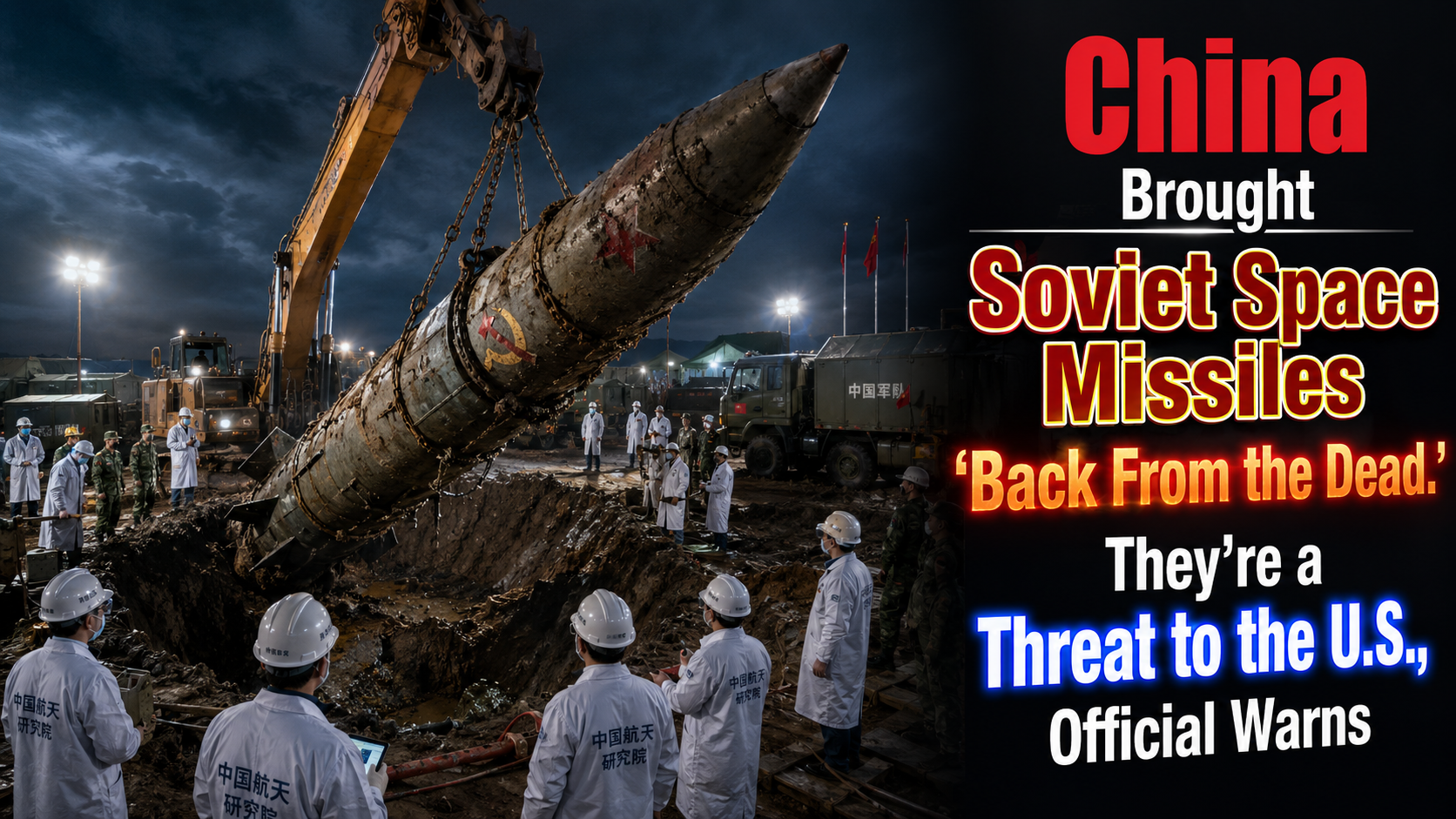
A weapon once feared during the Cold War is back in the spotlight as U.S. officials warn that China’s new missile technology could challenge America’s defenses from space.
A dangerous idea from the Cold War may be returning in a modern and more advanced form.
During the 1960s, the United States and the Soviet Union were locked in a nuclear standoff. Both sides built powerful missiles capable of crossing oceans and striking cities thousands of miles away. But behind the scenes, Soviet engineers were working on something even more alarming — a weapon that could travel through space before dropping toward its target.
That system was called the Fractional Orbital Bombardment System, or FOBS.
Unlike a normal intercontinental ballistic missile, which follows a more predictable path over the Earth, FOBS was designed to send a nuclear warhead into a partial orbit. It would not complete a full circle around the planet. Instead, it could travel through space, approach from an unexpected direction, and drop back toward Earth with very little warning.
You May Also Like


For U.S. defense planners, this created a terrifying problem. America’s early-warning systems were mainly built to watch for Soviet missiles coming over the North Pole. A FOBS-style weapon could potentially come from another direction, making it harder to detect and giving leaders less time to respond.
Decades later, that Cold War fear is being discussed again — this time because of China.
China’s New Missile Concern
U.S. defense officials and analysts have warned that China is developing advanced missile systems that may combine old Soviet-style orbital concepts with modern hypersonic technology.
Hypersonic glide vehicles are designed to travel at extremely high speeds, maneuver during flight, and fly lower than traditional ballistic missiles. That makes them harder to track and potentially harder to intercept.
When combined with a fractional orbital bombardment concept, the result could be a weapon that travels through space, moves at hypersonic speed, and approaches a target from a direction defenders do not expect.
That is why some officials see China’s testing and development as a serious challenge to U.S. homeland defense.
The concern is not only speed. It is surprise.
A weapon that can reduce warning time, avoid traditional detection routes, and strike from unexpected angles could force the United States to rethink how it protects its homeland.
What Made FOBS So Dangerous?
To understand why this issue matters, it helps to go back to the Cold War.
The Soviet Union developed FOBS as a way to bypass America’s missile-warning network. Instead of launching missiles along expected paths, the system could send a warhead into low orbit and then bring it down before completing a full orbit around Earth.
This design created a legal and strategic gray area.
The 1967 Outer Space Treaty banned placing nuclear weapons in orbit or stationing weapons of mass destruction in outer space. But FOBS did not need to complete a full orbit. It was designed to enter a partial orbit and then quickly deorbit toward a target.
That made it one of the most controversial weapons concepts of its time.
The Soviet system was eventually abandoned, partly because the United States improved its early-warning systems and because other nuclear delivery methods became more reliable. But the idea never completely disappeared.
Now, with China’s military modernization and rapid advances in hypersonic weapons, FOBS is once again being discussed as a possible future threat.
Why the U.S. Is Paying Attention
China’s military power has expanded rapidly in recent years. Its nuclear force is growing, its missile technology is improving, and its space capabilities are becoming more advanced.
For the United States, the fear is that China may be building a weapon that can challenge traditional missile defense systems.
A normal ballistic missile is already difficult to stop. A hypersonic weapon is even harder. A space-based or fractional-orbital delivery system could make the challenge greater by reducing warning time and creating uncertainty about where the attack is coming from.
Retired U.S. military officials have warned that America must be able to detect, track, and defend against this kind of threat. The concern is simple: if a weapon can be placed into a partial orbit, the United States needs to know when it happens and where it is going.
But not every expert agrees that China’s system is a game changer.
Some defense scholars argue that America’s modern warning systems are much stronger than they were during the 1960s. They believe China would have little chance of launching a completely surprise nuclear attack against the United States. In their view, the threat is serious, but not unstoppable.
Still, even if the weapon does not guarantee surprise, it could create pressure, confusion, and escalation during a crisis.
That is what worries many defense planners.
The Golden Dome Response
The growing concern over hypersonic and space-linked missile threats has helped fuel debate over America’s next-generation missile defense plans.
One major project is known as Golden Dome for America.
The goal of Golden Dome is to create a stronger shield for the United States against modern aerial threats, including ballistic missiles, hypersonic weapons, cruise missiles, drones, and other advanced systems.
Supporters say the project is necessary because America’s enemies are developing faster and more complex weapons. They argue that the United States must move beyond older missile defense models and build a layered system that can detect and stop threats earlier.
Critics, however, warn that such a system could be extremely expensive, technologically difficult, and potentially destabilizing. Some worry it could trigger a new arms race in space.
The debate reflects a larger question facing the United States: how do you defend a continent-sized country against weapons that can move faster, fly lower, maneuver unpredictably, and possibly travel through space?
There is no simple answer.
A New Arms Race in Space?
The return of FOBS-style thinking shows that the future of warfare may not be limited to land, sea, and air. Space is becoming a central part of national defense.
Satellites already guide weapons, track missile launches, support communications, and help militaries see what is happening on Earth. But as space becomes more important, it also becomes more vulnerable.
China, Russia, and the United States are all investing in space-related military capabilities. This raises the risk of a new kind of arms race — one where the battlefield extends beyond the atmosphere.
For ordinary people, this may sound distant or hard to imagine. But the consequences are very real.
If a future conflict includes weapons that travel through space or attack satellites, the impact could reach far beyond the military. Communications, GPS, banking systems, weather forecasting, and global transportation could all be affected.
That is why defense experts are watching China’s missile development so closely.
Should Americans Be Worried?
The answer depends on how the threat is understood.
China’s reported development of advanced missile systems does not mean an attack is imminent. It does not mean war is certain. But it does mean the balance of power is changing.
During the Cold War, the United States relied on early warning, deterrence, and overwhelming retaliation to prevent nuclear war. Today, those same ideas still matter, but the technology is different.
Missiles are faster. Sensors are more advanced. Space is more crowded. And great-power competition is becoming more intense.
China’s possible FOBS-style capability is part of that bigger picture.
It is a warning sign that old fears can return in new forms.
The Bigger Message
The most important lesson is not only about China or one missile system. It is about the speed of military change.
A weapon concept that once belonged to the Soviet Union is now being reimagined with modern technology. Hypersonic flight, space-based systems, artificial intelligence, and advanced sensors are reshaping how nations think about defense.
For the United States, this means the old playbook may no longer be enough.
America must be able to detect threats from every direction, track weapons that move unpredictably, and protect its people without creating unnecessary panic or escalation.
For the world, the return of space-related nuclear fears is a reminder that arms control, diplomacy, and defense planning are more important than ever.
The Cold War may be over, but some of its most dangerous ideas are not dead.
They are being rebuilt, modernized, and tested for a new era.