A Powerful Story of Loyalty, Sacrifice, and the Unbreakable Bond Between a Soldier and His Dog
Some heroes wear uniforms. Some carry rifles. Some fly jets, drive armored vehicles, or stand guard at lonely gates in dangerous places far from home.
And some heroes walk on four legs.
The viral story of K9 Valor has captured hearts across social media because it speaks to something deeply human: loyalty, courage, sacrifice, and love under fire. According to the widely shared account, Valor was not just a military working dog. He was a protector. A fighter. A guardian. A loyal partner who placed himself between danger and the men he served beside.
The story says Valor saved 47 soldiers, survived a suicide bomber, stopped three more attackers, and fought through unimaginable injuries. In the final act of his service, he reportedly placed his body between an explosion and his handler.
You May Also Like
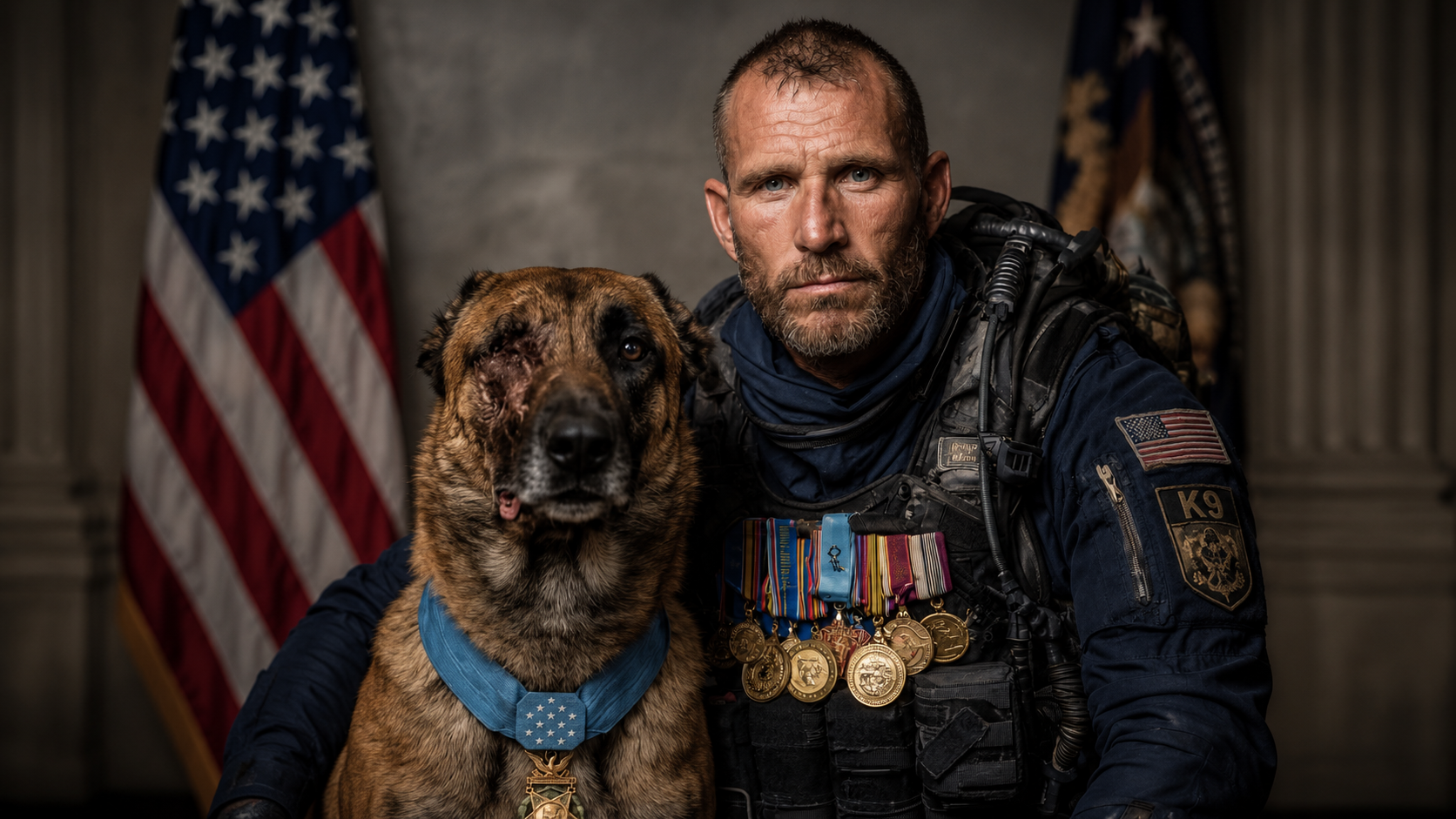
The blast shattered part of his face. He lost his left eye and ear. His jaw had to be rebuilt by surgeons. And later, at the Pentagon, the wounded K9 hero was said to have received a standing ovation that lasted more than eight minutes.
Whether told as a viral tribute, a battlefield legend, or an emotional reminder of what military working dogs endure, the story of K9 Valor has one message that is impossible to ignore:
Not every soldier is human. Not every hero can speak. And not every sacrifice is seen.
The Dog Who Would Not Back Down
In the viral account, Valor was the kind of military dog who did not hesitate.
He did not understand politics. He did not know headlines. He did not care about medals, applause, or ceremonies. Like many working dogs trained for combat, he understood the voice of his handler, the smell of danger, the rhythm of patrol, and the invisible language between soldiers who trust each other with their lives.
To the men around him, Valor was more than equipment. He was not just a dog assigned to a unit. He was a teammate.
He walked ahead when others stayed behind. He entered dangerous spaces first. He searched roads, buildings, vehicles, and suspicious ground where one wrong step could end a life. He used his nose to detect threats that human eyes could miss. He used his instincts to sense danger before chaos arrived.
That is the power of a military working dog.
Their job is not easy. They are trained for pressure, noise, explosions, gunfire, crowds, vehicles, and hostile environments. They work in heat, dust, darkness, and confusion. Their handlers learn to read every movement: a change in breathing, a shift in posture, a sudden stop, a focused stare.
Sometimes, that small signal is the only warning a patrol gets.
In the story of K9 Valor, that warning made the difference between life and death.
The Moment Everything Changed
The account says Valor survived a suicide bomber, then continued serving. That single detail is enough to stop anyone who understands the reality of combat.
An explosion does not simply end when the sound fades. It leaves behind smoke, blood, confusion, ringing ears, broken bodies, and memories that never completely disappear. For a dog, the trauma can be overwhelming. The blast, the heat, the pressure, the screams, the fear in the handler’s voice — all of it becomes part of the battlefield.
But the story says Valor kept going.
After surviving one attack, he reportedly helped stop three more. The phrase that spread online was unforgettable: “fighting tooth against knife.”
It sounds cinematic, almost impossible. But anyone who has seen a trained military or police dog in action understands the truth behind the image. These dogs are fast, fearless, and intensely loyal. When sent forward, they do not calculate odds. They do not hesitate because the enemy is armed. Their entire world narrows to one mission: protect the handler, stop the threat, finish the job.
That is why military working dogs are so respected by those who serve beside them.
They are not mascots.
They are not symbols.
They are partners in danger.
Between the Blast and His Handler
The most emotional part of Valor’s viral story comes near the end.
According to the account, Valor placed himself between an explosion and his handler.
That image is the reason the story spread so quickly. It is the kind of moment that breaks through politics, nationality, and even language. A dog sees danger. A dog moves forward. A dog takes the damage meant for the human he loves.
The blast reportedly tore through Valor’s body, shattering half his face. He lost his left eye and ear. His jaw was destroyed badly enough that surgeons later worked to rebuild it.
For many people reading the story online, this was the moment Valor became more than a military dog. He became a symbol of pure loyalty.
Because that is what dogs do.
They do not ask if we are worthy of their love. They do not ask if history will remember them. They do not understand speeches, awards, or applause. They only know the person they are bonded to. They only know the mission. They only know that when danger comes, they must move toward it.
That is why the handler-dog bond is so powerful.
A military working dog does not simply obey commands. He trusts. He listens. He protects. And in the most dangerous moments, that trust can become the thin line between survival and tragedy.
A Fight for Survival
After the blast, the story says Valor was flown to Germany, where surgeons worked to rebuild his jaw.
That detail reflects a painful reality of war: saving a wounded hero does not end on the battlefield. It continues in operating rooms, recovery wards, rehabilitation centers, and quiet moments where survival becomes its own mission.
A severely injured working dog may need emergency treatment, surgery, pain management, infection control, and long-term care. The wounds are not only physical. Military dogs can also carry stress and trauma from their service, just like the humans beside them.
If Valor’s story is read as a tribute to military working dogs, then this part matters deeply.
Too often, people remember the dramatic moment of sacrifice but forget the long road after it.
The surgery.
The healing.
The fear.
The missing eye.
The changed face.
The handler waiting for news.
The question no one wants to ask: will he survive?
In the viral story, Valor did survive.
Wounded, changed, scarred — but alive.
And sometimes survival itself is a form of victory.
The Pentagon Ovation
The story says that later, at the Pentagon, Valor received a standing ovation that lasted more than eight minutes.
Whether every detail of that ceremony can be independently verified or not, the image is powerful because it represents what many people believe military working dogs deserve: recognition.
Imagine the room.
Uniformed service members standing. Veterans wiping their eyes. Handlers remembering the dogs they served with. Families thinking of loved ones who came home because a K9 found a bomb before it exploded. A wounded dog standing quietly, not understanding the applause, not knowing that the room is honoring him.
That is the beauty and heartbreak of these animals.
They do extraordinary things without ever knowing how extraordinary they are.
Valor would not have understood the meaning of a standing ovation. He would not have understood that people were calling him a hero. He would not have understood the weight of his story traveling across the internet.
He would have looked for his handler.
That is what mattered to him.
Why K9 Valor’s Story Connects With So Many People
The reason this story went viral is not only because it is dramatic. It is because it touches something universal.
People understand loyalty.
They understand sacrifice.
They understand the love between a dog and a human.
Even people who have never served in the military can imagine the fear of losing a loyal companion. They can imagine a dog stepping forward when danger comes. They can imagine the pain of seeing a faithful animal wounded because he tried to protect someone else.
K9 Valor’s story connects because it reminds us that courage is not always loud.
Sometimes courage is a dog walking ahead of a patrol.
Sometimes courage is a nose pressed to the ground, searching for explosives.
Sometimes courage is a bark, a signal, a sudden stop that saves a convoy.
Sometimes courage is one final step between a blast and a friend.
That is why military working dogs hold such a special place in the hearts of service members. They do not just serve near soldiers. They serve with them.
They sleep near them.
They patrol with them.
They trust them.
They protect them.
And sometimes, they die for them.
The Real Legacy of Military Working Dogs
Beyond Valor’s viral story, there is a larger truth that deserves attention: military working dogs have saved lives for generations.
They have served in wars, security operations, search missions, bomb detection, patrols, and rescue efforts. They are trained to find explosives, locate hidden threats, track suspects, guard bases, and protect troops in places where danger can come from anywhere.
Their work is often invisible to the public.
When a bomb is found before it detonates, there may be no headline.
When a patrol turns back because a dog alerted to danger, there may be no viral post.
When a handler survives because his dog noticed what he could not see, the world may never know the dog’s name.
But the soldiers know.
The handler knows.
The unit knows.
And sometimes, that is the only record a hero receives.
This is why stories like Valor’s matter, even when readers should be careful to separate verified fact from viral legend. They remind the public to honor the real dogs who have served, suffered, protected, and sacrificed.
They remind us that behind every military working dog is a handler who trusted that animal with his life.
And behind every handler is a bond that war can test, but never fully break.
More Than a Dog
To people who have never worked with a military K9, it may be easy to say, “It was just a dog.”
But no handler would say that.
To a handler, a dog is a partner. A brother. A guardian. A living alarm system. A source of comfort in a violent place. A creature who can bring a moment of peace to a world full of fear.
Military dogs do not care about rank. They do not care about background. They do not care who is popular, powerful, rich, or poor. They care about loyalty, trust, routine, and love.
That purity is what makes them unforgettable.
A soldier can be trained to suppress fear. A dog can be trained to face danger. But the bond between them is something deeper than training. It is built through long days, repetition, discipline, shared hardship, and quiet trust.
The handler learns the dog’s signals.
The dog learns the handler’s voice.
And in combat, that bond becomes life-saving.
A Scar That Became a Symbol
In the viral version of the story, Valor’s wounds are described in painful detail: half his face shattered, one eye gone, one ear gone, jaw rebuilt.
Those scars became the center of the story because they show the cost of service.
People often celebrate heroes after the danger is over, but scars tell the truth. They show what courage costs. They show what was survived. They show that sacrifice is not just a word used in speeches. It is physical. It is permanent. It changes the body forever.
For Valor, the scarred face became a symbol of loyalty.
Not perfect.
Not untouched.
Not clean.
But alive.
And sometimes the most powerful heroes are not the ones who look untouched by battle. They are the ones who carry the evidence of what they endured and still remain gentle enough to rest their head near the person they saved.
Why America Honors K9 Heroes
America has a long tradition of honoring service, courage, and sacrifice. Usually, that honor goes to men and women in uniform. But more and more people are recognizing that military working dogs also deserve remembrance.
They do not choose war.
They do not understand politics.
They do not know the meaning of borders.
Yet they serve where they are sent.
They enter danger because humans ask them to. They trust their handlers completely. And when the mission demands it, they often go first.
That is why K9 heroes stir such emotion. They represent a kind of courage that feels innocent and pure. They are warriors without ego. Protectors without pride. Heroes without speeches.
The story of K9 Valor may be told in dramatic words, but its emotional power comes from a real truth: dogs have stood beside soldiers in some of the most dangerous places on earth.
And many never came home.
The Message Behind Valor’s Story
At its heart, the story of K9 Valor is about more than one dog.
It is about every military working dog who searched a road before a convoy moved forward.
It is about every K9 who entered a dark building before the soldiers behind him.
It is about every handler who whispered encouragement into a dog’s ear before a dangerous mission.
It is about every wounded dog carried to safety by the same troops he once protected.
It is about every veteran who still remembers the dog who helped him survive.
Valor’s story reminds us that courage can have paws. Loyalty can have teeth. Love can wear a collar. And sometimes the bravest soul on the battlefield is the one who cannot say a single word.
Final Salute
K9 Valor’s story has touched thousands because it gives people an image they cannot forget: a wounded dog, scarred by war, standing as proof that love and loyalty can be stronger than fear.
He may not have understood the applause.
He may not have understood the word “hero.”
He may not have understood why people cried when they saw his face.
But if the story tells us anything, it tells us this:
Valor understood his mission.
Protect the handler.
Protect the soldiers.
Stand between danger and the people he loved.
And that is why his story, whether read as a viral tribute or a symbol of all military working dogs, continues to move hearts.
Because a true hero does not always need a voice.
Sometimes, a true hero only needs loyalty, courage, and the will to step forward when everyone else is running for cover.
K9 Valor reminds us that some of America’s bravest warriors never wore boots. They left pawprints instead.