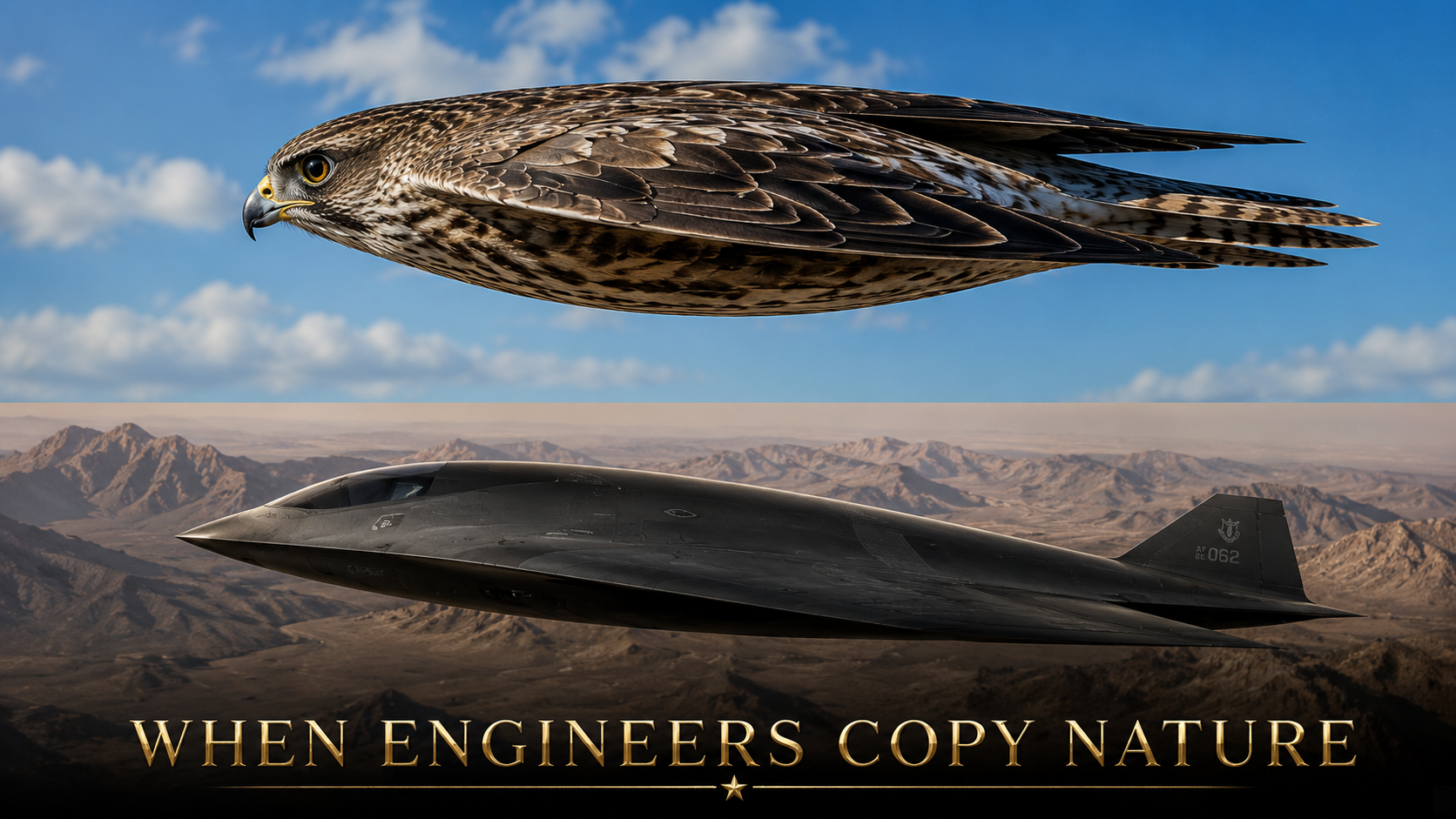
There are moments in engineering when human imagination seems to echo the genius of nature.
The Northrop B-2 Spirit is one of those moments.
To many observers, the B-2 Spirit does not look like a conventional airplane. It resembles a shadow. A silent crescent. A black wing gliding through the night.
And when viewed from above, its shape evokes one of the most remarkable hunters in the natural world: the Peregrine Falcon.
You May Also Like
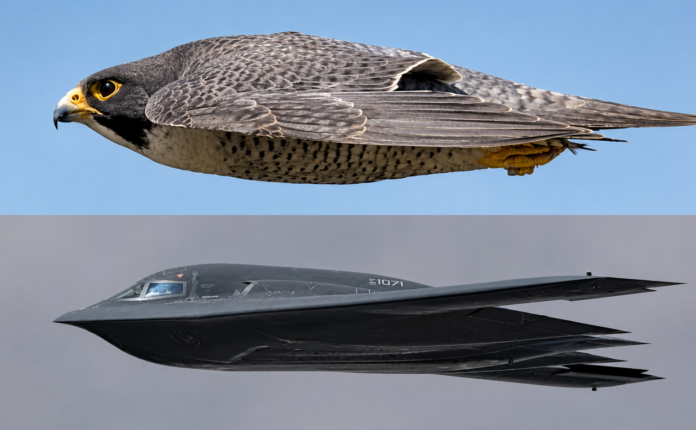
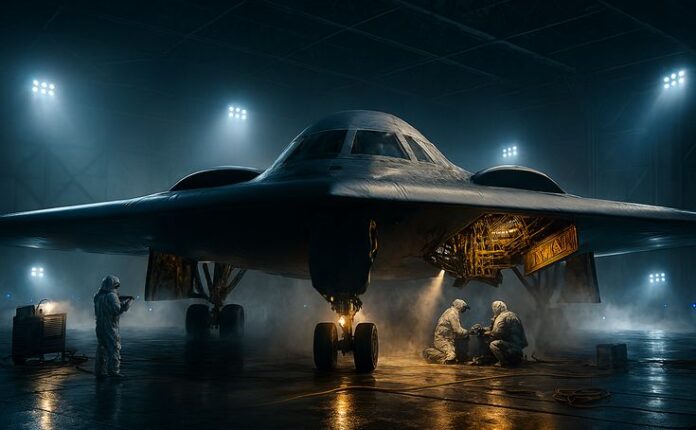

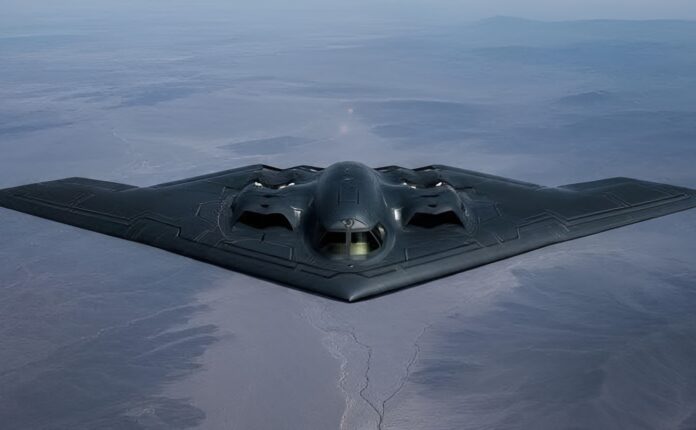
The comparison is striking.
Both are elegant.
Both are efficient.
Both are built for speed and surprise.
Both strike before their target fully understands what is happening.
One is a masterpiece of evolution.
The other is a masterpiece of engineering.
And together, they tell a powerful story about how humanity often advances by learning from nature.
Part I — The Falcon: Nature’s Ultimate Predator
The Fastest Creature on Earth
The peregrine falcon is the fastest animal ever recorded.
During its hunting dive—known as a stoop—it can exceed 240 miles per hour (386 km/h), and some measurements suggest even higher speeds.
From thousands of feet above, the falcon folds its wings into a streamlined shape and plunges toward its prey with extraordinary precision.
The victim often has no warning.
By the time danger is recognized, the attack is already over.
This extraordinary combination of speed, efficiency, and stealth has made the peregrine falcon one of nature’s most effective aerial predators.
A Shape Refined by Millions of Years
The falcon’s body is optimized for flight.
Its swept wings reduce drag.
Its smooth contours minimize turbulence.
Its compact structure provides exceptional aerodynamic efficiency.
Every feature serves a purpose.
Nature removed anything unnecessary and preserved only what worked.
That same philosophy lies at the heart of great aircraft design.
Part II — Jack Northrop’s Dream
The Visionary Who Wanted to Build a Pure Wing
Long before stealth technology, aviation pioneer Jack Northrop believed that the most efficient airplane would be a wing—and little else.
Traditional aircraft require fuselages, tails, and control surfaces that add weight and drag.
Northrop believed that eliminating those structures would create an aircraft that was lighter, more efficient, and capable of longer range.
This idea became known as the flying wing.
Early Flying Wings
Northrop’s experiments produced aircraft such as the Northrop YB-35 and the Northrop YB-49.
These machines were decades ahead of their time.
But the technology needed to control them reliably did not yet exist.
Without modern computers, the concept proved too difficult to operationalize.
Northrop’s dream was shelved.
But it was never forgotten.
Part III — The Birth of the B-2 Spirit
When Technology Caught Up to the Vision
By the late 20th century, advances in computers, composites, and radar science made the flying wing practical.
The result was the B-2 Spirit.
Developed by Northrop Grumman, the B-2 first flew in 1989 and entered service in the 1990s.
It combined Jack Northrop’s aerodynamic vision with revolutionary stealth technology.
Why the B-2 Looks Like a Bird
The B-2’s shape is not a literal copy of the peregrine falcon.
Its design was driven by engineering and stealth requirements.
Yet the resemblance is profound because both nature and engineers were solving similar problems:
- Reduce drag.
- Maximize lift.
- Minimize unnecessary structures.
- Approach the target efficiently.
- Strike with precision.
When two very different designers—evolution and aerospace engineers—seek the same goal, they often arrive at similar forms.
Part IV — The Science of Stealth
Not Invisible, but Hard to Detect
The B-2 was designed to evade radar by minimizing reflections.
Its smooth, continuous surfaces scatter radar energy away from the transmitter.
The lack of vertical tails removes strong radar-reflecting surfaces.
Radar-absorbent materials further reduce its signature.
The result is one of the most survivable bombers ever built.
Silent Hunter of the Night
Like a peregrine falcon diving from above, the B-2 is designed to arrive with minimal warning.
It can fly intercontinental missions, penetrate defended airspace, and deliver precision weapons against high-value targets.
Its strategic impact is psychological as much as physical.
It forces adversaries to assume that no target is truly beyond reach.
Part V — Biomimicry: Learning From Nature
When Engineers Study the Natural World
Biomimicry is the practice of drawing inspiration from nature to solve human problems.
Examples include:
- Shark skin inspiring drag-reducing surfaces.
- Owl feathers informing quieter technology.
- Kingfisher beaks influencing high-speed train design.
- Bird wings shaping aircraft aerodynamics.
The B-2 is an example of this broader principle, even if indirectly.
Nature and engineering converged on a shape of extraordinary efficiency.
Why Similar Shapes Reappear
Certain aerodynamic forms are simply effective.
When the objective is efficient high-speed flight with minimal drag, crescent and swept-wing configurations repeatedly emerge.
The resemblance between the falcon and the B-2 is a reminder that physics rewards certain solutions.
Part VI — Combat Legacy of the B-2 Spirit
Global Reach
The B-2 has participated in operations over:
- Kosovo.
- Afghanistan.
- Iraq.
- Libya.
It can take off from the United States, strike targets anywhere in the world, and return home after missions lasting more than 30 hours.
Precision and Deterrence
The B-2 carries both conventional and nuclear weapons.
Its unique ability to penetrate defended airspace makes it one of the most powerful tools of strategic deterrence.
Even a small fleet can have outsized influence because potential adversaries must account for its capabilities at all times.
Part VII — The B-21 and the Future
Evolution Continues
The forthcoming Northrop Grumman B-21 Raider carries forward the lessons of the B-2.
It also retains the flying wing configuration, confirming that the basic concept remains one of the most effective solutions ever devised.
Jack Northrop’s vision continues to shape the future of airpower.
Part VIII — The Deeper Meaning
Nature as the Greatest Engineer
The story of the B-2 and the peregrine falcon is about more than appearance.
It is about a universal truth.
Nature spent millions of years refining solutions to the challenges of flight.
Humanity, at its best, learns from those solutions and transforms them into technologies that expand our capabilities.
Two Predators, One Principle
The falcon hunts to survive.
The B-2 exists to deter conflict by ensuring that aggression carries unacceptable risk.
Both rely on speed, efficiency, and the element of surprise.
Both demonstrate the power of elegant design.
Final Thoughts: When Human Ingenuity Follows Nature’s Blueprint
The B-2 Spirit is one of the most extraordinary aircraft ever built.
Its shape reflects decades of engineering and the enduring vision of Jack Northrop.
Yet its resemblance to the peregrine falcon reminds us that the most advanced technologies often echo forms perfected in the natural world.
One was sculpted by evolution.
The other was forged by human imagination.
Both glide with purpose.
Both strike with precision.
Both embody the quiet power of design that appears almost effortless.
In the sweeping silhouette of the B-2 Spirit, we see more than a bomber.
We see a lesson written across the sky:
The closer human ingenuity comes to understanding nature, the more extraordinary our creations become.