

You May Also Like


The oceans cover more than 70 percent of our planet, yet much of the underwater world remains less explored than the surface of the Moon. Hidden beneath those dark waters are fragile ecosystems, strategic shipping lanes, submarine cables carrying the world’s internet traffic, and naval forces that help shape global power.
For decades, engineers tried to conquer this realm with propellers, metal hulls, and conventional underwater vehicles. But nature had already solved the problem millions of years ago.
The answer was gliding silently through the sea all along.
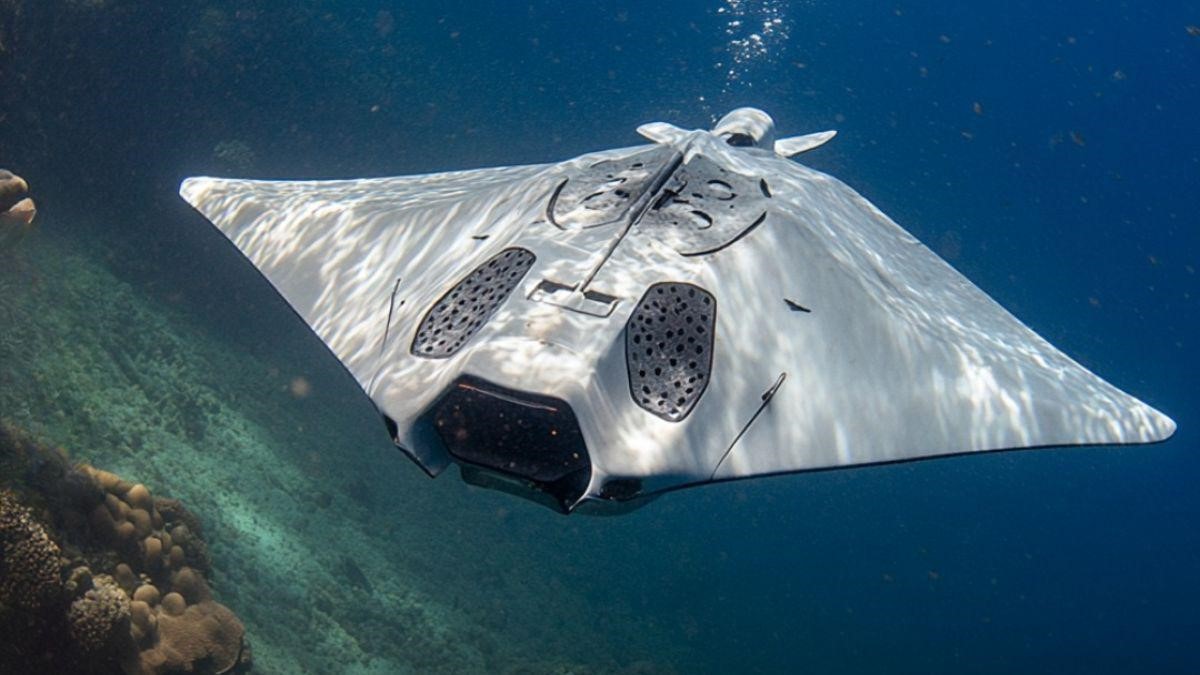
With wide, wing-like fins and extraordinary efficiency, manta rays move through the ocean with almost no wasted motion. They are quiet, graceful, and astonishingly agile. Today, Chinese engineers are turning that biological masterpiece into one of the most fascinating technologies of the 21st century: autonomous underwater drones modeled after the manta ray.
These machines are more than engineering curiosities. They represent a revolutionary fusion of biology, artificial intelligence, robotics, and military strategy.
And they may redefine how humanity explores—and controls—the oceans.
Nature as the Ultimate Engineer


A manta ray appears effortless in motion.
Its broad pectoral fins generate smooth undulating waves that produce lift and thrust simultaneously. Unlike propellers, which create turbulence and noise, manta rays glide almost silently, conserving energy while maintaining exceptional maneuverability.
Nature optimized this design over millions of years.
Key biological advantages include:
- Minimal hydrodynamic drag
- Low acoustic signature
- Tight turning ability
- Excellent energy efficiency
- Stable motion in turbulent currents
For roboticists, the manta ray offers an ideal template.
If engineers can replicate this natural locomotion, they gain a vehicle that is stealthier, quieter, and more efficient than traditional underwater drones.
China’s Vision: Building a Mechanical Manta Ray
At the forefront of this effort is Northwestern Polytechnical University, one of China’s premier aerospace and marine engineering institutions.
Researchers there have developed biomimetic underwater vehicles that reproduce the fin movements of real manta rays using:
- Flexible composite materials
- Artificial muscles and servo systems
- Hydrodynamic control algorithms
- Autonomous navigation software
- Energy-efficient battery systems
Instead of spinning propellers, these drones flap their wing-like fins to move through the water.
The result is a robotic creature that appears almost alive.
Its movement is smooth, silent, and highly efficient—an extraordinary example of technology learning directly from nature.
From Laboratory Prototype to Operational System
Early prototypes focused on proving that manta ray motion could be replicated mechanically.
That alone was a major challenge.
Real manta rays constantly adjust fin shape, amplitude, and timing in response to currents and obstacles. Engineers had to build systems capable of matching this complexity.
By 2023 and 2024, Chinese researchers reported successful tests demonstrating:
- Stable cruising
- Sharp turns
- Hovering capability
- Energy-efficient propulsion
- Autonomous waypoint navigation
By 2025, these systems were increasingly discussed as viable platforms for practical deployment.
What began as a research project had evolved into a strategic capability.
Deep-Sea Performance: Built for the Hidden World


Operating in the deep ocean is one of engineering’s greatest challenges.
Pressure rises dramatically with depth, temperatures fall near freezing, and communications become difficult.
China’s manta-inspired drones were designed to endure these conditions.
Reported capabilities include:
- Pressure-resistant hulls
- High-capacity lithium batteries
- Sonar mapping systems
- Optical cameras
- Obstacle avoidance sensors
- Autonomous navigation
Some prototypes have been described as capable of operating at depths exceeding 1,000 meters.
At these depths, the drone enters an environment where sunlight disappears and only machines can venture safely.
Silent Endurance: Why Efficiency Matters
Traditional underwater drones often sacrifice endurance for speed.
Propellers consume significant power and generate detectable noise.
Biomimetic propulsion offers a different solution.
By imitating the natural efficiency of manta rays, these drones can remain submerged for extended periods while using less energy.
Benefits include:
- Longer mission durations
- Reduced battery consumption
- Lower maintenance demands
- Near-silent operation
- Improved stealth
In military and scientific missions alike, endurance is one of the most valuable attributes.
A drone that can remain hidden and operational for 24 hours or more becomes a powerful strategic tool.
Swarm Intelligence Beneath the Waves


Perhaps the most remarkable feature of these drones is their ability to work together.
Inspired by schools of fish, multiple units can coordinate as an autonomous swarm.
Each drone shares data with nearby units and adjusts behavior without relying on a central controller.
This decentralized intelligence offers major advantages:
- Mapping vast areas quickly
- Maintaining coverage if one unit fails
- Surrounding points of interest
- Adapting to obstacles and currents
- Increasing resilience in contested environments
One drone is useful.
A coordinated swarm becomes transformative.
Scientific Applications: Exploring Without Disturbing
For marine scientists, these drones open extraordinary possibilities.
Their quiet movement allows them to study sensitive species without causing stress or behavioral disruption.
Potential research missions include:
- Coral reef monitoring
- Whale and dolphin observation
- Ocean temperature and salinity measurement
- Pollution assessment
- Deep-sea habitat exploration
Because they move like marine animals, they can blend into natural environments more effectively than noisy propeller-driven vehicles.
They become observers rather than intruders.
Industrial Applications: Guardians of Critical Infrastructure
The global economy depends on hidden infrastructure beneath the sea.
This includes:
- Internet cables
- Oil and gas pipelines
- Offshore wind farms
- Ports and harbor facilities
Manta-inspired drones can inspect these assets efficiently and quietly.
They can detect corrosion, structural damage, and unauthorized interference while reducing the cost and risk associated with manned inspections.
As the world grows more dependent on undersea infrastructure, these robotic guardians become increasingly valuable.
Military Potential: The Quiet Revolution Underwater


The same characteristics that make these drones useful for science also make them strategically important.
They are:
- Quiet
- Difficult to detect
- Energy efficient
- Highly maneuverable
- Capable of swarm coordination
Potential defense missions include:
- Underwater reconnaissance
- Harbor surveillance
- Mine detection
- Anti-submarine support
- Battle damage assessment
- Monitoring contested maritime zones
In sensitive areas such as the South China Sea, these drones could provide persistent underwater awareness without exposing human crews.
Their greatest weapon is not firepower.
It is invisibility.
The South China Sea and Strategic Competition
China’s investment in underwater robotics aligns with its broader maritime ambitions.
The South China Sea is one of the world’s most strategically significant waterways, carrying trillions of dollars in trade and containing vital energy resources.
Persistent underwater drones could help China:
- Monitor naval movements
- Inspect seabed infrastructure
- Track submarine activity
- Strengthen territorial claims
- Improve maritime domain awareness
This capability extends influence quietly and continuously.
In the future, underwater swarms may become as important as satellites and aircraft.
Biomimicry: When Nature Inspires Strategic Power
Biomimicry is the practice of designing technology based on solutions found in nature.
Examples include:
- Bird-inspired aircraft wings
- Gecko-inspired adhesives
- Sharkskin-inspired coatings
- Manta ray-inspired underwater drones
Nature offers designs refined by evolution over millions of years.
By studying those designs, engineers achieve solutions that are both elegant and efficient.
China’s manta drones are a striking example of this philosophy in action.
Technical Challenges Still Ahead
Despite their promise, several challenges remain.
Power Limitations
Battery capacity still constrains mission duration.
Underwater Communication
Radio waves do not travel well underwater, forcing reliance on acoustic communication with limited bandwidth.
Harsh Environments
Saltwater corrosion, pressure, and marine growth affect long-term reliability.
Navigation
GPS is unavailable underwater, requiring sophisticated inertial and sonar-based systems.
Ethical and Security Concerns
Dual-use technology raises concerns about surveillance and military escalation.
These challenges are significant, but they are engineering problems—not insurmountable barriers.
Environmental and Ethical Questions
The deployment of autonomous underwater systems raises important questions.
Could large fleets disrupt marine ecosystems?
How should nations regulate military drones in disputed waters?
Who owns the data collected from the deep ocean?
As technology expands humanity’s reach, responsibility must expand as well.
The oceans are not merely strategic spaces.
They are living systems essential to the health of the planet.
China’s Strategic Advantage
By combining robotics, AI, materials science, and marine engineering, China is positioning itself as a global leader in underwater technology.
This provides several advantages:
- Scientific prestige
- Commercial opportunities
- Export potential
- Maritime security enhancement
- Real-world military capability
In the same way stealth aircraft transformed airpower, biomimetic underwater drones may transform maritime operations.
A New Era of Ocean Exploration
The most inspiring aspect of these drones is what they represent.
They show that technological progress does not always require overpowering nature.
Sometimes the greatest breakthroughs come from learning from it.
The manta ray perfected silent movement over millions of years.
Human engineers studied that design and transformed it into a machine capable of exploring the darkest depths of the ocean.
This is innovation at its finest.
Final Analysis: The Future Glides on Silent Wings
China’s manta ray-inspired underwater drones are more than remarkable machines.
They are symbols of a profound shift in how technology is conceived and applied.
They combine:
- Biological inspiration
- Artificial intelligence
- Autonomous swarming
- Scientific discovery
- Strategic capability
Whether used to map coral reefs, inspect undersea cables, or monitor contested waters, these drones reveal a future where machines move with the elegance of living creatures.
The next great revolution in robotics may not roar with engines or thunder through the sky.
It may glide silently beneath the waves.
And like the manta ray itself, it will be graceful, efficient, and extraordinarily powerful.