The Day the Missile Failed
The radar operators watched their screens in disbelief.
A strange target had appeared high above their territory.
It wasn’t a fighter.
It wasn’t a bomber.
You May Also Like
And it certainly wasn’t moving at a normal speed.
Within minutes, alarms sounded throughout the air defense network.
Orders were issued.
Missiles were prepared.
Tracking stations locked onto the mysterious intruder.
Then came the launch.
A surface-to-air missile roared into the sky, accelerating toward its target at incredible speed.
For most aircraft, this would have been the beginning of a desperate fight for survival.
Pilots would dive.
Turn.
Deploy countermeasures.
Attempt to escape.
But the crew of the aircraft being targeted did something completely different.
They pushed the throttles forward.
That was it.
No violent maneuvering.
No panic.
No evasive action.
Just acceleration.
The X-1 Debate: Elon Musk’s UFO Jet and the Future of Flight

As the missile climbed higher and higher, the distance between it and the aircraft should have closed.
Instead, the gap grew larger.
The target simply pulled away.
Within moments the missile was no longer gaining.
The aircraft continued accelerating beyond Mach 3.
The missile eventually ran out of energy and fell harmlessly back toward Earth.
The aircraft continued its mission.
This was not science fiction.
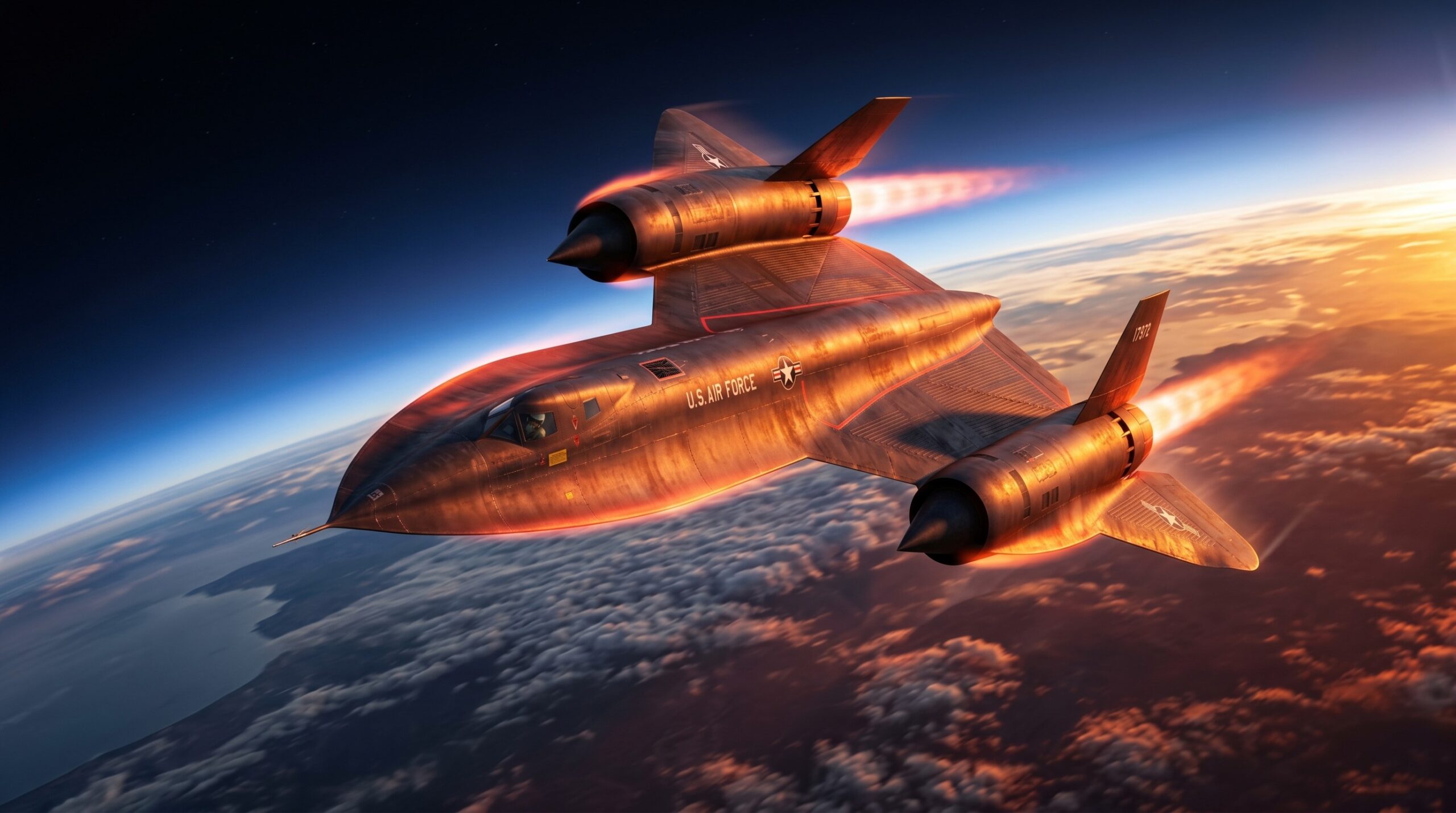
This was the SR-71 Blackbird.
An aircraft so advanced, so fast, and so far ahead of its time that even decades after retirement it remains one of the most legendary machines ever built.
Many aircraft become famous.
Very few become myths.
The Blackbird became both.
Even today, military pilots, engineers, and aviation enthusiasts speak about it with a level of respect normally reserved for history’s greatest achievements.
It was not simply an airplane.
It was a masterpiece of engineering.
A machine born from one of the most dangerous periods in human history.
A machine built to do the impossible.
And for more than three decades, it succeeded.

This Soviet MiG-31 Tried to Take on America’s SR-71 Spy – MiG-31: A fighter ahead of its time Plane
Why America Needed the Blackbird
To understand the Blackbird, we must first understand the world that created it.
The year was 1960.
The Cold War was intensifying.
The United States and the Soviet Union were locked in a struggle that affected nearly every corner of the globe.
Neither side trusted the other.
Both sides possessed nuclear weapons capable of destroying entire cities.
Knowing what the other side was doing became critically important.
Intelligence could mean the difference between peace and catastrophe.
At the time, satellites were still in their infancy.
Reconnaissance aircraft were the primary way to gather information.
But there was a problem.
Traditional aircraft could be intercepted.
And in May 1960, the world witnessed exactly that.
An American U-2 spy plane piloted by Francis Gary Powers was shot down deep inside Soviet territory.
The incident shocked Washington.
If America’s most advanced reconnaissance aircraft could be destroyed, a new solution would be needed.
The answer would not be stealth.
At least not yet.
The answer would be speed.
Extreme speed.
The idea was simple.
Build an aircraft so fast and so high that nothing could catch it.
Many experts believed such an aircraft was impossible.
The engineers at Lockheed’s legendary Skunk Works disagreed.
Led by aviation genius Clarence “Kelly” Johnson, they began developing what would eventually become the SR-71 Blackbird.
The result would change aviation history forever.

Under the Radar: Stealth Technology’s Dark Secrets
Building the Impossible
From the beginning, the project faced enormous challenges.
Flying faster than Mach 3 wasn’t simply a matter of installing larger engines.
Everything about the aircraft had to be reinvented.
At such speeds, friction with the atmosphere generates tremendous heat.
Temperatures across parts of the aircraft would exceed 500 degrees Fahrenheit.
Ordinary aluminum aircraft structures would warp or fail.
The engineers needed a material capable of surviving extreme temperatures.
They chose titanium.
Today titanium is relatively common.
In the 1960s it was revolutionary.
Nearly 85 percent of the Blackbird’s structure would eventually be made from titanium.
Working with titanium was incredibly difficult.
Tools broke.
Manufacturing techniques had to be invented.
Engineers repeatedly encountered problems nobody had faced before.
Every challenge required a new solution.
Every solution pushed aerospace engineering further into the future.
The Blackbird became one of the most technologically ambitious aircraft programs ever attempted.
And somehow, it worked.
The Aircraft That Leaked Fuel on Purpose
One of the strangest facts about the SR-71 is that it leaked fuel while sitting on the ground.
To most people, that sounds like a serious problem.
In reality, it was intentional.
At Mach 3, the aircraft became so hot that its entire structure expanded.
Engineers knew the airframe would grow several inches during flight.
To accommodate this expansion, small gaps existed between panels when the aircraft was cold.
Fuel would slowly drip from these gaps before takeoff.
Ground crews often placed containers beneath the aircraft.
Only after reaching operating temperatures would the panels expand and seal properly.
Imagine building a machine that becomes larger while flying.
That was the reality of the Blackbird.
Every aspect of its design reflected the extreme environment in which it operated.

“IS THE AGE OF THE PILOTED FIGHTER JET COMING TO AN END?”
Life Inside the Cockpit
Flying the Blackbird was unlike flying any other aircraft.
At 85,000 feet, the sky above looked almost black.
The curvature of Earth became visible.
The atmosphere appeared thin and distant.
Pilots operated at altitudes where human beings could not survive without specialized equipment.
Before every mission, crews spent hours preparing.
They wore full pressure suits similar to those used by astronauts.
Pure oxygen was breathed before flight to remove nitrogen from the bloodstream.
Without these precautions, dangerous medical complications could occur at high altitude.
The cockpit itself resembled something from a spacecraft.
Every mission required extraordinary concentration.
At Mach 3, the aircraft covered roughly 35 miles every minute.
A small navigation error could quickly become a major problem.
Blackbird pilots were among the most highly trained aviators in the world.
Even experienced military pilots considered assignment to the SR-71 community an enormous honor.
The Missile That Could Not Catch It
Over the course of its operational career, the SR-71 was tracked by enemy radar countless times.
Numerous missiles were launched against it.
Yet no SR-71 was ever lost to enemy action.
The aircraft’s greatest defense was its speed.
When radar operators detected a missile launch, crews often responded with the same procedure.
Accelerate.
The Blackbird could cruise comfortably above Mach 3.
At those speeds, interception became extraordinarily difficult.
By the time many missiles reached the aircraft’s altitude, the target had already moved far beyond the predicted intercept point.
Former crew members often joked that the aircraft’s most effective defensive system was the throttle lever.
Although simplified for storytelling, the reality remains astonishing.
The SR-71 consistently demonstrated survivability unlike anything before or since.

THE GHOST THAT COST BILLIONS
A Legacy That Refuses to Fade
The SR-71 was officially retired in 1998.
Yet its legend only grew stronger.
No operational military aircraft today combines its altitude, speed, and reconnaissance capability in quite the same way.
Its records remain remarkable.
Its appearance still looks futuristic.
Its engineering achievements continue to inspire new generations of aerospace designers.
More than half a century after its first flight, the Blackbird remains a symbol of human ingenuity.
It represents a time when engineers were asked to solve impossible problems—and somehow succeeded.
Many aircraft served their countries.
Some changed aviation.
Only a handful changed history.
The SR-71 Blackbird did all three.
And that is why, even today, it remains one of the most extraordinary aircraft ever built.




One Comment on “The SR-71 Blackbird: The Aircraft That Flew So Fast Missiles Could Not Catch It”