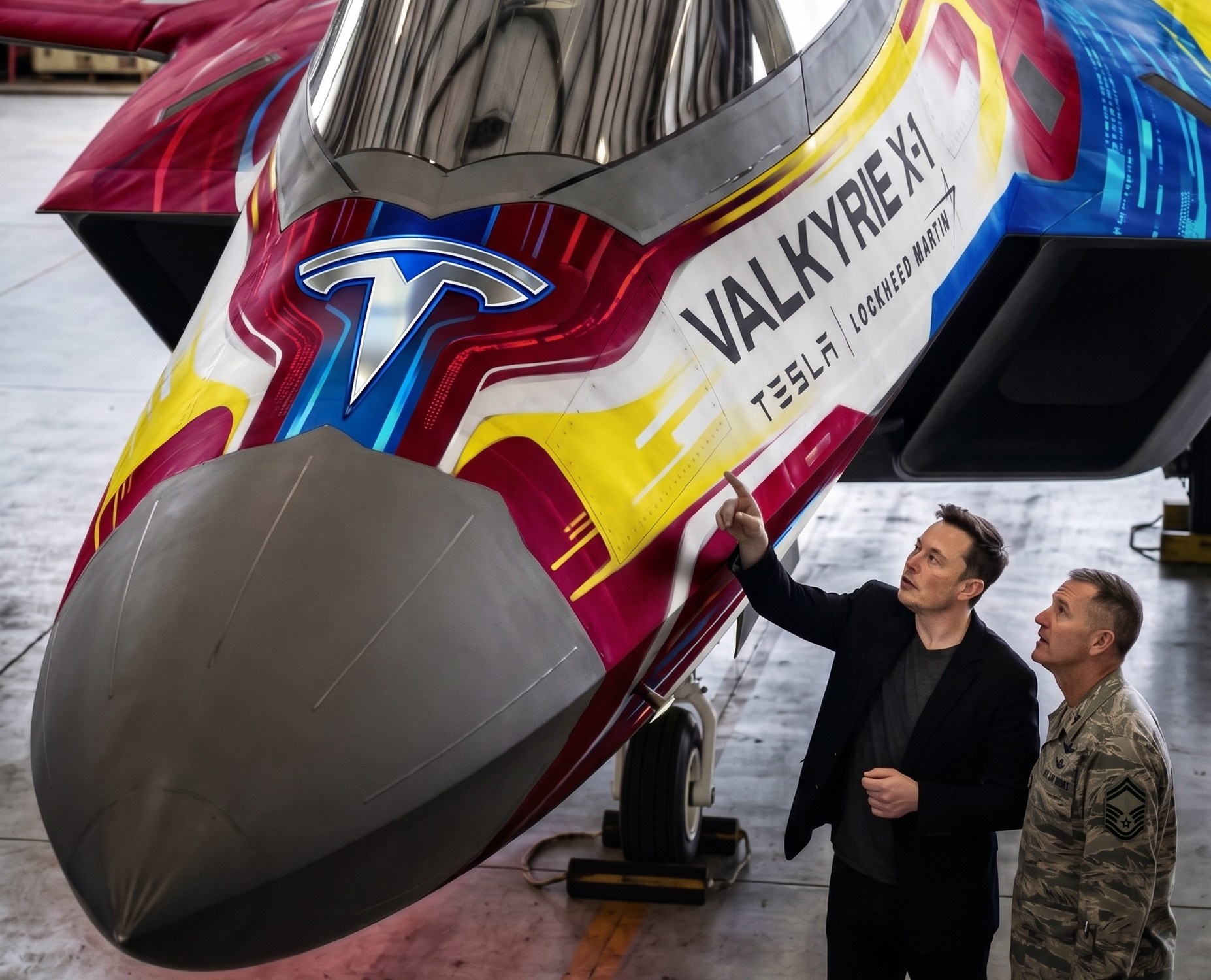
THE LAST PILOT IN THE SKY
A Three-Part Debate Story Between Two Scientists About Elon Musk, Fighter Jets, Drones, and the Future of War
Main Characters
Professor Adrian Vale
A brilliant aerospace scientist, futurist, and former adviser to several advanced defense technology programs. He believes Elon Musk is seeing the future clearly: piloted fighter jets are becoming outdated, too expensive, and too vulnerable. To Vale, drones are not just another weapon. They are the beginning of a new military age.
Professor Miriam Sato
A respected professor of military systems engineering and strategic technology. She has worked on aircraft survivability, electronic warfare, and defense ethics. She believes Musk has identified a real problem but has exaggerated the conclusion. To her, fighter jets are not dead. They are changing.
Moderator: Elena Cross
A sharp, elegant host of the International Forum for Future Warfare. She knows how to turn a technical discussion into a public battle of ideas.
“IS THE AGE OF THE PILOTED FIGHTER JET COMING TO AN END?”
Professor Adrian Vale walked onto the stage first. He wore a dark suit, no tie, and the calm smile of a man who knew he was about to offend half the room.
You May Also Like

Professor Miriam Sato entered next. Her expression was quieter, colder, almost unreadable. She carried a small notebook, placed it on the table, and looked at Vale as if she had already heard his best argument and found three holes in it.
The moderator, Elena Cross, stepped to the podium.
Elena Cross:
Ladies and gentlemen, tonight we examine one of the most controversial questions in modern defense technology. Elon Musk recently criticized the F-35 fighter jet and questioned the wisdom of continuing to build piloted combat aircraft in an age of drones, artificial intelligence, and autonomous warfare. His words were harsh. His meaning was clear. He believes the future belongs not to pilots, but to machines.
She paused.
Elena Cross:
So tonight, we ask: is Musk right? Are piloted fighter jets becoming relics of the past? Or are drones being overhyped by people who confuse battlefield trends with total replacement? Professor Vale, Professor Sato, the stage is yours.
The lights dimmed.
Professor Vale leaned toward his microphone.
And the first shot was fired.
PART ONE: MUSK’S MATCH IN THE FUEL TANK
Professor Adrian Vale:
Let us begin honestly. Elon Musk said what many people in defense circles whisper but rarely say out loud: building extremely expensive piloted fighter jets in the drone age may be madness.
A stir moved through the audience.
Professor Miriam Sato:
And let us also begin honestly. Elon Musk has a talent for turning complicated engineering debates into explosive one-liners. That does not mean the one-liner is wrong. But it does mean we should not confuse drama with doctrine.
Vale:
Drama wakes people up.
Sato:
Sometimes. Other times, it makes them stupid faster.
A few people laughed.
Vale:
Musk mocked the F-35 after seeing a video of drones flying in formation. His point was simple: while one part of the world is building swarms, autonomy, and cheap unmanned systems, another part is still spending fortunes on aircraft that require a human pilot inside them. His question was brutal, but fair: why are we still building machines that put humans directly in harm’s way?
Sato:
Because some missions still require human judgment.
Vale:
That is the old answer.
Sato:
Old answers are not automatically wrong.
Vale:
No, but they become dangerous when people repeat them without noticing that the world has changed.
Sato:
And new answers become dangerous when people worship them before testing them.
Vale:
Fine. Then let us test the old answer. The F-35 is one of the most expensive weapons programs in history. It was designed to serve multiple branches of the U.S. military and many allied countries. It had to be a stealth fighter, a strike aircraft, a sensor platform, an electronic warfare asset, and in some versions, even a short takeoff and vertical landing aircraft. That is not elegant engineering. That is a committee with wings.
Sato:
That is a good insult, not a complete analysis.
Vale:
It tried to become everything for everyone.
Sato:
True.
Vale:
And when an aircraft tries to be everything, it risks becoming too complex, too expensive, and too politically protected to fail.
Sato:
Also true.
Vale:
Then why defend it?
Sato:
Because identifying flaws in the F-35 program is not the same thing as proving the death of piloted fighters.
Vale:
But the F-35 is the symbol of the old system.
Sato:
No. It is a symbol of a transitional system. That distinction matters.
Vale:
Transitional to what?
Sato:
To a battlespace where manned aircraft, unmanned aircraft, satellites, missiles, cyber systems, and electronic warfare all operate together.
Vale:
That sounds like a very expensive way of saying “drones are coming.”
Sato:
No. It is a careful way of saying “drones are not magic.”
Vale:
No serious person says they are magic.
Sato:
Plenty of unserious people say it with serious faces.
Vale:
Then let me be serious. The logic of the future battlefield is clear: remove the human from the platform, reduce political risk, increase numbers, accept losses, iterate quickly, and overwhelm the enemy. That is the future. It is not emotional. It is mathematical.
Sato:
War is never only mathematical.
Vale:
But mathematics decides who can afford to keep fighting.
Sato:
And strategy decides whether the fighting means anything.
Vale:
You are avoiding the economics.
Sato:
No, I am adding the missing pieces. You say drones are cheaper. Which drones?
Vale:
Small FPV drones. Loitering munitions. Autonomous swarms. Long-range attack drones. Loyal wingman drones. Unmanned combat aircraft.
Sato:
That is not one category. That is six different categories pretending to be one word.
Vale:
They all share the same basic advantage: no pilot.
Sato:
A refrigerator also has no pilot. That does not make it airpower.
The audience burst into laughter. Vale smiled despite himself.
Vale:
Good. But the point stands. A human pilot is a limitation. The aircraft must support life, withstand human g-forces, include cockpit systems, ejection seats, oxygen supply, training infrastructure, and risk management around one irreplaceable human body. Remove the pilot, and the design changes completely.
Sato:
That is one of your strongest points. An unmanned aircraft can theoretically maneuver harder, be smaller, be cheaper, be more expendable, and take risks no pilot should take.
Vale:
Exactly.
Sato:
But theory has a way of getting shot down by air defenses.
Vale:
So do pilots.
Sato:
Yes. Which is why the answer is not simply “keep pilots.” The answer is to understand which missions still benefit from human presence and which missions should be handed to machines.
Vale:
You are arguing for a mixed future.
Sato:
Of course.
Vale:
Mixed futures are what institutions propose when they are afraid to admit the old age is dying.
Sato:
No. Mixed futures are what serious people propose when reality refuses to behave like a tweet.
A murmur of approval moved through the room.
Vale:
Let me ask you something, Miriam. If you were designing a combat aircraft from a blank page today, and there were no existing bureaucracies, no military nostalgia, no defense contractors, no pilots’ associations, no national pride attached to the cockpit — would you put a human inside?
Sato looked at him carefully.
Sato:
For some missions, no.
Vale turned to the audience.
Vale:
There it is.
Sato:
Do not celebrate. For other missions, yes.
Vale:
Why?
Sato:
Because not every mission is a suicide dash into enemy airspace. Some missions involve deterrence. Some involve intercepting unknown aircraft. Some involve complex rules of engagement. Some involve signaling political commitment. Some involve operating in environments where communications are jammed and the unexpected happens every minute.
Vale:
Autonomy can handle surprise.
Sato:
Autonomy can handle certain kinds of surprise. Humans can handle meaning.
Vale:
Meaning?
Sato:
Yes. Machines classify. Humans interpret. There is a difference.
Vale:
A shrinking difference.
Sato:
Perhaps. But not yet a dead one.
Vale:
You are defending the pilot as philosopher.
Sato:
I am defending the pilot as accountable agent.
Vale:
And I am defending the soldier who does not have to die because we were too sentimental to remove him from the machine.
That line landed harder. Several people in the audience stopped smiling.
Sato:
That is morally powerful. I will not dismiss it. If a machine can do a dangerous mission instead of a person, we should consider it seriously.
Vale:
Then Musk’s question is moral too.
Sato:
Yes. But morality has two sides here. Removing your pilot from danger may make it easier for your country to use force. When the cost is only machines, leaders may choose war more easily.
Vale:
That is not an argument against drones. That is an argument against bad leaders.
Sato:
Technology changes what bad leaders can do.
Vale:
So does every weapon.
Sato:
Exactly. Which is why we should be cautious when someone announces the end of one era and the birth of another as if replacing pilots with algorithms is only an efficiency upgrade.
Vale:
You make it sound sinister.
Sato:
No. I make it sound human.
PART TWO: THE LESSONS OF UKRAINE
The screen changed.
Now it showed a Ukrainian battlefield: trenches, smoke, destroyed armor, and in the corner of the image, a small quadcopter watching silently from above.
Elena Cross:
Professor Vale, many people argue that the war in Ukraine proves your point. Drones have become central to reconnaissance, artillery correction, direct attack, and psychological warfare. Do you believe Ukraine is the preview of the post-fighter-jet world?
Vale:
I believe Ukraine is the first chapter of a book militaries were not ready to read.
Sato:
That is a strong sentence. I disagree with half of it.
Vale:
Which half?
Sato:
The “post-fighter-jet” implication. Ukraine shows that drones are indispensable. It does not prove that fighters are obsolete.
Vale:
Ukraine shows that cheap systems can defeat expensive systems. That is the revolutionary lesson.
Sato:
Sometimes. Under certain conditions. Against certain targets. With certain limitations.
Vale:
You are burying the revolution in footnotes.
Sato:
You are selling the revolution without reading the warranty.
Vale:
Look at what happened. Small drones began as eyes in the sky. Then they became artillery spotters. Then they became grenade droppers. Then FPV drones became flying anti-armor weapons. Then long-range drones began striking oil facilities, airbases, ships, radar stations, and infrastructure. Every month, the battlefield adapted.
Sato:
Yes. The speed of adaptation has been extraordinary.
Vale:
Exactly. Now compare that to the life cycle of a fighter jet. Development takes decades. Procurement becomes political. Upgrades are slow. Costs rise. Every aircraft becomes too precious to risk. The drone war is fast, messy, cheap, and adaptive. That is why it wins.
Sato:
Careful. It wins where its conditions are favorable.
Vale:
Conditions can be created.
Sato:
Not always. A small FPV drone can terrify soldiers in trenches. It cannot establish air superiority over a continent.
Vale:
Not one drone. But thousands?
Sato:
Thousands of short-range drones still do not become an air superiority system unless they can find, reach, identify, and destroy enemy aircraft across distance and altitude.
Vale:
Then build different drones.
Sato:
Now you are back to expensive drones.
Vale:
Not necessarily.
Sato:
Yes, necessarily. The moment you demand long range, high speed, stealth, survivability, advanced sensors, secure communications, resistance to jamming, and large payload, cost rises. Physics sends the invoice.
Vale:
But even if advanced drones become expensive, they still do not risk pilots.
Sato:
Agreed. That is the strongest reason they will grow.
Vale:
So what are we arguing about?
Sato:
We are arguing about replacement versus transformation.
Vale:
Explain.
Sato:
Replacement says: drones make fighter jets obsolete. Transformation says: drones change what fighter jets do, how many are needed, where they fly, and how they fight.
Vale:
That sounds softer, but perhaps more realistic.
Sato:
It is realistic. The future air force may use piloted fighters as command nodes, stealth sensor platforms, missile carriers, or controllers of unmanned wingmen. The human may not fly directly into the most dangerous zone. The drones may go first.
Vale:
So the pilot becomes a shepherd of machines.
Sato:
Possibly.
Vale:
A shepherd sitting inside a very expensive sheep.
Sato:
That was terrible.
Vale:
But accurate.
Sato:
No, because the F-35 is not merely a shooter. Its defenders argue that it is a sensor fusion platform. It sees, collects, shares, and coordinates information. In many scenarios, its value is not only dropping bombs but understanding the battlespace.
Vale:
Then why put a human in it?
Sato:
Because a human can make decisions at the edge of uncertainty.
Vale:
Or slow everything down.
Sato:
Both can be true.
Vale:
In Ukraine, the side that adapts fastest survives. Soldiers modify drones in workshops. Software changes overnight. New antennas appear. New jamming appears. New counter-jamming appears. It is a living laboratory of war. That is the future. Not billion-dollar aircraft programs.
Sato:
I agree that the innovation cycle is one of Ukraine’s biggest lessons. But let us discuss another lesson: drones die in enormous numbers.
Vale:
That is the point. They are meant to die.
Sato:
Some are. But dependence on disposable systems creates supply chain hunger. Batteries, cameras, chips, radio modules, explosives, trained operators, repair networks — all of it becomes part of the fight.
Vale:
Better to lose a thousand drones than ten pilots.
Sato:
Yes. But if those thousand drones fail because the enemy jams them, spoofs them, blinds them, or destroys their operators, then the system collapses.
Vale:
Then build autonomous drones.
Sato:
Autonomy solves some problems and creates others.
Vale:
You keep saying that. Give me one concrete example.
Sato:
Target identification. Imagine an autonomous drone searching for an enemy vehicle. It sees a thermal shape. It resembles a military truck. It is near a contested road. The communication link is jammed. Does it strike?
Vale:
Depends on programming.
Sato:
Exactly. Who wrote the programming? What data trained the model? How does it handle civilian vehicles? What if the enemy uses decoys? What if the heat signature is from an ambulance? What if the algorithm is 92 percent confident? Is 92 percent enough to kill?
Vale:
Human pilots make those judgment calls with imperfect information too.
Sato:
Yes, but we know how to assign responsibility to human command chains. We are still struggling to assign responsibility to machine decisions.
Vale:
Responsibility should belong to the commander who deploys the system.
Sato:
Legally simple. Technically difficult. Politically explosive.
Vale:
War is already politically explosive.
Sato:
Which is why adding opacity is not a small matter.
Vale:
Let us turn to large drones. You will say the Bayraktar TB-2 had early success in Ukraine and then became more vulnerable once Russian air defense adapted.
Sato:
Because it is true.
Vale:
I concede it. Large drones flying slowly in contested airspace are vulnerable. But that does not weaken the drone argument. It strengthens the swarm argument. Do not send a few expensive drones. Send many cheap ones. Make defense economically impossible.
Sato:
That is a serious concept: saturation. Use cheap systems to overwhelm expensive defenses. But it has limits. Swarms require coordination. Coordination requires communication or autonomy. Communication can be jammed. Autonomy can be fooled. And swarms still need to reach the target.
Vale:
Missiles can deliver them. Aircraft can launch them. Ships can launch them. Trucks can launch them.
Sato:
Now we agree again. But notice what happened. Your future is not “drones replace jets.” Your future is “drones become part of a much larger strike architecture.”
Vale:
Only because the transition is not complete yet.
Sato:
Or because no single tool wins alone.
Vale:
Let me ask another question. During World War I, aircraft were first used for scouting. Later they carried bombs. Later they fought each other. At first, generals saw them as accessories. Then they became central. Are drones not following the same path?
Sato:
Yes. That is one of your best historical comparisons.
Vale:
Thank you.
Sato:
But remember: aircraft did not make artillery, infantry, ships, or tanks disappear. They changed all of them. Drones will do the same. They will not erase every old platform overnight.
Vale:
But some old platforms will die.
Sato:
Yes.
Vale:
And piloted fighters?
Sato:
They will shrink before they die.
Vale:
That is still death.
Sato:
Eventually, perhaps. But “eventually” is where futurists hide their mistakes.
Vale:
And “not yet” is where institutions hide their fear.
The audience clapped.
Elena Cross:
Let us pause there. I want each of you to answer directly. If Musk were sitting here, what would you tell him?
Vale:
I would tell him: you are right to attack complacency. The future belongs to unmanned systems, distributed intelligence, and mass. But stop making it sound like all drones are the same. A swarm of quadcopters is not a stealth bomber.
Sato:
I would tell him: you are right that the F-35 should be criticized, and right that drones are reshaping warfare. But you are wrong if you think an insult can replace strategy. The future will not be won by people who shout “drones” every time they see an expensive airplane.
Vale:
I almost agree with that.
Sato:
That must be uncomfortable.
Vale:
Deeply.
PART THREE: THE SKY AFTER PILOTS
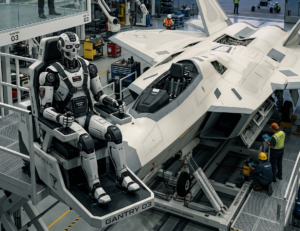
The auditorium grew darker. The screen now showed a fictional future battlefield.
Satellites watched from orbit.
Cyber systems attacked invisible networks.
Small drones crawled through ruined streets.
Larger drones circled above clouds.
A stealth fighter flew far from enemy radar range.
Beside it, unmanned wingmen carried missiles.
The question on the screen changed:
“WHAT COMES AFTER THE FIGHTER PILOT?”
Elena Cross:
We now enter the final part of tonight’s debate. I want both of you to imagine the year 2055. What does air combat look like?
Vale:
By 2055, the traditional fighter pilot is mostly gone from frontline combat. Not completely gone from ceremonies, training, air policing, or legacy systems — but gone from the center of high-end war. The decisive air battles will be fought by autonomous systems, drone swarms, long-range missiles, space-based sensors, electronic attack, and artificial intelligence.
Sato:
By 2055, piloted fighters may still exist, but their role will be narrower. They will not charge alone into enemy territory like the heroes of old war movies. They will operate as nodes in a network. They may command unmanned aircraft, launch stand-off weapons, gather intelligence, and provide human judgment when the stakes are too complex for full autonomy.
Vale:
So even you admit the romantic fighter ace is dead.
Sato:
The romantic fighter ace has been mostly dead for a long time. Modern air combat is not two pilots twisting through clouds with machine guns. It is sensors, missiles, data, stealth, electronic warfare, and decisions made before pilots can even see each other.
Vale:
Then why keep the pilot?
Sato:
Because the death of romance is not the death of usefulness.
Vale:
Nice line.
Sato:
Thank you. I wrote it while you were insulting committees.
Vale:
I stand by my insult.
Sato:
I know.
Vale:
Let us talk about loyal wingmen. These are unmanned aircraft designed to fly with or ahead of piloted fighters. They can carry sensors, weapons, jammers, or decoys. They can take risks the manned aircraft should not. This is already proof that the pilot is being pushed backward.
Sato:
Yes. It is one of the clearest signs of transformation. The manned fighter becomes less like a duelist and more like a quarterback.
Vale:
Until the quarterback is replaced by software.
Sato:
Perhaps. But do not underestimate the value of a human commander in a complex battlespace.
Vale:
Do not overestimate it either. Humans get tired. Humans panic. Humans misread data. Humans have limited reaction speed. Humans require rescue if shot down. Humans are expensive to train. Humans create political crises when captured. Machines do not.
Sato:
Machines fail silently, hallucinate patterns, follow bad instructions perfectly, and scale mistakes at machine speed.
Vale:
That is why you test them.
Sato:
Testing cannot reproduce every wartime condition.
Vale:
Pilot training cannot either.
Sato:
Correct. Which is why humility matters.
Vale:
Humility is not a strategy.
Sato:
Neither is arrogance.
Vale:
Let us imagine an air campaign. Enemy territory is defended by radar, surface-to-air missiles, jammers, fighter aircraft, cyber attacks, and decoys. You need to destroy a mobile missile launcher hidden deep inland. What do you send?
Sato:
First, I do not send one thing. I use satellites, signals intelligence, cyber operations, electronic warfare, decoy drones, perhaps stealth aircraft, perhaps long-range missiles, perhaps unmanned systems. The strike depends on timing, target confidence, political rules, and acceptable risk.
Vale:
You sound like a committee again.
Sato:
I sound like someone who has planned something more complicated than a tweet.
Vale:
I would send waves of drones.
Sato:
What kind?
Vale:
First wave: cheap decoys to trigger radar. Second wave: electronic attack drones to jam. Third wave: loitering munitions to hunt air defense systems. Fourth wave: heavier autonomous strike drones to destroy the launcher.
Sato:
Good. Now what happens if the enemy keeps radar off, uses passive sensors, deploys fake launchers, jams GPS, spoofs communications, and moves the real launcher under civilian cover?
Vale:
Then the drones adapt.
Sato:
How?
Vale:
Onboard AI. Multi-sensor recognition. Collaborative search patterns.
Sato:
What if the AI is uncertain?
Vale:
It waits or requests human authorization.
Sato:
Communication is jammed.
Vale:
Then it follows pre-authorized rules.
Sato:
And if the rules produce civilian casualties?
Vale:
Then the rules were badly written.
Sato:
By humans.
Vale:
Yes.
Sato:
So the human never leaves the war. He only moves from cockpit to code.
That sentence froze the room for a moment.
Vale:
That may be true. But moving the human out of the cockpit still matters.
Sato:
It does. I agree.
Vale:
Then perhaps we are debating the wrong question.
Sato:
What is the right question?
Vale:
Not “will drones replace fighter jets?” But “where should the human be located in the kill chain?”
Sato:
That is the real debate.
Vale:
Cockpit, command center, software design, political authorization, battlefield supervision — the human can move.
Sato:
Yes. And each location has consequences.
Vale:
A pilot in the cockpit has courage and immediate context but limited information and high personal risk.
Sato:
A remote operator has distance and perhaps more data, but may suffer from communication delays or psychological detachment.
Vale:
A commander authorizing autonomous rules has strategic control but may not see the specific moment of killing.
Sato:
A programmer shapes decisions before the battle but may never know the battlefield where those decisions unfold.
Vale:
That is terrifying.
Sato:
That is why the drone future is not simply “cleaner war.”
Vale:
But it may be less deadly for the side using drones.
Sato:
Yes. And possibly more tempting.
Vale:
You keep returning to temptation.
Sato:
Because power without risk changes political behavior.
Vale:
Did airpower not already do that?
Sato:
It did. Drones intensify the question.
Vale:
So you are not anti-drone.
Sato:
Not at all. I am anti-fantasy.
Vale:
And I am anti-nostalgia.
Sato:
Then perhaps we are useful enemies.
Vale:
I prefer “intellectual rivals.”
Sato:
Enemies sells more tickets.
The audience laughed again.
The Surprise Question
Elena Cross stepped away from the podium and walked closer to the two professors.
Elena Cross:
I have a question neither of you received in advance.
Vale raised an eyebrow.
Sato picked up her pen.
Elena Cross:
Imagine a young student is watching this debate. She dreams of becoming a fighter pilot. She believes flying is noble, difficult, beautiful, and meaningful. What do you tell her?
The hall became quiet.
Vale answered first, but his voice changed. It lost some of its sharpness.
Vale:
I would tell her that her dream is not foolish. The desire to fly is one of the oldest human dreams. Pilots are brave, disciplined, and extraordinary. But I would also tell her that the battlefield she imagines may not be the battlefield she inherits. She may become less of a lone warrior and more of a commander of intelligent machines. If she loves flying only for romance, she may be disappointed. If she loves mastery, responsibility, and adaptation, she may still have a place.
Sato nodded slowly.
Sato:
That is a good answer.
Vale:
Careful. People will think we agree.
Sato:
For once, I hope they do.
Then Sato turned toward the audience.
Sato:
I would tell her: do not let anyone convince you that courage becomes obsolete because technology changes. The tools change. The sky changes. The cockpit may change. But the need for disciplined judgment does not disappear. Whether you sit in a fighter jet, a control center, a command aircraft, or a laboratory designing autonomous systems, the question remains the same: can you be trusted with power?
No one laughed this time.
Elena Cross:
Professor Vale, do you think there will be fighter pilots in the next century?
Vale:
In museums, yes.
A few groans came from the fighter pilots in the audience.
Vale smiled.
Vale:
All right, not only museums. There may be pilots in limited roles. But the main trend is unmistakable. The most dangerous missions will move away from human bodies. The future combat aircraft will be increasingly unmanned. It may begin with loyal wingmen. Then optionally manned aircraft. Then autonomous strike systems. Eventually, the pilot becomes the exception.
Sato:
And I would say the pilot becomes rarer, not irrelevant.
Vale:
That is a softer extinction.
Sato:
No. It is specialization.
Vale:
What is the difference?
Sato:
Extinction means no role remains. Specialization means the role survives where it still matters.
Vale:
Like cavalry?
Sato:
Cavalry did not disappear entirely. It transformed into armored and air-mobile forces. The horse vanished from most battlefields, but the function of mobility survived.
Vale:
So the pilot vanishes, but air command survives.
Sato:
Perhaps.
Vale:
Then we are close.
Sato:
Closer than your opening insult suggested.
PART FOUR: THE GHOST OF THE F-35
Elena Cross looked surprised by the energy in the room. The official program had promised a three-part debate, but the audience was leaning forward, hungry for more.
She decided to push.
Elena Cross:
Let us return to the aircraft that started this public argument: the F-35. Is it a failure, a misunderstood success, or a symbol of a changing age?
Vale:
A symbol of a changing age — and of procurement excess.
Sato:
A troubled success.
Vale:
That phrase should be illegal.
Sato:
Many real things are troubled successes. Marriage. Democracy. Universities. Airplanes.
Vale:
The F-35 was sold as a universal solution. That was the problem. One aircraft for the Air Force, Navy, Marines, and allies. One family of variants. One logistics ecosystem. One stealthy multirole platform. It promised commonality but produced complexity.
Sato:
That criticism has merit.
Vale:
It became too important to cancel, too expensive to ignore, and too politically distributed to attack easily. Factories, jobs, allies, contracts, software, upgrades — the aircraft became an empire.
Sato:
Also true. But again, cost disease does not equal battlefield uselessness.
Vale:
Would you call it beautiful engineering?
Sato:
In some ways, yes.
Vale:
You surprise me.
Sato:
It is easy to mock complexity. It is harder to build a stealth aircraft that can collect data, fuse sensor inputs, share information, carry precision weapons, and operate with allied forces. That does not excuse the program’s failures. But we should not pretend it is a flying mistake simply because it is expensive.
Vale:
Musk’s deeper point was that the requirements were flawed.
Sato:
And he may be right about that. When you ask one aircraft to satisfy too many masters, you create compromises.
Vale:
Compromise is the enemy of excellence.
Sato:
Sometimes. But in military systems, compromise is often survival. A perfect single-mission aircraft may be useless if the war demands flexibility.
Vale:
Then why not build modular drones?
Sato:
We should.
Vale:
Why not build cheap attritable aircraft instead of gold-plated stealth fighters?
Sato:
We should build some of those too.
Vale:
You keep agreeing with me and still refusing to surrender.
Sato:
Because your conclusion is too absolute.
Vale:
The F-35 cannot be produced like drones.
Sato:
Correct.
Vale:
It cannot be risked like drones.
Sato:
Correct.
Vale:
It cannot adapt as fast as drones.
Sato:
Correct.
Vale:
Then it is strategically fragile.
Sato:
Not necessarily. It depends on the mission. A rare, expensive asset can still be valuable if it enables effects that cheap systems cannot.
Vale:
Such as?
Sato:
Penetrating sensor coverage. Stealthy targeting. Allied interoperability. Long-range precision strike. Acting as a command node. Surviving in environments where non-stealthy aircraft and large drones would be destroyed.
Vale:
Until new radars detect it.
Sato:
Stealth is never invisibility. It is delay, confusion, reduced detection range, and tactical advantage.
Vale:
Every advantage can be countered.
Sato:
Yes. That is war.
Vale:
So why invest so heavily in something that will be countered?
Sato:
Because everything is countered. The question is whether the enemy must spend enormous resources to counter it. If an aircraft forces adversaries to redesign radars, build new sensor networks, change tactics, and invest in counter-stealth, then it has strategic value even before firing a weapon.
Vale:
That is an interesting defense.
Sato:
Thank you.
Vale:
Still too expensive.
Sato:
Possibly.
Vale:
Possibly?
Sato:
No, certainly expensive. The question is whether the capability justifies the cost in a balanced force.
Vale:
And I say the balance is wrong. Too much exquisite, not enough expendable. Too much pilot culture, not enough machine mass.
Sato:
That is a powerful critique. I share part of it.
Vale:
Then say it clearly.
Sato looked out at the room.
Sato:
Fine. Any air force that enters the next major war relying too heavily on a small number of exquisite manned aircraft will suffer. The future demands mass, deception, unmanned systems, electronic resilience, and fast production. In that sense, Musk’s criticism should be taken seriously.
Vale nodded.
Sato:
But any air force that believes cheap drones alone can replace the full range of airpower will also suffer. It will discover that range, payload, survivability, command, legal control, and strategic signaling still matter. In that sense, Musk’s criticism should not be swallowed whole.
Vale tapped the table softly.
Vale:
That may be the most balanced statement tonight.
Sato:
Please do not tell my enemies.
PART FIVE: THE ETHICS OF EMPTY COCKPITS
The debate had now moved beyond aircraft. The audience could feel it. This was about more than machines.
It was about who should make decisions in war.
Elena Cross:
Before we close, I want to discuss ethics. A world of drone warfare may save pilots, but what else might it change?
Vale:
It changes courage.
Sato:
It changes responsibility.
Vale:
It changes risk.
Sato:
It changes distance.
Vale:
It changes speed.
Sato:
It changes accountability.
Elena Cross:
Then let us take them one at a time. Professor Vale, courage.
Vale:
For centuries, military courage has been tied to physical exposure. The knight rode into battle. The infantryman crossed open ground. The pilot entered hostile skies. But drone warfare changes that. Courage may no longer mean placing your body in danger. It may mean making hard decisions under moral pressure, designing systems responsibly, or refusing unlawful orders even when the machine makes violence easy.
Sato:
That is an important point. I agree that courage can exist outside the cockpit.
Vale:
Then the pilot’s defenders should stop pretending unmanned warfare is cowardly.
Sato:
Some people do say that, and they are wrong. A drone operator may carry heavy psychological burdens. A commander using unmanned systems may face serious moral decisions. Physical distance does not erase responsibility.
Vale:
Good.
Sato:
But distance can change perception. A pilot hearing missile warnings, seeing weather, feeling danger, and knowing death is possible may experience the mission differently from someone watching a screen thousands of kilometers away.
Vale:
Different does not mean worse.
Sato:
No. But it means we must study it.
Elena Cross:
Professor Sato, responsibility.
Sato:
Responsibility is the heart of the issue. If a piloted aircraft makes a strike, we can examine the pilot, the commander, the intelligence, the rules of engagement, and the chain of command. With autonomous systems, responsibility becomes distributed. A targeting model may be trained years earlier. A sensor may misclassify an object. A mission planner may set parameters. A commander may authorize a zone of operation. A drone may act under conditions nobody predicted. When tragedy occurs, who answers?
Vale:
The chain of command.
Sato:
That is the legal answer. But technical opacity may make the truth harder to find.
Vale:
Then require explainable systems, audit logs, strict authorization, and human oversight.
Sato:
Yes. That is where the serious work must happen.
Vale:
So again, the problem is not drones. It is governance.
Sato:
Governance is not separate from technology. A weapon that cannot be governed safely is not mature.
Vale:
Would you apply that standard to humans?
Sato:
I do. That is why militaries have training, law, command discipline, investigations, and courts.
Vale:
And still make mistakes.
Sato:
Yes. Which should make us humble about giving machines lethal authority.
Vale:
Let me challenge you. Suppose an autonomous drone can reduce civilian casualties by being more precise, more patient, and less emotional than a human pilot. Would you support it?
Sato:
If proven under real conditions, with lawful oversight, clear accountability, and meaningful human control, yes.
Vale:
That is a significant concession.
Sato:
It is not a concession. It is the point. I am not defending humans because they are perfect. I am defending responsibility because it is necessary.
Vale:
Then our disagreement is not moral. It is evidentiary. How much proof do you require before removing the pilot?
Sato:
Exactly.
Vale:
I require enough proof that the machine performs better.
Sato:
I require enough proof that the machine performs better and remains accountable under failure.
Vale:
That second requirement may slow innovation.
Sato:
Good.
Vale:
You want slow innovation in war?
Sato:
I want careful innovation in killing.
The applause was slower this time, but deeper.
PART SIX: THE FINAL EXCHANGE
Elena Cross returned to the center of the stage.
Elena Cross:
We are near the end. I want to give each of you a final challenge. Professor Vale, give the strongest argument against your own position. Professor Sato, do the same.
Vale leaned back. For the first time, he did not answer immediately.
Vale:
The strongest argument against my position is that drones are easier to praise in theory than to operate in a high-end war. Electronic warfare, air defenses, weather, logistics, cyber vulnerabilities, target identification, and ethical control are serious obstacles. A drone-centered military that ignores those problems may build a fragile illusion of power.
Sato nodded.
Elena Cross:
Professor Sato?
Sato:
The strongest argument against my position is that institutions often defend old platforms long after technology has moved on. Piloted fighter culture is powerful. Defense contractors are powerful. Procurement systems are slow. It is possible that people like me, by emphasizing complexity, unintentionally give cover to outdated spending and delay necessary change.
Vale smiled.
Vale:
That was honest.
Sato:
Do not look so pleased. Your turn to be uncomfortable.
Vale:
I already was.
Sato:
Good.
Elena Cross:
Now, final question. Complete this sentence: “The fighter jet is…”
Vale:
The fighter jet is becoming a monument to a fading age unless it learns to command, cooperate with, and eventually surrender missions to unmanned systems.
Sato:
The fighter jet is not dead, but it is no longer alone at the center of airpower.
Elena Cross:
And Elon Musk is…
Vale:
A necessary irritant.
Sato:
A useful provocateur and an unreliable strategist.
The audience roared.
Vale:
That may be the most accurate sentence of the evening.
Sato:
Thank you.
Elena Cross:
And drones are…
Vale:
The future.
Sato:
Part of the future.
Vale:
The largest part.
Sato:
A growing part.
Vale:
The decisive part.
Sato:
Sometimes.
Vale:
You are impossible.
Sato:
That is why I was invited.
Epilogue: After the Debate
The official debate ended, but the conversation did not.
Students crowded the aisles. Journalists rushed toward the stage. A retired fighter pilot shook Professor Sato’s hand. A robotics engineer argued passionately with Professor Vale. A young woman in the front row stared at the fading image of the F-35 on the screen.
Outside, rain tapped against the glass walls of the conference hall.
Vale and Sato stood together near the exit, away from the cameras.
For the first time all evening, they spoke quietly.
Vale:
Do you really think the pilot survives?
Sato:
For a while.
Vale:
That sounds like mercy, not confidence.
Sato:
Maybe. Do you really think machines will make war wiser?
Vale looked through the glass at the wet city lights.
Vale:
No. I think they will make it faster.
Sato:
That is what worries me.
Vale:
It worries me too.
Sato turned to him.
Sato:
You did not say that on stage.
Vale:
Neither did you say that some fighter programs deserve to die.
Sato:
Yes, I did.
Vale:
Politely.
Sato:
Someone has to keep civilization alive while you throw grenades at procurement offices.
Vale laughed softly.
Vale:
You know, Miriam, perhaps the real future is not drones replacing pilots.
Sato:
What is it?
Vale:
It is humans desperately trying to remain morally larger than the machines they build.
Sato closed her notebook.
Sato:
That may be the first thing you have said tonight that truly frightens me.
Vale:
Because it is wrong?
Sato:
Because it is right.
They walked out into the rain.
Behind them, the giant screen finally went dark.
For a moment, the hall was empty.
No jet engines.
No drone propellers.
No applause.
Only silence.
And somewhere in that silence, the future of war waited.
Final Message of the Debate
The age of the fighter jet is not ending in one dramatic explosion.
It is being surrounded.
By drones.
By artificial intelligence.
By electronic warfare.
By cost pressure.
By political risk.
By the terrifying speed of modern battle.
Elon Musk may be too harsh when he mocks piloted aircraft. But he is touching a real nerve. The world is moving toward unmanned systems, and every military that ignores that fact will pay for it.
But Professor Sato’s warning matters too.
A drone is not automatically smarter than a pilot.
A swarm is not automatically stronger than a fighter jet.
A cheap weapon is not automatically a better strategy.
And removing the human from the cockpit does not remove the human from responsibility.
So the true answer is not simple.
The fighter jet is not dead.
But it is no longer king.
The future sky will not belong only to pilots.
It will belong to networks.
To drones.
To sensors.
To algorithms.
To commanders.
To engineers.
To nations that can build fast, think clearly, and control the machines they unleash.
And perhaps one day, when the last human pilot looks up at a sky filled with unmanned aircraft, the question will no longer be:
“Can machines fight better than humans?”
It will be:
“Can humans remain wise enough to command them?”