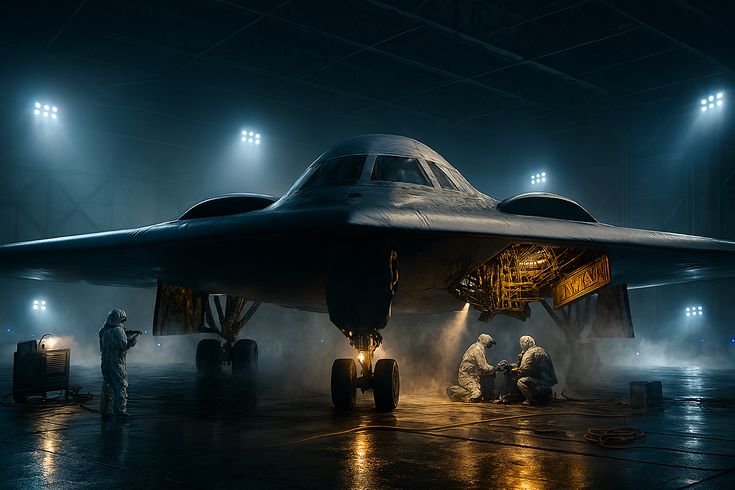
The Northrop B-2 Spirit Bomber is an aircraft that still looks unusual, even today, decades after it first entered service. Its smooth, triangular shape looks more like a shadow than a conventional airplane, setting it apart from the familiar outlines of wings, tails, and vertical fins. That distinctive appearance is the most visible sign that the B-2 Spirit Bomber was designed to operate in a very different way from earlier bombers.
Understanding the Northrop B-2 Spirit Bomber means looking at the reasoning behind its design rather than just its specifications, and nothing about the B-2 Spirit Bomber is accidental, from its overall form to the systems hidden beneath its surface. Instead of relying on speed, the aircraft combines efficiency, stealth, and long-range capability, demonstrating how deliberate design choices can fundamentally change how a strategic bomber is used. Let’s take a closer look…
The Flying Wing

At its core, the Northrop B-2 Spirit Bomber is a pure flying wing. There is no traditional fuselage, no tail, and no vertical stabilizers, meaning that the entire aircraft is essentially one continuous lifting surface. Flying wing concepts had been explored for decades before the B-2 Spirit Bomber, including earlier Northrop designs, but none had ever reached operational service at this scale or level of sophistication.
You May Also Like


A Stealth Aircraft

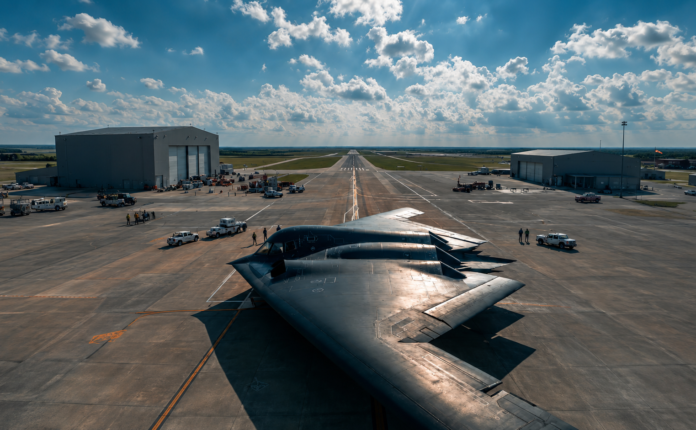
Stealth is the defining characteristic of the Northrop B-2 Spirit Bomber, and it starts with the aircraft’s shape. The smooth, continuous curves of the flying wing reflect radar energy away from the source rather than back toward it, while sharp angles and right-angle intersections, which are common radar reflectors, are carefully avoided wherever possible.
The Northrop B-2 Spirit Bomber uses radar-absorbent materials across much of its surface, turning incoming radar energy into heat rather than reflected signals. Even the engine intakes and exhausts are designed to reduce radar and infrared signatures – air enters through serpentine ducts that hide the engine faces, while exhaust is spread and cooled to make the aircraft harder to detect with heat-seeking sensors, resulting in an aircraft that can penetrate heavily defended airspace in ways that would be unthinkable for older bombers.
The B-2 Spirit Bomber’s Top Speed

These figures place the Northrop B-2 Spirit Bomber in an interesting position among bomber aircraft. It is slower than the supersonic Rockwell B-1B Lancer, which can exceed 900 mph (1,448 km/h), but it is broadly comparable to the venerable Boeing B-52 Stratofortress, which has a top airspeed of around 650 mph (1,046 km/h). Compared to stealth-focused contemporaries like the Lockheed F-117 Nighthawk, the B-2 Spirit Bomber offers similar subsonic performance but with vastly greater range and payload. In practice, the B-2 Spirit Bomber relies on stealth and planning rather than raw speed to survive, making its top speed more than adequate for what the aircraft is designed to do.
Range, Endurance & Global Reach

This endurance has real operational consequences, and Northrop B-2 Spirit Bomber crews have flown combat missions directly from the continental US to targets halfway around the world and back again. Long endurance reduces reliance on forward bases, which may be politically sensitive or vulnerable in a conflict, and it also allows planners to approach targets from unexpected directions, further enhancing the aircraft’s survivability and strategic flexibility.
Payload & Precision

The emphasis is on precision rather than volume, and the Northrop B-2 Spirit Bomber is capable of deploying GPS-guided bombs, allowing a small number of aircraft to strike multiple high-value targets with remarkable accuracy. This precision reduces the need for large formations and minimizes collateral damage.
The Northrop B-2 Spirit Bomber is flown by a crew of just two – a pilot and a mission commander, which is a striking contrast to older bombers that required crews of four or more. Advanced avionics and automation make this possible, handling navigation, flight management, and many defensive functions that once demanded dedicated crew members.
Inside the cockpit, the emphasis is on situational awareness and workload management. Long missions mean crew endurance is just as important as aircraft performance, so the cockpit includes provisions for rest and careful ergonomics. The aircraft’s systems are designed to be highly reliable, but also flexible, allowing crews to adapt to changing mission requirements while airborne. This means that flying the Northrop B-2 Spirit Bomber is less about aggressive maneuvering and more about precision, patience, and trust in the systems that quietly keep the B-2 Spirit Bomber invisible.
The B-2 Spirit Bomber’s Operational History

The Northrop B-2 Spirit Bomber first saw combat during the 1999 Kosovo conflict, when it flew missions directly from the US to strike targets in the former Yugoslavia. These demonstrated one of the aircraft’s defining strengths – its ability to deliver precision-guided weapons over intercontinental distances while bypassing sophisticated air defenses. A small number of B-2 Spirit Bombers were able to hit a significant portion of high-value targets early in the campaign, highlighting the efficiency of stealth-based operations.
In the years that followed, the Northrop B-2 Spirit Bomber was used by the US in Afghanistan and Iraq, again flying long-range missions supported by aerial refueling. Its ability to carry large numbers of precision weapons made it particularly useful in the opening phases of these conflicts, when defended targets needed to be neutralized quickly. The B-2 Spirit Bomber also took part in strikes in Libya in 2011, where it was used to attack aircraft shelters.
While no other country has operated the Northrop B-2 Spirit Bomber, its influence has been global, and the aircraft has shaped how other nations approach long-range strike and stealth technology, even if none have fielded a direct equivalent. In practice, the B-2 Spirit Bomber has been used sparingly, but when it has been deployed, it has typically been at moments where its unique capabilities mattered most.
How Does The B-2 Spirit Compare To Similar Aircraft?

When comparing the Northrop B-2 Spirit Bomber to other aircraft in a similar role, it quickly becomes clear that it was never meant to compete on the same terms. Rather than focusing on speed or payload alone, the B-2 Spirit Bomber was designed around survivability in heavily defended airspace, and that choice sets it apart from both earlier and contemporary bombers.
Against legacy platforms like the  Boeing B-52 Stratofortress, the contrast is especially sharp. The B-52 Stratofortress offers greater payload capacity and has proven remarkably adaptable over decades of service, but it relies on escort support to operate safely in modern threat environments. The B-2 Spirit Bomber, by comparison, is built to fly directly through advanced air defenses, using stealth rather than distance as its primary layer of protection. While the two aircraft share similar subsonic performance, their operational philosophies are very different.
The Rockwell B-1 Lancer provides another useful comparison – with its variable-sweep wings and supersonic capability, the B-1 Lancer emphasizes speed and flexibility. However, its radar signature is significantly larger than that of the Northrop B-2 Spirit Bomber, limiting where it can safely operate without support. In practice, the B-2 Spirit Bomber trades outright speed for the ability to reach targets that would be inaccessible to faster but more detectable aircraft.
Compared to stealth-focused designs like the Lockheed F-117 Nighthawk, the Northrop B-2 Spirit Bomber operates on a much larger scale. While both rely on low observability, the B-2 Spirit Bomber offers intercontinental range and a vastly greater payload, allowing it to carry out strategic missions rather than precision strikes on a limited number of targets. In this sense, the B-2 Spirit Bomber occupies a unique space, blending stealth with global reach in a way no other operational bomber has fully matched.




One Comment on “This Is How Fast The B‑2 Spirit Bomber Can Fly”