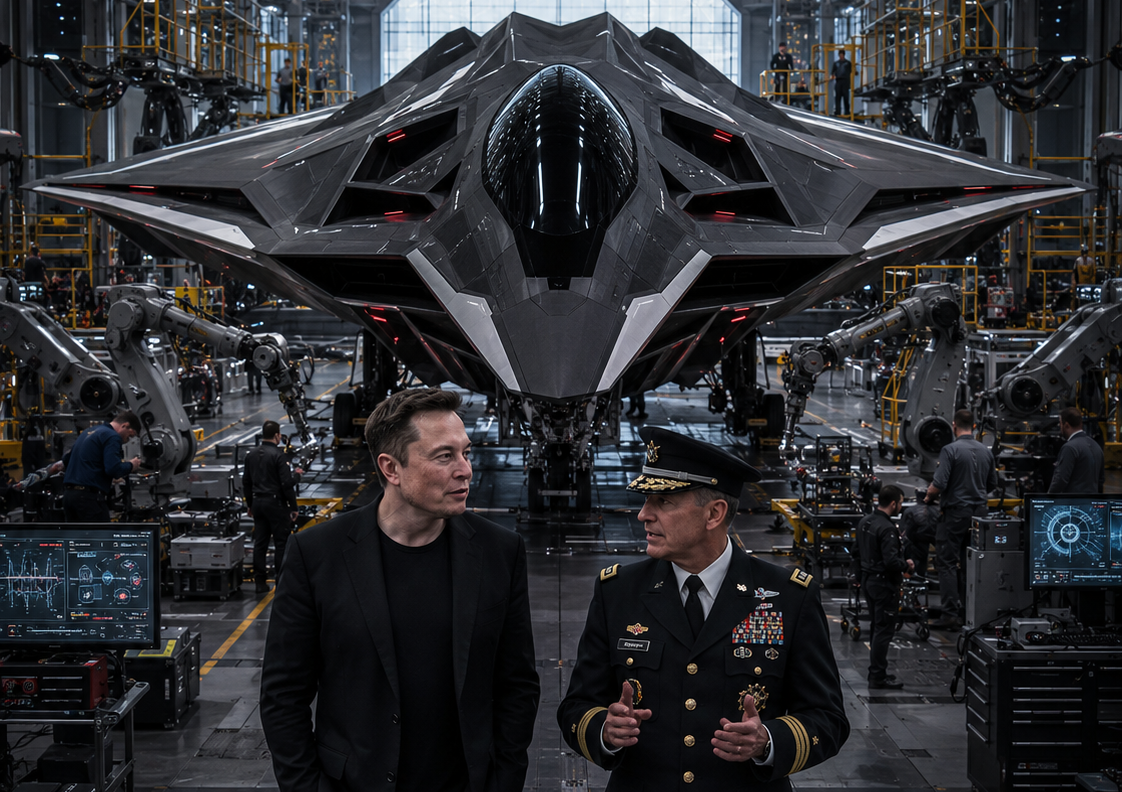
The X-1 Debate: Elon Musk’s UFO Jet and the Future of Flight
Characters
Professor Dr. Adrian Vale
Aerospace engineer, former advisor to experimental aircraft programs. Brilliant, calm, skeptical, and deeply loyal to the laws of physics.
Professor Dr. Mira Sen
Theoretical physicist and futurist, expert in plasma propulsion, artificial intelligence, and advanced materials. Bold, imaginative, and fascinated by impossible machines.
Part One: The Aircraft That Should Not Exist
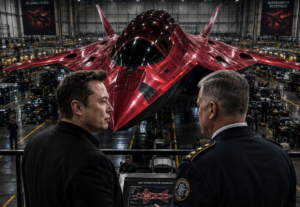
The debate hall at the International Institute of Advanced Aeronautics was packed beyond capacity. Students stood along the walls. Journalists filled the aisles. Engineers whispered into recorders. On the massive screen behind the stage hovered a glowing rendering of a strange aircraft: silver, circular, wingless, almost like a flattened pearl with black glass running around its rim.
Under it were the words:
You May Also Like


ELON MUSK’S FUTURISTIC “UFO” AIRCRAFT: THE X-1 FIGHTER JET — REVOLUTION OR FANTASY?
Professor Adrian Vale adjusted his glasses and looked at the image with a faint smile.
Professor Mira Sen leaned forward, eyes shining.
Mira:
“Tell me honestly, Adrian. When you first saw that shape, what did you feel?”
Adrian:
“Concern.”
The audience laughed.
Mira:
“Concern? Not wonder? Not curiosity? Not even a little fear?”
Adrian:
“Wonder is easy. Curiosity is useful. Fear is profitable. But concern is what keeps aircraft from becoming expensive fireworks.”
Mira:
“That is why you are beloved by engineers and feared by dreamers.”
Adrian:
“And that is why dreamers keep asking engineers to apologize to gravity.”
Mira:
“Gravity has been insulted before. Balloons insulted it. Airplanes insulted it. Rockets declared war on it.”
Adrian:
“No. Balloons obeyed buoyancy. Airplanes obeyed lift. Rockets obeyed thrust. The first rule of flight is not rebellion. It is negotiation.”
Mira smiled and gestured toward the glowing image behind them.
Mira:
“Then perhaps the X-1 is a new negotiation.”
Adrian:
“Or a beautiful rumor.”
A soft murmur passed through the crowd.
Mira:
“Let us begin there. You call it a rumor.”
Adrian:
“I call it unverified. The internet calls many things ‘revolutionary’ before anyone has measured a bolt, tested a wing load, or watched the landing gear survive touchdown.”
Mira:
“But suppose, for the sake of debate, that this so-called X-1 is not a conventional jet. Suppose it is a hybrid aircraft — part drone, part spacecraft, part atmospheric fighter. Suppose it is not designed to fly like an F-35, but to maneuver like something completely different.”
Adrian:
“Then my first question would be simple: what keeps it in the air?”
Mira:
“Thrust-vectoring.”
Adrian:
“Not enough.”
Mira:
“Distributed electric propulsion.”
Adrian:
“Still not enough for the shape shown.”
Mira:
“Plasma flow control.”
Adrian:
“Interesting. Not magic.”
Mira:
“AI-stabilized microsecond flight correction.”
Adrian:
“Useful. But software cannot repeal aerodynamics.”
Mira:
“No, but it can exploit instability.”
Adrian paused. That answer, unlike the others, interested him.
Adrian:
“Now we are speaking seriously.”
Mira:
“Many modern aircraft are not naturally stable in the old sense. They are made controllable by computers. A human pilot cannot manually keep certain high-performance platforms balanced in every regime. Computers do it constantly.”
Adrian:
“Yes. But the aircraft still has control surfaces. It still has airflow. It still has structure. It still has known failure modes.”
Mira:
“What if the X-1 uses no traditional wings because its body is the wing?”
Adrian:
“A lifting body?”
Mira:
“Exactly. But more advanced. A smooth disk-like blended surface, generating lift from pressure differentials while using hidden propulsion ports along its rim.”
Adrian:
“Then we are no longer talking about a UFO. We are talking about an extreme lifting-body aircraft with distributed thrust.”
Mira:
“Which would look like a UFO to most people.”
Adrian:
“Most people also think turbulence means the aircraft is falling.”
Mira:
“Do not underestimate the emotional power of appearance. The B-2 looked alien when it arrived. The SR-71 still looks like something stolen from tomorrow. The first time people saw the Bell X-1, they were watching the beginning of the supersonic age.”
Adrian:
“And the Bell X-1 was real, tested, documented, and flown by pilots who risked their lives.”
Mira:
“Chuck Yeager.”
Adrian:
“Yes. October 14, 1947. The Bell X-1, nicknamed Glamorous Glennis, became the first piloted airplane to exceed the speed of sound in level flight. That was not mythology. That was engineering.” (Encyclopedia Britannica)
Mira:
“And before it happened, many believed the sound barrier was almost mystical.”
Adrian:
“They believed it was dangerous, not mystical. And they were right. Compressibility, shock waves, control reversal, structural loads — those were real problems.”
Mira:
“Yet the barrier fell.”
Adrian:
“Because engineers understood it, not because they ignored it.”
Mira:
“Then imagine the new barrier is not speed. Imagine it is maneuverability. Imagine the next aircraft does not try to outrun missiles but confuse them. Not hide like a stealth fighter, but move in ways radar prediction models cannot easily solve.”
Adrian folded his hands.
Adrian:
“Now we are entering the dangerous part of the fantasy.”
Mira:
“Dangerous because it is impossible?”
Adrian:
“Dangerous because it is attractive.”
Mira:
“What is wrong with attractive?”
Adrian:
“People believe attractive ideas faster than correct ones.”
Mira:
“Then let us make it correct. If this fictional X-1 existed, what would it require?”
Adrian:
“Power. Enormous power. If it hovers, climbs vertically, accelerates supersonically, turns violently, and carries weapons, it needs energy density far beyond normal batteries. Jet fuel is dense. Batteries are not there yet.”
Mira:
“What about compact turbine-generators feeding electric ducted fans?”
Adrian:
“Possible for some designs. But not if people imagine silent UFO hovering, hypersonic dash, invisible radar signature, and limitless endurance all in one machine.”
Mira:
“You object to the bundle.”
Adrian:
“Exactly. Every futuristic claim wants to put ten miracles into one vehicle. Real aircraft are compromises. Speed fights range. Stealth fights maneuverability. Payload fights endurance. Heat fights materials. Cost fights everything.”
Mira:
“But Elon Musk’s companies are known for breaking assumptions.”
Adrian:
“Reusable rockets broke cost assumptions. They did not break physics.”
Mira:
“Fair. But they broke institutional pessimism.”
Adrian:
“That I will grant.”
Mira stood and walked slowly toward the projected aircraft.
Mira:
“Let me ask the audience something. What makes a UFO frightening? Is it speed? Shape? Silence? Or is it the feeling that it is not playing the same game as our machines?”
The hall quieted.
Mira:
“The fictional X-1 fascinates people because it symbolizes a new game. Not a fighter jet with sharper wings. Not a faster missile bus. But an aircraft that appears to think with its skin, move with its entire body, and turn the atmosphere itself into a weapon.”
Adrian looked at her carefully.
Adrian:
“That is beautifully said.”
Mira:
“You disagree?”
Adrian:
“I disagree with its likelihood, not with its poetry.”
Mira:
“Then answer me this, Professor Vale: if the public imagines a UFO aircraft, what are they really imagining?”
Adrian:
“They are imagining freedom from visible mechanism. No wings, no rotors, no exhaust, no limits.”
Mira:
“And science?”
Adrian:
“Science asks where the exhaust went.”
The audience burst into laughter.
Mira:
“Perhaps into plasma.”
Adrian:
“Perhaps into marketing.”
The laughter grew louder.
Part Two: The Physics of the Impossible
The moderator stepped aside. The screen changed. The UFO-like X-1 vanished, replaced by diagrams: shock waves, plasma sheaths, magnetic fields, air density curves, energy graphs.
Mira took the first question.
Mira:
“Let us build the fictional aircraft honestly. No magic. No anti-gravity. No secret alien engine. Only speculative but physically discussable technologies. Adrian, are you willing?”
Adrian:
“I am always willing to improve a bad rumor into a difficult engineering problem.”
Mira:
“Good. Component one: aerodynamic form. Could a disk-shaped fighter fly?”
Adrian:
“Yes, but poorly if designed carelessly. Disk shapes can generate lift at certain angles of attack, but they tend to have drag and stability issues. A pure flying saucer is not automatically efficient.”
Mira:
“What about a flattened triangular disk? A blended body?”
Adrian:
“Better. Once you introduce a lifting-body geometry, edge shaping, internal ducts, and controlled boundary-layer flow, it becomes more plausible.”
Mira:
“So the public’s ‘UFO’ may actually be a misnamed lifting-body aircraft.”
Adrian:
“That would be the charitable interpretation.”
Mira:
“Component two: propulsion. Suppose the X-1 uses distributed thrust around the rim. Small high-output vectoring nozzles. Some for lift, some for yaw, some for rapid lateral movement.”
Adrian:
“Possible in principle. Difficult in practice. The control system would be extremely complex. Failure of one thrust node at high speed could create violent torque.”
Mira:
“Unless AI corrects it instantly.”
Adrian:
“AI can correct within sensor and actuator limits. If the structure is overloaded, the AI can only record the disaster in high resolution.”
Mira:
“So the aircraft must be structurally adaptive.”
Adrian:
“Now you are spending money at a terrifying rate.”
Mira:
“Adaptive materials, morphing surfaces, embedded sensors, thermal skin, smart composites.”
Adrian:
“Each one exists in some form. Combining them into a combat aircraft is another matter.”
Mira:
“But not impossible.”
Adrian:
“Not impossible. Just brutally hard.”
Mira turned to the audience.
Mira:
“Ladies and gentlemen, please notice what just happened. Professor Vale has moved from ‘beautiful rumor’ to ‘brutally hard.’ That is scientific progress.”
Adrian:
“That is rhetorical theft.”
Mira:
“Component three: stealth.”
Adrian:
“Now the disk shape may help or hurt. Radar stealth is not about looking smooth. It is about controlling reflections. Angles, edges, materials, inlets, exhaust, heat signature — all matter.”
Mira:
“Could a circular aircraft be stealthy?”
Adrian:
“Possibly from certain angles, disastrously reflective from others. A flying disk could create radar return problems unless carefully faceted or coated.”
Mira:
“What if the surface uses metamaterials?”
Adrian:
“Metamaterials are promising, but people overuse that word like a magical spell. Broadband, multi-angle, durable, combat-ready radar absorption is not simple.”
Mira:
“You are allergic to miracle words.”
Adrian:
“I have seen too many PowerPoint slides commit crimes against Maxwell’s equations.”
Mira:
“Then let me use a different word: heat.”
Adrian nodded.
Adrian:
“Good. Heat is where fantasies go to die.”
Mira:
“Supersonic and hypersonic flight produce severe thermal loads. Even the historical X-planes taught us that speed is not just speed. It is heating, expansion, vibration, fuel management, and control.”
Adrian:
“Yes. The Bell X-1 opened the door. Later aircraft like the X-15 showed the extreme end of atmospheric speed. The faster you go, the more the air becomes less like a gentle fluid and more like a furnace wall.”
Mira:
“Could the fictional X-1 use active cooling?”
Adrian:
“Yes. Fuel could absorb heat. Skin channels could move coolant. Some spacecraft concepts do this. But every cooling system adds mass, complexity, and failure risk.”
Mira:
“So our aircraft needs energy, cooling, stealth, structure, control, and propulsion — all integrated.”
Adrian:
“Correct.”
Mira:
“Which sounds impossible.”
Adrian:
“It sounds like a defense contractor’s invoice.”
The audience laughed again.
Mira’s smile faded slightly. Her next question came quietly.
Mira:
“Adrian, do you think the public wants this aircraft because they admire technology, or because they are afraid of the future?”
Adrian leaned back.
Adrian:
“That is the best question tonight.”
Mira:
“Answer it.”
Adrian:
“Both. The UFO aircraft is a symbol. It says, ‘Someone is building tomorrow without asking permission.’ That excites people who feel trapped in the present. It terrifies people who wonder who controls tomorrow.”
Mira:
“And if Elon Musk’s name is attached?”
Adrian:
“It becomes myth fuel.”
Mira:
“Myth fuel?”
Adrian:
“Yes. Musk’s public image sits at the intersection of rockets, electric cars, AI, tunnels, satellites, Mars, and controversy. Attach his name to any futuristic machine and people instantly imagine it is either already real or secretly under construction.”
Mira:
“Even when it is not verified.”
Adrian:
“Especially then. Absence of evidence becomes part of the legend.”
Mira:
“Like classified aircraft.”
Adrian:
“Exactly. People remember that stealth aircraft were once secret. They then assume every strange internet image is the next hidden revolution.”
Mira:
“But some secret projects do exist.”
Adrian:
“Of course. But ‘classified’ does not mean ‘anything is possible.’ Secret aircraft still need fuel, landing gear, maintenance crews, materials, test ranges, budgets, supply chains, and physics.”
Mira:
“What if it is unmanned?”
Adrian:
“That helps. Remove the pilot and you remove life-support, cockpit visibility, human G-limits, ejection systems. A drone can maneuver harder than a crewed aircraft.”
Mira:
“So a UFO-like X-1 would probably be unmanned.”
Adrian:
“If it were real and extreme, yes. A human pilot is often the weakest structural component.”
Mira:
“That sentence will offend pilots.”
Adrian:
“Pilots know it already. They are brave, not indestructible.”
Mira:
“Then our fictional X-1 is not a fighter jet in the old sense. It is an autonomous combat aerospace platform.”
Adrian:
“Now you are describing something more plausible and more disturbing.”
Mira:
“Why disturbing?”
Adrian:
“Because the debate shifts from ‘Can it fly?’ to ‘Should it decide?’”
The hall went silent.
Mira:
“You mean autonomous weapons.”
Adrian:
“Yes. If the X-1 is AI-controlled, capable of high-speed maneuvering, target selection, and electronic warfare, the moral problem becomes as important as the engineering.”
Mira:
“But humans could remain in command.”
Adrian:
“At Mach speed, in contested airspace, with jamming and microsecond threats, the machine will act faster than the human can approve.”
Mira:
“Then the human becomes a supervisor.”
Adrian:
“Or a witness.”
Mira:
“That is a dark way to put it.”
Adrian:
“It is the honest way.”
Mira walked back to her chair, sat, and folded her hands.
Mira:
“Let me challenge you. Is it ethical to refuse such technology if rival nations build it first?”
Adrian:
“That is the oldest trap in military science.”
Mira:
“And yet it is real.”
Adrian:
“Yes. Deterrence often rewards speed. But science without restraint becomes a servant of panic.”
Mira:
“What would you do?”
Adrian:
“I would research the underlying technologies: propulsion, materials, AI safety, defensive systems. But I would resist mythology. Mythology makes citizens cheer for machines they do not understand.”
Mira:
“And I would argue that imagination must come first. Without myth, no one funds the prototype.”
Adrian:
“Without discipline, prototypes become graves.”
Mira:
“Without risk, civilization stagnates.”
Adrian:
“Without caution, civilization burns.”
For several seconds, neither spoke.
Then Mira leaned toward him.
Mira:
“Perhaps that is why this debate matters.”
Adrian:
“Because of the aircraft?”
Mira:
“No. Because the aircraft may not exist — but the desire for it certainly does.”
Part Three: Revolution, Illusion, or Warning?
The final part of the debate began after a short intermission. The screen now showed three images side by side:
The Bell X-1, orange and bullet-shaped.
A modern stealth aircraft silhouette.
The fictional silver disk called X-1.
Mira pointed to the first image.
Mira:
“The historical X-1 was not elegant in the way people imagine elegance. It was shaped like a bullet because engineers understood bullets could travel supersonically.”
Adrian:
“Correct. Its design came from practical reasoning.”
Mira:
“And yet it became a symbol.”
Adrian:
“Yes. A symbol earned by test flights.”
Mira:
“So maybe the fictional X-1 borrows the name because people want a new sound barrier.”
Adrian:
“A new psychological barrier.”
Mira:
“Exactly. The first X-1 asked: can humans fly faster than sound? This imagined X-1 asks: can machines fly beyond the categories we recognize?”
Adrian:
“That is a strong literary argument.”
Mira:
“You say literary as if literature does not build laboratories.”
Adrian:
“Science fiction has inspired real science. But inspiration is not evidence.”
Mira:
“Then let us separate the three layers. Layer one: the claim. Elon Musk has unveiled a UFO fighter jet. That is not verified.”
Adrian:
“Correct.”
Mira:
“Layer two: the concept. A highly autonomous, disk-like, lifting-body, distributed-propulsion aircraft. That is speculative but discussable.”
Adrian:
“Yes.”
Mira:
“Layer three: the dream. A machine that moves like nothing before it.”
Adrian:
“And that dream is powerful.”
Mira:
“Would you want to see it built?”
Adrian looked at the three images for a long moment.
Adrian:
“I would want to see its technologies tested carefully. Not as a weapon first. As flight research.”
Mira:
“Why not as a fighter?”
Adrian:
“Because when you build a machine first as a weapon, every question becomes narrower. How fast can it strike? How well can it evade? How lethal can it be? But when you build it as research, the questions widen. What can we learn about airflow? Can we reduce sonic booms? Can we improve emergency response aircraft? Can we reach orbit more efficiently?”
Mira:
“You sound like you want the UFO without the war.”
Adrian:
“I want the future without surrendering it to fear.”
Mira:
“That is idealistic.”
Adrian:
“No. It is practical. Civilian aviation changed the world more deeply than any fighter jet.”
Mira:
“But military research often pushes technology forward.”
Adrian:
“True. Radar, jet engines, rockets, GPS, the internet — many technologies were shaped by defense needs. But that does not mean war is the only engine of progress.”
Mira:
“What if conflict is what forces urgency?”
Adrian:
“Then wisdom is what must force restraint.”
Mira nodded slowly.
Mira:
“Let me play the believer one final time.”
Adrian:
“I expected nothing less.”
Mira:
“Imagine this: the year is 2038. A silent aircraft rises vertically from a desert base. It has no visible cockpit. Its surface flickers with adaptive material. It climbs, rotates, accelerates, and vanishes from ordinary radar. It is controlled by a human commander, assisted by an AI trained on billions of simulated flight hours. Its propulsion system uses compact turbines feeding superconducting electric fans. Plasma actuators shape the airflow. The aircraft does not dogfight. It appears, blinds sensors, disables drones, and disappears.”
The audience was utterly still.
Mira:
“Would that not change warfare?”
Adrian:
“Yes.”
Mira:
“Would that not change aerospace engineering?”
Adrian:
“Yes.”
Mira:
“Would that not deserve the name X-1?”
Adrian smiled faintly.
Adrian:
“No.”
Mira blinked.
Mira:
“No?”
Adrian:
“No. The name X-1 belongs to the aircraft that first proved humans could cross the sound barrier in controlled flight. A future aircraft should earn its own name.”
Mira:
“What would you call it?”
Adrian glanced at the UFO-like image.
Adrian:
“Not X-1. Maybe Janus.”
Mira:
“The Roman god of doorways and transitions.”
Adrian:
“And of two faces. One looking forward, one looking back.”
Mira:
“That is surprisingly poetic.”
Adrian:
“I ration poetry carefully.”
Mira:
“Janus. The aircraft that looks like the future but carries every old question with it.”
Adrian:
“Yes. Who builds it? Who controls it? Who verifies it? Who pays for it? Who is protected by it? Who is threatened by it?”
Mira:
“And who gets to know the truth?”
The last question landed heavily.
A student stood in the audience.
Student:
“Professors, may I ask something?”
The moderator nodded.
Student:
“If this aircraft is probably fictional, why are we all so fascinated?”
Mira smiled first, but Adrian answered.
Adrian:
“Because fiction is often where society rehearses its future.”
Mira added softly:
Mira:
“And because every great machine begins twice. First in imagination. Then, if reality permits, in metal.”
The student continued.
Student:
“So should we believe in it or not?”
Adrian and Mira looked at each other.
Adrian:
“Do not believe blindly.”
Mira:
“Do not dismiss lazily.”
Adrian:
“Ask for evidence.”
Mira:
“Ask better questions.”
Adrian:
“Respect physics.”
Mira:
“Respect imagination.”
Adrian:
“And never confuse a viral image with a flight test.”
Mira:
“But never forget that yesterday’s impossibility may become tomorrow’s engineering department.”
The audience erupted in applause.
But the moderator raised one final question.
Moderator:
“Professors, final statements. Is Elon Musk’s futuristic UFO X-1 fighter jet a revolution, an illusion, or a warning?”
Mira stood.
Mira:
“It is a revolution as a symbol. Whether or not this specific aircraft exists, the idea points toward real frontiers: autonomous flight, advanced materials, distributed propulsion, AI control, and unconventional aircraft geometry. The public is not foolish for being fascinated. They are sensing that aviation may be ready for another leap. The danger is not imagination. The danger is letting imagination be controlled by hype instead of knowledge.”
She sat.
Adrian stood next.
Adrian:
“It is an illusion if presented as fact without evidence. It is a warning if people begin to worship technology they cannot verify. But it can become useful if we treat it as a question: what would such a machine require, and what would it cost us technically, morally, and politically? The real Bell X-1 did not defeat physics. It obeyed physics more cleverly than anyone before it. That is the lesson. The future will not belong to those who shout ‘impossible,’ nor to those who shout ‘miracle.’ It will belong to those who can tell the difference.”
The hall rose in a standing ovation.
The screen behind them faded to black.
Then one final sentence appeared:
THE NEXT X-1 WILL NOT BE PROVEN BY RUMOR.
IT WILL BE PROVEN BY FLIGHT.




One Comment on “The X-1 Debate: Elon Musk’s UFO Jet and the Future of Flight”