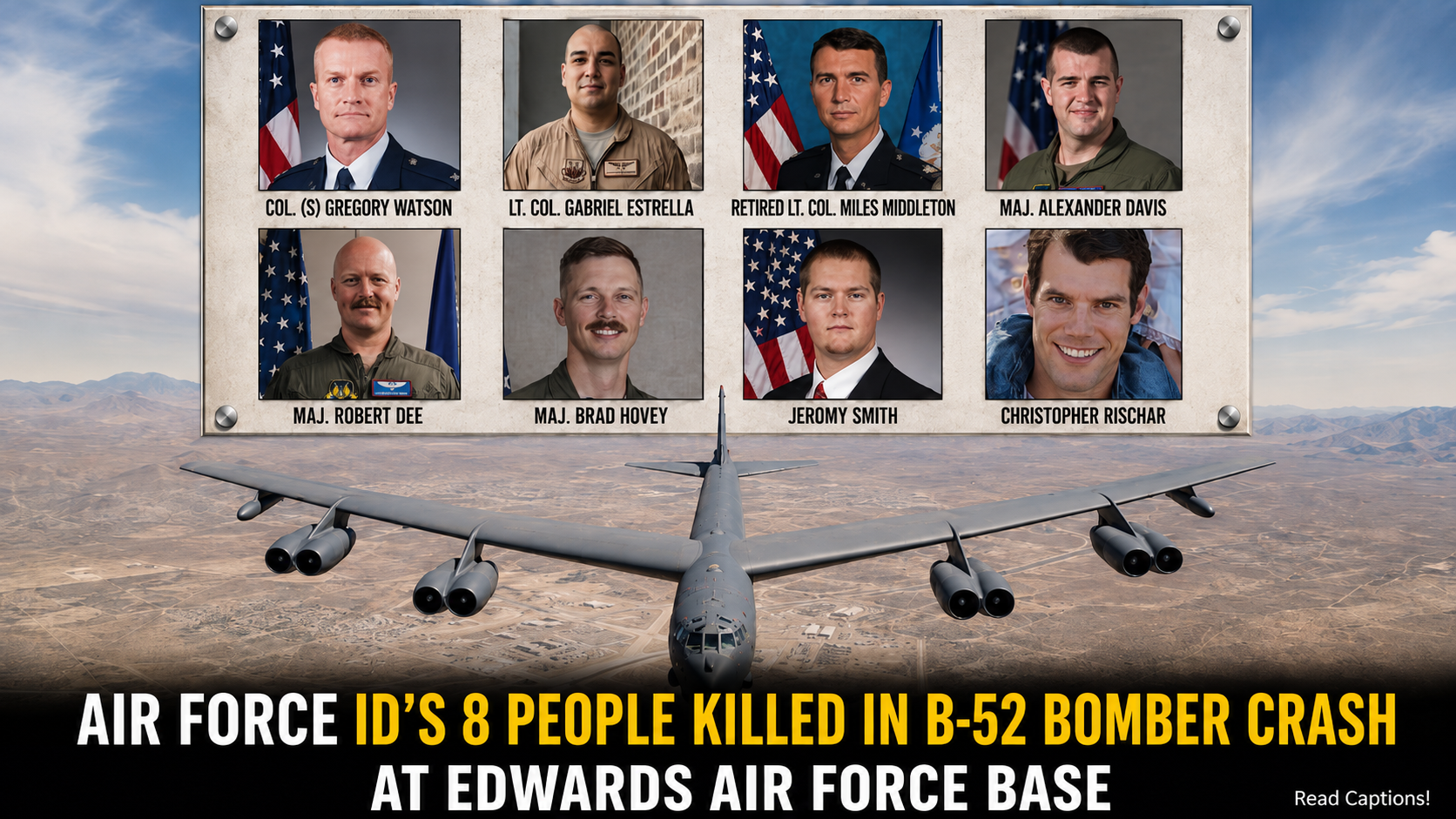
A routine test mission ended in heartbreak after a B-52H Stratofortress crashed shortly after takeoff, killing all eight people aboard.
The U.S. Air Force has identified the eight individuals who lost their lives in the tragic B-52H Stratofortress crash at Edwards Air Force Base, California, on June 15, 2026.
The aircraft was conducting a test mission in support of the Air Force’s Radar Modernization Program when it crashed shortly after takeoff and burst into flames. All eight people aboard were killed.
The victims included active-duty Air Force personnel, reservists, government civilians, contractors, and Boeing employees who were supporting one of the Air Force’s most important modernization efforts — a program designed to help keep the B-52 fleet flying into the 2050s.
The victims were identified as:
You May Also Like

Col. Gregory Watson, 53
Retired Lt. Col. Miles Middleton, 50
Lt. Col. Gabriel Estrella, 40
Maj. Alexander Davis, 34
Maj. Robert Dee, 40
Maj. Brad Hovey, 35
Jeromy Smith, 32
Christopher Rischar, 41
What began as a routine mission quickly turned into one of the darkest days for the Edwards Air Force Base community. Officials said the bomber became airborne only briefly before suffering a catastrophic event that led to the fatal crash.
The cause of the accident remains under investigation by Air Force accident investigators. A final report is expected to take several months, as investigators work to determine exactly what went wrong in the moments after takeoff.
The loss has sent shockwaves through the military aviation community. Tributes have poured in for the crew members, who are being remembered as dedicated professionals, innovators, and patriots who played an important role in advancing America’s aerospace and defense capabilities.
The B-52 Stratofortress has served the United States for decades and remains one of the most recognizable aircraft in military history. The modernization work being carried out at Edwards was part of a larger effort to ensure the bomber can continue operating for many years to come.
But behind the aircraft, the mission, and the technology were eight human lives — fathers, husbands, sons, friends, colleagues, and teammates.
Their work carried risk. Their service carried purpose. And their loss is being felt deeply by families, fellow service members, engineers, and the wider aviation community.
As the investigation continues, the focus now turns to honoring the lives of those who were lost and supporting the families who must carry the weight of this tragedy.
Our thoughts and prayers remain with the families, friends, and colleagues of all eight victims during this difficult time.