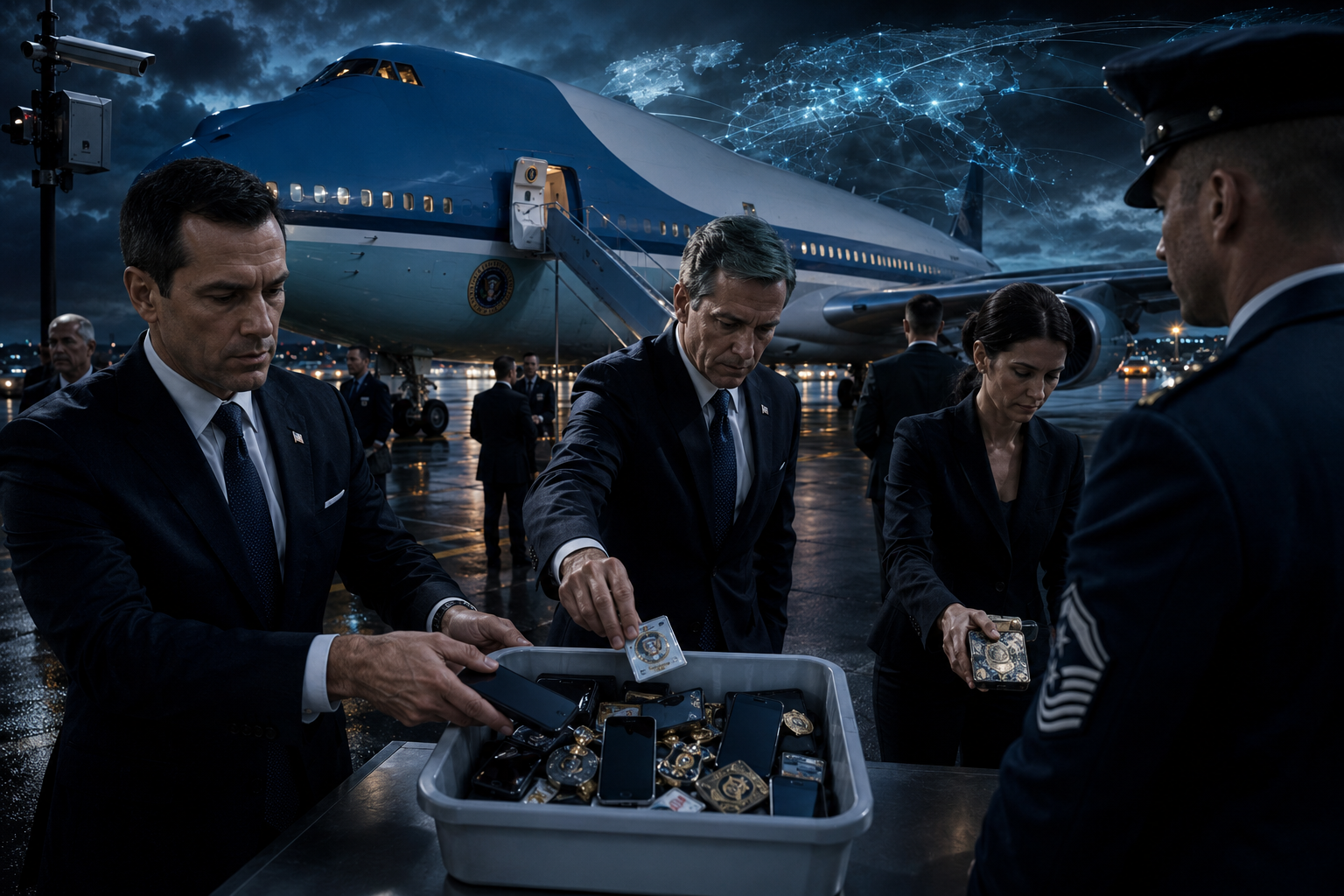
They smiled for the cameras in Beijing… then threw away every phone, badge, pin, and gift before boarding Air Force One.
What happened next inside the President’s aircraft became a chilling conversation about espionage, cyber warfare, surveillance, and the terrifying future of global power.
One sentence changed the entire mood of the flight:
“In today’s world, even a souvenir can be a weapon.”
You May Also Like
This is not just a political story.
It’s a warning about the world we are entering.
The cold Beijing wind swept across the runway while engines roared beneath the enormous body of Air Force One.
Rows of security lights reflected off the wet pavement like silver fire.
American officials walked toward the aircraft carrying folders, diplomatic documents, coffee cups, temporary phones, and souvenirs collected during two exhausting days of negotiations with Xi Jinping and senior Chinese officials.
Everything looked normal.
Until it suddenly didn’t.
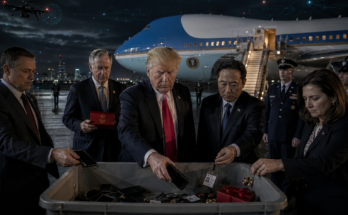
At the bottom of the aircraft stairs sat a large black security container.
Secret Service agents stood beside it with emotionless faces.
One officer raised his voice firmly.
“Before boarding, all China-issued items must be surrendered.”
People stopped walking.
Several reporters looked confused.
“What does that mean exactly?” one asked.
The answer came immediately.
“Phones. Badges. Gifts. Pins. Chargers. Electronics. Everything.”
For a moment nobody moved.
Then one White House aide slowly pulled a burner phone from his pocket and dropped it into the bin.
Clack.
Another followed.
Then another.
Soon the sound became constant.
Plastic.
Metal.
Glass.
Credential badges.
Conference electronics.
Chinese gift boxes.
Lapel pins.
Even expensive custom devices prepared for the diplomatic visit.
One journalist whispered quietly:
“This feels like a spy movie.”
But nearby intelligence officers were not laughing.
Because to them, this was not fiction.
This was procedure.
Standing several feet away, Donald Trump watched the scene silently.
The flashing runway lights reflected in his eyes as another security officer inspected a seemingly harmless souvenir pin.
Trump finally broke the silence.
“All this… over souvenirs?”
The officer answered carefully.
“Sir, today there’s no such thing as ‘just a souvenir.’”
That sentence changed the atmosphere instantly.
Trump stared toward the growing pile inside the container.
The bin no longer looked like trash.
It looked like evidence.
Or maybe something worse.
A warning.
As the President climbed the stairs into the aircraft, several senior advisers followed behind him, continuing a discussion that had quietly started hours earlier inside the Beijing summit rooms.
Only now the conversation became much darker.
Inside the aircraft conference section, the mood felt unusually tense.
Normally after a diplomatic trip there would be relief, jokes, casual conversations, maybe even celebration.
Not tonight.
Tonight felt different.
Military officers sat beside cyber-intelligence analysts.
Communications advisers whispered while reviewing secure tablets.
Several staff members looked unsettled after being forced to discard nearly everything they had used during the trip.
Trump entered the room and loosened his tie slightly.
Then he looked directly at the national security team.
“Alright,” he said. “Explain this to me like I’m hearing it for the first time.”
One intelligence official nodded.
“Yes, Mr. President.”
He placed a Chinese-issued credential badge on the table.
At first glance it looked harmless.
Plastic.
Barcode.
Photo.
Nothing unusual.
Then the official spoke.
“The danger with modern espionage isn’t obvious threats anymore.”
Trump leaned back.
“What does that mean?”
“It means the dangerous things are the things that appear ordinary.”
Another adviser joined the conversation.
“In the old days people imagined spies stealing paper documents in dark alleys.”
“And now?”
“Now information steals itself.”
The room fell quiet.
Trump narrowed his eyes.
“That’s a hell of a sentence.”
The adviser continued.
“A compromised device today can quietly collect data, monitor locations, activate microphones, track movement, analyze communication patterns, and transmit information without anyone realizing it.”
One younger aide still looked skeptical.
“You’re telling me a tiny pin can become a security threat?”
A cybersecurity expert immediately responded.
“No. I’m telling you modern intelligence agencies spend billions making sure threats look tiny.”
That shut the room up.
The expert continued calmly.
“The most dangerous thing in modern espionage is not technology.”
Trump looked at him.
“What is it?”
“Human underestimation.”
Another silence filled the aircraft.
Outside the windows, the lights of Beijing faded into darkness as the plane climbed higher into the night sky.
Trump crossed his arms.
“You really think they’d try to compromise something on Air Force One?”
A military communications officer answered instantly.
“Sir, every foreign intelligence service on Earth would love access to this aircraft.”
“Why?”
The officer almost laughed.
“Because this plane isn’t just transportation.”
He pointed around the cabin.
“This aircraft carries the President of the United States, secure communications systems, military coordination capabilities, intelligence channels, emergency command authority, and some of the most protected information on Earth.”
Another adviser added quietly:
“To adversaries, this aircraft is a flying strategic fortress.”
Trump slowly nodded.
“And one weak point matters.”
“Yes, sir.”
A younger political adviser leaned forward.
“But realistically, what are the odds that a conference badge or souvenir pin is actually dangerous?”
The intelligence officer responded immediately.
“That’s the wrong question.”
“What’s the right question?”
“Are the consequences severe enough that we cannot afford to take the chance?”
Nobody argued after that.
Trump looked again toward the table full of discarded items.
Then he smiled slightly.
“You know what’s amazing?”
The room waited.
“We live in a world where everybody trusts their phones more than people…”
He paused.
“…while intelligence agencies trust neither.”
Several officials exchanged glances.
Because it was true.
One reporter sitting nearby finally spoke.
“I still can’t get over how fast everyone threw everything away.”
A senior security officer answered him calmly.
“That reaction is exactly why these procedures exist.”
“What do you mean?”
“Complacency.”
The officer folded his hands.
“People become emotionally attached to objects. A gift feels polite. A souvenir feels harmless. Familiarity creates trust.”
“And that’s dangerous?”
“In intelligence work, unnecessary trust is always dangerous.”
Trump suddenly interrupted.
“That’s the real story, isn’t it?”
Everyone looked toward him.
He pointed toward the security bin still visible through a camera feed near the aircraft entrance.
“That bin represents the whole relationship.”
One adviser asked softly:
“With China?”
“With everybody.”
The room became quiet again.
Trump continued speaking more slowly now.
“The world changed.”
He looked around the aircraft.
“Countries still shake hands. Smile for cameras. Sign agreements.”
Then his expression hardened.
“But underneath all of it… nobody truly trusts anybody anymore.”
One cyber analyst nodded.
“That’s modern geopolitics.”
Trump looked toward him.
“Not politics.”
“What do you mean, sir?”
“This is psychology now.”
The analyst seemed curious.
Trump leaned forward.
“Fear drives everything.”
Nobody interrupted him.
“Fear of losing power. Fear of being watched. Fear of being hacked. Fear of falling behind. Fear of dependence.”
Another official added quietly:
“Fear of vulnerability.”
Trump pointed at him.
“Exactly.”
He stood up and slowly walked toward the aircraft window.
The cabin lights reflected faintly against the dark glass.
“You know what people don’t understand?”
The room listened carefully.
“They think wars begin with explosions.”
He shook his head.
“No.”
Then he turned around.
“Modern wars begin with information.”
A military officer responded:
“That’s already happening.”
Trump nodded.
“Cyber attacks. Financial manipulation. Data theft. Infrastructure sabotage. Satellite disruption. AI competition.”
He paused again.
“And most people don’t even realize the battlefield already exists around them.”
One younger aide looked unsettled.
“So this never really ends?”
The intelligence officer answered before Trump could.
“No.”
The aide frowned.
“That’s depressing.”
The officer shook his head slowly.
“No. It’s reality.”
Trump suddenly smiled again, though this time it looked more thoughtful than amused.
“You know something funny?”
“What’s that, sir?”
“The more advanced civilization becomes…”
He glanced toward the discarded devices list on the screen.
“…the more suspicious everybody becomes.”
Another official answered quietly:
“Technology connected the world.”
Trump nodded.
“And destroyed privacy at the same time.”
Nobody argued.
Because once again, nobody could.
Hours passed as discussions continued inside the aircraft.
The conversations shifted from China to artificial intelligence, cyber warfare, digital infrastructure, satellite systems, surveillance capitalism, military technology, and the terrifying speed of global transformation.
At one point, a communications adviser asked:
“Do you think ordinary people understand how serious this is becoming?”
A cyber analyst answered immediately.
“No.”
“Why not?”
“Because the most dangerous technological revolutions happen invisibly.”
Trump overheard that sentence while reviewing briefing papers.
Then he looked up slowly.
“That may be the smartest thing said tonight.”
The analyst continued.
“When tanks move, people panic. When missiles launch, people panic.”
He pointed toward a phone lying on the table.
“But when algorithms quietly collect human behavior for years, nobody notices.”
The aircraft became silent again except for the engines.
One staff member finally whispered:
“That’s terrifying.”
The analyst looked at him calmly.
“It should be.”
Another aide suddenly asked a deeper question.
“Then how do countries cooperate if nobody trusts each other?”
That question changed the mood of the room completely.
For several seconds, nobody answered.
Finally, Trump spoke.
“Because they have no choice.”
The aide looked confused.
Trump continued.
“The world’s biggest powers are competitors, rivals, trading partners, military threats, technological partners, and economic lifelines all at the same time.”
One adviser nodded slowly.
“Interdependence.”
“Exactly.”
Trump pointed toward the map screen showing global supply chains.
“We’re connected whether we like it or not.”
The adviser added:
“And that creates tension.”
“No,” Trump said quietly.
“That creates pressure.”
He paused.
“And pressure creates instability.”
Another silence filled the room.
A younger reporter finally asked the question nobody else wanted to ask.
“So are we heading toward conflict?”
Every eye in the aircraft shifted toward Trump.
But before he could answer, a senior military officer spoke first.
“Conflict already exists.”
The reporter looked shocked.
“You mean war?”
“No.”
The officer shook his head.
“I mean competition so intense that it influences every area of modern life.”
Technology.
Trade.
Semiconductors.
Artificial intelligence.
Cybersecurity.
Military positioning.
Energy.
Media.
Narratives.
Information.
Data.
Space.
Everything.
The officer looked around the room.
“The future global order is being shaped right now.”
Trump slowly sat back down.
“And everybody knows it.”
One communications aide looked toward the discarded item inventory one last time.
“All this because of phones and pins.”
A senior intelligence official quietly corrected him.
“No.”
The room looked toward him.
“This is about trust.”
The aircraft fell silent again.
Deep silence.
The kind of silence that only appears when people realize they are discussing something much larger than politics.
Much larger than diplomacy.
Much larger than one trip.
Trump finally broke the silence with one final thought.
“You know what the scariest part is?”
Nobody answered.
He looked slowly around the room.
“Twenty years ago this conversation would sound paranoid.”
He paused.
“Today it sounds responsible.”
Nobody in the aircraft disagreed.
Because every person there understood the same thing:
The world had entered a new era.
An era where information had become power.
Where technology had become territory.
Where data had become ammunition.
Where trust had become the rarest currency on Earth.
And where a simple black bin at the bottom of Air Force One’s stairs had revealed more truth about modern geopolitics than any official speech ever could.