“Nothing From China Allowed on the Plane”
The cold night air around Air Force One carried a strange silence.
The meetings in Beijing were over. The handshakes had been photographed. The official statements had been delivered. President Donald Trump and the American delegation were preparing to leave China after two days of high-level talks with Chinese President Xi Jinping. But before anyone could board the presidential aircraft, something unusual happened.
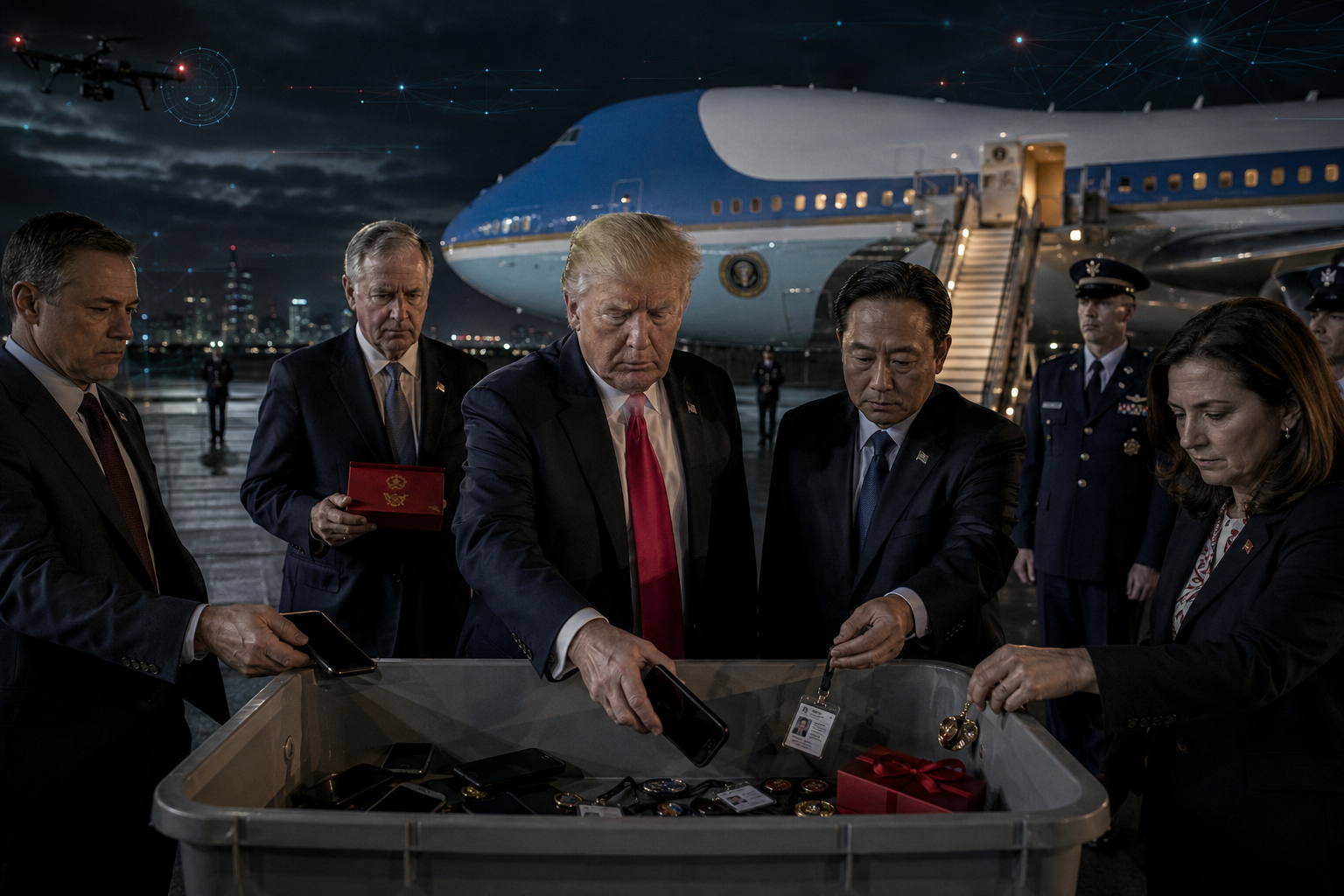
At the bottom of the stairs, security officers placed a bin.
You May Also Like
“Phones in the bin,” one officer said.
A staffer stopped. “My phone?”
“Burner phone. China-issued materials. Badges. Pins. Gifts. Anything collected during the trip.”
Another aide looked confused. “Even the lapel pin?”
“Yes.”
The aide laughed nervously. “It’s a pin.”
The officer did not laugh.
“Nothing from China goes on Air Force One.”
Trump, standing a few steps away, turned his head.
“What did he say?”
Steven Cheung answered, “Security procedure, sir. They’re collecting everything from the trip.”
Trump looked toward the bin.
Inside were burner phones, credential badges, small gift boxes, pins, and official materials. Ordinary objects. Harmless-looking objects. The kind of things people usually keep as souvenirs.
Trump walked closer.
“You’re telling me we came here for diplomacy, and now we’re throwing away the souvenirs like hazardous waste?”
A Secret Service officer answered carefully.
“Mr. President, anything received or used in a high-risk environment has to be treated as a potential security concern.”
Trump picked up a small badge with two fingers.
“This?”
“Yes, sir.”
“A badge?”
“Yes, sir.”
Trump stared at it for a moment, then tossed it into the bin.
The plastic hit the metal bottom with a sharp sound.
“Well,” Trump said, “that’s the world now.”
A senior officer nodded.
“Yes, sir. That is exactly the world now.”
The original article described this moment as a powerful symbol of modern espionage: before boarding Air Force One, White House staffers and reporters reportedly surrendered China-related items, including burner phones, credential badges, and lapel pins, after the Beijing trip.
Trump began walking up the stairs, but he stopped halfway.
“Bring the security team to the conference room once we’re airborne,” he said.
“Yes, Mr. President.”
“And bring the cyber people too.”
Inside Air Force One, the atmosphere was different from the usual post-summit flight. Normally, people would be reviewing headlines, preparing statements, or trying to rest. But now almost everyone was talking about the bin.
A young aide whispered, “Do they really think a pin can spy on us?”
Another staffer replied, “Apparently.”
A reporter shook his head. “This sounds like a spy movie.”
An older official nearby turned around.
“That’s the problem. Everyone thinks espionage looks dramatic. It usually doesn’t. Sometimes it looks like a free charger. Sometimes it looks like a badge. Sometimes it looks like a gift you politely accepted because refusing it would be rude.”
The young aide looked uncomfortable.
“So we trust nothing?”
The older official answered, “On this aircraft? Correct.”
The engines roared. Air Force One lifted into the night sky.
Minutes later, Trump entered the conference room. Around the table sat intelligence officials, military officers, communications advisers, Secret Service representatives, and cybersecurity specialists.
Trump sat down.
“Alright,” he said. “Explain to me why a badge, a pin, and a burner phone are being treated like weapons.”
A cyber adviser leaned forward.
“Sir, in modern counterintelligence, the danger is not only what an object appears to be. The danger is what it could contain, what it could transmit, what it could track, or what system it could touch.”
Trump looked unimpressed.
“That sounds expensive.”
“It is.”
“And complicated.”
“Very.”
“And necessary?”
The adviser paused.
“Yes, sir.”
Trump leaned back.
“Convince me.”
The adviser placed several images on the screen.
A USB cable.
A phone battery.
A conference badge.
A decorative pin.
A hotel room charger.
“These are ordinary objects,” the adviser said. “But each one can theoretically be modified. Some can contain tracking components. Some can contain microphones. Some can carry malicious hardware. Some can be used to compromise a device the moment they are connected.”
Trump pointed at the lapel pin image.
“That little thing?”
“Yes.”
A political adviser interrupted.
“With respect, this is where normal people start thinking Washington has lost its mind.”
The cyber adviser turned toward him.
“Normal people also use public Wi-Fi, plug unknown USB drives into laptops, and carry personal phones into hostile intelligence environments.”
The political adviser frowned.
“Hostile intelligence environment? We were at a diplomatic summit.”
The intelligence officer answered this time.
“A diplomatic summit is one of the most intense intelligence environments in the world.”
Trump looked from one officer to another.
“Why?”
“Because everyone important is there,” the officer said. “Leaders. Advisers. Communications teams. Negotiators. Journalists. Security staff. Translators. People carrying sensitive information. People with access. People under pressure. People moving fast.”
Another officer added, “And everyone is distracted by ceremony.”
Trump nodded slowly.
“Smiles, flags, speeches…”
“And opportunities,” the officer said.
The room became quiet.
Trump tapped the table.
“So the handshake is real, but the suspicion is real too.”
“Yes, sir.”
“That’s a hell of a relationship.”
A military communications officer spoke next.
“Air Force One changes the calculation. This aircraft is not simply transportation. It is a secure command platform. It carries protected communications, senior decision-makers, and sensitive operational routines.”
Trump looked toward the wall, as if seeing the whole aircraft differently.
“So anything brought on board becomes part of the security environment.”
“Exactly.”
“And if something is compromised?”
“We do not want to find out after it is inside.”
Trump gave a short laugh.
“So the rule is: when in doubt, throw it out.”
The Secret Service officer nodded.
“Yes, sir.”
Trump looked around the table.
“And nobody thought that sounded strange?”
The officer replied, “Sir, strange is safer than careless.”
That line stayed in the room.
A senior adviser crossed his arms.
“I understand phones. I understand chargers. But badges and pins? At some point, aren’t we sending a message that we don’t trust anything from China?”
The intelligence official answered calmly.
“That message was already understood by both sides before the plane landed.”
Trump’s eyes sharpened.
“What do you mean?”
“Sir, major powers do not enter these meetings naively. Every delegation assumes surveillance. Every host nation assumes counter-surveillance. Every room is inspected. Every device is questioned. Every gift is screened. The public sees diplomacy. The professionals see risk management.”
Trump smiled faintly.
“That’s the most honest thing anyone has said all day.”
Another adviser said, “But we still need to talk to them.”
“Of course,” Trump said. “You talk to everyone. You negotiate. You make deals. But you don’t bring their devices onto your plane.”
A few people laughed, but the laughter faded quickly.
The cyber adviser continued.
“Sir, the burner phones were especially important. They are used because we assume regular devices may be exposed during sensitive travel. Burner devices are temporary by design. Once the trip is over, they are not trusted anymore.”
Trump pointed at him.
“That part I understand. You use it, then dump it.”
“Yes.”
“Like a paper plate.”
“More like a contaminated paper plate.”
Trump laughed.
“That’s good. That’s very good. Don’t say that publicly.”
A communications aide made a note anyway.
Trump turned serious again.
“But tell me something. Are we being cautious because we know something was wrong with these items, or because we don’t know?”
The intelligence officer answered.
“Because we don’t know.”
Trump nodded.
“That’s worse.”
“In security, uncertainty is enough.”
The political adviser leaned forward.
“But there’s a diplomatic cost. If the world sees American officials throwing away Chinese-issued items before boarding Air Force One, Beijing may see it as an insult.”
Trump turned to him.
“They probably expected it.”
“Maybe.”
“No. They expected it. And if they didn’t, they should have.”
The adviser hesitated.
“Still, optics matter.”
Trump replied, “Security matters more.”
Then he paused.
“But optics matter too.”
He looked toward the communications team.
“How are people reacting?”
One aide checked a tablet.
“The image of the bin is spreading fast. Reporters are focusing on the phrase ‘Nothing from China allowed on the plane.’”
Trump looked amused.
“That’s a strong line.”
“It is.”
“It’s also true.”
The aide nodded. “Yes, sir.”
Trump leaned back again.
“The bin is going to become the story, isn’t it?”
The communications aide hesitated.
“It may become the symbol of the trip.”
Trump looked toward the intelligence officials.
“Not the talks. Not the handshake. Not the official statement. The bin.”
One officer said quietly, “Sometimes symbols explain reality better than statements.”
Trump stared at him.
“That’s true.”
For a moment, nobody spoke.
Outside, Air Force One moved through the darkness, carrying inside it the weight of two superpowers that needed each other, feared each other, traded with each other, competed with each other, and watched each other constantly.
Trump finally broke the silence.
“What does China think when they see us do this?”
The intelligence officer replied, “They understand the game.”
“The game?”
“Yes, sir. Strategic competition. Cyber defense. Counterintelligence. Signaling. Mutual suspicion.”
Trump looked annoyed.
“I don’t like that word. Game. Makes it sound harmless.”
The officer nodded.
“You’re right, sir. It is not harmless.”
Another military adviser spoke.
“The modern battlefield is not only land, sea, and air anymore. It is networks, devices, satellites, data, and infrastructure.”
Trump turned toward him.
“You think the next big conflict starts with cyber?”
“It could.”
“Before anyone fires a shot?”
“Yes.”
“Banks?”
“Yes.”
“Power grids?”
“Yes.”
“Airports?”
“Yes.”
“Phones?”
“Yes.”
“Elections?”
The officer paused.
“Yes.”
Trump looked around the room.
“And people still think a lapel pin is just a lapel pin.”
The cyber adviser said, “That is why small objects matter.”
Trump nodded.
“You know, years ago, people worried about microphones in the walls. Now the microphone is in your pocket, connected to the world, and people buy it themselves.”
The adviser replied, “That is one of the central problems of modern security.”
Trump smiled.
“I should have been a professor.”
No one knew whether to laugh.
Steven Cheung finally said, “You’d have had very high ratings, sir.”
That broke the tension for a moment.
But only for a moment.
A Secret Service officer spoke again.
“Mr. President, the strict rule exists because people make exceptions. One person says, ‘It’s just a gift.’ Another says, ‘It’s just a badge.’ Another says, ‘It’s just a cable.’ Eventually something gets through.”
Trump nodded.
“So you make the rule simple.”
“Yes.”
“Nothing from China.”
“Yes, sir.”
“Nothing means nothing.”
“Correct.”
Trump looked toward the communications aide.
“That’s why people understand it. Simple rule. Strong image.”
The aide said, “Some will call it dramatic.”
Trump replied, “Good. Security should be dramatic enough that people remember it.”
One adviser spoke carefully.
“Sir, there’s also a broader issue. This may reinforce the idea that U.S.–China relations are becoming dangerously distrustful.”
Trump’s expression hardened.
“They are distrustful.”
“Yes, sir.”
“Pretending otherwise doesn’t make it better.”
“No, but diplomacy requires some appearance of trust.”
Trump leaned forward.
“Diplomacy requires communication. It does not require stupidity.”
The room went still.
Trump continued.
“We can talk to China. We can negotiate with China. We can make agreements if they are good agreements. But we do not have to pretend that the world is innocent.”
The intelligence officer nodded.
“That is the basic principle.”
Trump looked at the screen again, where the image of the discarded items remained.
“What bothers me is not that we threw them away. What bothers me is that we had to.”
That sentence changed the mood in the room.
A younger officer looked up.
“Sir, that may be the most important point.”
Trump said nothing.
The officer continued.
“The bin is not really about China alone. It is about the age we live in. No major power fully trusts another major power’s technology. No leader enters a sensitive environment without assuming collection attempts. No secure platform allows unknown objects without screening.”
Trump said, “So this is bigger than one trip.”
“Much bigger.”
“It’s the new normal.”
“Yes, sir.”
Trump looked out the window.
“That’s sad.”
No one expected him to say that.
But he did.
“It’s sad,” he repeated. “Because there was a time when a gift was just a gift.”
An older diplomat, sitting quietly until then, finally spoke.
“Mr. President, perhaps there never really was such a time. Perhaps the difference is that now the tools are smaller, faster, and harder to see.”
Trump turned back.
“You’re saying suspicion was always there.”
“Yes. But technology has made suspicion universal.”
The room absorbed that.
Technology had not only changed war. It had changed trust. It had changed diplomacy. It had changed the meaning of objects. A phone was no longer just a phone. A badge was no longer just a badge. A gift was no longer just a gift.
A communications aide said softly, “That line will resonate.”
Trump looked at him.
“What line?”
“A gift is no longer just a gift.”
Trump waved his hand.
“Use it if you want. But make it stronger.”
The aide waited.
Trump said, “A gift can be a question mark. And on Air Force One, question marks don’t board.”
The aide wrote that down.
Later in the flight, the discussion moved into a smaller room. Trump sat with a handful of officers and senior advisers. The tone was less formal now, but the subject remained serious.
Trump asked, “Do our people understand this? Not just officials. Regular people. Business people. Journalists. Travelers.”
A cyber official shook his head.
“Not enough.”
“Why not?”
“Because convenience beats caution. People want to charge their phones. They want free Wi-Fi. They want to keep souvenirs. They do not think like intelligence targets.”
Trump said, “But some of them are targets.”
“Yes. Executives. Researchers. Engineers. Journalists. Government contractors. Activists. Anyone with access, influence, or information.”
Trump said, “And sometimes they don’t even know what they know.”
“Exactly.”
A military officer added, “A person may think they carry nothing sensitive. But their contacts, travel patterns, messages, and location data can reveal networks.”
Trump shook his head.
“So the person becomes the doorway.”
“Yes, sir.”
The older diplomat said, “That is why the security culture matters. You cannot protect only secrets. You also have to protect the paths leading to secrets.”
Trump looked at him approvingly.
“That’s good.”
The diplomat gave a small nod.
“Thank you, sir.”
Trump then asked, “What would happen if we didn’t collect the phones?”
The cyber adviser answered.
“Best case, nothing.”
“And worst case?”
“Persistent compromise. Tracking. Data extraction. Microphone activation. Network probing. Attempts to connect later to U.S. systems. Even if the device itself contains no classified data, it can become a stepping stone.”
Trump frowned.
“A stepping stone to what?”
“To people. To accounts. To systems. To patterns. To future access.”
The President was quiet.
Then he said, “So we’re not protecting the phone. We’re protecting everything the phone can touch.”
“Yes.”
“And everything the person using it can touch.”
“Yes.”
Trump nodded slowly.
“That is a very different way of thinking.”
“It has to be.”
Hours passed. Staffers tried to rest, but the conversation kept spreading through the aircraft.
In the press cabin, a reporter said, “This is going to be the detail everyone remembers.”
Another replied, “It’s visual. A bin full of discarded objects before boarding Air Force One. You can’t invent a better symbol.”
A third reporter said, “It tells the whole story of U.S.–China relations without needing a paragraph.”
One staffer nearby asked, “And what story is that?”
The reporter answered, “They talk because they must. They distrust because they can’t afford not to.”
No one argued.
Near the front of the aircraft, Trump continued speaking with his officers.
“I want to know something,” he said. “How do we keep diplomacy from turning into total suspicion?”
The room was quiet.
Finally, the diplomat answered.
“By maintaining channels. By talking even when trust is limited. By creating rules. By reducing accidents. By understanding that suspicion does not remove the need for communication.”
Trump replied, “But communication doesn’t remove the need for suspicion.”
“No, sir.”
Trump smiled faintly.
“So we talk with one hand and secure the other.”
“That is one way to put it.”
A military officer added, “Peace often depends on disciplined mistrust.”
Trump looked at him.
“Disciplined mistrust?”
“Yes, sir. Enough caution to protect yourself. Enough communication to avoid disaster.”
Trump repeated it.
“Disciplined mistrust.”
He leaned back.
“That might be the whole foreign policy now.”
No one said anything, but several people wrote it down.
As Air Force One continued across the sky, the officers returned to the image of the bin again and again. The more they discussed it, the more it seemed to contain more than discarded objects. It contained the truth of an era.
A truth where nations could be economically connected and strategically opposed.
A truth where leaders could shake hands in public while intelligence teams worked in silence.
A truth where technology made every object suspicious.
A truth where security no longer began at borders, but at the level of chips, circuits, signals, and data.
Trump finally stood.
Before leaving the room, he turned back to the officers.
“Let me tell you what people will say. Some will say we were paranoid. Some will say we insulted China. Some will say it was theater.”
He paused.
“But if one bad device gets onto this aircraft, those same people will ask why nobody stopped it.”
The Secret Service officer nodded.
“That is correct, sir.”
Trump continued.
“So we stop it before we know. Not after.”
“Yes, sir.”
“And the rule stays simple.”
“Nothing from China on the plane.”
Trump looked at him.
“Nothing questionable on the plane. From anywhere.”
The officer nodded again.
“Yes, sir.”
Trump walked toward the door, then stopped.
“And next time?”
“Yes, Mr. President?”
“Bigger bin.”
A few people laughed.
This time, the laughter felt human. Tired. Nervous. Real.
But after Trump left, the officers remained seated for a moment longer.
One cyber adviser looked at the others and said, “He understands the symbol.”
The intelligence officer replied, “The public will too.”
The diplomat looked down at his notes.
“The question is whether they understand what it means.”
The military officer answered, “It means trust is now one of the rarest things in the world.”
No one corrected him.
Because that was the truth.
By the time Air Force One approached home, the story had already begun moving across screens. People debated whether the order was smart, excessive, insulting, necessary, paranoid, or simply realistic.
But inside the aircraft, among the people who had seen the bin firsthand, the meaning felt clear.
The discarded phones were not just phones.
The badges were not just badges.
The pins were not just pins.
They were reminders that modern power is invisible until something goes wrong. They were reminders that diplomacy now happens under the shadow of cyber warfare. They were reminders that the smallest object can carry the largest risk.
And perhaps most of all, they were reminders that in the age of digital espionage, trust does not board automatically.
It must be inspected.
It must be earned.
And sometimes, when the stakes are high enough, it must be left behind in a bin at the bottom of the stairs.