The Secret Air Force One Conversation Between America’s Top Security Chief and the CIA Director That Exposed the Terrifying Reality Behind Modern Diplomacy
“As Trump’s team threw Chinese-issued phones, badges, gifts, and even souvenir pins into a black security bin beside Air Force One, one CIA officer whispered something that froze the entire room:
‘The most dangerous weapon in the world today doesn’t explode… it listens.’
What happened next inside Air Force One became one of the most chilling conversations ever held about China, cyber warfare, and the collapse of global trust.”
The freezing wind moved across the dark runway in Beijing while the engines of Air Force One rumbled like distant thunder beneath the night sky.
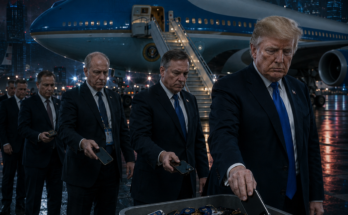
Floodlights reflected against wet concrete. Secret Service agents stood motionless near the aircraft stairs. Military officers moved quietly through the shadows carrying black security cases locked with biometric seals.
And at the bottom of the stairs sat a large black container.
You May Also Like
Simple.
Silent.
Terrifying.
One by one, American officials approached it before boarding the aircraft.
Chinese-issued burner phones.
Conference badges.
Gift boxes.
Electronic accessories.
Lapel pins.
Chargers.
Translation devices.
Everything went into the bin.
No exceptions.
A young White House aide hesitated while staring at a polished red-and-gold commemorative summit pin handed to him earlier that afternoon by Chinese officials.
A Secret Service officer extended his hand calmly.
“The pin, sir.”
The aide looked confused.
“It’s just a souvenir.”
The officer’s face remained cold.
“So is a fishing hook until somebody swallows it.”
The aide slowly dropped the pin into the container.
Clink.
Another officer tossed in two encrypted conference devices.
Clink.
Another dropped a stack of electronic credentials.
Clink.
The sound echoed across the runway like tiny pieces of trust breaking apart.
Nearby, Donald Trump stood silently with his coat moving in the wind while he watched his delegation throw away almost everything connected to the trip.
For several moments, nobody spoke.
Then Trump quietly muttered:
“Amazing, isn’t it?”
Several people turned toward him.
“We travel halfway around the world talking about cooperation,” he said slowly, “and before we leave, we throw everything away like it’s radioactive.”
No one answered immediately.
Because nobody wanted to say the obvious truth out loud.
Finally, one senior security officer replied carefully:
“Sir… this is the world now.”
Trump stared at the overflowing bin.
“Yeah,” he answered quietly. “That’s the part people don’t understand.”
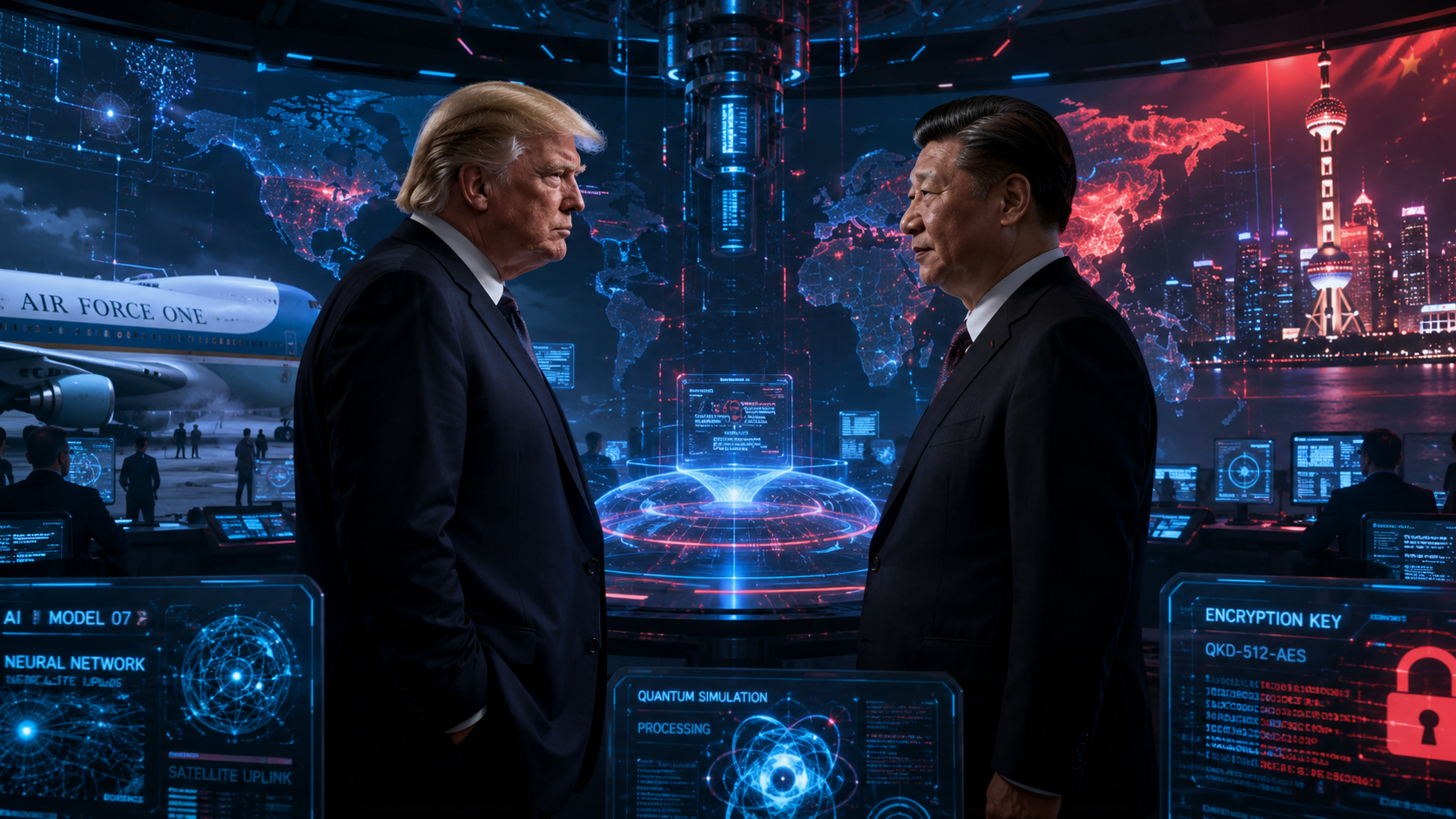
Minutes later, after takeoff, deep inside a secured compartment aboard Air Force One, two men sat across from each other beneath dim blue lights.
One was the United States Top Secret Security Leader responsible for presidential survival operations overseas.
The other was the CIA Director.
Between them glowed a massive digital screen displaying live intelligence feeds from China, Taiwan, satellite networks, cyber activity maps, and aircraft security systems.
The aircraft hummed steadily around them.
The Security Leader broke the silence first.
“All China-issued electronics isolated?”
The CIA Director nodded.
“Completely separated from aircraft systems.”
“Badges?”
“Destroyed after analysis.”
“Phones?”
“Quarantined.”
“Gift boxes?”
“Under counterintelligence review.”
The Security Leader leaned back heavily.
“You know what bothers me?”
The CIA Director looked up calmly.
“That none of this feels unusual anymore.”
The CIA Director gave a faint humorless smile.
“Because it isn’t.”
The Security Leader rubbed his forehead.
“Ten years ago this would sound insane.”
The CIA Director replied immediately.
“Ten years ago governments still believed technology was making the world safer.”
Silence filled the room.
The Security Leader looked toward the aircraft window.
“And now?”
The CIA Director leaned forward slowly.
“Now every object is a potential doorway.”
The Security Leader stared at him.
“You really think something as small as a conference pin could be weaponized?”
The CIA Director answered without hesitation.
“In modern intelligence work, size is irrelevant.”
The Security Leader crossed his arms.
“So we’ve reached the point where diplomats fear souvenirs.”
The CIA Director shook his head.
“No.”
He pointed toward the digital intelligence display.
“We’ve reached the point where information is more valuable than missiles.”
That sentence changed the atmosphere immediately.
The CIA Director stood and walked toward the glowing screen.
“You know what most people still misunderstand about modern warfare?” he asked quietly.
The Security Leader remained silent.
“They think war begins with explosions.”
The Director tapped a blinking cyber network map.
“But future wars may begin with access.”
The Security Leader looked carefully at the display.
Compromised infrastructure.
Communication networks.
Satellite systems.
Power grids.
Artificial intelligence pathways.
Cyber infiltration routes.
The CIA Director continued:
“One compromised device in the wrong environment can expose movement patterns, communication systems, security protocols, behavioral habits, psychological profiles, or network structures.”
The Security Leader frowned slightly.
“You’re talking about total information warfare.”
“I’m talking about invisible warfare.”
The aircraft cabin vibrated softly through turbulence.
The Security Leader stared at the cyber maps.
“So this is what diplomacy has become.”
The CIA Director answered quietly:
“No. This is what civilization has become.”
For several moments neither man spoke.
Outside the aircraft windows stretched nothing except darkness over the Pacific Ocean.
Then the Security Leader asked carefully:
“Do you think China actually sees us as enemies?”
The CIA Director paused thoughtfully.
“China sees America as both partner and obstacle.”
“That sounds contradictory.”
“It is.”
The Director folded his hands together.
“China needs access to American markets, technology flows, and global stability. But China also wants to replace American dominance over time.”
The Security Leader nodded slowly.
“So both sides cooperate while preparing for confrontation.”
“Exactly.”
The room fell silent again.
Then the Security Leader suddenly laughed once.
“You know what’s strange?”
The CIA Director raised an eyebrow.
“We spend billions building Air Force One into a flying fortress.”
He gestured toward the aircraft around them.
“Secure communications. EMP shielding. encrypted systems. military defenses. airborne command capability.”
The CIA Director nodded.
“And?”
The Security Leader pointed toward the destroyed electronics report.
“And everybody’s still terrified of a conference badge.”
For the first time that night, the CIA Director smiled faintly.
“Because the world changed faster than military doctrine.”
The Security Leader leaned forward now.
“You really believe information is more dangerous than bombs?”
The CIA Director answered immediately.
“Information controls bombs.”
That answer hung in the air like ice.
The Director continued quietly.
“Information controls economies. Elections. Narratives. Public fear. Military timing. Supply chains. Financial markets. Artificial intelligence systems.”
He paused carefully.
“The nations that control information shape reality itself.”
The Security Leader looked toward another screen showing Trump speaking earlier beside Xi Jinping.
“You think Xi understands this better than most world leaders.”
The CIA Director nodded slowly.
“Xi understands patience.”
The Security Leader frowned.
“And America?”
The Director answered carefully.
“America understands speed.”
Another silence.
Then the Security Leader quietly asked:
“Which one wins?”
The CIA Director looked toward the darkness outside the aircraft.
“That depends on whether the future rewards patience… or adaptability.”
Hours passed while conversations became deeper.
Less political.
More philosophical.
The Security Leader finally whispered:
“You know what scares me most?”
The CIA Director looked up.
“That this level of suspicion is becoming normal.”
The Director nodded slowly.
“Because trust is collapsing globally.”
The Security Leader looked exhausted now.
“Every nation spies. Every corporation collects data. Every device tracks behavior. Every algorithm watches attention.”
The CIA Director responded quietly:
“And every government fears falling behind.”
The aircraft lights dimmed slightly as midnight passed.
The conversation continued.
The Security Leader spoke softly now.
“You know what’s tragic?”
The CIA Director waited.
“Technology connected humanity more than ever before.”
He pointed toward the discarded electronics report.
“And somehow we trust each other less.”
The CIA Director stared silently at the glowing intelligence maps.
Then he quietly replied:
“Because connection without trust creates surveillance.”
That sentence seemed to freeze the room itself.
The engines hummed steadily around them.
Then suddenly Trump entered the compartment.
Both men stood immediately.
Trump waved them down casually.
“Relax.”
He sat slowly near the glowing digital map.
“You boys look depressed.”
Nobody laughed.
Trump glanced at the intelligence reports.
“Still worried about the phones?”
The CIA Director answered carefully.
“We’re worried about the future, sir.”
Trump nodded once.
“Good answer.”
He looked toward the aircraft window thoughtfully.
“You know what people don’t understand about world leaders?” he asked quietly.
Neither man interrupted him.
“Everybody thinks power removes fear.”
Trump slowly shook his head.
“But power creates new kinds of fear.”
The room remained silent.
Trump pointed toward the discarded electronics inventory.
“At least during the Cold War people understood the battlefield.”
He leaned back slowly.
“Now the battlefield sits in your pocket.”
Nobody disagreed.
Trump continued quietly.
“A charger. A pin. A phone. A badge.”
He paused.
“People laugh at that until they realize modern empires are built on information.”
The CIA Director nodded slowly.
“That’s exactly the reality, sir.”
Trump stared at the glowing map of China and the Pacific.
“You know what the real crisis is?”
One officer answered carefully:
“What, Mr. President?”
Trump folded his hands together.
“We created the most connected civilization in history…”
The room remained completely silent.
“…and somehow became more suspicious of each other than ever before.”
Nobody answered.
Because nobody could.
As dawn slowly appeared across the horizon outside Air Force One, one image from the trip had already spread around the world faster than any summit speech or diplomatic photograph.
Not the handshake.
Not the negotiations.
Not the red carpet.
The bin.
The black bin overflowing with discarded Chinese-issued phones, badges, electronics, gifts, and pins beneath the stairs of Air Force One.
A simple image.
But one that revealed the terrifying truth modern diplomacy rarely admits publicly:
That nations may smile together while quietly preparing for cyber war.
That alliances now exist beside deep mistrust.
That invisible conflicts may become more dangerous than visible ones.
And that in the age of digital power…
A phone is never just a phone.
A gift is never just a gift.
And trust itself may be the rarest resource left on Earth.