For decades, the Northrop Grumman B-2 Spirit has symbolized the pinnacle of American airpower. Designed to slip through the world’s most advanced air defenses, the bat-wing bomber was built around one core promise: invisibility.
Now, a Chinese defense technology company claims that promise is no longer absolute.
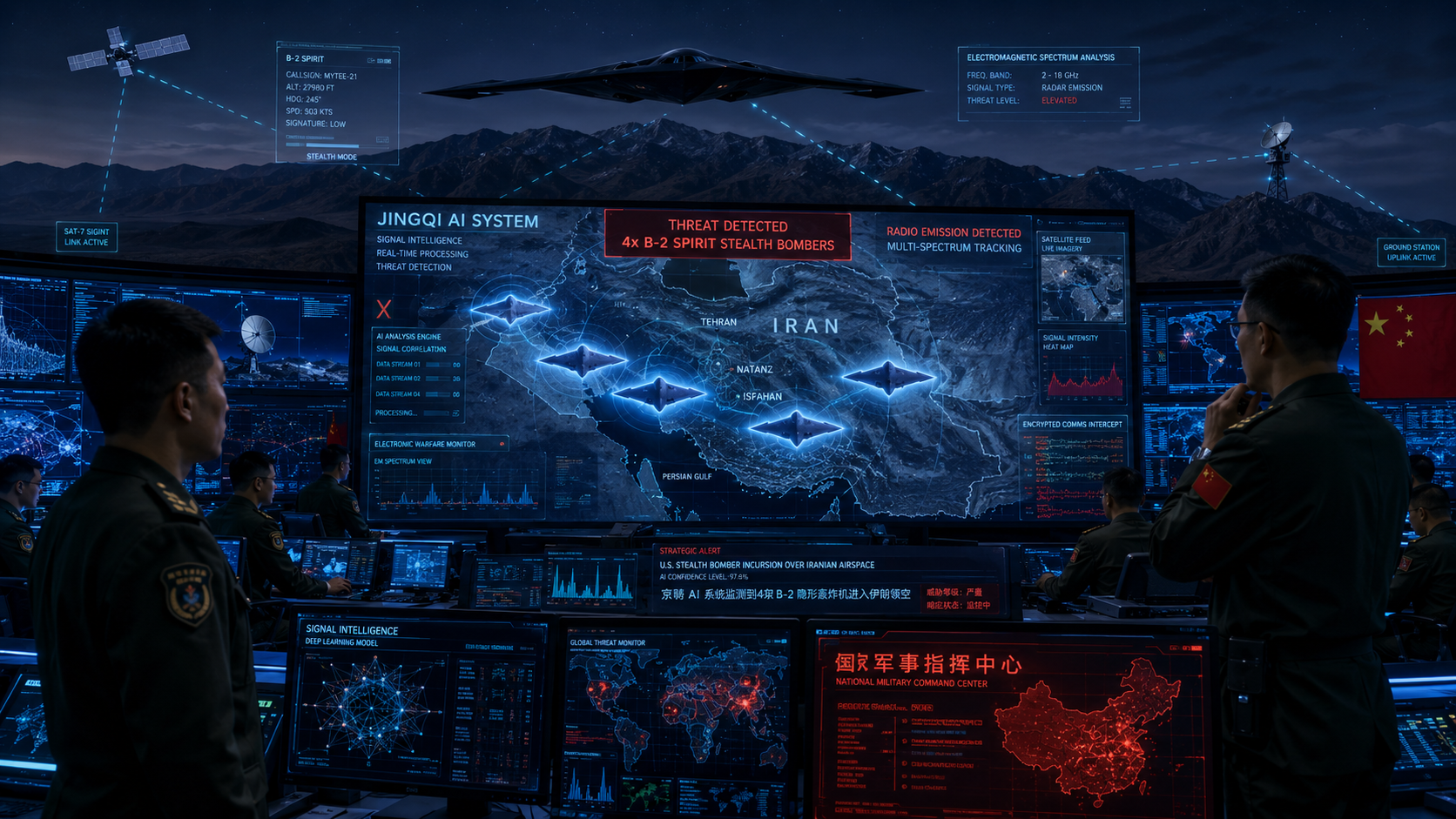
According to Hangzhou-based Jingan Technology, its artificial intelligence-powered monitoring platform, known as Jingqi, tracked radio emissions from four B-2 bombers during a U.S. strike operation over Iran in March 2026.
If true, the announcement marks a profound strategic message: in the age of artificial intelligence, stealth may still hide aircraft from radar—but it may not hide their digital footprints.
You May Also Like



A New Kind of Detection
The reported mission, known as Operation Epic Fury, allegedly involved four B-2 bombers operating under the callsigns Petro 41 through Petro 44.
Jingan Technology says its AI system intercepted communications from the bombers during their return flight after striking Iranian military infrastructure.
This is an important distinction.
China is not claiming that radar saw the B-2.
Instead, it claims that AI correlated radio transmissions, satellite imagery, open-source intelligence, and aircraft movement patterns to reconstruct the mission.
That difference matters enormously.
Stealth aircraft are designed to evade radar, but they still generate data:
- Brief radio transmissions
- Navigation updates
- Refueling coordination
- Satellite observations
- Logistics activity at airbases
A single clue may reveal little. But when AI connects thousands of clues, hidden operations become easier to infer.
The B-2 Spirit: America’s Invisible Sword
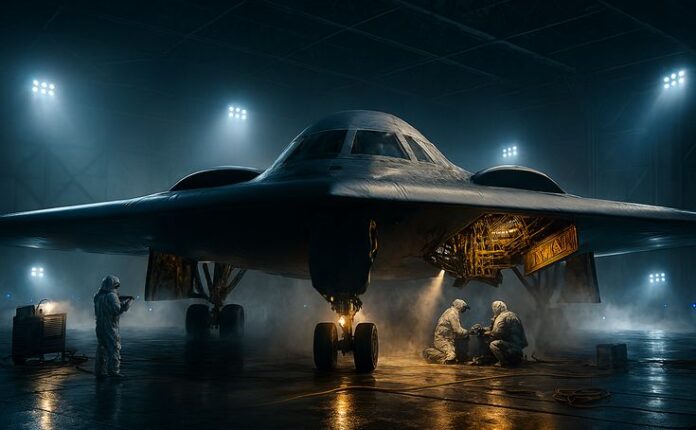
Northrop Grumman B-2 Spirit remains one of the most sophisticated combat aircraft ever built.
Key capabilities include:
- Radar cross-section often compared to that of a bird
- Intercontinental range exceeding 6,000 nautical miles without refueling
- Ability to deliver conventional and nuclear weapons
- Capacity to carry the GBU-57 Massive Ordnance Penetrator
- Penetration of heavily defended targets
Each aircraft cost roughly $2 billion to build, making the B-2 one of the most expensive aircraft in history.
Its purpose is simple but decisive: strike the most heavily defended targets on Earth.
Meet Jingqi: China’s AI War-Watching System
Jingan Technology describes Jingqi as a next-generation military intelligence platform that combines:
- Open-source intelligence (OSINT)
- Signals intelligence (SIGINT)
- Commercial satellite imagery
- Aviation tracking data
- Machine learning analytics
The company says the platform can detect unusual military patterns long before conflict erupts.
Jingan claims Jingqi noticed abnormal U.S. force movements beginning in January 2026 and identified increasing activity from early February, interpreting it as signs of impending military action.
Whether or not every claim is accurate, the concept itself is realistic.
Modern wars leave digital trails, and AI excels at spotting patterns invisible to human analysts.
Stealth vs Signal Intelligence
Stealth and signal intelligence are fundamentally different.
Stealth protects against radar.
Signal intelligence listens for emissions.
If a stealth aircraft transmits, and a capable listener is within range, the transmission can potentially be detected.
That does not mean the aircraft can be targeted or shot down.
It simply means someone may know it was there.
This distinction is crucial.
The B-2 mission reportedly struck its targets successfully and returned safely, suggesting operational success despite the Chinese claim.
Why This Matters More Than Radar
For decades, military power was measured by who had the fastest aircraft, the longest-range missiles, and the strongest armor.
Today, victory increasingly depends on who can collect, process, and understand information faster.
Artificial intelligence can:
- Analyze millions of data points in seconds
- Detect subtle anomalies
- Predict military movements
- Reveal hidden operational patterns
In this environment, secrecy becomes harder to maintain.
Even invisible aircraft can cast detectable informational shadows.
Strategic Signaling from Beijing
China’s announcement serves more than a technical purpose.
It also sends a powerful geopolitical message.
Beijing wants Washington—and the world—to understand that China is building systems designed to challenge U.S. military advantages.
By publicizing this claim, China is effectively saying:
“Your stealth aircraft may evade radar, but they do not escape our algorithms.”
Whether fully verified or not, the psychological impact is significant.
Military competition is fought not only with weapons, but with perception.
The Real Question: Can Detection Become Targeting?
Detecting a radio transmission is not the same as guiding a missile.
To threaten stealth bombers in real time, China would need to integrate:
- Detection sensors
- Data fusion networks
- Tracking systems
- Command-and-control infrastructure
- Long-range weapons
That is a far more difficult challenge.
But this is exactly where global military development is heading.
The race is no longer just about building better aircraft.
It is about building smarter networks.
The Future of Airpower
The B-2 Spirit remains one of the most formidable weapons ever created.
Yet the rules of warfare are evolving.
Stealth still matters.
But in an age of AI, satellite constellations, and global sensors, invisibility is no longer solely about avoiding radar.
It is about controlling every signal, every transmission, and every pattern that reveals intent.
Tomorrow’s most powerful weapon may not be the aircraft itself.
It may be the intelligence system that sees what others believe is hidden.
Final Analysis: The Invisible Is Becoming Visible
China’s claim does not prove the end of American air superiority.
It does not show that the B-2 was tracked by radar, targeted, or endangered.
But it does highlight a transformational reality.
The future battlefield belongs to nations that can turn fragments of data into actionable intelligence.
The B-2 Spirit still dominates the skies.
Yet the rise of AI-driven surveillance means that even the most secret missions may leave traces for advanced algorithms to discover.
In the contest between stealth and artificial intelligence, the world is witnessing the opening moves of a new era.
And in this era, the side that sees first may shape history.