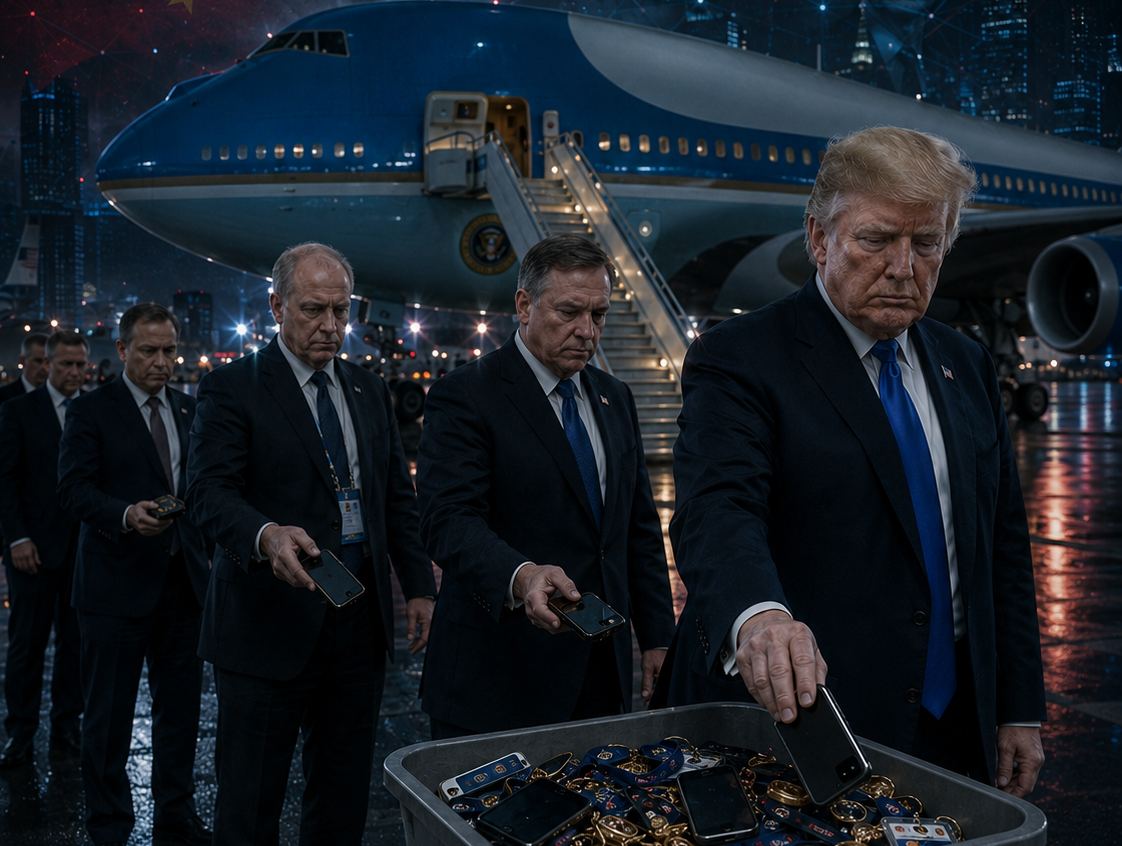
The engines of Air Force One rumbled against the cold Beijing night while floodlights reflected off the wet runway like scattered pieces of broken glass.
American officials moved carefully across the tarmac after two exhausting days of diplomatic meetings with Xi Jinping and senior Chinese officials. Cameras had already captured the smiles, the handshakes, the polished press conferences, and the carefully scripted moments designed for the world to see.
But what happened next was never meant to look symbolic.
You May Also Like
It was procedure.
Cold.
Quiet.
Uncomfortable procedure.
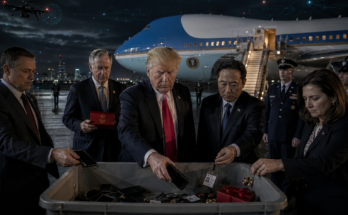
At the bottom of the aircraft stairs sat a black security bin surrounded by Secret Service agents and intelligence officers wearing gloves.
One by one, members of the U.S. delegation were stopped before boarding.
“Phones.”
Into the bin.
“Badges.”
Into the bin.
“Conference electronics.”
Into the bin.
“Gift boxes too.”
Into the bin.
Even lapel pins.
Throw them away.
A young aide hesitated while staring at a small red-and-gold commemorative pin from the summit.
The Secret Service officer repeated himself.
“Sir. Everything.”
The aide slowly dropped it into the container.
Clink.
Another sound followed.
And another.
The bin slowly filled with discarded objects from one of the most important diplomatic visits on Earth.
Nearby, Donald Trump stood silently with his coat moving in the wind as he watched American officials throw away nearly everything they had touched during the China trip.
For a moment, nobody spoke.
Then Trump finally looked toward one of his officers and said quietly:
“Amazing, isn’t it?
We travel halfway across the world to build relations…
and before we leave, we throw everything away like it’s contaminated.”
No one answered immediately.
Because nobody knew how to answer honestly without admitting something deeply unsettling.
The officer finally responded.
“Sir… this is the world now.”
Trump stared at the bin again.
“Yeah,” he muttered. “That’s the part people don’t understand.”
The staircase lights illuminated the faces of intelligence officials while they carefully monitored every item being discarded.
One younger staff member looked visibly uncomfortable.
“You really think a souvenir pin could be dangerous?”
A cybersecurity officer turned toward him instantly.
“You still think espionage looks like old spy movies.”
The young aide crossed his arms defensively.
“So what? We’re supposed to believe every little object is a threat now?”
The officer stepped closer.
“Not every object.”
He pointed toward the bin.
“Just any object.”
The aide frowned.
“That sounds paranoid.”
“No,” the officer answered calmly. “Paranoia is irrational. This is probability.”
The younger aide stayed quiet.
The officer continued.
“Modern intelligence work isn’t about giant hidden devices anymore. It’s about tiny vulnerabilities. Tiny openings. Tiny mistakes.”
He picked up a discarded conference badge with two fingers.
“People see plastic. Intelligence agencies see access.”
Trump overheard the exchange while stepping toward the stairs.
Without turning around, he spoke loudly enough for everyone nearby to hear.
“The scary thing is…
ten years ago that conversation would sound insane.
Today it sounds responsible.”
Silence followed him up the stairs.
Inside the aircraft, the mood felt completely different from the public images broadcast around the world only hours earlier.
The smiles from the summit were gone.
The relaxed diplomatic posture was gone.
Now the atmosphere felt heavier.
Real.
Strategic.
Almost military.
Screens glowed inside secure conference rooms while intelligence officers reviewed travel protocols and communications security procedures.
Outside, the world saw diplomacy.
Inside, the world looked far more fragile.
Trump entered a briefing room where military officers and cyber specialists were already waiting around a large illuminated table.
A map of Asia covered the digital screen.
Trade routes.
Satellite zones.
Military positions.
Cyber activity patterns.
Artificial intelligence infrastructure.
Semiconductor supply chains.
One adviser began speaking immediately.
“Mr. President, all China-issued electronics from the trip have been isolated and removed from the aircraft environment.”
Trump sat down slowly.
“You know what’s strange?”
The room stayed silent.
“We just spent two days talking about cooperation.”
Nobody interrupted him.
“Trade deals. Stability. Peace. Economic coordination.”
He leaned back in his chair.
“And now everybody in this room is acting like we just escaped enemy territory.”
One intelligence official answered carefully.
“Sir… modern geopolitics is complicated.”
Trump laughed softly.
“That’s a very polite way of saying nobody trusts anybody.”
No one disagreed.
The adviser activated another screen displaying examples of modern cyber espionage operations discovered over the past decade.
Compromised cables.
Modified chargers.
Surveillance implants.
Tiny embedded chips hidden inside ordinary devices.
Trump narrowed his eyes.
“You’re telling me a phone charger can become an intelligence tool?”
“Yes, sir.”
“A badge?”
“Yes, sir.”
“A pin?”
“Potentially.”
Trump shook his head slowly.
“Unbelievable.”
Then one older military officer spoke from across the room.
“With respect, sir… this is no longer the age of visible warfare.”
Everyone looked toward him.
The officer continued carefully.
“Wars used to begin with explosions.”
He pointed toward the cyber diagrams.
“Now they begin with access.”
The room fell silent.
The officer stood and walked toward the digital map.
“Future conflicts may begin without missiles. Without tanks. Without aircraft carriers moving into position.”
He pointed toward blinking cyber network indicators.
“A successful cyber operation can disrupt communications, transportation, finance, energy grids, military logistics, satellite systems, and intelligence infrastructure before the first shot is ever fired.”
Trump folded his arms.
“So you’re saying the battlefield is invisible now.”
“In many ways, yes, sir.”
Another adviser joined the discussion.
“The most powerful weapon today may not be a bomb.”
Trump looked at him.
“What is it then?”
The adviser answered immediately.
“Information.”
That single word changed the energy in the room.
Because everyone understood it.
Information controlled economies.
Information controlled militaries.
Information controlled elections.
Information controlled narratives.
And the nations that mastered information would shape the future world order.
Trump looked down at the conference table thoughtfully.
“You know what’s dangerous about all this?”
One officer responded.
“How invisible it is?”
Trump nodded.
“At least during the Cold War people knew where the danger was.”
He looked around the room.
“Now danger can sit in your pocket.”
Nobody spoke.
The aircraft engines hummed steadily through the silence.
One communications adviser carefully shifted the conversation.
“Sir, some critics will say these precautions make diplomacy impossible.”
Trump looked up immediately.
“No,” he said firmly. “They make honesty impossible.”
The adviser seemed surprised.
Trump continued.
“Think about it. Every country smiles for the cameras. Every leader talks about partnership. Cooperation. Respect.”
He pointed toward the discarded electronics inventory displayed on-screen.
“And then behind closed doors everybody assumes everybody’s spying on everybody.”
One intelligence officer quietly replied:
“That assumption is usually correct.”
A few people in the room laughed nervously.
Not because it was funny.
Because it was true.
Trump leaned back again and stared at the glowing world map.
“You know what this really means?”
No one answered.
“It means trust has become the rarest currency on Earth.”
The room became completely still.
One younger military aide finally spoke carefully.
“Sir… do you think the U.S. and China can actually trust each other again?”
Trump paused for several long seconds before answering.
“They can cooperate.”
The aide waited.
“But trust?” Trump shook his head slowly. “That’s harder.”
The aircraft continued cutting through the darkness over the Pacific Ocean while conversations deepened into something far larger than security procedures.
The discussion became philosophical.
Civilizational.
One adviser spoke quietly from the far end of the table.
“Maybe this is the price of technological civilization.”
Trump looked over.
“What do you mean?”
The adviser took a breath.
“We created systems so advanced that nobody fully controls them anymore.”
He pointed toward the digital intelligence network maps.
“Artificial intelligence. Mass surveillance. Quantum computing. Cyber warfare. Autonomous systems.”
He paused.
“The more connected humanity becomes… the less secure humanity feels.”
Another officer nodded slowly.
“Technology was supposed to make the world smaller.”
“And instead?” Trump asked.
The officer answered softly.
“It made the world more suspicious.”
That sentence lingered heavily in the room.
For several moments nobody spoke.
Then Trump suddenly smiled faintly.
“You know what’s ironic?”
Everyone looked toward him.
“The same technology that lets nations communicate instantly…”
He pointed toward the discarded electronics report.
“…is also the reason nobody trusts the communication.”
Several officials exchanged glances.
Because that contradiction sat at the center of modern civilization itself.
The aircraft lights dimmed slightly as midnight approached.
In another section of the plane, staff members quietly discussed the security ritual they had witnessed before takeoff.
One young reporter shook her head.
“I still can’t believe they made us throw away everything.”
An older correspondent replied immediately.
“You know what bothered me most?”
“What?”
“That nobody argued.”
The younger reporter frowned.
“What do you mean?”
The older journalist looked toward the dark aircraft window.
“Everyone accepted it instantly. That’s how normalized suspicion has become.”
Another aide joined the conversation.
“We live in a world where governments trust algorithms more than people.”
A silence followed.
Then someone quietly whispered:
“And maybe they have reasons to.”
Hours later, Trump returned to the secure conference room for one final discussion before landing.
The atmosphere had grown more reflective.
More personal.
Less political.
Trump stood near the window looking out into complete darkness beyond the aircraft.
“You know,” he said quietly, “history books will probably describe this era wrong.”
One officer asked carefully:
“How so, sir?”
Trump kept staring outside.
“They’ll focus on trade wars. Military budgets. Elections. Speeches.”
He turned back toward the room.
“But the real story of this era is fear.”
Nobody moved.
Trump continued.
“Fear of losing power. Fear of surveillance. Fear of cyber attacks. Fear of manipulation. Fear of artificial intelligence. Fear of dependence.”
He pointed downward slightly.
“And fear that every device around us may be listening.”
The room remained silent.
Because every single person there had already thought the same thing before.
Trump slowly sat down again.
“You know what’s amazing?”
One officer responded quietly.
“What, Mr. President?”
Trump folded his hands together.
“Humanity created the most connected civilization in history…”
He paused.
“…and somehow ended up trusting each other less than ever.”
No one had an answer for that.
Because maybe there wasn’t one.
As dawn slowly approached on the horizon, one image from the trip had already begun spreading across the world faster than any official diplomatic photograph.
Not the handshake.
Not the summit table.
Not the speeches.
The bin.
The black bin filled with discarded phones, badges, pins, electronics, and gifts sitting beneath the stairs of Air Force One.
A simple image.
But one that revealed the truth modern diplomacy rarely says out loud.
That nations may stand together for photographs while secretly preparing for digital war.
That cooperation and suspicion now exist side by side.
That the most powerful conflicts of the future may begin silently.
And that sometimes the smallest discarded objects reveal the biggest truths about the world.
Because in the age of cyber power…
A phone is never just a phone.
A gift is never just a gift.
A pin is never just a pin.
And trust itself may be the most endangered resource left on Earth.