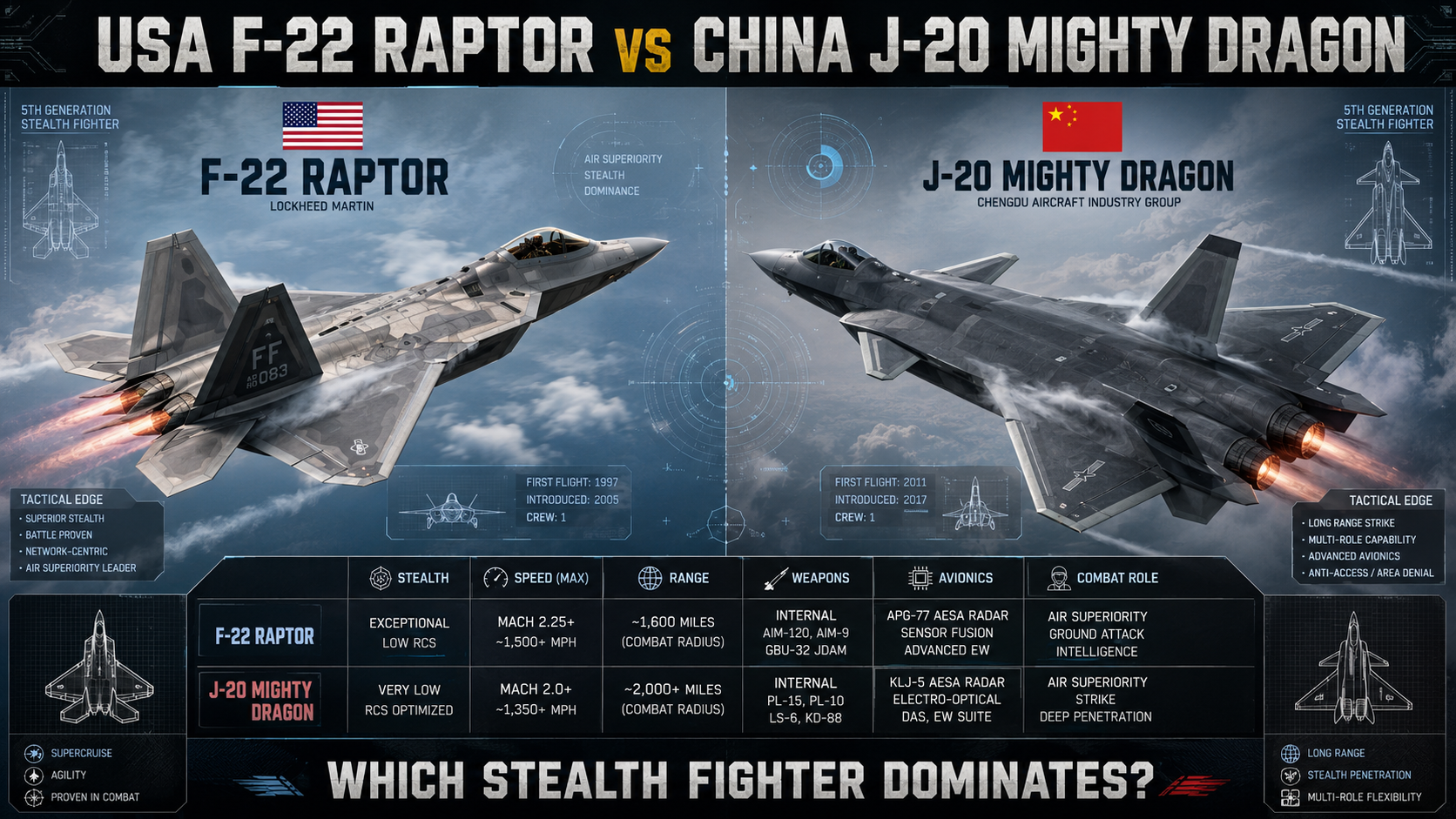
In the skies above the Pacific, two of the most advanced combat aircraft ever built represent the technological pride and strategic ambitions of the world’s two most powerful nations.
The Lockheed Martin F-22 Raptor is widely regarded as the finest air-dominance fighter ever produced. Built by Lockheed Martin, it was designed to achieve one goal: absolute control of the skies.
Facing it is China’s Chengdu J-20 Mighty Dragon, developed by Chengdu Aircraft Industry Group. Long-range, stealthy, and heavily armed, the J-20 was created to challenge U.S. air power and push American forces farther from Asia.
This is more than a comparison of two fighter jets. It is a contest between two military philosophies, two engineering cultures, and two visions of the future of aerial warfare.
You May Also Like



The F-22 Raptor: America’s Unmatched Air Predator

The F-22 is the ultimate expression of air superiority.
It combines stealth, speed, agility, and sensor fusion into one lethal platform. The Raptor was designed to detect enemy aircraft first, fire first, and destroy threats before they ever know it is there.
Its defining advantages include:
- True all-aspect stealth with an extremely low radar signature
- Supercruise above Mach 1.5 without afterburners
- Two-dimensional thrust-vectoring nozzles for extraordinary maneuverability
- Internal weapons carriage to preserve stealth
- A 20mm M61 Vulcan cannon for close combat
In a visual dogfight, few aircraft in history can match the F-22.
The J-20 Mighty Dragon: China’s Long-Range Hunter

The J-20 reflects China’s strategic priorities.
Rather than emphasizing close-range maneuvering, it was designed to strike high-value targets such as tankers, airborne early warning aircraft, and support assets that are essential to U.S. operations.
Its strengths include:
- Large internal weapon bays
- Long combat radius of roughly 1,100 miles
- Advanced active electronically scanned array radar
- Compatibility with very long-range PL-15 missiles
- Strong frontal stealth shaping
The J-20 is built to reshape the battlefield before the main fight even begins.
Stealth: The Art of Remaining Invisible

Stealth is the foundation of fifth-generation air combat.
The F-22 was engineered from the start to minimize radar visibility from nearly every angle. Its carefully blended fuselage, concealed engine faces, and stealth-optimized exhaust nozzles make it exceptionally difficult to detect.
The J-20 also features advanced low-observable design, especially from the front. However, its canards and engine exhaust geometry may increase radar visibility from side and rear aspects.
Both aircraft are stealthy. The F-22 is generally considered the more refined and comprehensive stealth platform.
Speed and Range: Sprint vs. Endurance


Both fighters can exceed Mach 2.
The difference lies in how they use that performance.
F-22 Raptor
- Combat radius: approximately 650 miles
- Optimized for rapid penetration and close combat dominance
J-20 Mighty Dragon
- Combat radius: approximately 1,100 miles
- Designed for long-range patrols and extended operations
The F-22 is a knife fighter. The J-20 is a long spear.
Weapons and Avionics: Information Is Power


The F-22 typically carries:
- Six AIM-120 AMRAAM missiles
- Two AIM-9 Sidewinder missiles
- One 20mm cannon
The J-20 is believed to carry:
- Up to six long-range air-to-air missiles internally
- Short-range missiles in side bays
- Larger missiles optimized for extended-range engagements
The J-20’s missile reach may exceed that of the F-22, but the F-22 benefits from exceptional sensor fusion and highly mature combat systems.
Dogfight vs. Long-Range Engagement

If the fight becomes visual, the F-22 has a decisive edge.
Its thrust-vectoring and aerodynamic design allow rapid turns, post-stall maneuvers, and superior energy management.
At beyond-visual-range, the J-20 may exploit its longer-range missiles and support from airborne radars, satellites, and networked sensors.
In simple terms:
- Close-range fight: Advantage F-22
- Long-range, networked engagement: Potential advantage J-20
Strategic Roles: Different Missions, Different Priorities


The F-22 was built to secure air superiority anywhere in the world.
The J-20 was developed primarily to deter intervention near China and extend defensive reach across the Western Pacific.
The F-22 seeks to dominate enemy fighters directly. The J-20 seeks to dismantle the support network that makes those fighters effective.
The Human Factor


Aircraft do not win wars on their own.
Pilot training, mission planning, intelligence support, electronic warfare, and battlefield awareness often matter more than technical specifications.
The United States Air Force has decades of experience integrating stealth aircraft into combat operations. China continues to rapidly improve its doctrine, training, and support infrastructure.
In modern warfare, the best network usually beats the best individual machine.
Final Verdict: Two Titans, Two Strengths

The F-22 Raptor remains the benchmark for air superiority.
The J-20 Mighty Dragon is a formidable and increasingly capable challenger.
The Raptor excels in stealth, agility, and close-combat dominance. The Mighty Dragon offers longer range, larger missile capacity, and strategic reach tailored for Pacific operations.
If they ever met in combat, the winner would not be determined by speed alone.
It would be decided by who sees first, thinks faster, and turns information into decisive action.
In the age of stealth warfare, victory belongs to the pilot and nation that can remain invisible the longest—and strike with certainty when the moment arrives.