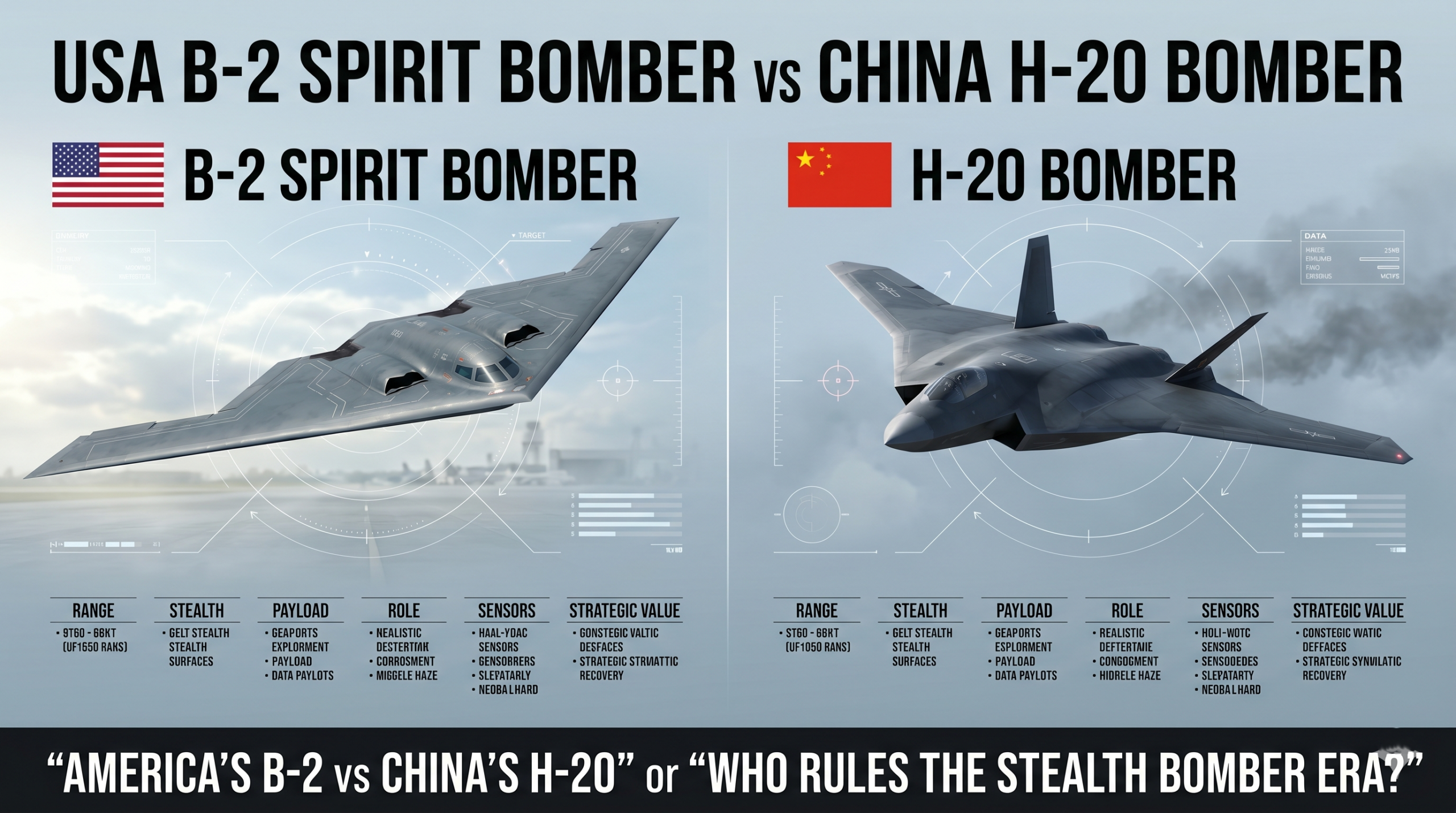
America’s proven ghost bomber and China’s mysterious next-generation weapon reveal two very different visions of airpower, deterrence, and global influence.
1. Introduction: Two Flying Wings, Two Strategic Eras

The U.S. B-2 Spirit and China’s expected H-20 stealth bomber are often compared because they appear to share the same basic idea: a subsonic, flying-wing aircraft built to penetrate defended airspace and strike high-value targets from long range. But beneath that similar shape lies a deeper story.
The B-2 is not a rumor, a promise, or a symbol. It is a combat-proven aircraft that has flown real missions, carried real weapons, and shaped American long-range strike doctrine for decades. The H-20, by contrast, remains one of the most mysterious aircraft in modern military aviation. It has not been publicly fielded, and many of its specifications remain estimates, projections, or intelligence-based assessments.
That difference matters. The B-2 represents proven stealth power. The H-20 represents strategic ambition. One aircraft shows what the United States has already achieved; the other shows what China is trying to become.
The most accurate way to understand this comparison is not to ask, “Which bomber is better?” The better question is: What does each aircraft reveal about the country that built it?
You May Also Like

2. The B-2 Spirit: America’s Proven Ghost in the Sky

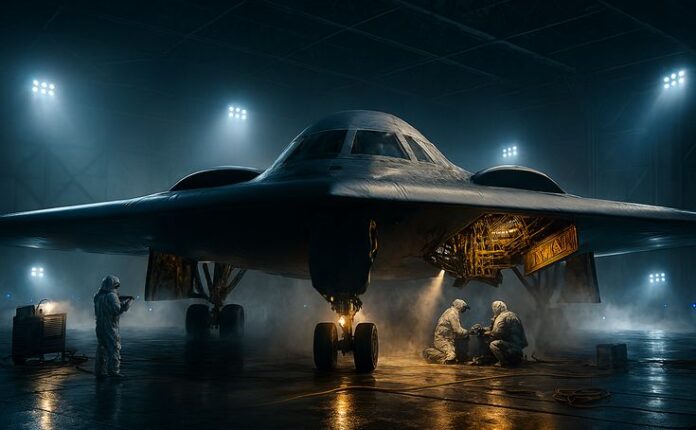
The B-2 Spirit is one of the most iconic aircraft ever built. Its smooth flying-wing shape was designed to reduce radar visibility, while its long range and internal weapons bays allow it to strike heavily defended targets without relying on forward airbases.
According to the U.S. Air Force, the B-2 is a multi-role bomber capable of carrying both conventional and nuclear weapons. Its purpose is to bring “massive firepower” anywhere in the world through defenses that were once considered nearly impossible to penetrate. The Air Force lists its unrefueled range at about 6,000 nautical miles, or roughly 9,600 kilometers, and describes its stealth as a combination of reduced radar, infrared, acoustic, electromagnetic, and visual signatures. (af.mil)
The B-2’s real strength is not only its technology. It is its record. It has been used in major U.S. military operations and has proved that stealth bombers are not just Cold War concepts. They are practical tools of deterrence, coercion, and precision strike.
The B-2 is expensive, rare, and difficult to maintain, but it remains one of the clearest symbols of American strategic reach. It tells U.S. allies and adversaries the same message: distance is not protection.
3. The H-20: China’s Mysterious Bid for Long-Range Stealth Power

China’s H-20 is different because it lives partly in the world of facts and partly in the world of strategic uncertainty. The aircraft is widely believed to be a future long-range stealth bomber for the People’s Liberation Army Air Force, likely using a flying-wing design similar in concept to the B-2 and B-21.
The most important point is caution: the H-20’s real performance is not publicly confirmed. Its radar cross-section, payload, range, engines, avionics, and weapons integration remain uncertain. Some public estimates describe it as having a range above 10,000 kilometers, while other estimates vary depending on whether analysts are discussing combat radius, ferry range, or refueled range.
The U.S. military’s 2024 China Military Power Report stated that China is developing a new generation of long-range bomber, likely named the H-20, and that it may debut sometime in the next decade. Reporting based on that assessment says the bomber could have a range of more than 10,000 kilometers, enabling China’s air force to reach the Second Island Chain and deeper into the western Pacific. (The War Zone)
That makes the H-20 important even before it becomes operational. It signals China’s desire to move beyond regional defense and toward a more powerful long-range strike posture. If successfully fielded, the H-20 could strengthen China’s nuclear deterrent, threaten U.S. bases in the Pacific, and give Beijing a more flexible tool for crisis signaling.
In simple terms, the H-20 is not just an airplane. It is China’s announcement that it wants to compete in the highest tier of strategic aviation.
4. Key Specifications and Capability Comparison
| Feature | U.S. B-2 Spirit | Chinese H-20 |
|---|---|---|
| Status | Operational since the 1990s | Under development / not publicly operational |
| Aircraft type | Stealth strategic bomber | Expected stealth strategic bomber |
| Design | Flying wing | Expected flying wing |
| Speed | High subsonic | Estimated subsonic |
| Range | About 6,000 nautical miles / 9,600 km unrefueled | Often estimated above 10,000 km, unconfirmed |
| Payload | More than 40,000 lb / about 18,000 kg | Unconfirmed; public estimates vary widely |
| Role | Global nuclear and conventional strike | Long-range regional/global deterrence, especially Pacific-focused |
| Combat record | Proven in operations | No confirmed combat record |
| Main advantage | Proven capability and global infrastructure | Potentially newer design and strategic reach |
| Main weakness | Aging fleet, high maintenance burden | Unknown maturity, unproven performance |
Northrop Grumman lists the B-2 as a strategic, long-range heavy bomber with low-observable technology, a crew of two, a high-subsonic top speed, a 50,000-foot combat ceiling, and more than 40,000 pounds of payload capacity. (Northrop Grumman)
The H-20’s numbers should be treated differently. They are not official public specifications. They are estimates based on defense reporting, U.S. government assessments, Chinese military modernization trends, and analysis of what China would need from such an aircraft.
That distinction is crucial: the B-2 is measured; the H-20 is estimated.
5. Combat Experience vs. Theoretical Capability

This is the biggest difference between the two bombers.
The B-2 has already done the job it was built to do. It has flown long-range missions, operated across continents, integrated with U.S. command-and-control networks, and delivered weapons in real conflicts. Its stealth, logistics, maintenance system, pilot training, and mission planning ecosystem have all been tested over time.
The H-20 has not yet proved any of that publicly.
A bomber is not powerful only because of its shape. True strategic power comes from the entire system around the aircraft: pilots, maintainers, secure communications, aerial refueling, weapons, targeting networks, electronic warfare support, hardened bases, doctrine, and political decision-making.
The B-2 has all of that behind it. The H-20 may eventually have it, but for now, its true capability remains unknown.
That does not mean the H-20 should be dismissed. China has made enormous advances in missiles, naval power, space systems, drones, sensors, and military aviation. But until the H-20 flies publicly, enters service, trains at scale, and demonstrates operational readiness, it remains a powerful possibility rather than a proven instrument.
6. Strategic Purpose: Global Reach vs. Pacific Deterrence
The B-2 was designed during the Cold War for a global mission: penetrate advanced air defenses and strike targets deep inside enemy territory. With aerial refueling, it can operate at intercontinental distances. It is not tied to one theater. Its message is global.
The H-20’s likely mission is more focused on the Indo-Pacific. Its purpose would be to extend China’s strike reach beyond the Chinese mainland and deeper into the Pacific. A stealth bomber with long range could place pressure on U.S. facilities in Guam, possibly Hawaii depending on range and basing assumptions, and other strategic locations across the region.
This matters because China’s current bomber force, based heavily around H-6 variants, is limited compared with true intercontinental stealth bombers. The H-20 would represent a major leap: from modified legacy bombers to a purpose-built long-range stealth platform.
In strategic terms, the B-2 tells the world: America can reach you from anywhere.
The H-20 would tell the Pacific: China can reach farther than ever before.
7. Payload and Weapons: What Each Bomber Can Carry
The B-2 carries its weapons internally to preserve stealth. That internal carriage is essential. A stealth bomber loses much of its advantage if weapons are mounted externally, because external stores increase radar signature.
The B-2 can deliver both nuclear and conventional munitions, including precision-guided weapons. Its payload capacity, listed by Northrop Grumman at more than 40,000 pounds, gives it the ability to carry serious destructive power while remaining low observable. (Northrop Grumman)
For the H-20, the payload remains unconfirmed. Many analysts believe China would want it to carry nuclear gravity weapons, long-range cruise missiles, and possibly advanced standoff weapons. Some public estimates suggest a very large internal payload, but those claims should be treated carefully until China reveals more credible data.
The most important question is not simply how many tons the H-20 can carry. The deeper question is what weapons it will carry and how those weapons will fit into China’s broader strike network.
If the H-20 carries long-range stealthy cruise missiles or future hypersonic weapons internally, it may not need to fly directly over every target. It could launch from outside the densest air-defense zones. That would make it not just a bomber, but a mobile strategic launch platform.
8. Stealth: Shape Is Only the Beginning
Many people think stealth means “invisible to radar.” That is not accurate. Stealth means reducing the chance of detection, tracking, targeting, and engagement. It is a chain-breaking technology. The goal is not magic invisibility; the goal is to make the enemy’s kill chain slower, weaker, and less reliable.
The B-2 uses a flying-wing design, special coatings, composite materials, and signature-reduction techniques to lower radar and other detectable signatures. The U.S. Air Force notes that many details remain classified, but identifies the aircraft’s composite materials, coatings, and flying-wing design as contributors to its stealth. (af.mil)
The H-20 may benefit from decades of global stealth research and more modern materials. But stealth is extremely difficult. It is not only about the outer shape of the aircraft. It depends on engine inlets, exhaust treatment, heat management, surface quality, maintenance discipline, sensor apertures, weapons-bay doors, flight profile, electronic emissions, and manufacturing precision.
That is why comparing the B-2 and H-20 only by silhouette is misleading. Two aircraft can look similar but perform very differently.
The B-2’s stealth has been refined through years of operation. The H-20’s stealth, at least publicly, remains unproven.
9. The B-21 Raider: The Real Future Rival
The H-20 is often compared to the B-2 because the B-2 is famous. But strategically, the more important comparison may be between the H-20 and the B-21 Raider.
The B-21 is the United States’ next-generation stealth bomber. The U.S. Air Force says the B-21 will incrementally replace the B-1 Lancer and B-2 Spirit and become the backbone of the future bomber force. It is designed as a long-range, highly survivable stealth aircraft capable of delivering both conventional and nuclear weapons. (af.mil)
That means China is not only chasing the B-2. It is trying to enter a race in which the United States is already moving to the next lap.
The B-2 proved the concept.
The B-21 modernizes it.
The H-20 attempts to challenge it.
This is why the H-20 matters even if it is delayed. Its existence forces planners in Washington, Tokyo, Canberra, Taipei, Manila, and Guam to think about a future where China has a stealth bomber arm of its own.
10. What the H-20 Would Change in the Indo-Pacific
If the H-20 becomes operational with credible stealth, long range, and modern weapons, it could change the Indo-Pacific balance in several ways.
First, it would give China a more survivable air-breathing nuclear delivery platform. That would strengthen the air leg of China’s nuclear deterrent and make its nuclear force more flexible.
Second, it would increase pressure on U.S. and allied bases across the Pacific. Guam, long considered a major U.S. military hub, would become more vulnerable not only to missiles but also to stealth bomber-launched weapons.
Third, it would complicate air-defense planning. Defending against ballistic missiles is different from defending against stealth aircraft and cruise missiles. A mixed threat forces defenders to spend more money, spread sensors wider, and maintain higher readiness.
Fourth, it would give China a powerful tool for signaling. A bomber can be flown visibly during a crisis, deployed to a forward base, or used in patrol patterns. Missiles are often hidden until launch; bombers can be used as political theater.
In other words, the H-20 would not only add firepower. It would add strategic drama.
11. Final Verdict: Proven Power vs. Emerging Ambition
The B-2 Spirit and the H-20 are not equal in the most important sense: one is real, operational, and proven; the other is still emerging from secrecy.
The B-2 remains one of the most powerful military aircraft ever built. It has demonstrated the value of stealth, long-range precision strike, and nuclear-conventional flexibility. It is aging, but it is not obsolete in strategic meaning. It still represents a level of global reach that few nations can match.
The H-20, meanwhile, represents China’s future ambitions. If it performs as many analysts expect, it could become one of the most important aircraft in Asia’s military balance. It could push China’s strike reach deeper into the Pacific, strengthen Beijing’s nuclear deterrent, and challenge U.S. assumptions about sanctuary bases.
But the key word is if.
Until the H-20 is publicly revealed, tested, fielded, and integrated into real operations, its power remains projected rather than proven.
The B-2 is a weapon with history.
The H-20 is a weapon of expectation.
And between them lies the future of stealth airpower.
Most Powerful Closing Line
The B-2 Spirit shows what stealth airpower has already achieved; the H-20 shows what China wants the world to believe it will soon achieve. One is the shadow that has already crossed the battlefield. The other is the shadow still forming on the horizon.