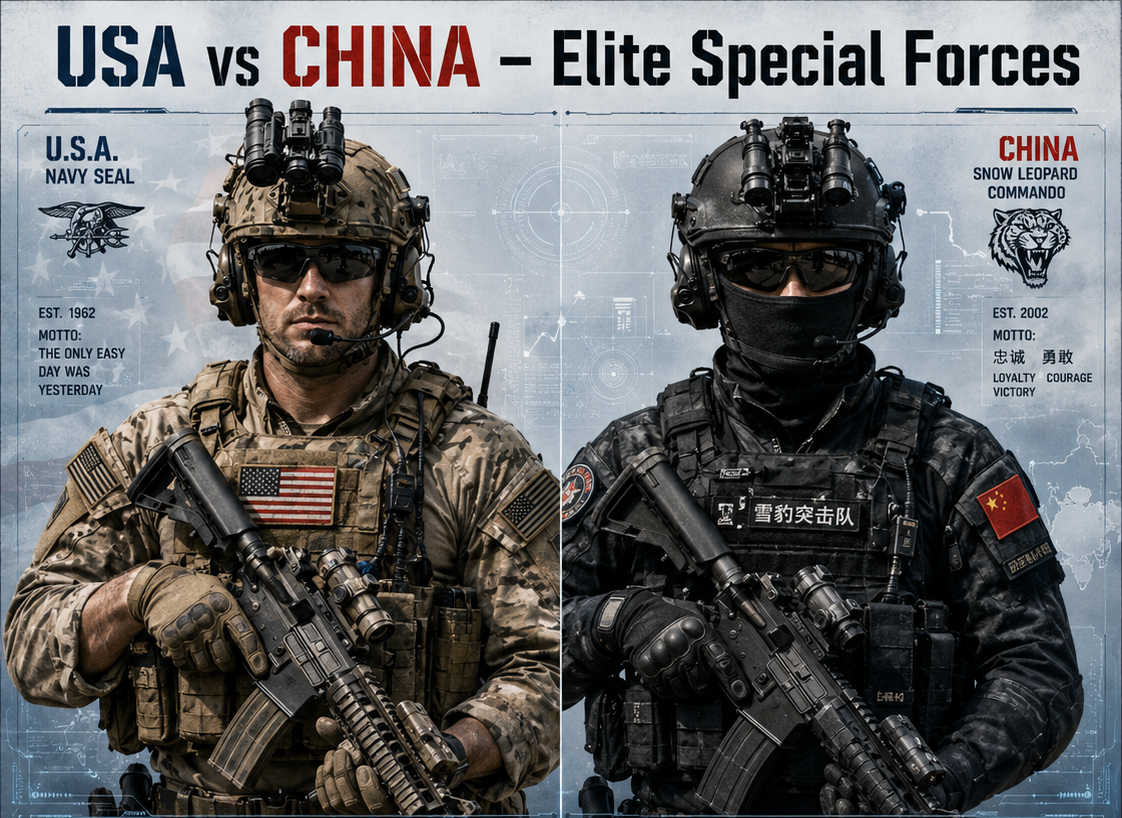
TITANS IN THE SHADOWS
A Long Debate Story of Professors, Scientists, Soldiers, and Silent Warriors
The room had no windows.
That was the first thing the guests noticed.
No city skyline.
No flags waving outside.
No sunlight crossing the polished floor.
Only a long black conference table, a wall-sized screen, and a single title glowing above the stage:
You May Also Like
“TITANS IN THE SHADOWS: WHAT MAKES A SPECIAL OPERATIONS FORCE TRULY ELITE?”
Beneath the title were two names:
U.S. Navy SEALs
China’s Snow Leopard Commando Unit
The audience was unusual.
There were military historians, psychologists, political scientists, security analysts, former officers, young cadets, journalists, and graduate students who had spent years studying war but had never heard a shot fired outside of a documentary.
Nobody wore medals.
Nobody carried weapons.
Nobody shouted.
Yet the room felt tense, as if two invisible forces had entered before the speakers and were already standing opposite each other in silence.
On one side of the screen appeared an image of waves breaking under moonlight.
On the other side appeared snow-covered mountains under a pale winter sky.
Sea and snow.
Raiders and commandos.
One force shaped by maritime warfare, global deployments, and decades of expeditionary combat.
The other shaped by counterterrorism, internal security, hostage crises, and the disciplined machinery of a rising state.
At the center of the table sat the moderator, Professor Daniel Harrow, a scholar of modern warfare.
To his left sat Professor Helena Cross, military historian.
Beside her was Dr. Maya Kline, a psychologist who studied elite selection, fear control, and combat stress.
Next sat Dr. Adrian Voss, a defense systems analyst.
Beside him sat Professor Samuel Reed, a philosopher of war and ethics.
Across the table sat Colonel Marcus Vale, a retired special operations officer who had worked with NATO units.
Next to him was Dr. Lin Wei, a Chinese security studies professor known for his careful, unsentimental analysis.
And finally, at the far end sat Commander Rachel Stone, a retired naval officer who had studied maritime special operations for two decades.
Professor Harrow looked at the audience.
“Tonight,” he said, “we ask a question people love to simplify.”
He paused.
“Who is better?”
A quiet murmur moved through the room.
Harrow raised one finger.
“But that question is almost always foolish unless we first ask: better at what?”
The screen changed.
Hostage rescue. Maritime raids. Reconnaissance. Counterterrorism. Foreign internal defense. Direct action. Intelligence gathering. Crisis response. Psychological endurance. Strategic secrecy. Political control.
Harrow continued.
“Special operations forces are not sports teams. They are tools built by states for specific missions. A hammer is not better than a scalpel. A scalpel is not better than a hammer. But if you choose the wrong one, someone dies.”
The room fell silent.
Then he turned to Professor Cross.
“Let us begin with history. Professor Cross, what are we really comparing?”
1. THE HISTORIAN’S WARNING
Professor Helena Cross leaned toward the microphone.
“We are comparing two very different answers to two very different national questions.”
She turned slightly toward the screen.
“The U.S. Navy SEALs emerged from a long American tradition of maritime special warfare. Their deeper roots reach back to World War II, when amphibious scouts, raiders, and underwater demolition teams were needed for dangerous coastal and maritime missions. Over time, that tradition evolved into the SEALs: Sea, Air, and Land.” (U.S. Department of War)
She let the words sit.
“Sea. Air. Land. Even the name is a doctrine.”
Commander Stone nodded.
“It says they are not supposed to belong to one environment. They are supposed to cross boundaries.”
Professor Cross continued.
“The Snow Leopard Commando Unit, by contrast, belongs to a different historical need. It is publicly associated with China’s People’s Armed Police and with missions such as counterterrorism, hostage rescue, anti-hijacking, high-risk security, and major event protection. Public sources connect it to preparations around the 2008 Beijing Olympics, when China wanted to show the world that it could secure a global event.” (Wikipedia)
Dr. Lin Wei nodded carefully.
“That is correct, but I must add: outsiders often misunderstand Chinese elite police units by comparing them directly to military expeditionary forces.”
Colonel Vale leaned forward.
“Because Western audiences hear ‘commando’ and imagine battlefield raids.”
Lin Wei replied, “Exactly. But internal security, counterterrorism, and hostage rescue are not lesser missions. They are different missions.”
Dr. Maya Kline smiled.
“So the first answer is: the SEALs were shaped by global military reach; the Snow Leopards were shaped by state security and counterterrorism readiness.”
Professor Reed added, “And each force reflects the fears of the society that created it.”
Harrow looked intrigued.
“What do you mean?”
Reed answered, “America feared threats across oceans. China feared instability, terrorism, domestic crisis, and the need to secure national prestige events. Elite forces are mirrors. They show what a state believes it cannot afford to fail at.”
The audience quieted.
Colonel Vale gave a slow nod.
“That is the first honest sentence of the evening.”
2. THE FALSE QUESTION: WHO WOULD WIN?
Professor Harrow looked toward the audience.
“Many fans want a simple answer. SEALs versus Snow Leopards. Who wins?”
Commander Rachel Stone almost laughed.
“In what? A hostage rescue? A maritime insertion? A mountain pursuit? An embassy crisis? A counter-piracy boarding? A desert raid? A domestic barricade? A covert reconnaissance mission? A public security operation during an international event?”
Dr. Voss added, “Exactly. The question ‘who wins’ is lazy unless the mission is defined.”
A student raised his hand early.
“But people compare elite units all the time. Isn’t there still a general ranking?”
Colonel Vale answered.
“General rankings are mostly entertainment.”
The student looked disappointed.
Vale continued.
“Do not misunderstand me. Some units have more combat experience. Some have better funding. Some have broader mission sets. Some have deeper intelligence support. Some have more advanced aviation, communications, and global logistics. But elite forces are not magic. They are ecosystems.”
Dr. Kline said, “And ecosystems matter more than mythology.”
Professor Cross leaned forward.
“When people say ‘Navy SEAL,’ they often imagine one operator. But the operator is only the visible point of a spear. Behind him are selection pipelines, intelligence agencies, aircraft, ships, satellites, medical teams, communications networks, political authorization, legal frameworks, and years of institutional memory.”
Lin Wei added, “The same applies to Snow Leopard. The public may see a commando in black uniform during a demonstration, but behind that figure is the People’s Armed Police system, state security priorities, domestic counterterrorism doctrine, and political command structures.”
Harrow asked, “So we should not compare warriors?”
Vale answered, “Compare them. But compare them honestly.”
3. THE PSYCHOLOGIST: HOW ELITE HUMANS ARE MADE
Professor Harrow turned to Dr. Maya Kline.
“What makes a human being capable of joining such forces?”
Maya folded her hands.
“Selection is less about creating toughness than revealing it.”
The room went still.
She continued.
“Elite units search for people who can function under exhaustion, uncertainty, pain, fear, social pressure, and moral weight. Physical fitness is only the entrance exam. The deeper test is psychological.”
Commander Stone nodded.
“Especially in maritime special warfare. Water changes the mind. Cold water. Darkness. Breath control. Disorientation. The ocean does not care how strong you are.”
Professor Cross said, “That is why naval special warfare has a mystique. The sea is already an enemy.”
Maya looked toward the audience.
“For SEALs, the public often focuses on the brutal reputation of selection and training, especially Basic Underwater Demolition/SEAL training. Official descriptions emphasize that only a fraction of those who attempt that pipeline complete it.” (U.S. Department of War)
A student whispered, “Hell Week.”
Maya heard him.
“Yes. But do not reduce it to a slogan. The point of extreme selection is not merely suffering. It is to see who remains useful while suffering.”
Colonel Vale said, “That is the key. Anyone can suffer. Few can think while suffering.”
Lin Wei added, “Chinese special police selection also emphasizes endurance, discipline, physical stress, and obedience under pressure. Public descriptions of Snow Leopard candidates mention physical and psychological testing, though much remains outside public view.” (Wikipedia)
Maya turned to Lin.
“And there is likely a cultural difference in what selection rewards.”
Lin nodded.
“American special operations culture often celebrates initiative, improvisation, and small-team autonomy. Chinese elite police culture likely places heavier emphasis on discipline, coordination, political reliability, and controlled response.”
Vale replied, “Initiative can win a fight.”
Lin answered, “Undisciplined initiative can ruin a hostage rescue.”
Stone smiled.
“And excessive control can freeze a team when the plan collapses.”
Maya said, “That is why elite selection is always a balance: obedience and initiative, aggression and restraint, speed and patience, confidence and humility.”
Professor Reed leaned forward.
“And humanity and violence.”
No one laughed.
4. THE SEAL MYTH AND THE BURDEN OF FAME
Harrow turned to Commander Stone.
“Commander, the U.S. Navy SEALs are globally famous. Does fame help or hurt an elite unit?”
Stone exhaled.
“Both.”
She looked at the image of waves on the screen.
“The SEALs became famous because of real history, real missions, and real sacrifices. But fame creates distortion. Movies, books, games, and headlines turn a community into a symbol. Symbols are useful for recruiting and national morale. But they can become dangerous.”
“How?” Harrow asked.
“Because the public begins to believe the symbol instead of the reality.”
Colonel Vale added, “People imagine commandos as superheroes. They forget that special operations are fragile. A mission can fail because of weather, intelligence gaps, mechanical problems, bad timing, political hesitation, or one locked door no one expected.”
Maya said, “Fame also creates identity pressure. When a unit becomes legendary, members may feel pressure to live up to the myth.”
Professor Reed asked, “Can myth corrupt judgment?”
Stone answered carefully.
“It can. If warriors start performing for the legend rather than the mission, discipline suffers.”
Lin Wei said, “China’s Snow Leopard unit has the opposite situation internationally. It is less mythologized globally, less exposed to pop culture, and far less publicly understood.”
Professor Cross replied, “Secrecy protects, but it also obscures.”
Lin nodded.
“Yes. Outsiders may underestimate them because they lack famous operations in Western media. But lack of publicity is not proof of lack of capability.”
Vale added, “And publicity is not proof of superiority.”
The audience murmured in approval.
5. THE SECURITY ANALYST: MISSION SETS MATTER
Dr. Adrian Voss stood and changed the slide.
Two columns appeared.
U.S. Navy SEALs
- Maritime special operations
- Direct action
- Special reconnaissance
- Counterterrorism
- Foreign internal defense
- Global expeditionary missions
- Joint operations with broader U.S. special operations ecosystem
Snow Leopard Commandos
- Counterterrorism
- Hostage rescue
- Anti-hijacking
- High-risk law enforcement
- Major event security
- Domestic crisis response
- People’s Armed Police mission structure
Voss turned back to the panel.
“This is where honest comparison begins. The SEALs are primarily a military special operations force with global expeditionary reach. Snow Leopard is publicly described more as an elite police tactical and counterterrorism unit under the People’s Armed Police structure.” (nsw.navy.mil)
A student asked, “So are the SEALs automatically more elite?”
Voss shook his head.
“No. They are broader in certain military roles. That does not automatically make them better at every mission. A unit designed for overseas maritime raids is not the same as a unit designed for domestic hostage rescue or anti-hijacking.”
Colonel Vale added, “If the mission is a complex maritime operation supported by submarines, aircraft, intelligence networks, and joint U.S. command structures, the SEALs have deep institutional advantage.”
Lin Wei replied, “If the mission is a domestic counterterrorism incident inside China, Snow Leopard would operate with local authority, language, intelligence access, police integration, and command legitimacy.”
Professor Reed said, “So geography itself becomes a weapon.”
Voss nodded.
“Exactly. Home-field advantage matters. Legal authority matters. Intelligence access matters. Cultural familiarity matters.”
Stone added, “A special operations force is not just measured by how hard its members train. It is measured by how well it fits the mission environment.”
Maya said, “In psychology, we might call that adaptive fitness.”
Professor Cross smiled.
“In history, we call it survival.”
6. THE FIRST HEATED EXCHANGE
A journalist stood.
“Let me ask bluntly. The SEALs have decades of combat experience. Does that not put them far ahead?”
Colonel Vale answered.
“In many ways, yes.”
Lin Wei looked at him.
“I appreciate the honesty.”
Vale continued.
“The SEALs have operated in major conflicts and counterterrorism campaigns over decades. Experience matters. Combat teaches things no classroom can.”
Stone added, “It builds institutional memory: planning, joint coordination, intelligence fusion, aviation integration, medical evacuation, after-action learning.”
Maya said, “It also creates scars.”
Professor Reed nodded.
“Experience is not free. It is paid for in trauma, mistakes, moral injury, and loss.”
Lin Wei spoke next.
“However, combat experience is not the only measure. A hostage rescue unit may train constantly for a mission it hopes never to conduct. The absence of famous combat operations does not mean absence of readiness.”
Vale replied, “True. But training is not the same as combat.”
Lin said, “Nor is combat experience always transferable. A unit experienced in rural raids may not automatically be superior in an urban hostage scenario.”
Stone nodded.
“He is right. Mission specificity matters.”
The journalist pressed.
“So who has the advantage?”
Vale answered, “In global combat operations? SEALs.”
Lin answered, “In Chinese domestic counterterrorism jurisdiction? Snow Leopard.”
Maya added, “In a neutral comparison without mission context? The question collapses.”
Professor Harrow smiled.
“Good. Now we are no longer doing fan fiction. We are doing analysis.”
7. THE ETHICIST: ELITE DOES NOT MEAN FREE
Professor Samuel Reed spoke softly, but the entire room listened.
“Special operations forces are often admired for skill. But skill does not solve the moral danger of secrecy.”
The screen dimmed.
Reed continued.
“The more elite a force becomes, the more likely governments are to use it in missions hidden from public view. That creates a moral tension. Secrecy protects operations and lives. But secrecy can also protect mistakes from accountability.”
Stone’s face became serious.
“That is true.”
Vale said, “But some missions cannot be public.”
Reed nodded.
“Of course. I am not arguing for reckless transparency. I am saying that elite forces operate at the edge of law, politics, violence, and secrecy. That edge requires discipline.”
Lin Wei added, “In any country, special units reflect the political system above them. They do not choose strategic purpose. They execute state decisions.”
Maya asked, “So can we morally compare units without comparing the governments that use them?”
Reed answered, “Not fully.”
A silence followed.
Professor Cross said, “The warrior is never completely separate from the state.”
Vale replied, “But the warrior is also not the entire state.”
Reed nodded.
“That is the tragedy. Individuals may be courageous and disciplined while serving policies that history later judges harshly.”
The audience grew quiet.
Harrow said, “This debate is becoming larger than SEALs and Snow Leopards.”
Reed replied, “It was always larger.”
8. THE COMMANDO AND THE CITY
Dr. Lin Wei leaned forward.
“May I explain something about Snow Leopard that Western audiences often miss?”
Harrow nodded.
“Please.”
Lin said, “People hear ‘elite’ and immediately imagine foreign raids. But a counterterrorism unit operating inside a major city faces a different kind of difficulty. It must act under intense political pressure, often surrounded by civilians, media, infrastructure, and legal constraints.”
Maya nodded.
“Urban crisis response is psychologically brutal.”
Lin continued.
“In a hostage situation, speed matters, but so does patience. Force matters, but so does restraint. The unit must know when not to shoot, when to negotiate, when to wait, when to enter, and when a single second changes everything.”
Colonel Vale said, “That is true of hostage rescue everywhere.”
“Exactly,” Lin replied. “So when people ask whether Snow Leopard is ‘as good as’ SEALs, they may be asking the wrong question. A police tactical unit may measure success by ending a crisis with minimal casualties. A military raiding force may measure success by destroying a target, capturing intelligence, or removing an enemy commander.”
Stone added, “Different verbs. Rescue. Capture. Destroy. Secure. Deter. Protect. Each verb creates a different force.”
Professor Cross smiled.
“Language is doctrine.”
Voss added, “And doctrine shapes training.”
Maya said, “Training shapes psychology.”
Reed finished, “Psychology shapes decisions under fear.”
9. THE SEAL AND THE SEA
Commander Stone stood.
“If Dr. Lin has explained the city, let me explain the sea.”
The screen changed to a dark ocean.
“The sea is not just water. It is concealment, danger, distance, and unpredictability. Maritime special operations require comfort in an environment that naturally kills humans. Cold, currents, darkness, pressure, disorientation, waves, machinery, silence.”
She paused.
“The SEAL tradition is shaped by the idea that warriors may come from the water, cross into land, and disappear again. That creates a particular mindset: patience before violence, endurance before action, and comfort with isolation.”
Maya said, “Water training also has psychological effects. It strips away ego. Panic in water is immediate. You cannot bluff the ocean.”
Vale nodded.
“The ocean teaches humility faster than instructors do.”
Lin Wei said, “This is a major difference. Snow Leopard’s public mission identity is not maritime expeditionary warfare. The SEALs’ identity is inseparable from it.”
Voss added, “And that means SEALs fit naturally into the broader U.S. Navy and joint special operations architecture.”
A student asked, “So if the mission is at sea?”
Stone answered, “Then the SEALs’ institutional advantage is obvious.”
Lin nodded.
“I would not dispute that.”
Another student asked, “And if the mission is a hostage crisis in Beijing?”
Stone said, “Then Snow Leopard has the natural advantage.”
The room murmured. The debate was becoming sharper, but also more honest.
10. THE MYTH OF THE PERFECT OPERATOR
Professor Harrow asked Maya Kline, “What do people misunderstand about elite operators psychologically?”
Maya answered.
“They think elite means fearless.”
She shook her head.
“It does not. Elite means fear-managed.”
Colonel Vale smiled.
“That is good.”
Maya continued.
“Fear is not removed. It is trained, organized, contained, and redirected. The operator does not become less human. He becomes more disciplined under human limits.”
Reed asked, “What happens when people believe they are beyond fear?”
“Then they become dangerous,” Maya said. “Overconfidence kills elite people too.”
Voss added, “Technology does not remove that. Better gear can create false confidence.”
Lin Wei said, “So can political trust.”
Stone added, “So can reputation.”
Professor Cross leaned toward the audience.
“History is full of elite units destroyed because they began believing their own legend.”
Vale nodded.
“The enemy gets a vote.”
Maya said, “Exactly. Elite selection creates exceptional performers, not invincible beings.”
A cadet stood.
“Then what separates elite forces from regular forces?”
Maya answered.
“Consistency under extreme conditions. The ability to perform difficult tasks with less degradation under stress.”
Vale added, “And the ability to recover after something goes wrong.”
Stone said, “Because something always goes wrong.”
Lin said, “In hostage rescue, a plan may collapse in one second.”
Reed said, “In moral decision-making too.”
11. WHO TRAINS HARDER?
A young man in the audience asked the question everyone knew was coming.
“Who trains harder?”
Several panelists laughed.
Professor Harrow smiled.
“Now we reach the ancient fan question.”
Maya answered first.
“Harder is not a scientific category unless we define it. Harder physically? Psychologically? Technically? More dangerous? Longer duration? More selective? More specialized?”
The student said, “Overall.”
Colonel Vale replied, “Overall is where bad comparisons go to hide.”
The room laughed.
Maya continued.
“SEAL training is famous for extreme physical and psychological demands, especially its water-based selection culture. Snow Leopard training, from public descriptions, also emphasizes physical endurance, weapons proficiency, counterterror skills, and psychological screening. But much about both remains non-public, and even public training descriptions can be shaped for image.”
Voss added, “Training difficulty must match mission. A maritime commando needs different stressors than an urban counterterror police unit.”
Lin said, “A Snow Leopard operator may train repeatedly for precise hostage rescue under domestic legal and political constraints. A SEAL may train for maritime infiltration, reconnaissance, foreign raids, and joint operations.”
Stone said, “So the better question is not who trains harder. It is who trains closer to the mission they are expected to perform.”
Reed added, “And who trains harder in restraint.”
The student looked confused.
Reed explained.
“The ability not to fire may be as important as the ability to fire.”
The room fell quiet again.
12. THE BATTLE OF DOCTRINES
Professor Harrow changed the slide.
AMERICAN SPECIAL OPERATIONS DOCTRINE
CHINESE COUNTERTERROR DOCTRINE
Harrow asked, “What are the doctrinal differences?”
Voss replied.
“The American model emphasizes expeditionary reach, joint operations, small-team initiative, global logistics, intelligence integration, and mission command. In simple terms: send highly trained teams far away, support them with a massive network, and allow initiative within commander’s intent.”
Lin Wei said, “The Chinese model for a unit like Snow Leopard is more closely tied to domestic security, counterterror response, anti-hijacking, public order, and state crisis management. It likely emphasizes discipline, centralized control, coordination with police structures, and political reliability.”
Vale said, “Centralized control can slow decisions.”
Lin replied, “Decentralized initiative can create political risk.”
Stone added, “Both are true.”
Maya said, “This is a psychological difference too. American elite operators may be trained to improvise aggressively when isolated. Chinese elite police units may be trained to maintain coordination and avoid uncontrolled escalation.”
Reed asked, “Which is better?”
Professor Cross answered.
“In chaos, improvisation saves. In crisis management, control saves. In the wrong context, each becomes a weakness.”
Harrow smiled.
“That may be the cleanest comparison of the night.”
13. THE SECOND HEATED EXCHANGE: BATTLE TESTED VS STATE TESTED
A defense journalist stood.
“Colonel Vale, would you say SEALs are more battle-tested?”
Vale answered.
“Yes.”
Lin Wei replied.
“In the public record, yes. But we should be careful about equating battle-tested with universally superior.”
Vale said, “I agree, but battle reveals truth.”
Lin said, “So does crisis.”
Vale leaned forward.
“Crisis without enemy fire is not the same.”
Lin’s voice remained calm.
“Hostage rescue against armed terrorists is not theater.”
Vale nodded.
“I did not say it was.”
Maya intervened.
“There are different kinds of truth. Combat reveals whether a unit can function under lethal chaos. Domestic counterterror operations reveal whether a unit can apply force under political and civilian constraints.”
Reed added, “A battlefield failure may lose a tactical objective. A hostage rescue failure may be broadcast globally and damage state legitimacy in minutes.”
Stone said, “Special operators are always fighting more than the enemy. They are fighting time, intelligence gaps, command pressure, political expectations, and uncertainty.”
Professor Cross said, “And history afterward.”
14. THE QUESTION OF EQUIPMENT
Professor Harrow asked Dr. Voss, “How much does equipment matter?”
Voss smiled.
“More than warriors admit, less than manufacturers claim.”
The room laughed.
He continued.
“Elite forces need weapons, communications, night vision, protective gear, transport, intelligence systems, breaching tools, medical equipment, and secure command networks. But equipment is only as good as training, maintenance, and integration.”
Stone said, “The SEALs benefit from the enormous U.S. defense ecosystem: naval platforms, aviation, satellites, intelligence agencies, special operations command structures.”
Lin Wei added, “Snow Leopard benefits from domestic integration, state security structures, and familiarity with operating inside Chinese legal and urban environments.”
Maya said, “Technology can also create dependence. If a unit becomes too reliant on perfect communications, it may struggle when cut off.”
Vale nodded.
“The best teams train for things breaking.”
Reed said, “And morally, better equipment can create more temptation to use force quickly.”
Harrow asked, “How so?”
Reed answered, “When a state has a highly capable tool, it may see more problems as solvable by that tool.”
Professor Cross said, “To a country with elite commandos, every crisis can begin to look like a raid.”
Nobody laughed at that.
15. THE STUDENT ASKS: WHO IS BRAVER?
A young woman stood slowly.
“My question may sound simple. Who is braver?”
The panel paused.
Colonel Vale answered first.
“Bravery is not owned by a flag.”
Lin Wei nodded.
“Agreed.”
Maya said, “Courage is individual before it is institutional.”
Stone added, “A SEAL entering dark water and a Snow Leopard operator entering a hostage room both face fear. Different missions, same human nervous system.”
Reed said, “But courage without judgment is just momentum.”
Professor Cross said, “And courage used by bad policy can become tragedy.”
The student asked, “Then can we admire both?”
Reed answered, “Yes. But mature admiration must not become worship.”
Vale said, “Admire discipline. Admire sacrifice. Admire skill. But never forget that elite warriors are still instruments of state power.”
Lin added, “And state power must always be examined.”
The student sat down.
The room seemed older than it had before.
16. THE TABLETOP SCENARIOS
Professor Harrow placed three sealed envelopes on the table.
“I will now present three fictional scenarios. No tactical details. Just mission profiles. Each panelist must say who has the advantage and why.”
The audience leaned forward.
Scenario One: A maritime hostage crisis aboard a hijacked vessel in international waters.
Stone answered immediately.
“SEAL advantage. Maritime environment, naval integration, ship approach, sea-based command structure.”
Lin nodded.
“I agree. Snow Leopard may have anti-hijacking training, but the SEALs’ maritime identity and U.S. naval support ecosystem would be decisive.”
Maya added, “Psychological comfort in water and shipboard environments matters.”
Scenario Two: A hostage crisis inside a major Chinese city with local intelligence and police support.
Lin answered.
“Snow Leopard advantage. Language, jurisdiction, local infrastructure, domestic intelligence, police coordination, political authority.”
Vale nodded.
“Agreed. Even the best foreign unit would struggle without local integration.”
Reed added, “Legitimacy matters. The force legally empowered to act has advantages beyond skill.”
Scenario Three: A covert reconnaissance mission far from friendly territory, requiring insertion, observation, and extraction across multiple environments.
Stone said, “SEAL advantage, especially if supported by broader U.S. special operations assets.”
Lin said, “Likely, yes. That is closer to American expeditionary special operations.”
Voss added, “This shows mission design determines comparison.”
Harrow opened a fourth envelope.
The panelists looked surprised.
Scenario Four: A major international event requiring visible deterrence, counterterror standby, and rapid domestic crisis response.
Lin answered, “Snow Leopard advantage in China.”
Stone added, “But if the event were in the United States, American forces would have the advantage.”
Maya said, “So elite status is not portable in a simple way. Environment matters.”
Professor Cross smiled.
“The map always argues.”
17. THE INVISIBLE SUPPORT SYSTEM
Harrow asked, “What does the public not see?”
Voss answered.
“Everything that makes the operator possible.”
He counted on his fingers.
“Intelligence analysts. Language specialists. Cyber teams. Pilots. Sailors. Police investigators. Medical teams. Logistics officers. Maintenance crews. Legal advisors. Political decision-makers. Satellite operators. Communications specialists.”
Stone added, “Special operations are often described as small-team missions, but small teams ride on enormous systems.”
Lin said, “For Snow Leopard, public order systems, surveillance infrastructure, local police networks, and internal command channels matter.”
Vale said, “For SEALs, naval platforms, aircraft, intelligence fusion, and joint command matter.”
Reed said, “So the warrior in the photograph is not the whole weapon.”
Cross nodded.
“The photograph is the myth. The system is the reality.”
18. THE FINAL DEBATE: WHO STANDS AT THE SUMMIT?
Professor Harrow looked at the panel.
“We return to the central question. Who stands at the summit of special operations?”
Professor Cross answered first.
“There is no single summit. There are mountains. Maritime special warfare is one mountain. Domestic counterterrorism is another. Hostage rescue is another. Covert reconnaissance is another. Direct action is another.”
Dr. Maya Kline said, “The SEALs may be superior in global expeditionary maritime special operations. Snow Leopard may be superior within its designed domestic counterterrorism environment. Neither should be judged outside mission context.”
Dr. Adrian Voss said, “The SEALs are a broad military instrument with global reach. Snow Leopard is a specialized state security instrument. Comparing them without mission context is like comparing a submarine to a fortress.”
Professor Reed said, “The true summit is not violence. It is disciplined judgment under pressure.”
Commander Stone said, “The SEALs are among the most capable maritime special operations forces in history. Their strength is adaptability across sea, air, and land, supported by a vast U.S. military network.”
Dr. Lin Wei said, “Snow Leopard represents China’s disciplined counterterrorism and crisis-response capability. Its strength lies in controlled response, domestic integration, and state security focus.”
Colonel Vale spoke last.
“Fans want a winner. Professionals want the right force for the right mission. If you ask who wins in a movie, choose whoever the writer likes. If you ask who wins in reality, first tell me the mission, the terrain, the intelligence, the support, the rules, the enemy, the time, and the political cost.”
The room erupted in applause.
19. AFTER THE DEBATE: TWO SHADOWS
After the audience left, the panelists remained in the quiet room.
The screen still showed the two images:
Waves under moonlight.
Mountains under snow.
Professor Cross stood before them.
“Sea and snow,” she said. “Two environments that punish arrogance.”
Commander Stone nodded.
“The sea drowns ego.”
Lin Wei added, “Snow hides danger.”
Maya said, “Both demand patience.”
Vale said, “And both kill the careless.”
Professor Reed closed his notebook.
“Perhaps that is what elite forces really are. Human beings trained not to be careless in places where carelessness is fatal.”
Harrow looked at the empty chairs.
“Do you think the public will understand the answer?”
Vale smiled.
“No. They will still ask who wins.”
Lin Wei smiled too.
“And perhaps that is human nature.”
Stone looked at the screen.
“Then we answer again: it depends.”
Professor Cross said, “The two most hated words in serious analysis.”
Maya corrected her.
“The two most honest words.”
20. EPILOGUE: THE LETTER FROM THE CADET
A week after the debate, Professor Harrow received a letter from a cadet who had attended.
It read:
Professor,
I came to the debate wanting a winner.
I wanted someone to say: the SEALs are better, or the Snow Leopards are better.
But I left understanding that elite forces are not ranked like athletes. They are shaped like keys.
A key is only powerful when it fits the lock.
The SEALs are a key forged for oceans, distance, raids, reconnaissance, and global reach.
Snow Leopard is a key forged for crisis control, counterterrorism, hostage rescue, and state security.
Both require courage.
Both require discipline.
Both require sacrifice.
Both live in shadows most citizens never see.The real question is not who is stronger.
The real question is: what kind of danger was each force created to face?
I think that question is harder.
And because it is harder, it is probably closer to the truth.
Professor Harrow folded the letter and placed it beside his notes.
Outside, the city moved as if nothing had happened.
People crossed streets.
Trains arrived.
Restaurants opened.
Children laughed.
Rain tapped against windows.
Somewhere across the world, men trained in darkness.
Some in water.
Some in snow.
Some in city rooms built to look like hostage sites.
Some in aircraft.
Some on ships.
Some under flags.
Some under silence.
They did not know the names of the professors who debated them.
They did not care about applause.
They did not ask to become symbols.
But nations had made them symbols anyway.
Titans in the shadows.
Not gods.
Not monsters.
Not movie heroes.
Human beings shaped by discipline until fear became manageable, pain became information, and hesitation became something to master.
And in the end, Professor Harrow wrote one final sentence beneath the title of the debate:
The greatest special operations force is not the one that looks most terrifying in the shadows, but the one that knows exactly when to step out of them.