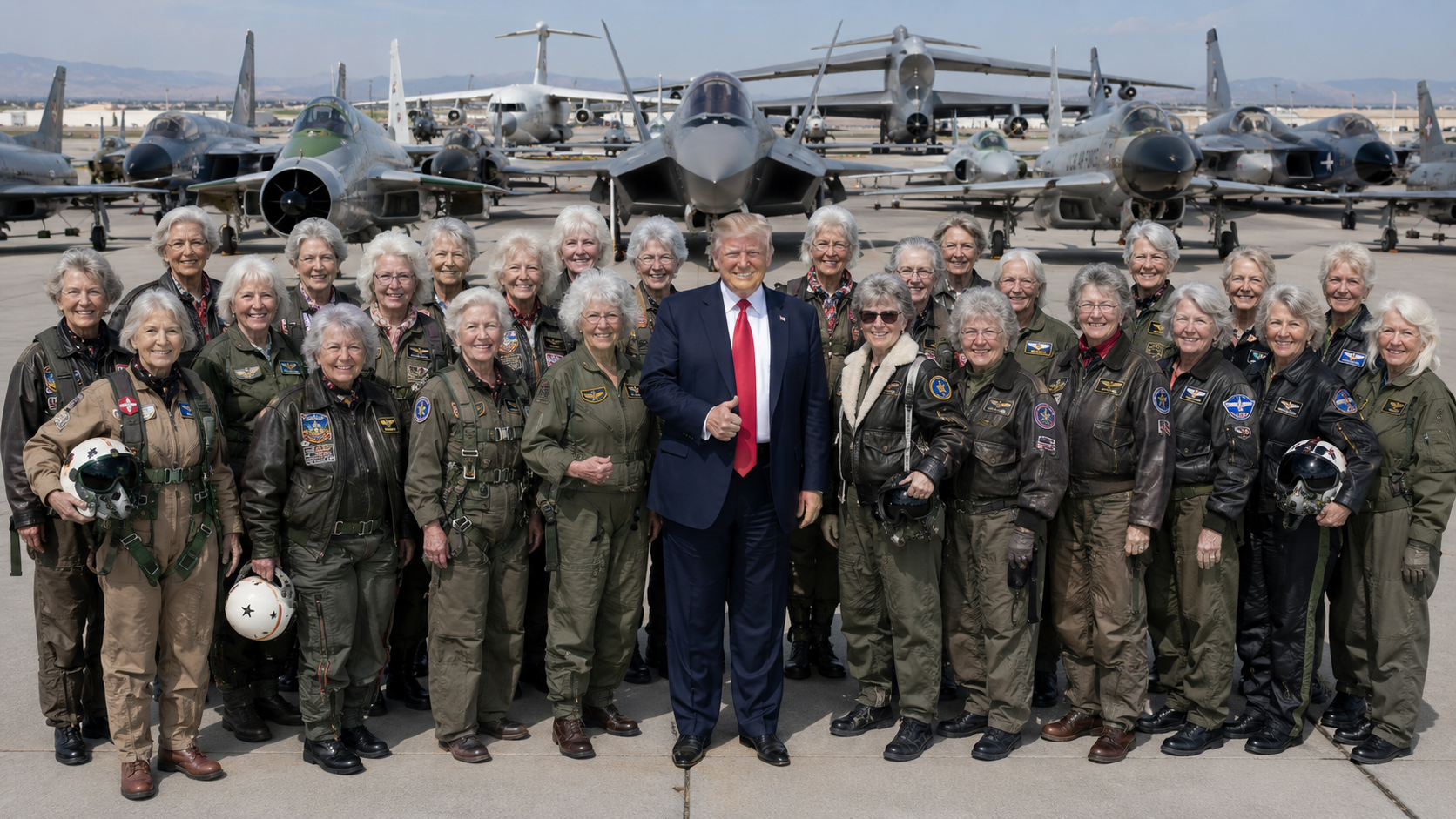
During the darkest days of the Second World War, when freedom itself was under threat, a remarkable group of American women stepped forward and accomplished what many believed was impossible.
They flew military aircraft.
They ferried fighters and bombers across the United States.
They tested newly built planes.
You May Also Like
They trained male pilots for combat.
They towed aerial targets for live-fire gunnery practice.
And they did it without military rank, without veterans’ benefits, and without any guarantee that history would remember them.
These pioneers were the Women Airforce Service Pilots—better known as the WASP.
More than 1,100 women served in the program. Together, they logged over 60 million miles in the air, proving beyond any doubt that courage, skill, and patriotism are not defined by gender.
The WASP were not merely pilots.
They were trailblazers.
They shattered barriers at 20,000 feet and opened the cockpit to generations of women who would follow.
Their story is one of determination, sacrifice, and a powerful truth:
Sometimes the people who change history are the ones history almost forgot.
A Dream Born Before America Entered the War

Long before the United States entered World War II, two visionary women saw what others could not.
Nancy Harkness Love and Jackie Cochran were among the most accomplished pilots of their era.
Nancy Harkness Love earned her pilot’s license as a teenager and argued that women with proven flying skills could ferry military aircraft, freeing male pilots for combat.
Jackie Cochran, one of the greatest aviators in history, demonstrated the idea’s practicality by flying aircraft to Britain and helping organize female pilots for the British Air Transport Auxiliary.
Both women understood a simple but revolutionary fact:
The nation was overlooking a valuable force already prepared to serve.
When war expanded and the military faced a shortage of qualified pilots, their vision became impossible to ignore.
The Birth of the WASP


In September 1942, Nancy Harkness Love organized the Women’s Auxiliary Ferrying Squadron (WAFS), recruiting elite civilian women pilots to transport military aircraft.
Two months later, Jackie Cochran convinced General Henry H. Arnold to create the Women’s Flying Training Detachment (WFTD).
In August 1943, the two programs merged to form the Women Airforce Service Pilots.
More than 25,000 women applied.
Fewer than 10 percent were accepted.
Applicants had to:
- Be between 21 and 35 years old
- Hold a commercial pilot’s license
- Have substantial flight experience
- Pass rigorous physical and military-style training
The standards were exceptionally high.
Only the most skilled and determined women earned the right to wear the silver WASP wings.
Learning to Fly Under Military Discipline


Training took place at Avenger Field in Sweetwater, Texas.
The women faced intense instruction in:
- Navigation
- Meteorology
- Aircraft mechanics
- Formation flying
- Instrument procedures
- Military discipline
They trained in Texas heat, endured exhausting schedules, and confronted doubts from those who believed women did not belong in military cockpits.
Yet they persisted.
They knew they were carrying more than themselves.
They were carrying the hopes of every woman who dreamed of proving her worth in the skies.
Flying Every Aircraft in America’s Arsenal

The WASP flew virtually every major aircraft in the Army Air Forces inventory.
Their aircraft included:
- P-51 Mustang
- P-47 Thunderbolt
- B-17 Flying Fortress
- B-26 Marauder
- AT-6 Texan
Their duties were critical:
- Ferrying aircraft from factories to operational bases
- Conducting maintenance test flights
- Serving as flight instructors
- Demonstrating aircraft to commanders
- Towing targets for anti-aircraft gunnery practice
These missions were essential to the war effort.
Without them, combat squadrons would have received aircraft more slowly, and male pilots would have been diverted from frontline operations.
Courage in the Face of Real Danger


The WASP did not fly in combat, but their missions were far from safe.
They tested aircraft with mechanical issues.
They flew in poor weather.
They towed targets while live ammunition was fired nearby.
Thirty-eight WASP lost their lives in service.
Because they were classified as civilian employees rather than military personnel, their families received no government death benefits.
Often, fellow WASP members collected money to bring their fallen sisters home.
Their sacrifice was no less real because they were denied official military status.
They served with the same courage and accepted the same risks as many uniformed aviators.
A Historic First in the Jet Age

In October 1944, Ann Baumgartner Carl became the first American woman to fly a jet aircraft.
She piloted the experimental Bell YP-59A Airacomet.
It was a remarkable achievement.
At a time when women were still fighting for recognition, one of them was already helping lead aviation into the jet age.
The Program Ends Too Soon


In December 1944, with Allied victory appearing increasingly likely and more male pilots becoming available, the WASP program was disbanded.
Their contribution had been extraordinary.
Yet they returned home quietly.
No parades.
No veteran status.
No military honors.
No widespread recognition.
For decades, their service remained largely overlooked.
But history was not finished with them.
The Long Fight for Recognition

More than thirty years later, Congress finally acted.
In 1977, the WASP were officially granted veteran status.
Their service was formally recognized as military service.
In 2009, President Barack Obama signed legislation awarding the WASP the Congressional Gold Medal.
In 2010, more than 200 surviving WASP gathered at the U.S. Capitol to receive one of the nation’s highest civilian honors.
The recognition was long overdue.
But it confirmed what these women had always known:
They had served their country with distinction.
The Legacy That Opened the Cockpit

The WASP changed American aviation forever.
Three decades passed before women were again allowed to fly U.S. military aircraft.
Today, women pilot fighters, bombers, helicopters, tankers, and transports across every branch of the U.S. military.
Each modern female military pilot stands on the shoulders of the WASP.
Every takeoff carries part of their legacy.
Every set of wings honors their courage.
What the WASP Teach Us
The story of the WASP is about far more than aviation.
It is about perseverance.
It is about service without recognition.
It is about believing in your abilities even when others doubt you.
It is about proving that barriers are often built from assumptions rather than facts.
Most of all, it is a reminder that history is shaped by those willing to step forward when their nation needs them.
Final Thoughts: The Women Who Taught America to Look Higher
The Women Airforce Service Pilots were among the bravest and most overlooked heroes of World War II.
They flew millions of miles.
They delivered thousands of aircraft.
They endured prejudice and danger.
They sacrificed without expecting applause.
And they transformed the future of military aviation.
Their engines may have fallen silent, but their legacy still soars.
They did not ask for special treatment. They asked only for the chance to serve.
When that chance came, they proved that the sky had never belonged to one gender.
It belonged to the bold.