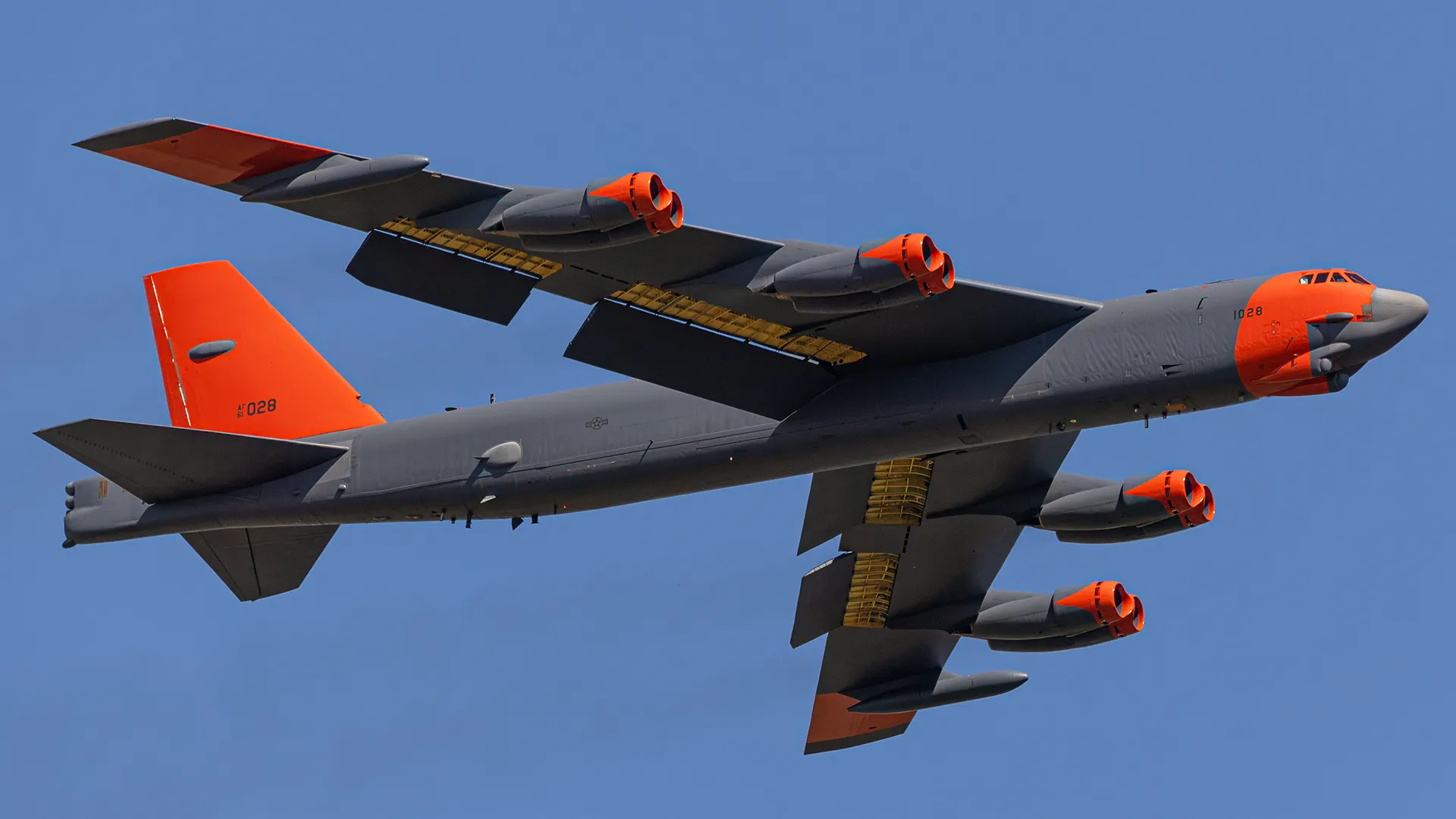
Long before reusable rockets, stealth bombers, and hypersonic missiles became symbols of modern aerospace power, one aging bomber quietly helped rewrite the future of flight. It did not fight wars or drop bombs in combat. Instead, it carried humanity’s boldest dreams beneath its wing.
That aircraft was the legendary Boeing B-52 known as “Balls Eight.”
For nearly half a century, this remarkable airplane served as the ultimate “mother ship,” launching experimental aircraft that pushed the boundaries of speed, altitude, spaceflight, and technology. From the groundbreaking X-15 rocket plane to the experimental vehicles that helped shape the Space Shuttle era, Balls Eight became one of the most important research aircraft in aviation history.
It was not just a bomber.
It was a flying launch pad for the future.
You May Also Like


A Problem That Changed Aviation Forever
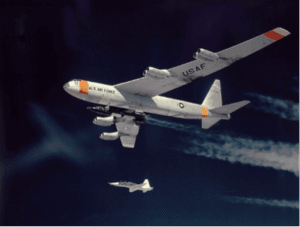
During the Cold War, American engineers faced a challenge that seemed almost impossible.
They had designed the revolutionary North American X-15 — an experimental aircraft capable of flying at speeds greater than Mach 5, or five times the speed of sound. The X-15 promised to explore the edge of space and unlock secrets about hypersonic flight that no one fully understood.
But there was one major problem:
The aircraft carried so much rocket fuel and was built for such extreme performance that it could not take off from a normal runway under its own power.
Engineers needed another solution.
The answer was brilliantly simple:
carry the X-15 into the sky using a larger aircraft, then release it at high altitude.
That aircraft became the Boeing B-52 Stratofortress.
The Birth of the Ultimate “Mother Ship”
The idea of launching smaller aircraft from larger bombers was not entirely new. In 1947, a modified Boeing B-29 Superfortress famously carried the Bell X-1, the rocket plane flown by legendary test pilot Chuck Yeager during the world’s first supersonic flight.
But the X-15 program required something far more powerful.
By the late 1950s, the massive B-52 Stratofortress had entered service with the U.S. Air Force. Designed as a long-range nuclear bomber, the aircraft possessed enormous lifting capability, exceptional range, and the ability to fly at high altitude for long periods.
Two early-production B-52s were transferred to Edwards Air Force Base and transformed into highly specialized launch aircraft for the X-15 program.
One of them would become legendary.
Why It Was Called “Balls Eight”
The aircraft that became famous as “Balls Eight” originally entered service in 1954 as an RB-52B reconnaissance aircraft with the serial number 52-0008.
In Air Force slang, zeros in aircraft serial numbers were often called “balls.”
So “0008” became “Balls Eight.”
The nickname stuck forever.
What nobody realized at the time was that this aircraft would go on to become one of the most historically significant airplanes ever built.
Turning a Nuclear Bomber Into a Space-Age Launch Platform
Transforming the B-52 into a mothership required extensive engineering modifications.
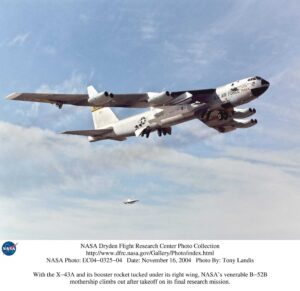
Because the giant bomber sat relatively low to the ground, engineers could not mount the X-15 underneath the fuselage. Instead, they installed a massive launch pylon beneath the bomber’s right wing, between the fuselage and the inboard engines.
To make room for the X-15’s tail fin, an eight-foot section of the B-52’s wing flap had to be removed.
But that was only the beginning.
The bomb bay was converted to carry liquid oxygen and hydrogen peroxide systems used to fuel the X-15 before launch. Engineers also installed a dedicated launch control station behind the cockpit filled with instruments and controls for monitoring the rocket plane.
Since the pilots could not directly see the X-15 from the cockpit, a small observation window was added so the launch operator could visually inspect the aircraft moments before release.
The result was unlike any bomber the world had ever seen.
Balls Eight had become a flying laboratory.
Launching the X-15 Into History
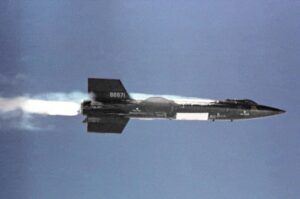
Between 1959 and 1968, the two modified B-52 motherships conducted over 199 X-15 launch missions and more than 60 captive-carry test flights.
These missions transformed aerospace science forever.
The X-15 shattered records and ventured into flight regimes that bordered on space travel. Pilots flew faster and higher than any human beings before them, gathering data that would later influence spacecraft design, astronaut training, and future high-speed aircraft.
Some X-15 pilots even reached altitudes high enough to earn astronaut wings.
The program was dangerous and experimental. One X-15 was tragically lost in a fatal crash, reminding the world that pushing the limits of flight often came at great risk.
But the knowledge gained from those missions laid the groundwork for generations of aerospace innovation.
And through every launch, Balls Eight was there.
More Than a Bomber — A Flying Testbed for the Future
Most aircraft retire after one successful career.
Balls Eight simply began another.
After the X-15 program ended, the aircraft continued serving as America’s airborne research platform for decades. Instead of being retired, it evolved alongside aerospace technology itself.
It became a launch platform for some of the most advanced experimental aircraft ever created.
Helping Build the Space Shuttle Era
One of Balls Eight’s most important contributions came through its support of the lifting-body programs of the 1960s and 1970s.
These strange-looking aircraft, including the Martin Marietta X-24, explored how wingless vehicles could safely glide back through Earth’s atmosphere and land without engines.
At first glance, the concept seemed bizarre.
But the data collected from these flights directly influenced the development of the Space Shuttle.
Without these experiments, the Shuttle program may have looked very different—or may not have succeeded at all.
Balls Eight helped make reusable spaceflight possible.
Advancing Fighter Technology and Hypersonic Research
The aircraft’s career stretched far beyond space research.
Balls Eight also launched NASA’s Highly Maneuverable Aircraft Technology program, known as HiMAT. This unmanned research vehicle tested cutting-edge technologies such as:
- Composite materials
- Advanced aerodynamics
- Digital flight controls
- Remote piloting systems
- Canard wing configurations
Many of these innovations later appeared in modern fighter aircraft.
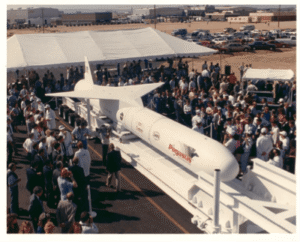
The bomber also helped launch the Pegasus rocket, the world’s first privately developed air-launched orbital rocket system capable of placing satellites into space.
Even after four decades of service, Balls Eight remained at the forefront of aerospace innovation.
Its final major contribution came in 2004 when it launched NASA’s X-43A hypersonic research vehicle — an experimental aircraft powered by a scramjet engine capable of extraordinary speeds.
Incredibly, the same aircraft that helped pioneer Mach 5 research in the 1950s was still advancing hypersonic technology nearly fifty years later.
Few machines in history have remained relevant for so long.
The End of a Remarkable Journey
On December 17, 2004, Balls Eight officially retired after 49 years of service.
By then, it had become the oldest active B-52 in operation.
Ironically, despite its age, it had accumulated fewer flight hours than many operational bombers because so much of its life was spent undergoing specialized modifications between research programs.
But its impact on aerospace history was immeasurable.
Few aircraft can claim they helped pioneer:
- Hypersonic flight
- Spaceplane technology
- Reusable spacecraft concepts
- Advanced fighter technologies
- Air-launched orbital rockets
- Scramjet propulsion research
Balls Eight did all of them.
Today, the legendary aircraft stands proudly at the entrance of Edwards Air Force Base — a silent monument to one of the most extraordinary careers in aviation history.
Why Balls Eight Still Matters Today
In many ways, Balls Eight represents something larger than aviation itself.
It symbolizes the courage to experiment.
The aircraft carried ideas that were considered impossible. It launched machines that routinely pushed beyond the limits of known science. It supported pilots, engineers, and dreamers willing to risk failure in pursuit of discovery.
Modern hypersonic weapons, reusable spacecraft, advanced fighters, and commercial space systems all trace part of their heritage back to the missions launched beneath its wing.
The world often remembers the sleek experimental aircraft, the astronauts, and the speed records.
But behind many of those achievements stood an aging B-52 quietly carrying the future into the sky.
Balls Eight was not merely a support aircraft.
It was the bridge between the dawn of supersonic flight and the birth of the space age.