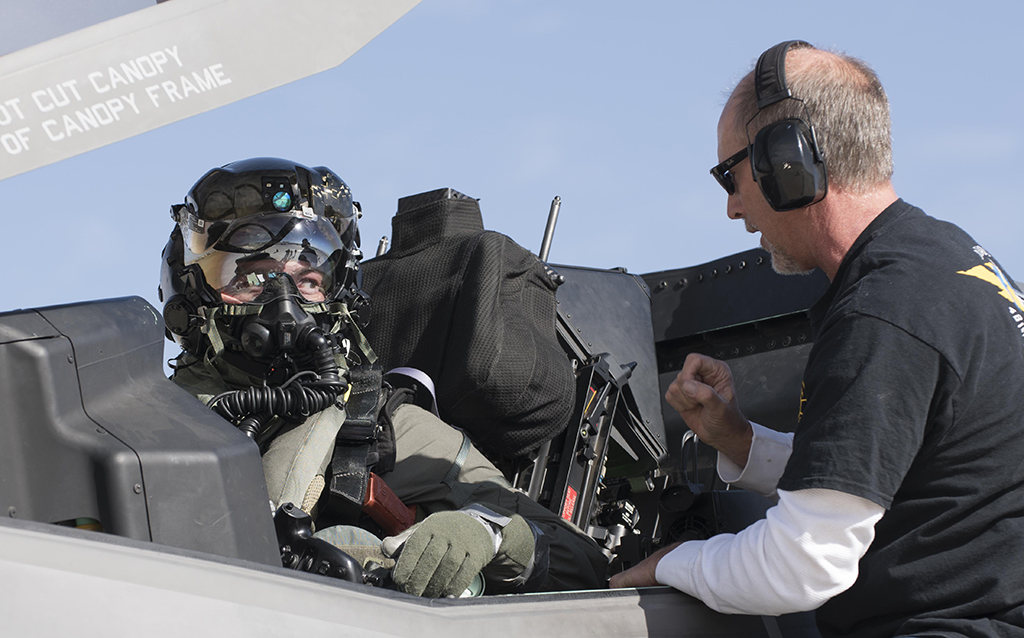
Modern air combat is no longer fought only with missiles, stealth, and speed. In the most dangerous future battlefields, fighter pilots may also have to survive invisible enemies — chemical and biological weapons capable of turning the air itself into a weapon.
That terrifying possibility is exactly why the U.S. Air Force spent more than a decade developing and testing a specialized protective system for pilots of the Lockheed Martin F-35 Lightning II.
The result is something that looks less like traditional flight gear and more like equipment from a science-fiction war movie: a sealed chemical-biological survival ensemble designed to keep pilots alive while flying through contaminated environments.
And according to test personnel, it even makes pilots sound like Darth Vader.
You May Also Like

The Battlefield of the Future Could Be Invisible
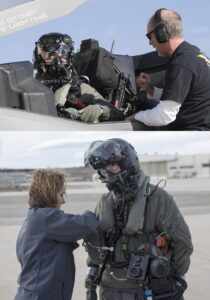
For decades, military planners feared that future conflicts between major powers could involve nuclear, biological, or chemical weapons. While stealth aircraft are designed to survive advanced missiles and radar systems, protecting the human inside the cockpit presents an entirely different challenge.
A stealth fighter can evade radar.
But a pilot still has to breathe.
That is why the U.S. Air Force’s 461st Flight Test Squadron at Edwards Air Force Base began testing a highly advanced Chemical-Biological (CB) protective ensemble specifically for F-35 pilots. The mission was simple in theory but enormously difficult in practice:
Can a pilot still fly, fight, and survive while surrounded by deadly contamination?
The answer required years of engineering, testing, and human endurance research.
A Flying Hazmat Suit for Elite Fighter Pilots
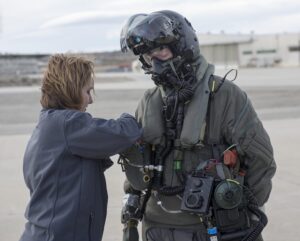
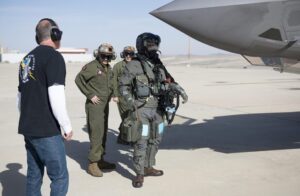
The protective system is far more advanced than a normal military gas mask or protective suit.
The ensemble includes:
- A specialized chemical-biological protective suit
- A Joint Service Aircrew Mask adapted for the F-35
- Pilot-mounted CB air filters
- Protective gloves and socks sealed with double-taped wrists
- A filtered air blower system
- Cooling and anti-fog airflow for the mask and goggles
- Integrated communications equipment
All of this is worn in addition to the pilot’s standard flight jacket and high-G flight suit.
The result is an incredibly heavy and restrictive setup — one that transforms a fighter pilot into a sealed survival system.
Yet every component exists for one reason: to prevent microscopic toxins from entering the pilot’s body.
Why the F-35 Was the Perfect Aircraft for the Test
The aircraft selected for the experiment was an F-35B Lightning II borrowed from Marine Corps Air Station Yuma.
The F-35B is the most mechanically complex version of the Joint Strike Fighter family because of its Short Takeoff and Vertical Landing (STOVL) capability. Its internal systems contain more openings, ducts, and hidden spaces where contaminants could potentially collect.
That made it the perfect stress test.
Military planners wanted to know whether stealth fighters could continue operating after exposure to chemical agents — and whether crews could rapidly decontaminate and return them to combat.
Because in real war, grounding advanced fighters for long periods could mean losing air superiority.
The “Dirty Jet” Experiment
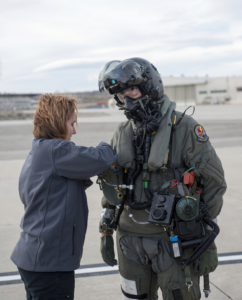
The tests themselves sounded like scenes from a Cold War thriller.
First, one pilot approached a completely clean aircraft while fully suited in the CB ensemble. Technicians then introduced a simulated contaminant into the environment.
When the aircraft engine started, the danger increased dramatically.
Jet engines pull enormous amounts of air into the aircraft. If contaminated particles entered the life-support systems, the pilot could be exposed while airborne.
To prevent this, the F-35’s onboard oxygen generation system filtered the air before it passed through additional pilot-mounted CB filters. Engineers also used multiple air-sampling devices to ensure the pilot’s breathing air remained uncontaminated.
Then came the next phase.
A second pilot approached what testers called a “dirty jet” — an aircraft already exposed to simulated contamination. That pilot started the engine and actually flew the aircraft while wearing sensors designed to detect whether any toxic particles penetrated the protective suit.
The goal was not simply survival.
The goal was operational combat capability inside a contaminated warzone.
Flying While Sealed Inside a Chemical Warfare Suit
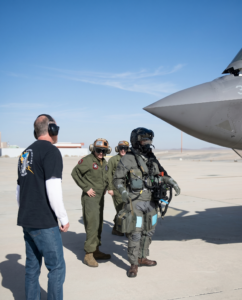
One of the greatest challenges was not filtration — it was human performance.
Flying an F-35 already demands extreme concentration. Pilots manage vast amounts of sensor data while enduring intense G-forces at supersonic speeds. Adding layers of protective gear increases heat, fatigue, stress, and physical restriction.
Even basic movements become harder.
Communication becomes difficult. Vision can narrow. Heat builds rapidly inside sealed equipment.
To solve part of the communication problem, engineers added what they called a “conversational communication unit,” allowing pilots to speak through the mask to ground crews and support personnel.
According to Darren Cole, the Human Systems Integration lead for the 461st Flight Test Squadron, the filtered mask altered the pilots’ voices so dramatically that they sounded like Darth Vader.
It may sound humorous, but behind the joke lies a deadly serious reality: modern fighter pilots may someday fight in environments where even breathing unprotected air could kill them.
The Hidden Human Cost of Future Air Warfare
What makes this testing especially important is that chemical and biological warfare changes the entire nature of military operations.
Aircraft can be repaired.
Pilots cannot be easily replaced.
A stealth fighter represents billions of dollars in technology, but the highly trained human inside the cockpit is even more valuable. Training an F-35 pilot takes years, enormous resources, and thousands of flight hours.
Protecting those pilots is therefore a strategic necessity.
The challenge becomes even greater because NBC (Nuclear, Biological, Chemical) protective gear is notoriously uncomfortable and exhausting to wear for long periods. Military personnel around the world consistently describe such equipment as hot, restrictive, mentally draining, and physically punishing.
Simple tasks become difficult.
Complex tasks become dangerous.
Now imagine performing aerial combat at hundreds of miles per hour while wearing that equipment.
Could the Suit Affect Combat Performance?
One concern raised during testing involved visibility and situational awareness.
Unlike older fighter aircraft, the F-35 has more restricted rearward visibility because of its cockpit structure and large headrest design. Pilots cannot simply turn around easily to check behind the aircraft during combat.
Adding bulky chemical-biological equipment could potentially worsen that limitation.
But the F-35 was designed to overcome traditional visibility problems through technology rather than human eyesight alone.
Its revolutionary AN/AAQ-37 Distributed Aperture System uses multiple infrared cameras around the aircraft to provide pilots with a near-360-degree spherical awareness of the battlefield. Combined with the powerful AN/APG-81 AESA Radar, the aircraft can detect, track, and display threats far beyond normal human vision.
In many ways, the F-35 is already fighting a different kind of war — one where pilots rely less on physically looking outside the cockpit and more on fused sensor intelligence.
That technological advantage could become even more critical in chemical or biological warfare scenarios.
More Than Just a Fighter Jet
What these tests truly reveal is how modern warfare is evolving.
The F-35 is not simply a stealth fighter. It is part aircraft, part sensor network, part survival system. Every detail — from oxygen filtration to thermal stress monitoring — reflects preparation for battlefields that are becoming more technologically advanced and potentially more horrifying.
The idea of pilots launching combat missions through contaminated air once belonged mainly to Cold War nightmares.
Today, militaries are preparing for it as a realistic operational possibility.
And that preparation sends a powerful message:
The future pilot may not only need to defeat enemy aircraft.
He may also need to survive the battlefield itself.
Final Thought
The image of an F-35 pilot sealed inside a chemical warfare suit, breathing through filtered systems while preparing to launch into hostile skies, captures the reality of modern military aviation better than almost anything else.
It is no longer enough for fighter pilots to be fast, skilled, or fearless.
Tomorrow’s pilots may also need to operate inside environments where a single breath of contaminated air could mean death.
And yet, despite the danger, the mission remains unchanged:
Fly. Fight. Survive. Return.