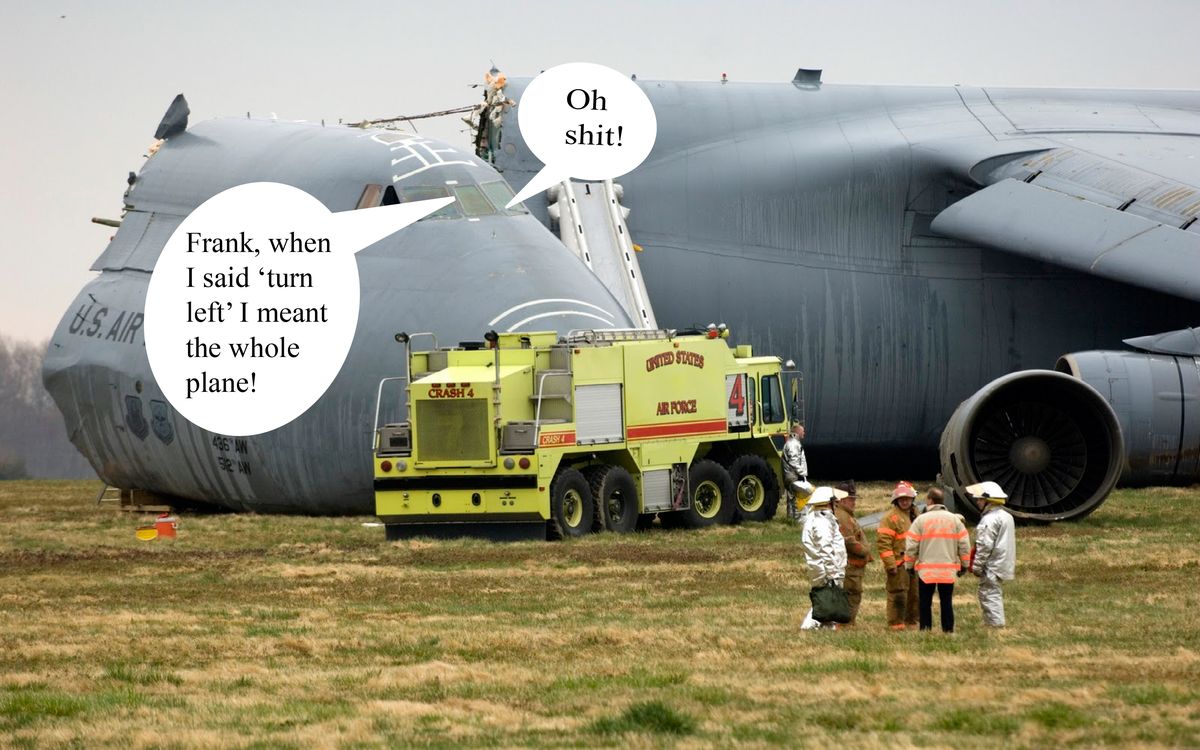
On the cold morning of April 3, 2006, one of the largest military aircraft ever built fell from the sky near Dover Air Force Base in Delaware. What should have been a routine strategic airlift mission to the Middle East turned into one of the most dramatic crashes in modern U.S. Air Force history.
The aircraft was a massive Lockheed C-5B Galaxy — a symbol of American global power, capable of carrying tanks, helicopters, armored vehicles, and entire military operations across continents. Nicknamed the “Galaxy,” the aircraft represented more than engineering. It represented reach, endurance, and the ability of the United States to move overwhelming force anywhere in the world.
But on that morning, the giant nearly became a graveyard.
And somehow, against impossible odds, every single person aboard survived.
You May Also Like
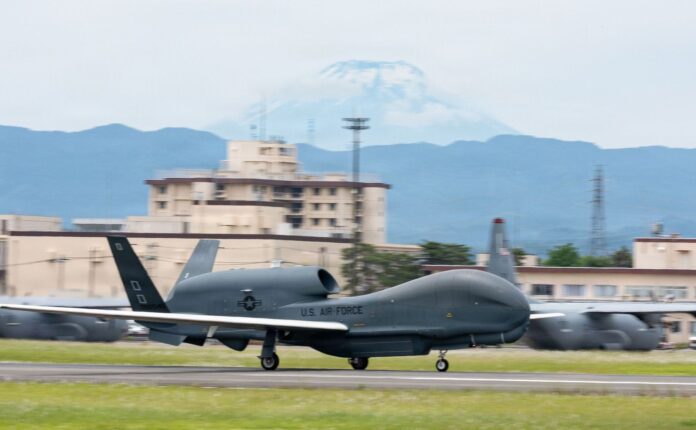
A Giant of the Skies
The crashed aircraft, tail number 84-0059, belonged to the United States Air Force and operated from Dover Air Force Base, one of America’s most important military airlift hubs.
The C-5 Galaxy is not an ordinary airplane. It is one of the biggest military aircraft ever designed. With its enormous cargo bay, nose-loading capability, and intercontinental range, it became a cornerstone of American logistics during conflicts in Iraq, Afghanistan, and across the globe.
When these aircraft launch, they do not merely transport cargo. They transport military capability itself.
On April 3, 2006, the aircraft departed Dover at approximately 6:21 in the morning, heading first toward Kuwait before continuing support operations connected to ongoing U.S. military missions in the Middle East.
There were 17 people on board.
No one expected disaster only minutes after takeoff.
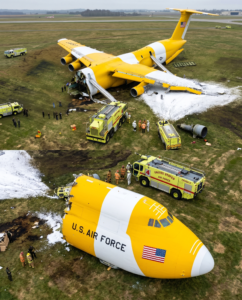
The First Warning
Roughly ten minutes into the flight, the crew noticed something alarming: a warning indication involving the aircraft’s No. 2 engine thrust reverser.
In aviation, even a single abnormal indication on a large transport aircraft is treated seriously. On a giant aircraft like the C-5, where systems are deeply interconnected and safety margins are carefully managed, caution is essential.
The crew decided to shut down the No. 2 engine as a precaution and return to Dover.
At first glance, this decision appeared disciplined and correct. Military crews are trained extensively to handle engine abnormalities, and the C-5 was designed to continue flying safely even with an engine shut down.
The aircraft still had three functioning engines.
The situation should have remained manageable.
But aviation disasters are rarely caused by one mistake alone.
They are usually chains of small errors that slowly grow into catastrophe.
And that chain was only beginning.
The Fatal Breakdown in the Cockpit
As the aircraft returned toward Dover, a series of critical mistakes unfolded inside the cockpit.
According to investigators, the pilots and flight engineers mistakenly continued using the throttle for the shut-down No. 2 engine instead of relying properly on the fully operational No. 3 engine. In simple terms, the crew was unintentionally demanding power from an engine that was no longer producing thrust while leaving usable thrust unavailable.
That error dramatically reduced the aircraft’s performance during one of the most critical phases of flight: approach and landing.
At the same time, another dangerous problem emerged.
The wrong flap configuration was selected.
Flaps are essential during landing because they increase lift and help large aircraft maintain stable flight at lower speeds. Using an incorrect flap setting can drastically change how an aircraft handles, especially one as enormous and heavy as the C-5 Galaxy.
Instead of using safer reduced flap settings that investigators later determined should have been considered, the aircraft approached using a full 100% flap configuration.
This increased drag significantly.
Now the aircraft was slow, low, heavy, and lacking proper thrust management.
The margin for error disappeared.
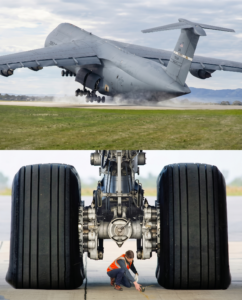
Descending Into Disaster
As the C-5 lined up for Runway 32 at Dover, the aircraft descended below the proper glidepath.
This was the turning point.
Modern instrument approaches exist for a reason: they provide pilots with safe descent profiles that protect aircraft from terrain and obstacles. But the Galaxy drifted dangerously low.
Inside the cockpit, the situation was becoming unstable.
The aircraft was losing energy.
Losing speed.
Losing lift.
And slowly, the giant began falling from the sky.
Then came impact.
The aircraft struck a utility pole before crashing into an open field short of the runway.
The force tore the giant aircraft apart.
The tail section separated violently.
The nose section broke away during impact.
Debris scattered across the crash site as one of the world’s largest military aircraft collapsed into destruction only moments from safety.
For witnesses, the sight was horrifying. A massive strategic airlifter — an aircraft built to survive global military operations — had been destroyed in front of its own base.
Yet what happened next stunned investigators.
Everyone survived.
The Miracle No One Could Explain
In most crashes involving large aircraft stalling close to the ground, survival rates are devastatingly low.
But on that morning at Dover, all 17 occupants escaped alive.
It was nothing short of extraordinary.
The survival of the crew became one of the most remarkable aspects of the accident. Despite the catastrophic breakup of the aircraft, despite the violent crash sequence, despite the destruction of the fuselage, no fatalities occurred.
For many within military aviation circles, the accident became known not only as a tragedy narrowly avoided, but as proof of the incredible survivability engineered into the C-5 Galaxy.
The aircraft was destroyed.
But it protected its people.
That mattered.
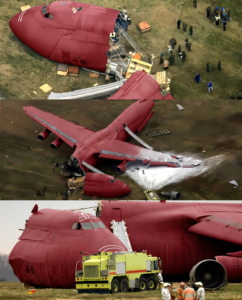
A Painful Truth About Human Error
The official Air Force investigation reached a difficult conclusion: the crash was not caused primarily by mechanical failure.
It was caused by human error.
The investigation board determined that the crew failed to properly utilize the functioning No. 3 engine, failed to apply the correct flap configuration, and conducted an unsafe approach profile far below standard glidepath procedures.
The report also identified incomplete briefing procedures and failures in cockpit coordination.
This is one of the harshest realities in aviation.
Technology alone cannot guarantee safety.
Even highly trained crews flying some of the most advanced aircraft in the world remain vulnerable to confusion, breakdowns in communication, procedural mistakes, and decision-making under pressure.
The Dover crash became a textbook example of how manageable problems can escalate when multiple small errors align at the wrong moment.
One engine issue alone was survivable.
Incorrect throttle usage alone might have been recoverable.
Improper flap settings alone might not have caused disaster.
A low approach alone might have been corrected.
But together, they became catastrophic.
Aviation history repeatedly teaches the same lesson:
Disasters are rarely created by a single failure.
They are built step by step.
The Legacy of the Crash
Although the aircraft itself was lost, the lessons from Dover reshaped training, procedures, and awareness throughout the Air Force mobility community.
The crash reinforced the importance of:
- Strict cockpit coordination
- Precise checklist discipline
- Proper crew resource management
- Accurate approach briefings
- Engine-out landing procedures
- Understanding aircraft energy management during approach
The salvaged cockpit section of the destroyed C-5 was later transported to Robins Air Force Base, where it was repurposed as part of a modernized simulator program.
In an almost symbolic way, the wreckage itself continued serving future aircrews.
The broken aircraft became a teacher.
Future pilots would train inside a cockpit pulled from disaster, learning lessons written in twisted metal and survival.
More Than a Crash
The 2006 Dover C-5 crash remains one of the most important non-fatal military aviation accidents in modern American history.
Not because the aircraft was destroyed.
But because everyone lived.
It exposed how even elite military crews can fall victim to cascading errors. It revealed the unforgiving nature of aviation, where seconds and decisions separate survival from catastrophe. And it demonstrated the astonishing resilience of both aircraft engineering and human beings under extreme conditions.
The C-5 Galaxy has always symbolized American reach and logistical power.
But on April 3, 2006, it symbolized something else:
Survival.
Because sometimes the most powerful stories in aviation are not about perfect missions or flawless victories.
Sometimes they are about the moments when everything goes wrong — and people still make it home alive.