For decades, the United States possessed something no rival could truly match:
A complete system of military dominance.
Not just advanced fighter jets.
Not just aircraft carriers.
You May Also Like

Not just stealth technology.
But an entire ecosystem of power — a networked force where stealth fighters, carriers, satellites, drones, airborne radar aircraft, missiles, cyber warfare, and artificial intelligence all operated together as one integrated machine.
This system allowed America to dominate the skies after the Cold War and project military power anywhere on Earth.
The U.S. military did not simply build weapons.
It built a method of war.
And now, China is copying it.
Carefully.
Relentlessly.
Systematically.
What makes this moment so significant is not that China created a stealth fighter.
It is that Beijing now appears to understand the deeper lesson behind American military supremacy:
The fighter jet alone was never the real advantage.
The system was.
And for the first time in modern history, China is assembling a military architecture that increasingly mirrors the American model of integrated air and naval warfare.
Two stealth fighter families.
Catapult-equipped supercarriers.
Carrier air wings.
Airborne early warning aircraft.
Networked drones.
Long-range missile systems.
Integrated command-and-control structures.
Artificial intelligence-assisted warfare.
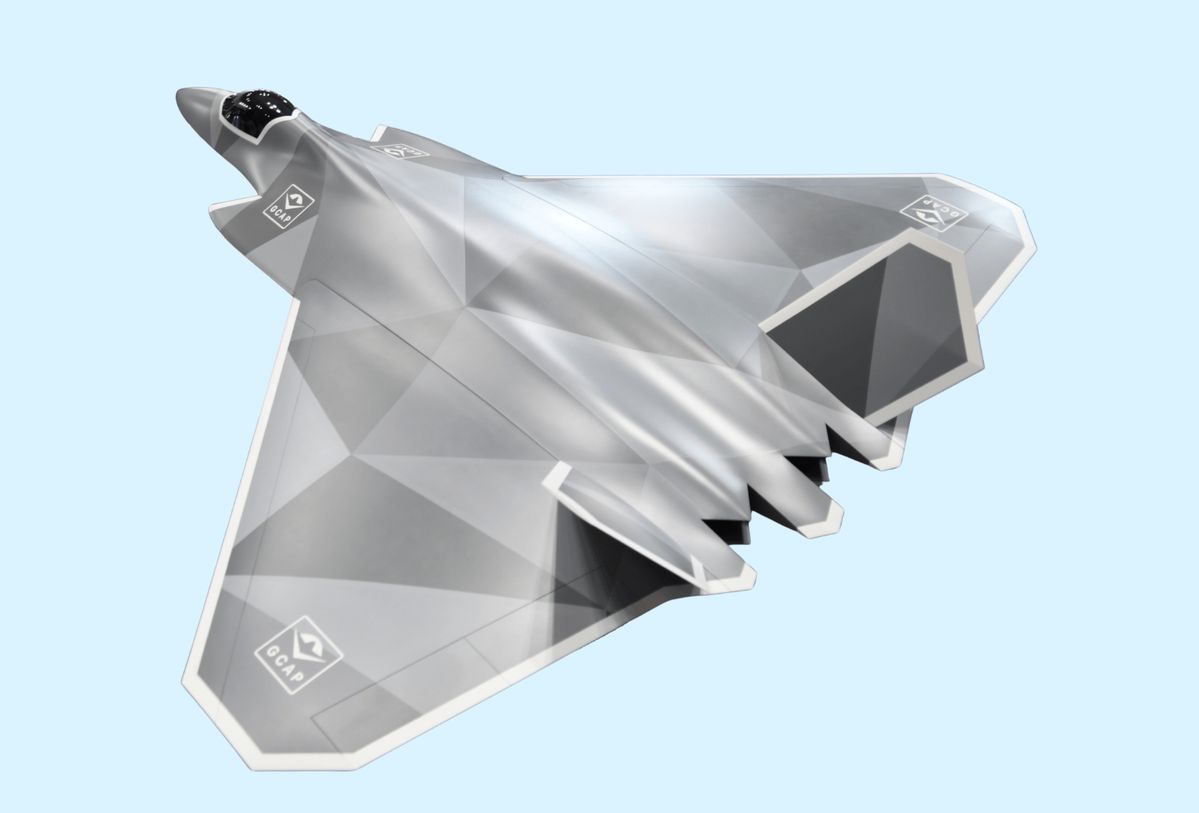
Next-generation stealth aircraft.
Even sixth-generation concepts.
China is no longer merely modernizing its military.
It is building a military ecosystem designed to compete directly with the United States on a global scale.
And perhaps most concerning for Washington:
It is working.
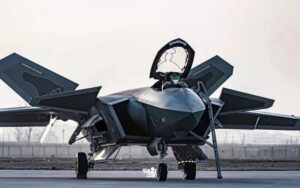
The Moment China Crossed Into The Stealth Era
When China officially inducted the J-20 stealth fighter into service in 2017, the world took notice.
The aircraft represented far more than another jet fighter.
It symbolized China’s arrival as the second nation on Earth capable of fielding an operational fifth-generation stealth aircraft.
For decades, stealth aviation had been dominated almost entirely by the United States.
Aircraft like the F-22 Raptor and F-35 Lightning II gave America unmatched advantages in survivability, sensor fusion, and long-range combat operations.
The J-20 changed the global balance psychologically.
Even if questions remained about Chinese engines, avionics, pilot training, and networking capability, Beijing had crossed a historic threshold.
China was no longer merely copying Soviet-era designs.
It was entering the highest tier of military aerospace engineering.
But the J-20 alone was never enough.
Because one stealth fighter does not create a complete military revolution.
The United States understood this decades earlier.
America built the F-22 for air dominance and paired it with the F-35 as a multirole stealth platform capable of serving across the Air Force, Navy, and Marine Corps.
Those aircraft then operated alongside:
- Airborne radar aircraft
- Carrier strike groups
- Satellites
- Drones
- Electronic warfare systems
- Integrated battlefield networks
That combination created a force far more powerful than any individual aircraft.
China studied that lesson closely.
And the unveiling of the J-35A in 2024 revealed that Beijing is now applying it.
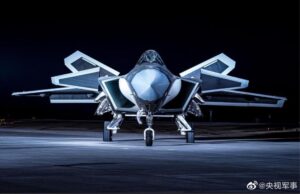
The J-35: China’s Answer To The F-35
The J-35 and J-35A represent something much bigger than a new aircraft.
They represent a strategic shift.
The naval J-35 is designed for aircraft carrier operations.
The J-35A serves as the land-based variant for the People’s Liberation Army Air Force.
Together, they form a stealth fighter family intended to operate across multiple branches of China’s military — remarkably similar to how the United States employs the F-35 across different services.
This is not coincidence.
It is imitation with purpose.
The J-20 remains China’s elite long-range air superiority fighter, much like the F-22.
Meanwhile, the J-35 appears designed to become the workhorse stealth platform:
- More flexible
- Easier to mass produce
- Adaptable for multiple missions
- Usable from carriers and land bases alike
In military terms, this matters enormously.
Wars are not won only by elite aircraft flying in small numbers.
They are won by sustainable systems capable of operating continuously across massive theaters of conflict.
China appears to understand this now.
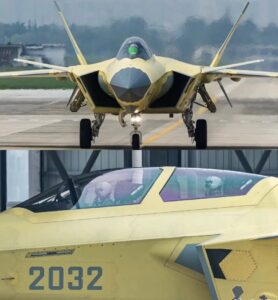
From Coastal Defense To Global Power Projection
For most of modern history, China’s military strategy focused primarily on defending its own territory.
Its air force depended heavily on Soviet-derived aircraft such as the MiG-21 and Su-27 families.
Its navy remained relatively limited.
And its doctrine centered around homeland protection rather than overseas operations.
But over the last two decades, something profound changed.
China stopped thinking like a regional military power.
And started thinking like a global one.
The transformation accelerated dramatically during the 2000s.
New aircraft such as the J-10 and upgraded J-11s gave China more capable indigenous airpower.
Then came the J-20.
Then advanced missile forces.
Then artificial islands in the South China Sea.
Then massive naval expansion.
Then aircraft carriers.
Then stealth drones.
Then integrated battlefield networks.
What emerged was not isolated modernization.
It was a coordinated long-term strategy aimed at changing the balance of power in Asia — and eventually beyond it.
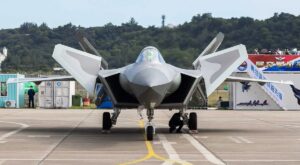
The Aircraft Carrier Revolution
Perhaps nowhere is this transformation more visible than in China’s rapidly expanding aircraft carrier fleet.
China’s first two carriers — Liaoning and Shandong — used ski-jump launch systems similar to older Soviet designs.
These systems limited aircraft weight and operational flexibility.
Heavier aircraft carrying larger fuel loads or advanced weapons struggled to launch efficiently.
America solved this problem decades ago through catapult systems.
Now China is following the same path.
Its newest carrier, Fujian, represents a major leap forward.
Unlike earlier Chinese carriers, Fujian uses electromagnetic catapult technology — similar in concept to the U.S. Navy’s newest supercarriers.
This changes everything.
Catapults allow carriers to launch:
- Heavier stealth fighters
- Airborne early warning aircraft
- Larger drones
- Fully loaded strike aircraft
In practical terms, this dramatically expands combat capability.
And the J-35 appears designed specifically for this new environment.
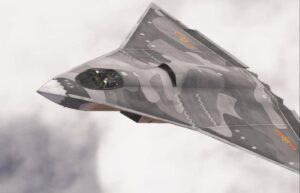
Why Fujian Changes The Game
The significance of Fujian goes far beyond China owning another aircraft carrier.
It marks the birth of a true blue-water power projection capability.
A stealth-capable carrier air wing supported by airborne radar aircraft fundamentally changes the operational environment in the Western Pacific.
China is reportedly preparing to pair the J-35 with the KJ-600 airborne early warning aircraft — a system comparable in concept to America’s E-2 Hawkeye.
This creates an integrated carrier air wing capable of:
- Long-range detection
- Coordinated strikes
- Defensive air control
- Fleet protection
- Extended operational reach
Again, this mirrors the American model almost exactly.
And that is the point.
China is not improvising randomly.
It is replicating the architecture of the world’s most successful modern military force.
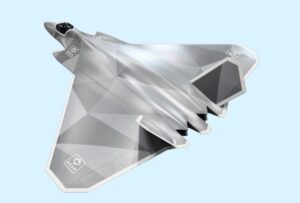
Taiwan Changes Everything
The rise of China’s stealth naval aviation capability becomes especially important in the context of Taiwan.
For decades, American military planning assumed the U.S. Navy and allied forces could project airpower relatively close to the region during a crisis.
But stealth-capable Chinese carrier groups complicate that equation enormously.
A Chinese carrier operating stealth fighters supported by advanced radar aircraft could:
- Extend Chinese air coverage
- Push defensive perimeters farther outward
- Threaten allied naval operations
- Complicate missile defense
- Increase uncertainty for U.S. planners
This creates what military strategists fear most:
A rapidly narrowing technological advantage.
For years, America relied on overwhelming superiority in stealth aviation and carrier warfare.
Now China is building parallel capabilities at astonishing speed.
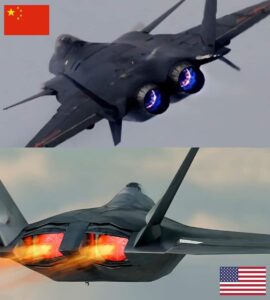
China’s Most Dangerous Strength: Speed
One reason China’s military rise alarms Western analysts is not merely the technology itself.
It is the pace.
The United States often struggles with:
- Budget battles
- Procurement delays
- Political infighting
- Cost overruns
- Slow production cycles
China operates differently.
Its centralized industrial system allows rapid experimentation, testing, and iteration.
That speed is becoming increasingly visible.
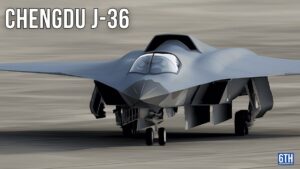
Recent sightings of advanced Chinese aircraft — including tailless stealth designs often associated with sixth-generation concepts — suggest Beijing is already looking beyond today’s technologies.
Images circulating in late 2024 reportedly showed massive next-generation stealth aircraft flying near Chengdu.
These designs featured:
- Tailless configurations
- Blended wing-body structures
- Reduced radar signatures
- Long-range optimization
Analysts believe China may even be developing multiple sixth-generation concepts simultaneously.
That is significant.
Because it indicates growing confidence in both technological capability and industrial capacity.
Drones, AI, And The Future Of Chinese Airpower
The next stage of warfare will not depend solely on manned aircraft.
It will revolve around networks.
Artificial intelligence.
Autonomous drones.
Sensor fusion.
Electronic warfare.
And distributed battlefield systems.
Again, China is closely following the trajectory pioneered by the United States.
Future Chinese stealth aircraft are expected to operate alongside:
- Loyal wingman drones
- AI-assisted targeting systems
- Networked battlefield communications
- Swarm technologies
- Advanced missile ecosystems
This mirrors America’s own Next Generation Air Dominance concepts.
The difference is that China is compressing decades of military evolution into a much shorter timeline.
And that compression is changing the global balance faster than many expected.
Why America Is Paying Attention
The United States still maintains enormous military advantages.
American pilots possess unmatched combat experience.
The U.S. Navy remains the world’s most powerful maritime force.
America still leads in stealth technology, logistics, global basing, and alliance structures.
But what worries Pentagon planners is no longer whether China can compete eventually.
It is how quickly the gap is shrinking.
For years, analysts assumed Chinese systems would remain crude imitations.
That assumption is becoming harder to defend.
China’s aircraft are improving.
Its shipbuilding capacity is staggering.
Its missile forces are expanding rapidly.
Its stealth programs are accelerating.
Its industrial base can produce military hardware at immense scale.
And increasingly, its military is no longer copying isolated weapons.
It is replicating entire systems of warfare.
The Real Lesson Behind China’s Rise
The most important lesson here is not about one aircraft or one carrier.
It is about strategic learning.
China spent decades studying how America achieved military dominance after the Cold War.
Then it began building its own version.
Patiently.
Methodically.
Without rushing headlines.
Without dramatic announcements.
While much of the world focused on counterterrorism wars in the Middle East, China focused on the future balance of power in the Pacific.
Now the results are becoming impossible to ignore.
The J-35 is not merely a stealth fighter.
Fujian is not merely an aircraft carrier.
These are pieces of a much larger transformation.
A transformation aimed at creating a military capable not only of defending China’s shores, but of challenging American power far beyond them.
And that may be the most important geopolitical shift of the 21st century.
Because for the first time since the end of the Cold War, the United States faces a rival that is not merely building weapons.
It is building a competing model of military supremacy itself.