For decades, military analysts predicted the same ending.
The Fairchild Republic A-10 Thunderbolt II would retire.
New stealth fighters would replace it.
Technology would move on.
The age of the slow-flying attack jet would finally come to an end.
And yet the A-10 Warthog continues to survive.
Again.
And again.
And again.
You May Also Like
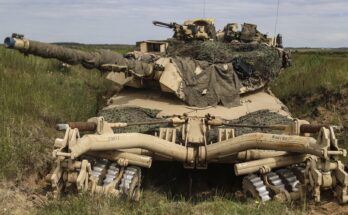


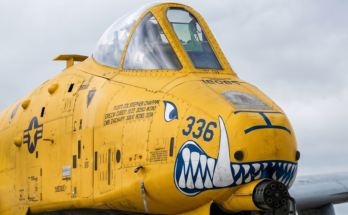
Now, in one of the most remarkable stories in modern military aviation, the United States Air Force has decided that the legendary Warthog could remain operational into the 2040s — meaning the aircraft may still fly more than sixty years after first entering service in the late 1970s.
That alone is extraordinary.
But the deeper story is even more fascinating.
Because the A-10 is surviving not simply as an aircraft, but as a symbol of a painful truth modern warfare still cannot escape:
No machine has ever fully replaced the brutal necessity of protecting soldiers on the ground.
Even in the age of stealth fighters, artificial intelligence, autonomous drones, cyberwarfare, and hypersonic missiles, America still cannot let go of the Warthog.
The aircraft is simply too useful.
Too trusted.
Too feared.
Too legendary.
Yet its survival also reveals something tragic.
The battlefield that the A-10 was built to dominate may no longer exist.
And the aircraft once designed to destroy Soviet tank armies across Europe is now entering a strange final chapter — fighting insurgents, terrorists, and lightly armed enemies while stealth aircraft and drones take over the deadliest wars of the future.
The Warthog survived.
But the world around it changed completely.
The Aircraft Built Around A Cannon
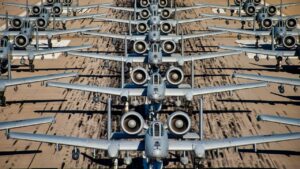
Few military aircraft in history have developed reputations as powerful as the A-10.
The Warthog was never elegant.
It looked ugly.
Slow.
Almost primitive compared to sleek fighter jets.
But every inch of the aircraft served a purpose.
The A-10 was designed during the Cold War for one terrifying scenario: stopping massive Soviet armored invasions pouring into Western Europe.
American strategists feared endless waves of tanks crossing battlefields faster than NATO forces could respond. The Air Force needed an aircraft capable of flying directly into that chaos, surviving enemy fire, and annihilating armored formations from close range.
The solution became the A-10 Thunderbolt II.
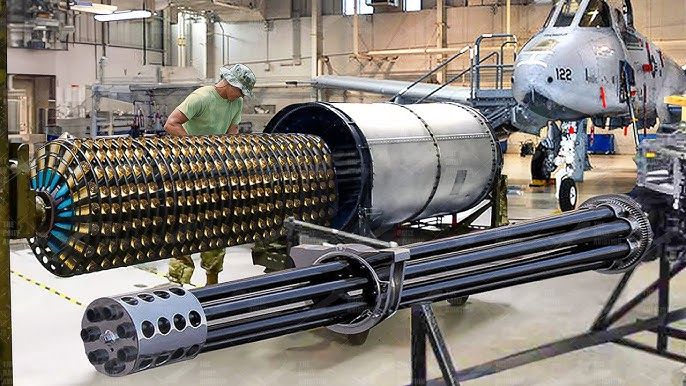
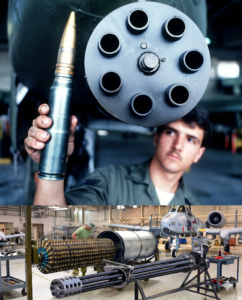
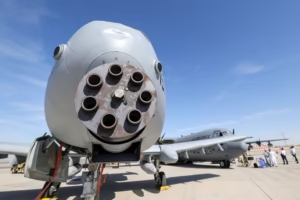
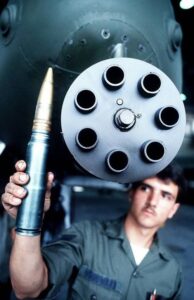
The aircraft was built around one monstrous weapon: the GAU-8/A Avenger cannon.
This 30mm Gatling gun is so enormous that engineers essentially designed the airplane around it. The cannon fires nearly 4,000 armor-piercing rounds per minute with devastating force. Entire enemy vehicles can be shredded within seconds.
Its sound became legendary:
“BRRRRRT.”
For American troops fighting in Iraq and Afghanistan, hearing that sound overhead often meant survival.
The A-10 became far more than an attack aircraft. It became a guardian angel for soldiers trapped in combat.
Why Ground Troops Worship The Warthog
The emotional bond between the A-10 and American troops is almost unmatched in modern warfare.
Many advanced fighter jets operate from enormous distances, dropping precision weapons guided by satellites and sensors. Pilots may never visually see the soldiers they support.
The A-10 fights differently.
It flies low.
It stays close.
Its pilots often maintain direct awareness of battlefield conditions.
It can circle combat zones for long periods waiting for troops to call for help.
Most importantly, it was designed to survive punishment.
The Warthog’s cockpit sits inside a titanium armored “bathtub” protecting the pilot from heavy fire. Its engines are mounted high to reduce vulnerability. The aircraft can continue flying despite severe damage that would destroy many other jets.
Stories of crippled A-10s returning home became legendary across the military.
Aircraft landed missing sections of wing.
Hydraulic systems destroyed.
Fuselages riddled with holes.
Engines barely functioning.
Yet the Warthog kept bringing pilots home.
That reliability created enormous trust among infantry forces.
And in war, trust matters.
The Problem: Modern Battlefields Became Deadlier
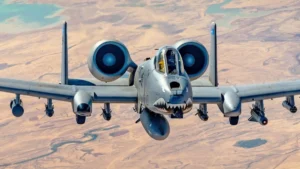
Despite its legendary status, the Air Force has spent years trying to retire the A-10.
Not because the aircraft failed.
But because warfare evolved.
The Cold War battlefield the Warthog was designed for no longer exists in the same form. Modern air defense systems have become dramatically more lethal. Advanced radar networks, mobile missile launchers, electronic warfare systems, and infrared-guided weapons now create environments far deadlier than those envisioned when the A-10 was born.
The Air Force now openly admits that the Warthog cannot safely survive over heavily defended battlefields against advanced military powers such as Russia or China.
Systems like the Russian SA-11 Buk, SA-15 Tor, SA-22 Pantsir, and shoulder-fired missiles create enormous danger for slow-flying aircraft operating at low altitude.
The war in Ukraine proved that reality brutally.
Attack aircraft and helicopters on both sides suffered severe losses. Modern air defense systems transformed low-altitude operations into deadly gambles.
The romantic image of the A-10 fearlessly hunting tank columns through missile fire suddenly looked far less realistic.
Military leaders reached a difficult conclusion:
The Warthog could still fight.
But not everywhere.
From Tank Killer To Counterinsurgency Aircraft
This decision fundamentally changed the A-10’s mission.
The aircraft once envisioned as NATO’s ultimate Soviet tank destroyer is now increasingly limited to operations over “lightly contested” airspace.
That means conflicts against insurgents, militias, terrorists, and lightly armed forces rather than sophisticated peer militaries.
Think:
Afghanistan.
Somalia.
Counterterrorism missions.
Border conflicts.
Insurgent warfare.
Not massive mechanized wars against advanced nations.
This represents one of the most dramatic role changes in modern military aviation history.
The aircraft originally built to stop World War III in Europe is now largely restricted to hunting pickup trucks, militant positions, and lightly defended targets.
Some military analysts view this as the final admission that the A-10’s original mission is over forever.
But others see something different.
They see proof that even outdated aircraft remain valuable if they solve specific battlefield problems better than anything else.
Why The F-35 Cannot Fully Replace The A-10
The Air Force insists the Lockheed Martin F-35 Lightning II will increasingly take over close air support operations in high-threat environments.
And in some ways, the F-35 is unquestionably superior.
It is faster.
Stealthier.
Packed with advanced sensors.
Capable of surviving inside modern air defense networks.
The aircraft can detect threats, share targeting information, and coordinate attacks in ways unimaginable during the A-10’s development.
But there is a major problem.
The F-35 is not truly built for close air support the way the Warthog is.
The differences are enormous.
The A-10 carries over 1,100 rounds for its massive 30mm cannon. It can carry Mavericks, rockets, bombs, and enormous external payloads.
The F-35’s internal stealth configuration carries far fewer weapons. Its 25mm cannon contains only 181 rounds. Carrying additional external weapons compromises its stealth advantages.
And perhaps most importantly:
The F-35 costs vastly more to operate.
Current estimates place its operating cost around $45,000 per flight hour.
Using such an advanced and expensive aircraft for prolonged low-level support missions raises difficult strategic questions.
Should one of the world’s most advanced stealth fighters spend hours hunting insurgents with machine guns?
Many military planners increasingly believe the answer may eventually be no.
The Drone Revolution Could Change Everything
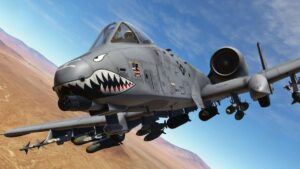
Ironically, the future replacement for the A-10 may not be another fighter jet at all.
It may be drones.
The rise of autonomous warfare is transforming military thinking across the world. Cheap unmanned aircraft now destroy tanks, attack ships, conduct surveillance, and overwhelm air defenses in conflicts from Ukraine to the Middle East.
The Pentagon increasingly envisions future battlefields dominated by networks of drones working alongside manned aircraft.
And strangely enough, the A-10 may still fit into that future.
Some analysts imagine heavily armed drone swarms controlled by pilots operating from safer distances. Others envision manned aircraft directing autonomous strike systems rather than engaging targets directly.
In such scenarios, the A-10’s endurance, payload capacity, battlefield awareness, and survivability could remain useful.
The aircraft that once represented Cold War airpower might evolve into a command platform for drone warfare.
That possibility would have sounded absurd decades ago.
Now it seems surprisingly plausible.
Why The Warthog Keeps Winning
The A-10’s continued survival exposes a recurring pattern in military history:
Experts often predict the death of older systems too early.
Battleships survived longer than expected.
Tanks survived longer than expected.
Attack helicopters survived longer than expected.
And now the Warthog refuses to disappear.
Why?
Because real warfare is messy.
Modern militaries may prepare for advanced conflicts against peer adversaries, but much of actual combat still involves counterinsurgency, regional instability, irregular warfare, and prolonged operations against enemies without sophisticated air defenses.
In those environments, the A-10 remains devastatingly effective.
It is rugged.
Reliable.
Simple compared to newer stealth systems.
Capable of carrying enormous firepower.
And deeply trusted by troops.
Sometimes the most advanced solution is not the most practical one.
The End Of An Era — And The Beginning Of Another
Still, something important has undeniably changed.
The mythic vision of the A-10 as an unstoppable Cold War tank hunter charging through storms of enemy missiles is effectively over.
Modern air defenses are simply too dangerous.
The aircraft’s future now lies in a narrower but still vital role supporting operations where air superiority already exists.
That reality is bittersweet for Warthog fans.
The A-10 survived into the 2040s.
But the world it was built for disappeared long ago.
Yet perhaps that makes the aircraft’s endurance even more remarkable.
Because very few military machines remain relevant across generations of warfare.
The A-10 fought through the Cold War.
It survived the Gulf War.
It dominated Iraq and Afghanistan.
It adapted to counterterrorism operations.
And now it may evolve again for the drone age.
Few aircraft in history have endured such massive shifts in military doctrine.
The Aircraft That Refused To Be Forgotten
At some point, the Warthog will finally retire.
Time eventually defeats every machine.
But the A-10’s story has already become larger than the aircraft itself.
It represents an older philosophy of warfare — one centered on toughness, persistence, and protecting soldiers above all else.
The Warthog was never about elegance.
It was about survival.
And perhaps that is why people still love it.
Even in an era dominated by stealth, algorithms, satellites, and artificial intelligence, there remains something deeply human about an armored aircraft flying low through danger to protect troops on the ground.
The A-10 reminds the world that war is still ultimately fought by people.
And until the very end, the Warthog intends to keep fighting beside them.