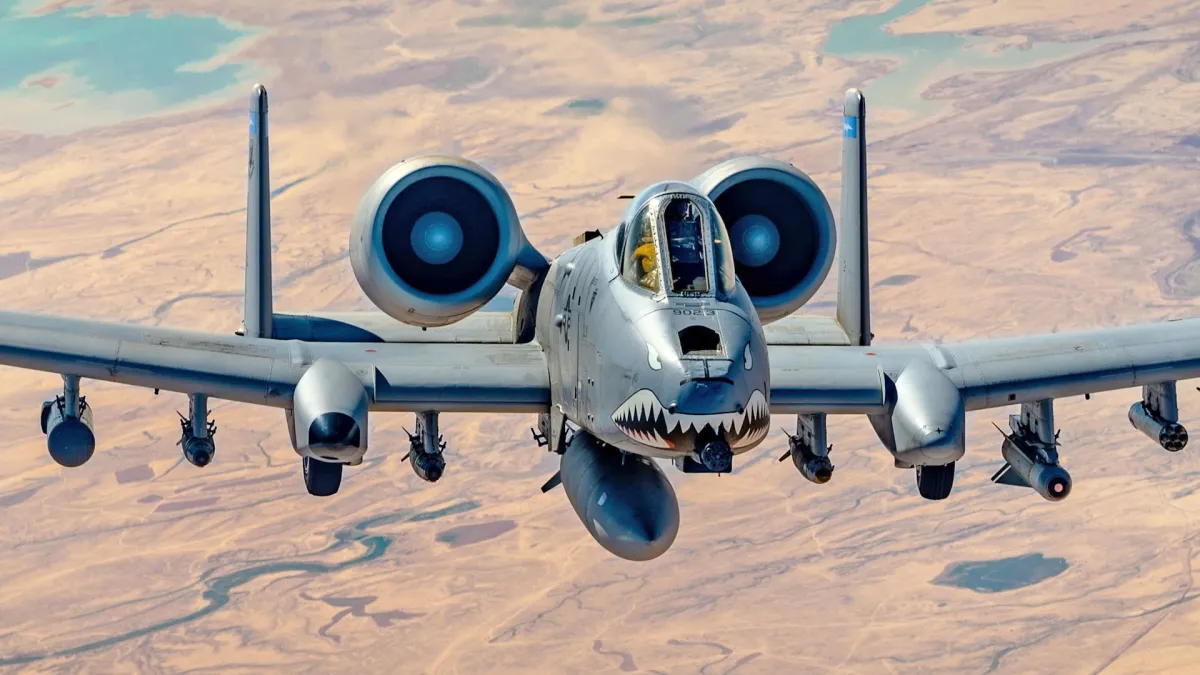
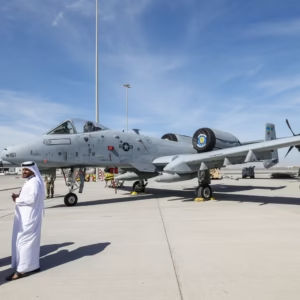
The Fairchild Republic A-10 Thunderbolt II was never supposed to survive this long.
For decades, military planners inside the United States Air Force tried to retire it. Strategists called it outdated. Budget officials called it expensive. Modern warfare experts argued that slow-flying attack aircraft could not survive on tomorrow’s battlefield.
Yet the A-10 Warthog refused to disappear.
Again and again, wars brought it back.
You May Also Like
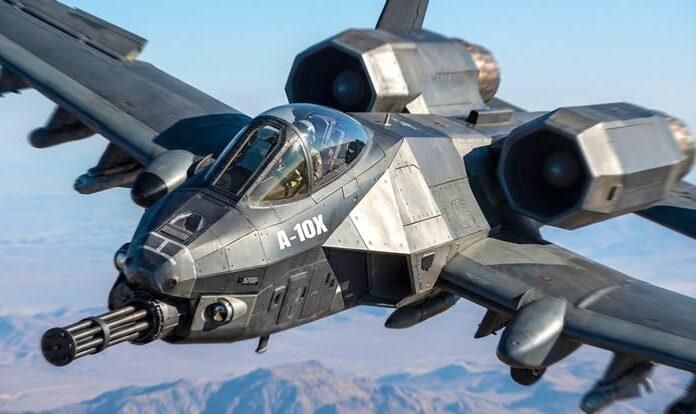
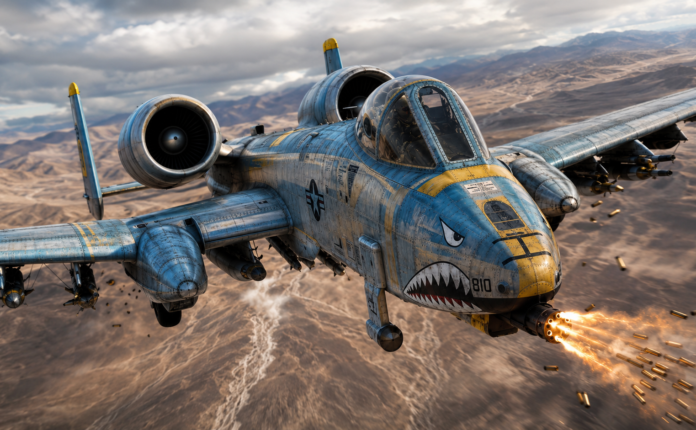
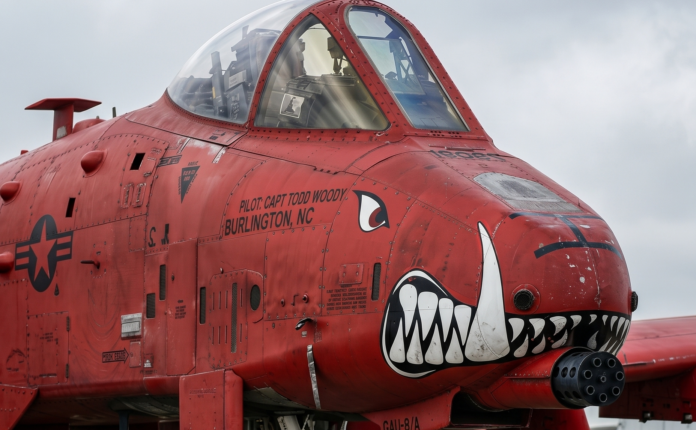
American troops loved it. Pilots trusted it. Enemies feared it. And every time the Air Force moved closer to retirement, another crisis reminded the world why the ugly, thunderous aircraft still mattered.
Now, as the United States finally prepares to phase out the last Warthogs by 2029, a new mystery has emerged inside global military circles:
Who is trying to buy them?
In testimony before Congress, former Air Force Secretary Frank Kendall revealed that at least one country had already expressed interest in acquiring surplus A-10s once the aircraft leave American service.
He did not reveal the nation’s identity.
That single statement ignited intense speculation across the defense world.
Because despite the rise of stealth fighters, drones, artificial intelligence, and hypersonic missiles, someone still believes the Warthog remains valuable enough to save.
And perhaps that country sees something many modern military planners have forgotten.
The Aircraft That Refused To Die
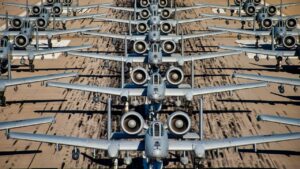
The A-10 is unlike almost every other military aircraft ever built.
It was not designed to look elegant.
It was not designed to fly the fastest.
It was not designed to dominate airshows or impress politicians.
It was built for one brutal purpose:
Destroy enemy armor and protect soldiers on the ground.
Introduced during the Cold War, the A-10 emerged from American fears of massive Soviet tank invasions sweeping across Europe. Military planners needed an aircraft capable of flying low over battlefields, surviving heavy enemy fire, and obliterating armored formations with overwhelming force.
The result looked almost primitive compared to sleek fighter jets.
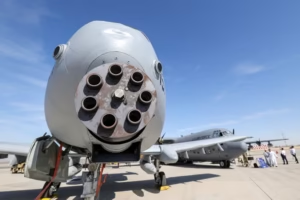
The Warthog carried thick armor around the cockpit, massive straight wings, oversized engines mounted high for survivability, and the legendary GAU-8/A Avenger cannon — one of the most terrifying weapons ever installed on an aircraft.
That cannon fires 30mm rounds at nearly 4,000 rounds per minute.
Its sound became legendary:
“BRRRRRT.”
For American troops in Iraq and Afghanistan, that sound often meant survival.
The A-10 earned a reputation not merely as an aircraft, but as a battlefield guardian. It could loiter for long periods over combat zones, identify friendly positions carefully, and strike enemy forces with devastating accuracy dangerously close to American troops.
Unlike high-altitude bombers or stealth fighters operating from a distance, the Warthog fought alongside soldiers.
That emotional connection made the aircraft nearly impossible to kill politically.
Why The Air Force Wants It Gone
Despite its legendary status, the Air Force has spent decades trying to retire the A-10.
The reason is simple:
Modern warfare has changed.
Potential conflicts against advanced powers like China or Russia involve dense networks of long-range radar systems, precision missiles, electronic warfare, and advanced air defenses.
In those environments, flying low and slow over battlefields becomes extraordinarily dangerous.
The war in Ukraine reinforced those fears dramatically.
Both Ukrainian and Russian attack aircraft have suffered severe losses operating near modern air defenses. Even helicopters and drones struggle to survive close to the front lines. Soviet-designed close-air-support aircraft like the Sukhoi Su-25 — often compared to the A-10 — have been repeatedly shot down.
Military planners now question whether traditional manned attack aircraft can survive in future high-intensity wars at all.
That reality pushed the Air Force toward newer systems such as the Lockheed Martin F-35 Lightning II and future AI-assisted combat drones.
The A-10 may still dominate against lightly defended enemies, but against modern missile systems, its survival becomes far less certain.
And yet someone still wants it.
Why?
Because not every country fights the same kind of war.
Why Ukraine Probably Said No
At first glance, Ukraine seemed like the obvious candidate.
The country has spent years fighting heavily armored Russian forces. Supporters of transferring A-10s to Kyiv argued the Warthog’s anti-tank capabilities could devastate Russian formations across eastern Ukraine.
But reality proved more complicated.
Ukraine’s battlefield is saturated with deadly surface-to-air missiles, radar-guided systems, portable anti-aircraft weapons, and electronic warfare. Flying an A-10 in that environment could become extraordinarily risky.
Secretary Frank Kendall acknowledged that Ukraine itself showed limited enthusiasm for receiving the aircraft.
That surprised many observers.
But Ukrainian military leaders understand modern air defense realities better than almost anyone on Earth.
The skies above Ukraine have become one of the most dangerous combat environments since World War II.
And that forces an uncomfortable question:
If not Ukraine, then who still believes in the Warthog?
Poland: Preparing For Europe’s Worst Nightmare
One possible answer is Poland.
No European nation has moved more aggressively to modernize its military in response to Russian aggression. Poland remembers centuries of invasions, occupations, and war. The destruction of Ukraine reinforced fears that Eastern Europe could once again become a battlefield.
As a result, Poland is conducting one of the largest military buildups in Europe.
The country is purchasing M1 Abrams tanks, HIMARS rocket systems, Apache helicopters, Patriot missiles, and F-35 stealth fighters.
Could the A-10 fit into that strategy?
Possibly.
The Warthog was originally built specifically to destroy Soviet-style armored invasions across Europe. If Poland fears massive mechanized warfare returning to the continent, the aircraft’s anti-tank firepower could still hold value.
And emotionally, the idea of heavily armored American attack aircraft defending Eastern Europe against Russian aggression carries powerful symbolism.
South Korea: Mountains, Armor, And Endless Tension
Another strong possibility is South Korea.
The Korean Peninsula remains one of the most militarized places on Earth. North Korea maintains enormous artillery forces, armored units, and hardened military positions near the border.
Mountainous terrain could actually favor the A-10 in certain combat scenarios.
The aircraft’s ability to fly through valleys, attack mechanized forces, and rapidly disappear behind terrain features may still provide tactical advantages in Korea’s geography.
The United States Air Force already operates A-10s from Osan Air Base, meaning South Korean military planners are highly familiar with the aircraft’s capabilities.
If Seoul fears losing that close-air-support capability after American retirement, purchasing surplus Warthogs could offer a temporary solution.
Taiwan: The Island Preparing For Invasion
Perhaps no country faces a more dangerous future than Taiwan.
The threat of potential Chinese invasion shapes nearly every aspect of Taiwan’s defense planning. Military analysts envision terrifying scenarios involving amphibious assaults, airborne operations, helicopter landings, missile strikes, and naval blockades.
In such a conflict, the A-10 could theoretically become devastating.
Chinese landing ships, troop transports, helicopters, and armored vehicles would all represent ideal targets for the Warthog’s cannon and missile systems.
Taiwan also possesses unusual defensive infrastructure, including hardened mountain air bases and highway launch systems designed to keep aircraft operational after missile attacks.
Still, Taiwan’s situation also highlights the A-10’s greatest vulnerability:
China’s massive missile and air defense network.
In a modern Pacific war, survival would become extraordinarily difficult.
Yet desperate nations sometimes value any weapon capable of slowing invasion.
And few aircraft are better at destroying exposed armor and transports than the Warthog.
Egypt: Power In The Desert
Egypt represents another intriguing possibility.
Egypt operates large numbers of American military systems and sees itself as a dominant regional military power. Surrounded by instability in places like Libya and Sudan, Egypt constantly monitors long desert borders vulnerable to insurgency, smuggling, and armed conflict.
The A-10’s long endurance, rugged design, and ability to patrol hostile terrain could make it useful in desert warfare and border security operations.
Unlike Europe or the Pacific, many Middle Eastern conflicts still involve lightly defended battlefields where the Warthog could operate more safely.
And because the aircraft is being retired rather than newly manufactured, surplus A-10s could become relatively affordable for nations seeking combat capability without massive procurement costs.
Vietnam: The Most Unexpected Candidate
One of the most fascinating possibilities is Vietnam.
Vietnam shares a long and tense border with China while simultaneously challenging Beijing’s territorial ambitions in the South China Sea.
Historically, Vietnam has excelled at extracting maximum value from aging military equipment. The country operates a relatively modest but highly pragmatic military force accustomed to adapting older systems creatively.
The A-10 could theoretically support both land and maritime operations. Against armored ground forces, it remains dangerous. Against ships and transports in coastal waters, it could function as a heavily armed patrol aircraft.
Forty years ago, countries worldwide would have lined up to buy the Warthog.
Today, only a handful still might.
But those nations tend to face very real security threats.
The Deeper Meaning Behind The A-10’s Survival
The mystery surrounding the Warthog’s potential buyer reveals something larger about modern warfare itself.
Military technology evolves constantly. Every generation believes its newest systems will replace older ones completely.
Yet battlefields repeatedly prove more complicated.
The A-10 survives because it solves a brutally simple problem exceptionally well:
Destroying targets while protecting troops under fire.
No stealth coating changes that reality.
No drone swarm fully replaces that emotional trust.
No advanced fighter replicates the psychological reassurance soldiers feel hearing an A-10 overhead.
The aircraft represents an older philosophy of warfare — one focused on toughness, persistence, and direct battlefield support rather than technological elegance alone.
And some nations still value that philosophy.
The Last Roar Of The Warthog
Eventually, the A-10 will disappear from American skies.
Its retirement now seems inevitable. The age of stealth, autonomy, artificial intelligence, and networked warfare is rapidly accelerating. Future conflicts may belong increasingly to drones and machine-speed combat systems.
But the Warthog’s story is not ending quietly.
Even as the United States moves on, at least one mysterious country still sees value in the legendary attack jet.
Perhaps that nation understands something timeless:
Wars are still ultimately fought on the ground.
Soldiers still need protection.
Armor still must be destroyed.
Fear still matters.
And few aircraft in history have inspired fear quite like the A-10 Warthog diving low across the battlefield, cannon roaring, announcing its presence with the unforgettable sound that became one of modern warfare’s most iconic signatures:
“BRRRRRT.”