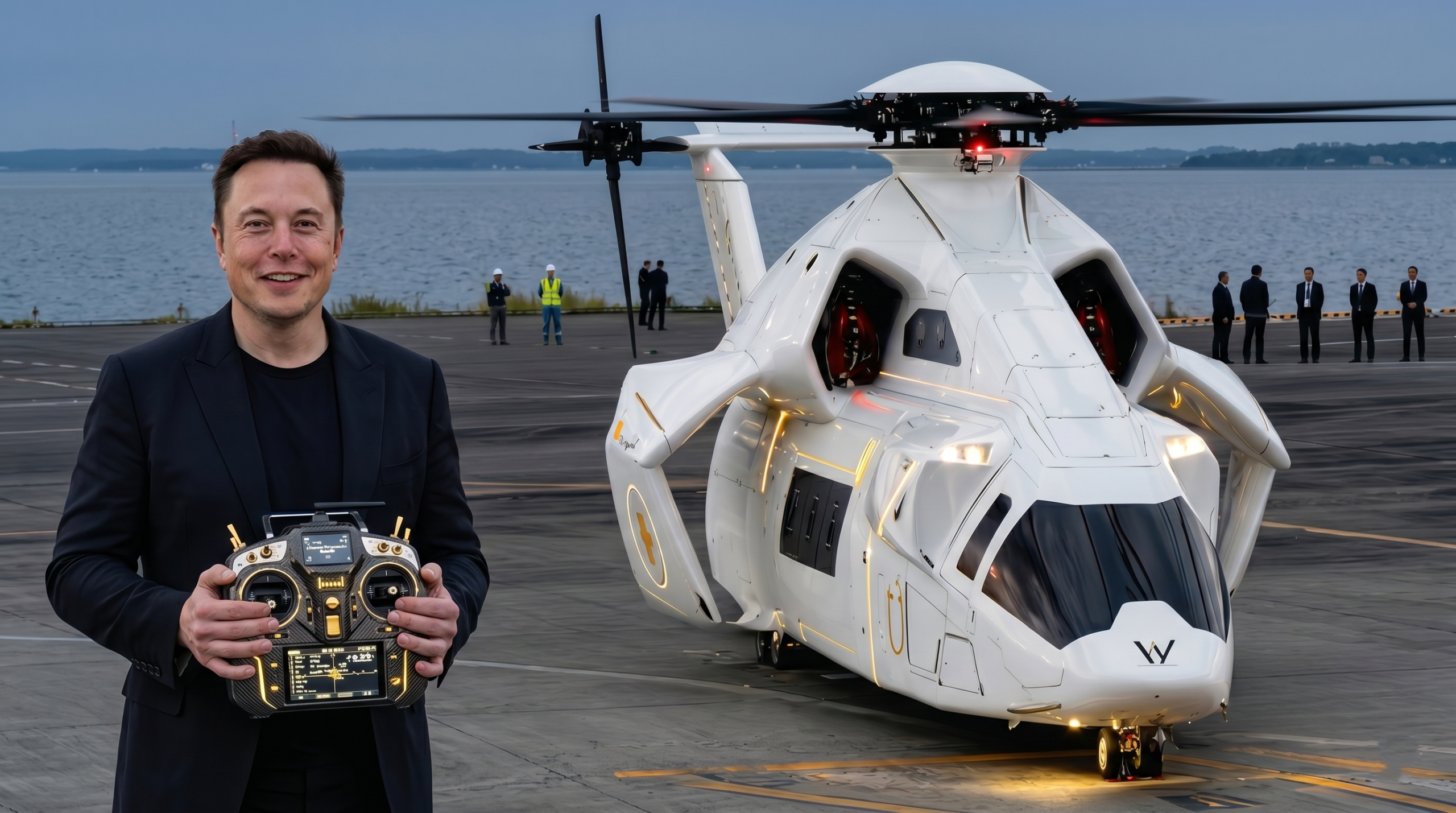
Once, humanity believed cavalry would rule forever. Then tanks arrived. Nations once believed battleships were untouchable, until aircraft carriers transformed naval warfare. For decades, fighter pilots represented the ultimate symbol of military supremacy — elite humans soaring above the clouds at supersonic speeds, controlling machines worth hundreds of millions of dollars while carrying the strategic weight of nations on their shoulders.
But history has a brutal habit of replacing legends with algorithms.
And few people have challenged that reality more aggressively than Elon Musk.
When Musk publicly mocked the continued development of piloted fighter aircraft like the Lockheed Martin F-35 Lightning II, many military analysts reacted with outrage. Veterans called the comments disrespectful. Defense experts accused him of oversimplifying warfare. Aerospace traditionalists dismissed him as another billionaire speaking outside his field.
You May Also Like

Yet beneath the controversy was a question so powerful that it shook the foundations of modern military doctrine:
What if the age of the human fighter pilot is slowly coming to an end?
The Biological Bottleneck
To understand why Musk’s argument carries devastating scientific weight, one must look not at the engineering of the aircraft, but at the fragile biology of the human inside it. Modern aerospace engineering has far surpassed the physiological limits of the human body. In an advanced fighter jet, the ultimate constraint is no longer thrust or aerodynamics; it is the squishy, blood-filled organism sitting in the cockpit.
During aggressive aerial maneuvers, pilots are subjected to extreme gravitational forces (G-forces). When pulling into a tight turn, a pilot experiences positive Gz forces, which aggressively push blood away from the brain and toward the lower limbs. The human limit, even with advanced pressurized anti-G suits and intense muscle-straining breathing techniques (the Anti-G Straining Maneuver), is an absolute ceiling of about 9 Gs. At this threshold, a 2-kilogram pilot’s helmet effectively weighs 18 kilograms, threatening to snap their neck. Push slightly past 9 Gs, or sustain it for too long, and the pilot suffers G-LOC (Gravity-Induced Loss of Consciousness).
In contrast, a machine feels no pain, requires no oxygen, and cannot blackout. Unmanned interceptors and modern air-to-air missiles—effectively one-way suicide drones—routinely pull 40 to 60 Gs. They can execute geometric turns that would instantly kill a human. By removing the pilot, you eliminate the life support systems, the ejection seat, the heavy cockpit glass, and the armored tub. You create an aircraft that can out-turn, out-climb, and out-maneuver any human-flown jet in existence. Musk is factually correct: chaining a multi-million-dollar supersonic platform to the biological limitations of a human spine is an engineering paradox.
The Algorithmic Supremacy
Furthermore, the cognitive processing power of a human is being rapidly outpaced by silicon. In 2020, the Defense Advanced Research Projects Agency (DARPA) hosted the AlphaDogfight trials. The climax of the event pitted a highly experienced human F-16 pilot against an artificial intelligence system developed by Heron Systems.
The AI had trained through deep reinforcement learning, accumulating the equivalent of 12 years of flight experience in a matter of months. The result was a massacre. The AI defeated the human expert 5-0. It executed superhuman, hyper-aggressive maneuvers, taking micro-second shots with pinpoint accuracy that a human brain simply could not process in real-time. The human OODA loop (Observe, Orient, Decide, Act) operates in fractions of a second; the AI’s loop operates in nanoseconds. In a pure, sterile dogfight, the human pilot is obsolete.
The Fatal Flaw in Musk’s Vision
However, the reality of warfare is never a pure, sterile simulation, and this is where Musk’s dismissal of the F-35 and human pilots proves critically short-sighted.
Musk criticized the F-35 as a “complex jack of all trades, master of none.” But evaluating the F-35 solely on its dogfighting capabilities is akin to evaluating a modern smartphone solely on its ability to make phone calls. The F-35 was not designed to be just a dogfighter; it is a flying supercomputer, a stealth intelligence node, and an electronic warfare platform. It possesses unparalleled sensor fusion, sweeping up radar, infrared, and electromagnetic data, processing it, and painting a God’s-eye view of the battlefield for every friendly asset in the sky and on the sea.
To say a drone can easily replace this ignores the massive, flashing vulnerability of all unmanned systems: the electromagnetic spectrum.
The Un-Jammable Human Mind
Drones require data links. Whether they are remotely piloted by an operator halfway across the world or relying on GPS and satellite uplinks to coordinate an autonomous swarm, they are tethered to the electromagnetic spectrum. In a high-end conflict against a peer adversary like China or Russia, the airspace will not be clear. It will be a tempest of electronic warfare, jamming, spoofing, and cyber-attacks.
If a drone’s communication link is severed, it becomes either a multi-million-dollar paperweight falling from the sky, or worse, an unpredictable autonomous weapon operating without a moral compass. Artificial Intelligence is incredibly capable in the rigid parameters of a simulation, but it is notoriously brittle when confronted with the “fog of war”—the chaotic, rule-breaking unpredictability of a real battlefield.
A human pilot is an onboard, un-jammable, morally accountable decision-maker. If satellite links drop, if radars are jammed, a human pilot can look out the canopy, assess the geopolitical stakes of a split-second encounter, distinguish between a civilian airliner and a military threat through visual context, and execute a mission using intuition—a trait AI fundamentally lacks.
The Structural Reality of Reusable Drones
Additionally, Musk’s vision of cheap, reusable drones dominating the sky runs into the cold, hard wall of physics. It is true that small, single-use drones can pull high Gs easily. But to replace an F-35, a drone must be large enough to carry a heavy payload of long-range missiles, radar arrays, and fuel for intercontinental range. As an aircraft scales up in size and weight, the structural reinforcement required to survive 20 or 30 Gs becomes exponentially heavier. A large, reusable drone designed to do the job of a fighter jet ultimately ends up weighing—and costing—nearly as much as a piloted jet, defeating the economic argument.
The Synthesis: Human-Machine Symbiosis
Elon Musk is right that the era of the human fighter pilot as the sole arbiter of aerial combat is dying. Flying into a merge to settle a dispute with machine guns and pure airmanship is a romanticized relic of the past. If the future is a math equation of G-forces and processing speeds, flesh and blood will always lose to metal and code.
But Musk is profoundly wrong to call the architects of manned jets “idiots.” He underestimates the chaotic, mathematically unsolvable reality of war. The true future of air superiority is not man versus machine; it is man teamed with machine.
Military doctrine is already shifting toward “Collaborative Combat Aircraft” (CCAs)—where a single human pilot in an F-35 acts as a battlefield quarterback, commanding a swarm of autonomous “loyal wingman” drones. The drones will fly ahead, absorbing the physical risks, pulling the extreme Gs, and firing the weapons. But the human will remain the un-hackable, intuitive core of the formation. The fighter pilot isn’t going extinct; they are simply being promoted from a dogfighter to a god of the digital battlefield.