
For thousands of years, humanity measured power through the size of armies.
Empires rose behind walls of bronze shields, iron swords, cavalry charges, and wooden fleets crossing violent seas beneath dark sails. Kingdoms expanded through physical conquest. Strength belonged to those who commanded the largest formations of warriors, the strongest horses, the tallest fortresses, and the most disciplined legions.
In the 12th century, warfare was deeply human.
Battles depended on courage, endurance, leadership, terrain, weather, and direct physical combat. Kings stood beneath banners stitched by hand while soldiers clashed face-to-face with steel and fire. Military strategy revolved around castles, supply routes, horseback communication, naval dominance, and the psychological power of fear itself.
You May Also Like



A commander’s vision extended only as far as the human eye could see.
A messenger on horseback represented the fastest transmission of information.
The battlefield moved at the speed of human biology.
But history never stands still.
Every century transforms warfare because every century transforms human knowledge.
Gunpowder shattered the age of armored knights and castle walls.
Industrial machinery converted nations into engines of mass production capable of manufacturing destruction at unimaginable scale.
Railroads accelerated troop movement across continents.
Telegraphs allowed commanders to communicate across enormous distances.
Aircraft transformed the sky into a battlefield.
Submarines turned the oceans invisible.
Radar changed detection forever.
Nuclear weapons redefined fear itself by giving humanity the power to erase civilization within hours.
And now, humanity is entering another transformation — perhaps the greatest transformation since the invention of flight.
A transformation driven not merely by machinery, but by intelligence itself.
Artificial intelligence.
Autonomous systems.
Quantum communication.
Hypersonic propulsion.
Directed-energy weapons.
Cyberwarfare.
Machine-learning combat systems.
Space-based surveillance.
Neural computation.
Advanced robotics.
Swarm coordination algorithms.
The battlefield of the 21st century is no longer defined solely by bullets, tanks, or soldiers standing on front lines. Increasingly, modern warfare is fought through interconnected systems operating at speeds beyond direct human perception.
Sensors detect movement instantly across continents.
Satellites observe planetary activity in real time.
Algorithms process battlefield data faster than entire military staffs once could.
Autonomous drones coordinate attacks without direct pilot input.
Cyber systems can disrupt infrastructure without firing a missile.
Artificial intelligence predicts movement patterns before human commanders fully recognize threats.
War itself is becoming computational.
And standing at the center of this technological revolution is the United States.
For decades, rumors have circulated about America’s next generation of military systems — futuristic aircraft carriers enhanced by AI-assisted battlefield coordination, autonomous drone ecosystems, directed-energy defense systems, electromagnetic launch platforms, advanced stealth architecture, and communication networks so sophisticated they appear almost extraterrestrial compared to traditional naval engineering.
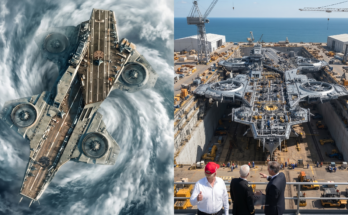
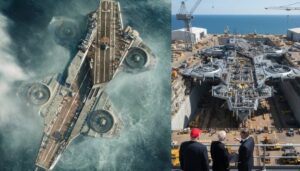
Some conceptual images online portray enormous floating fortresses unlike anything officially operational today: vast intelligent warships carrying hypersonic aircraft, drone swarms, orbital communication arrays, stealth coatings, electromagnetic rail systems, underwater autonomous fleets, and AI command centers integrated into a single combat organism.
While many of these images are speculative or artistic interpretations, they reflect something scientifically and strategically very real:
The United States remains the most technologically advanced military power on Earth.
And the reasons are deeply rooted in science, engineering, economics, industrial capacity, military doctrine, computational superiority, and decades of accumulated technological infrastructure.
An aircraft carrier alone is already among the most complex machines humanity has ever constructed.
A modern American supercarrier is not simply a ship.
It is a floating nuclear-powered city.
It is an airport capable of launching combat aircraft into hostile territory thousands of miles away from home ports.
It is a radar network scanning enormous regions of ocean and sky simultaneously.
It is a missile defense platform.
It is a command-and-control fortress.
It is a mobile intelligence hub.
It is a symbol of geopolitical power visible from space itself.
And all of this must operate continuously in some of the harshest environments on Earth: corrosive saltwater oceans, violent storms, electromagnetic threats, cyber attacks, missile risks, and high-tempo military operations.
The USS Gerald R. Ford represents the most advanced operational aircraft carrier currently built by humanity. Scientifically and technologically, it demonstrates why American naval engineering continues to dominate globally.
Unlike older carriers relying on steam catapult systems developed during the Cold War, the Ford-class introduced electromagnetic launch technology known as EMALS — the Electromagnetic Aircraft Launch System.
This is not a minor upgrade.
It represents a fundamental engineering transformation.

Traditional steam systems rely on massive pressure-driven mechanics that create tremendous stress on aircraft frames. EMALS instead uses electromagnetic force to accelerate aircraft with extraordinary precision, smoother force distribution, reduced maintenance complexity, and greater energy efficiency.
From a physics perspective, this matters enormously.
Smoother acceleration reduces structural fatigue on aircraft.
It enables future aircraft designs that may be lighter, unmanned, or more aerodynamically sensitive.
It improves launch consistency.
It reduces operational turnaround time.
And critically, it supports the future integration of autonomous combat drones into carrier warfare.
In essence, the Ford-class carrier was designed not only for today’s aircraft — but for technologies that may not fully exist yet.
That is one of the defining characteristics of American military engineering:
It often builds infrastructure for future technological ecosystems decades in advance.
The ship’s nuclear reactors further demonstrate this philosophy.
The Ford-class generates significantly more electrical power than previous carriers, and this detail may be one of the most important scientific clues about the future of warfare.
Because modern military power increasingly depends not merely on ammunition — but on energy itself.
Future combat systems demand enormous electrical generation capacity.
High-powered radar arrays require immense processing energy.
Artificial intelligence computation networks consume vast electrical resources.
Electronic warfare systems rely on electromagnetic dominance.
Laser defense weapons require concentrated energy projection.
Directed-energy interception systems depend on stable power distribution.
Quantum communication systems may require unprecedented computational infrastructure.
The next era of naval warfare may therefore depend less on traditional explosives and increasingly on data processing, sensor integration, electromagnetic control, and energy management.
In many ways, future warships may resemble giant mobile supercomputers floating across the oceans.
This is precisely why rumors surrounding advanced American carrier programs fascinate military analysts worldwide.
Increasingly, defense strategists believe future U.S. naval doctrine will combine human decision-making with AI-supported battlefield management at levels previously unimaginable.
Aircraft carriers may evolve into intelligent combat ecosystems capable of coordinating autonomous systems across air, sea, underwater, cyber, and orbital environments simultaneously.
Imagine a future battlefield where hundreds of autonomous drones launch from a carrier automatically, forming coordinated reconnaissance networks across thousands of square miles of ocean.
Some drones monitor submarines deep underwater.
Others intercept incoming missiles.
Others jam enemy radar systems.
Others conduct reconnaissance over contested islands.
Others function as airborne communications relays connected to satellites in low Earth orbit.
All of them exchanging information instantly through machine-speed networks while human commanders oversee strategic objectives from AI-enhanced command centers.
This is no longer pure science fiction.
Many aspects of this future are already under active research and testing.
And the scientific disciplines involved are astonishingly advanced.
Machine learning algorithms capable of real-time target recognition.
Quantum-resistant encrypted communication systems.
Adaptive electronic warfare platforms.
Autonomous navigation systems.
Swarm intelligence modeling inspired by insect coordination behavior.
Advanced composite materials engineered at microscopic scales.
Thermal management systems capable of reducing infrared detection signatures.
Hypersonic propulsion research involving temperatures so extreme that atmospheric friction ionizes surrounding air into plasma.
The physics behind these systems is brutally complex.
For example, hypersonic vehicles traveling above Mach 5 experience extraordinary thermal loads. At such speeds, the atmosphere itself behaves differently around the vehicle. Air compression creates temperatures capable of melting conventional materials. Scientists must therefore develop advanced ceramics, heat-resistant alloys, and thermal protection systems capable of surviving conditions similar to spacecraft reentry.
Stealth technology is equally sophisticated.
Most people imagine stealth as invisibility, but scientifically, stealth involves minimizing detection probability across multiple sensor domains simultaneously.
Radar signature reduction.
Infrared suppression.
Acoustic minimization.
Electronic emission control.
Aerodynamic shaping.
Material absorption properties.
Even tiny geometric angles influence radar reflection behavior.
Designing stealth systems requires mastery of computational fluid dynamics, electromagnetic theory, advanced materials science, and precision manufacturing at extraordinary tolerances.
This level of technological integration explains why only a handful of nations can even attempt to build fifth-generation stealth systems.
And yet the United States still leads in combining these technologies together at operational scale.
America’s military dominance did not emerge accidentally.
It developed through decades of scientific investment accelerated during World War II and the Cold War. Massive research ecosystems formed between universities, government agencies, defense contractors, aerospace engineers, physicists, mathematicians, and computer scientists.
The Manhattan Project demonstrated unprecedented scientific mobilization.
Cold War competition accelerated missile technology, nuclear propulsion, satellite systems, and advanced aerospace research.
Then came one of humanity’s greatest technological achievements:
Apollo 11 Moon Landing.
The significance of Apollo extended far beyond planting a flag on the Moon.
It proved that American industrial capacity, computational engineering, and scientific coordination could solve problems once considered impossible.
The same nation that landed humans on another world also pioneered stealth aircraft decades ahead of rivals, developed the GPS infrastructure now used globally, advanced semiconductor industries critical for modern computation, and helped create the foundations of the internet through defense research programs.
Modern American military superiority therefore does not rest on one aircraft, one ship, or one missile.
It rests on ecosystems of innovation.
The United States operates advanced stealth bombers like the Northrop Grumman B-2 Spirit and the emerging Northrop Grumman B-21 Raider.
It fields fifth-generation fighters such as the Lockheed Martin F-22 Raptor and Lockheed Martin F-35 Lightning II.
Its submarine fleets include nuclear-powered vessels considered among the quietest machines ever engineered.
Its satellite infrastructure supports planetary-scale surveillance, missile detection, navigation, and communication systems.
Its research institutions collaborate directly with artificial intelligence laboratories, quantum computing researchers, robotics experts, aerospace companies, and semiconductor manufacturers.
No rival nation currently combines all these domains simultaneously at equivalent global scale.
This does not mean other powers are weak.
China has advanced rapidly in aerospace engineering, naval expansion, AI research, and missile technology.
Russia maintains formidable strategic systems and deep military engineering traditions.
Other nations continue producing sophisticated technologies.
But the United States remains unique in one critical way:
It does not simply create weapons.
It creates the environments where future technological revolutions are born first.
That distinction is profound.
Organizations like DARPA have repeatedly transformed global civilization through experimental research once considered impossible.
Stealth systems.
Precision-guided weapons.
Advanced robotics.
Autonomous vehicles.
Artificial intelligence integration.
Early internet architecture.
Machine vision systems.
Many technologies now shaping civilian life originated within military research ecosystems before spreading into society itself.
Historically, military innovation repeatedly reshapes civilization far beyond warfare.
GPS revolutionized navigation.
Satellites transformed communication and weather forecasting.
The internet changed human civilization permanently.
AI research increasingly influences medicine, manufacturing, logistics, transportation, and scientific discovery.
This is why advanced military technology matters beyond conflict.
It often becomes the engine driving broader human progress.
And perhaps that is the deeper meaning behind the fascination surrounding futuristic American supercarriers.
People are not merely staring at giant warships.
They are witnessing the visible edge of humanity’s next technological age.
An age where artificial intelligence and human intelligence merge operationally.
An age where fleets become intelligent computational organisms.
An age where warfare depends less on raw manpower and increasingly on information dominance, predictive systems, autonomous coordination, and scientific superiority.
The transformation since the medieval world is almost unimaginable.
In the 12th century, strength meant physical force.
In the 21st century, strength increasingly means technological intelligence.
And right now, no nation on Earth has invested more deeply into mastering that future than the United States.
Because modern power is no longer measured only by armies, ships, or weapons.
It is measured by who can shape the future before the rest of the world even realizes it has already arrived.