America Is Building the Future of War –
For thousands of years, humanity measured power through the size of armies.
Empires rose behind walls of bronze shields, iron swords, cavalry charges, and wooden fleets crossing dangerous seas beneath black sails. In the 12th century, warfare depended largely on physical dominance, territorial control, and the courage of soldiers fighting face-to-face beneath banners that represented kings, dynasties, and civilizations.
But history never stands still.
You May Also Like



Every century reshapes the battlefield.
Gunpowder erased the supremacy of castles.
Industrial machinery transformed nations into war factories.
Aircraft changed the sky into a battlefield.
Nuclear weapons redefined fear itself.
And now, humanity is entering another transformation — one driven not only by machines, but by intelligence.
Artificial intelligence.
Autonomous systems.
Quantum communication.
Hypersonic weapons.
Cyberwarfare.
Space-based surveillance.
The modern battlefield is no longer fought only by humans carrying weapons. It is increasingly fought by networks of sensors, algorithms, satellites, drones, and predictive systems operating faster than human reaction itself.
And standing at the center of this technological revolution is the United States.
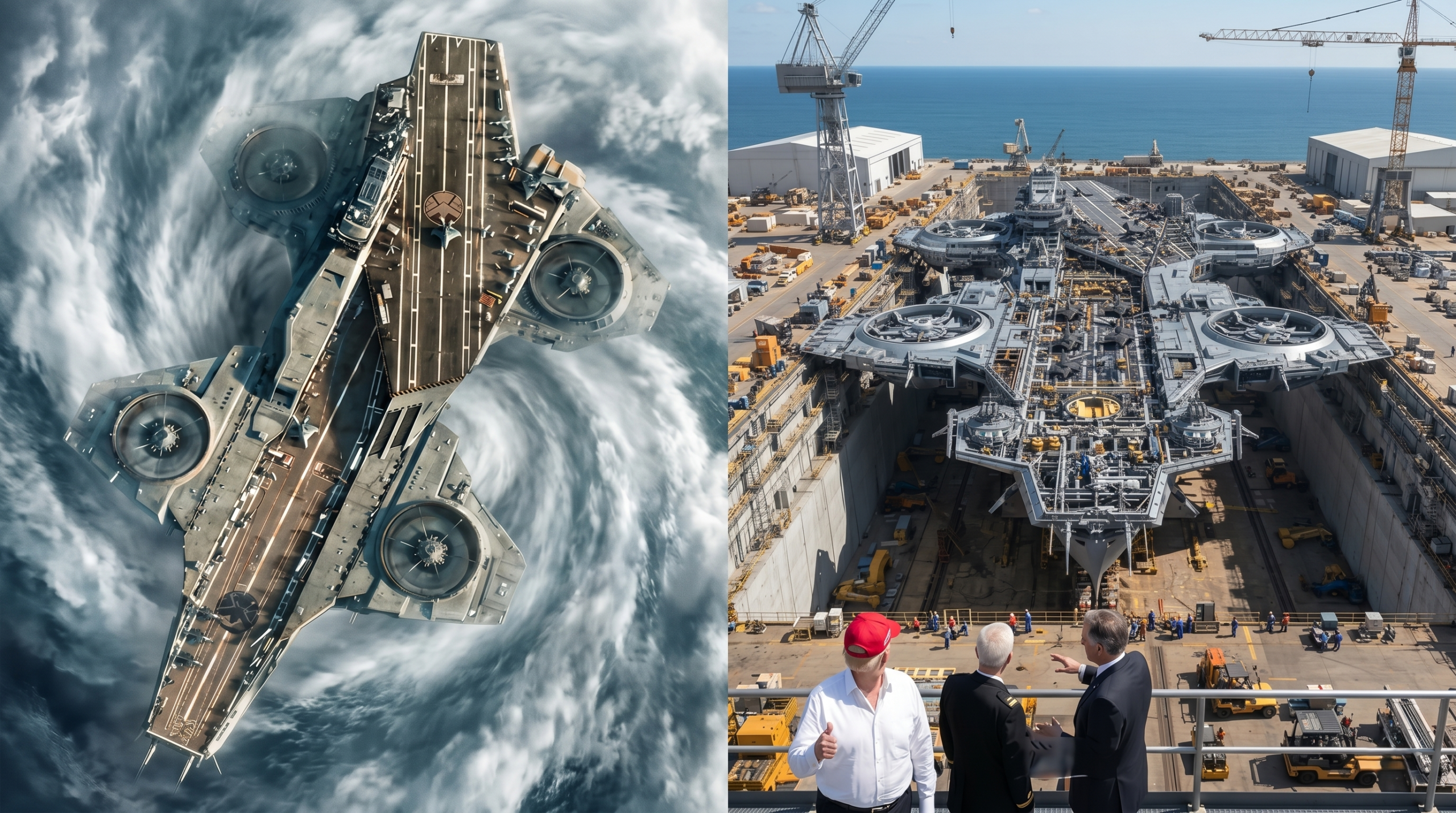
For decades, rumors have circulated about America’s next generation of military platforms — enormous aircraft carriers enhanced by AI-assisted warfare systems, autonomous drone coordination, directed-energy defenses, quantum-secure communications, and battlefield networks so advanced they resemble science fiction more than traditional naval engineering.
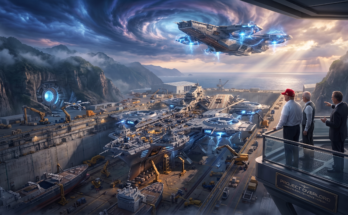
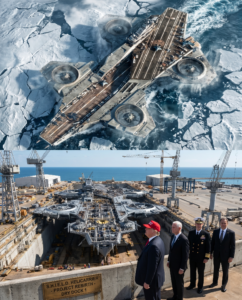
Some images appearing online show futuristic warships unlike anything currently operational: massive floating fortresses carrying drone swarms, electromagnetic launch systems, stealth architecture, and vertical-lift aircraft integrated into a single intelligent combat ecosystem.
While many of these dramatic visuals are conceptual or speculative, they reflect something very real:
The United States remains the global leader in advanced military technological development.
And the reasons are deeply scientific, industrial, economic, and historical.
An aircraft carrier itself is already one of the most complex machines humanity has ever created. A modern U.S. supercarrier is not simply a ship. It is a floating city, nuclear power station, airport, command center, missile platform, radar network, and strategic symbol combined into a single structure operating in some of the harshest environments on Earth.
The USS Gerald R. Ford represents the most advanced operational aircraft carrier currently built by humanity. Its technological sophistication demonstrates why American military engineering continues to dominate globally.
Unlike older carriers, the Ford-class uses electromagnetic catapult systems rather than traditional steam launch mechanisms. This technology, known as EMALS, uses electromagnetic force to launch aircraft more efficiently, with greater precision and reduced mechanical stress. Scientifically, it represents a massive leap in naval aviation engineering because it allows smoother acceleration profiles and supports future aircraft designs, including potentially autonomous combat drones.
The ship also integrates advanced nuclear reactors capable of generating significantly more electrical power than previous carriers.
Why does this matter?
Because future warfare increasingly depends on energy.
Directed-energy weapons, AI computation systems, high-powered radar arrays, electronic warfare systems, and electromagnetic defense platforms require enormous electrical capacity. The next era of naval warfare may depend less on ammunition and more on power generation and data processing.
This is where the rumors surrounding futuristic American carriers become scientifically fascinating.
Military analysts increasingly believe future U.S. naval doctrine will combine human decision-making with AI-supported battlefield coordination on unprecedented levels. Aircraft carriers may evolve into floating artificial intelligence hubs capable of controlling autonomous drones across air, sea, underwater, and even orbital environments simultaneously.
This shift mirrors a larger historical transformation.
In the 12th century, battlefield strategy depended on visible formations, cavalry movement, terrain awareness, and human communication limited by distance and time. Commanders relied on banners, horns, horseback messengers, and direct visual coordination.
Today, modern military systems process battlefield information faster than any medieval commander could possibly imagine.
Satellites track global movement in real time.
AI systems analyze surveillance data instantly.
Hypersonic missiles travel faster than sound itself.
Cyberwarfare can disable infrastructure without firing a single bullet.
Drones perform reconnaissance, targeting, and attack missions remotely across enormous distances.
The battlefield has become computational.
And the United States leads much of this transformation because it possesses something no rival fully matches:
The combination of scientific innovation, industrial scale, economic power, military experience, and global technological infrastructure operating together simultaneously.
This dominance did not appear overnight.
America’s rise in military technology emerged from decades of research institutions, engineering culture, private industry collaboration, and scientific investment accelerated dramatically during World War II and the Cold War.
Projects like the Apollo 11 Moon Landing demonstrated that American technological capability extended beyond warfare into the mastery of entirely new scientific frontiers.
The same nation that placed humans on the Moon also developed stealth aircraft decades ahead of competitors, created the internet through defense research networks, pioneered GPS systems, and built advanced nuclear submarines capable of remaining underwater for months.
Modern American military dominance is therefore not based on one machine.
It is based on ecosystems of innovation.
The United States operates the world’s most advanced stealth bomber fleet with the Northrop Grumman B-2 Spirit and the emerging Northrop Grumman B-21 Raider.
It fields fifth-generation stealth fighters like the Lockheed Martin F-22 Raptor and Lockheed Martin F-35 Lightning II.
Its naval forces include nuclear-powered submarines considered among the quietest and deadliest ever constructed.
Its space capabilities integrate military surveillance, missile detection, and global communication networks at planetary scale.
Its defense industry collaborates directly with leading AI companies, aerospace engineers, semiconductor manufacturers, robotics researchers, and quantum computing laboratories.
No other nation currently combines all these domains at equivalent scale simultaneously.
This does not mean rivals are weak.
China has advanced rapidly.
Russia maintains formidable strategic capabilities.
Other nations continue developing sophisticated weapons systems.
But the United States remains unique in one critical way:
It does not merely build weapons.
It builds technological environments where entire categories of future warfare are invented first.
That distinction matters enormously.
For example, stealth technology itself required revolutionary breakthroughs in radar physics, computational modeling, material science, thermal signature management, and aerodynamic design. Hypersonic research requires mastery of plasma effects, extreme thermal resistance, and advanced propulsion systems operating at speeds where atmospheric friction becomes scientifically brutal.
Artificial intelligence integration introduces another entirely new frontier.
Future aircraft carriers may not simply launch aircraft.
They may coordinate intelligent drone swarms capable of autonomous reconnaissance, electronic warfare, missile interception, underwater detection, and strategic attack operations simultaneously.
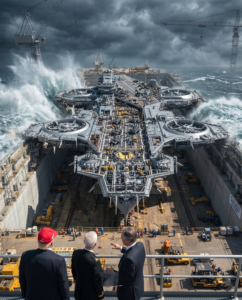
Imagine hundreds of interconnected autonomous systems sharing battlefield information instantly across oceanic distances while human commanders oversee strategic decisions from AI-enhanced command centers.
That future is no longer fantasy.
It is actively being researched.
And America’s unmatched advantage lies not only in possessing advanced machines, but in possessing the scientific institutions capable of continuously creating the next generation of them.
This includes organizations like DARPA, whose experimental programs have repeatedly shaped global technological history. Technologies once considered impossible — stealth systems, autonomous vehicles, advanced robotics, precision-guided weapons, and early internet architecture — often originated from American research ecosystems before transforming civilian civilization itself.
Historically, military innovation repeatedly spills into civilian life.
GPS became essential for global navigation.
The internet transformed communication worldwide.
Satellite systems revolutionized weather forecasting, logistics, and global commerce.
AI systems initially developed for defense increasingly influence medicine, transportation, manufacturing, and scientific research.
This is why military technology matters beyond war itself.
It often shapes the future of civilization.
And perhaps that is the deeper meaning behind the rumors surrounding futuristic American carriers.
People are not merely fascinated by giant warships.
They are witnessing the visible edge of humanity’s next technological age.
An age where AI and humans operate together.
An age where naval fleets become intelligent networks.
An age where warfare depends less on raw numbers and more on information dominance, computational speed, autonomous coordination, and scientific superiority.
The mindset of warfare has completely transformed since the medieval world.
In the 12th century, strength meant physical force.
In the 21st century, strength increasingly means technological intelligence.
And right now, no nation on Earth has invested more deeply into that reality than the United States.
Because modern power is no longer measured only by soldiers or weapons.
It is measured by who controls the future before the rest of the world even sees it coming.