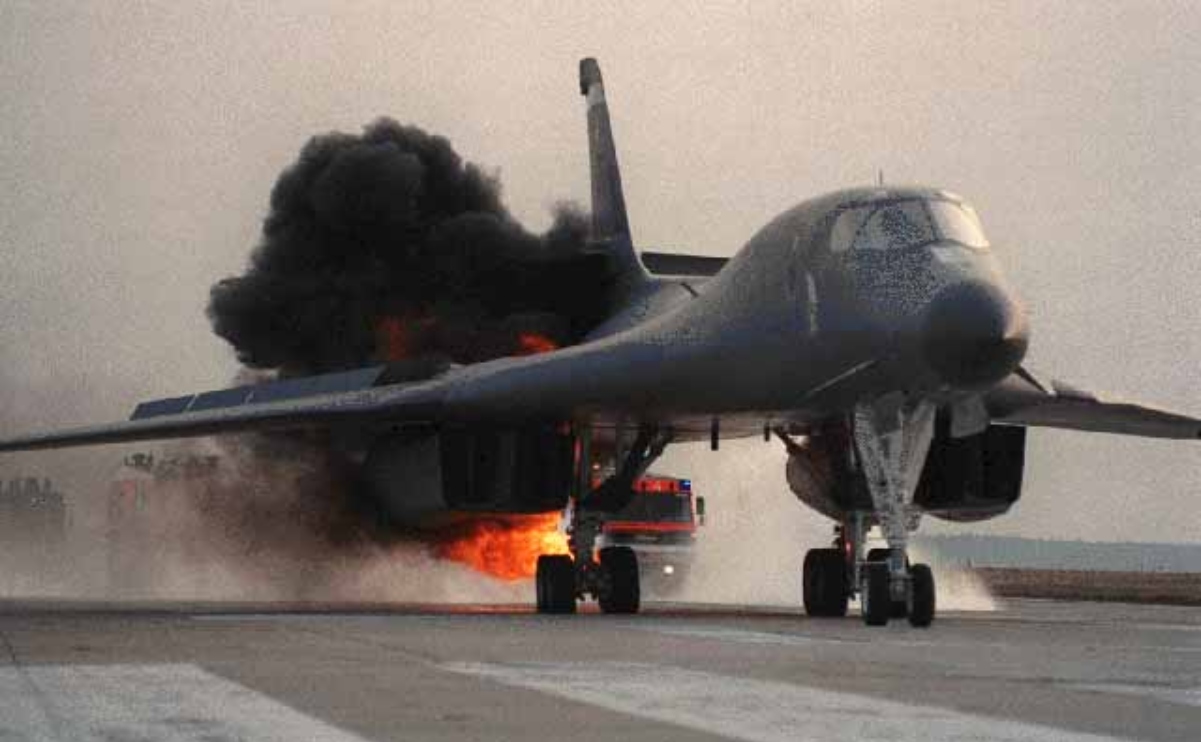
On October 4, 1989, a U.S. Air Force B-1B Lancer faced the kind of emergency that turns a routine training mission into a test of nerve, skill, and aircraft design.
The bomber had taken off from Dyess Air Force Base, Texas.
It was supposed to be a normal training flight.
Four crew members were on board.
You May Also Like

The aircraft was one of America’s most powerful long-range bombers, known by its nickname: the Bone.
Sleek.
Fast.
Massive.
Capable of flying low, hard, and far.
But three hours into the mission, something went wrong.
The crew discovered that the nose landing gear would not extend.
For any aircraft, that is serious.
For a heavy bomber like the B-1B, it is a nightmare.
A bomber can fly without its nose wheel down.
But eventually, it has to land.
And when a bomber lands with no nose gear, the question becomes terrifyingly simple:
Can the crew keep the aircraft alive long enough to stop?
A Routine Flight Turns Dangerous
The B-1B Lancer was designed to be fast and powerful.
It was not a small aircraft that could simply float onto a runway and stop easily.
It was a giant swing-wing bomber with four engines, a long fuselage, and tremendous weight.
When the crew realized the nose landing gear was not coming down, the mission changed instantly.
Training was over.
Emergency management began.
Inside the cockpit, the aircrew had to stay calm.
There was no room for panic.
There was no room for guessing.
Every checklist mattered.
Every system mattered.
Every decision could determine whether the aircraft would be repaired later—or destroyed in a fireball.
The crew worked the problem for hours.
They tried to troubleshoot the landing gear issue.
They ran procedures.
They coordinated with ground controllers.
They evaluated fuel, airspeed, aircraft behavior, emergency options, and landing locations.
But after hours of effort, the nose gear still would not extend.
The bomber remained flyable.
But it could not land normally.
Why Edwards AFB Became the Best Option
The Air Force made a critical decision.
The aircraft would not attempt a conventional landing at an ordinary runway.
Instead, it would head to Edwards Air Force Base in California.
There was a very important reason.
Edwards is not just another base.
It is one of the most famous flight test locations in the world.
And beside its runways lies Rogers Dry Lake, a huge natural dry lake bed that has served for decades as a safety net for experimental aircraft, test flights, and emergency landings.
The surface is broad.
Flat.
Open.
Forgiving compared with a narrow paved runway.
For an aircraft with landing gear trouble, that space can be the difference between controlled survival and disaster.
The B-1B crew needed distance.
They needed room.
They needed a surface where the aircraft could slide without immediately tearing itself apart.
Rogers Dry Lake offered the best chance.
The Longest Hours in the Air
The situation dragged on for hours.
Imagine being inside that cockpit.
You know the nose gear will not come down.
You know the aircraft is too valuable to abandon unless absolutely necessary.
You know ejection is possible, but not simple.
You know the bomber beneath you is carrying fuel, mass, and momentum.
You know the world is waiting to see whether you can bring it home.
For roughly nine more hours after discovering the problem, the crew kept working.
They had time, but time can be cruel in an emergency.
Every minute gives you another chance to solve the problem.
Every minute also gives fear more room to grow.
The crew had to manage fuel.
They had to manage aircraft weight.
They had to coordinate with command and controllers.
They had to think through landing attitude.
How fast?
How high?
How long to hold the nose up?
When would the front of the aircraft drop?
Would the fuselage dig in?
Would the aircraft veer?
Would sparks ignite fuel?
Would the crew have to eject at the last second?
There are emergencies where a pilot reacts instantly.
This was different.
This was a slow emergency.
A waiting emergency.
A thinking emergency.
And that can be even harder.
The Final Approach
When the B-1B finally approached Edwards, the crew had one task:
Put the bomber down as gently as possible.
The main landing gear would carry the initial touchdown.
The missing piece was the nose gear.
That meant the crew had to keep the nose elevated as long as possible after landing.
If the nose dropped too quickly, the aircraft could dig into the surface, break apart, or lose control.
If the touchdown was too hard, structural damage could become catastrophic.
If the aircraft drifted or yawed, the bomber might slide sideways.
The dry lake bed waited below.
Wide.
Flat.
Dusty.
Silent.
The B-1B came in on its main gear.
The crew guided it down carefully.
The bomber touched.
The main wheels met the lake bed.
For a brief moment, the giant aircraft kept its nose in the air.
That moment mattered.
The crew held the nose up for roughly half a minute, bleeding off speed and reducing the violence of what had to happen next.
Then gravity won.
The front of the bomber slowly settled.
The nose contacted the dry lake surface.
Dust exploded around the aircraft.
The B-1B began to slide.
The Slide
A massive plume of dust rose behind the bomber.
The aircraft scraped across the lake bed, throwing dirt and clay into the air.
From a distance, it looked almost unreal.
A huge strategic bomber, nose down, sliding across the desert floor.
But inside the aircraft, nothing about it was cinematic.
It was control versus chaos.
The crew had to ride out the landing.
They had to keep the aircraft aligned.
They had to prevent a violent turn.
They had to avoid fire.
They had to stay with the bomber until it stopped—or eject if stopping became impossible.
The B-1B continued sliding.
Dust swallowed the aircraft.
Then, slowly, the movement died.
The bomber stopped.
No explosion.
No fatal crash.
No ejection.
No lost crew.
All four crew members walked away.
The aircraft was damaged, but not destroyed.
For a bomber with a failed nose gear, that was a remarkable outcome.
Why the Landing Was So Impressive
Emergency landings are not just about bravery.
They are about discipline.
The crew had to avoid panic for hours.
They had to trust procedures.
They had to trust each other.
They had to trust the aircraft.
They had to make one of the hardest choices in aviation:
Do we eject and lose the bomber?
Or do we attempt to land and accept the risk?
Ejection is not failure.
In many cases, ejection is survival.
But in this case, the crew believed they still had a chance to save both themselves and the aircraft.
They were right.
The B-1B’s long fuselage and the dry lake bed helped make the controlled slide possible.
But the aircraft did not save itself.
The crew did.
They managed energy.
They managed attitude.
They managed the landing.
They kept the bomber under control when one of its most important landing systems failed.
That is why the incident remains so memorable in military aviation history.
A Bomber Built for Power, Tested by Failure
The B-1B Lancer is one of the most recognizable bombers ever flown by the U.S. Air Force.
Its variable-sweep wings give it a dramatic appearance.
Its four engines give it speed and reach.
Its low-level penetration design made it a major Cold War-era symbol of American airpower.
But even the most powerful aircraft can be humbled by a landing gear failure.
That is the lesson of this story.
A bomber may be designed for strategic missions.
It may carry advanced avionics.
It may fly at high speed across long distances.
But at the end of the flight, it still depends on wheels, hydraulics, checklists, and human judgment.
The 1989 emergency showed that the B-1B was not only a powerful bomber.
It was also an aircraft that could survive a brutal situation when handled by a disciplined crew.
The Human Side
Military aviation stories often focus on machines.
The bomber.
The engines.
The landing gear.
The runway.
The lake bed.
But the human side is what makes this incident powerful.
Four people were inside that aircraft.
They had families.
Careers.
Responsibilities.
Fear.
Training.
They knew the aircraft might be lost.
They knew the landing could go badly.
They knew that when the nose came down, they would be committed.
There would be no second chance.
And still, they stayed with it.
They did not panic.
They did not rush.
They did not turn a difficult emergency into a disaster.
They brought the bomber down.
They walked away.
And the aircraft eventually returned to service.
Why Rogers Dry Lake Matters
Rogers Dry Lake is more than a flat desert surface.
It is part of the history of American flight testing.
For decades, Edwards AFB and its dry lake beds have supported some of the most important aircraft testing in U.S. aviation history.
Aircraft that push limits need room.
Emergency aircraft need options.
Runways are long, but they are still narrow.
A dry lake bed gives pilots something rare in aviation:
space.
Space to correct.
Space to slide.
Space to survive.
That is why sending the B-1B to Edwards was such a smart decision.
It gave the crew the best possible environment for the worst possible landing condition.
The Aircraft Was Repaired
One of the most important parts of the story is what happened after the dust settled.
The B-1B was not written off.
It was repaired.
That matters.
The emergency landing caused only limited damage compared with what could have happened on a normal runway or in an uncontrolled crash.
A bomber that could have been destroyed was saved.
A crew that could have been forced to eject stayed with the aircraft and survived.
The result was a rare kind of aviation victory:
not a victory in combat, but a victory over disaster.
Why the Story Still Connects Today
People remember dramatic aviation moments because they reveal something deeper than machines.
They show preparation under pressure.
They show calm in danger.
They show how training becomes instinct when the emergency is real.
The B-1B’s 1989 landing on Rogers Dry Lake remains powerful because it was not a perfect flight.
It was a flawed flight saved by skill.
A machine failed.
A crew responded.
A disaster was avoided.
That is the kind of story aviation people never forget.
Final Reflection
On October 4, 1989, a B-1B Lancer took off on a routine training mission and became the center of a long, tense emergency.
The nose landing gear would not extend.
The crew worked the problem for hours.
The Air Force sent the bomber to Edwards AFB.
Rogers Dry Lake became the runway of last resort.
The crew touched down on the main gear, held the nose up, let it settle, and rode the massive bomber through a dust-filled slide until it stopped.
No one died.
No one ejected.
The aircraft survived.
The crew walked away.
That is why this incident still deserves to be remembered.
Not because everything went right.
But because when something went terribly wrong, the crew stayed calm long enough to save lives and save the aircraft.
In military aviation, heroism does not always look like combat.
Sometimes it looks like patience.
Checklist discipline.
A steady hand.
A dry lake bed.
And a bomber sliding through dust instead of burning on a runway.
THE END.