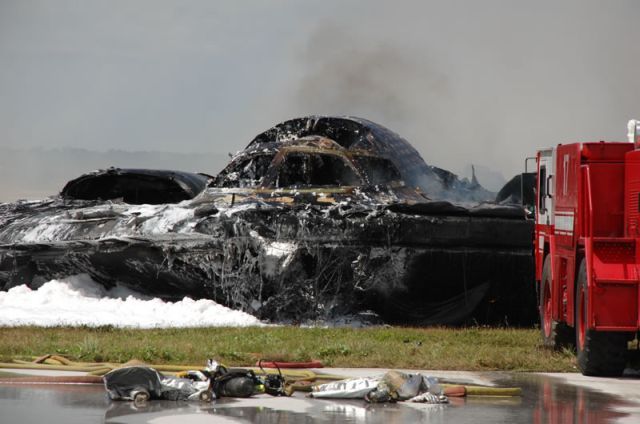
On February 23, 2008, one of the most advanced aircraft ever built rolled down the runway at Andersen Air Force Base in Guam.
It was not an ordinary bomber.
It was the B-2 Spirit.
A stealth aircraft shaped like a dark flying wing, built to slip through enemy defenses, cross continents, and strike targets with terrifying precision.
You May Also Like

Its name was Spirit of Kansas.
Its tail number was 89-0127.
Its price tag was about $1.4 billion, and even more when adjusted for inflation.
To the outside world, the B-2 looked almost untouchable.
Silent.
Mysterious.
Powerful.
But that morning in Guam, the aircraft’s fate was not decided by enemy radar, missiles, or combat.
It was decided by something shockingly simple.
Water.
Rainwater.
Moisture trapped inside small sensors helped bring down one of the most expensive aircraft in U.S. Air Force history.
And the entire disaster unfolded in seconds.
A Routine Takeoff That Turned Into Disaster
The Spirit of Kansas had been deployed to Andersen Air Force Base as part of America’s continuous bomber presence in the Pacific.
For the crew, the mission should have been routine.
The aircraft was preparing to depart Guam and return to Whiteman Air Force Base in Missouri, the home of the B-2 fleet.
Inside the cockpit were two experienced airmen:
Major Ryan Link.
Captain Justin Grieve.
They were flying one of the rarest aircraft in the world.
The B-2 is not like a normal bomber. It is a flying wing, controlled by advanced computers and air-data systems. It depends heavily on accurate sensor information to maintain stable flight.
Every number matters.
Airspeed.
Altitude.
Angle of attack.
Aircraft attitude.
Flight control computers must know what the aircraft is doing every fraction of a second.
But on this day, the aircraft’s computers were about to receive a lie.
The Hidden Problem Inside the Skin
Before takeoff, the B-2’s air-data system relied on small skin-flush sensors called Port Transducer Units, or PTUs.
These sensors help measure pressure data used to calculate key flight information.
The problem began before the aircraft even moved.
Heavy rain had fallen in Guam.
That rain left moisture trapped inside the aircraft’s sensor system.
From the outside, the bomber still looked ready.
No obvious mechanical failure.
No engine explosion.
No dramatic warning.
But inside the sensor system, moisture had created a dangerous condition.
During pre-flight air-data calibration, the trapped water distorted the readings.
The aircraft’s system calculated incorrect airspeed and angle-of-attack data.
In simple words, the bomber’s computers were being told the aircraft was positioned differently than it really was.
And once a computer believes bad data, even a billion-dollar aircraft can become helpless.
The Moment Everything Went Wrong
As the B-2 accelerated down the runway, the crew believed they were flying a normal departure.
But the aircraft was already operating with bad information.
The system thought the bomber’s nose was lower than it really was.
The flight control computers believed the aircraft was in a dangerous condition.
Then, just after takeoff, the B-2 suddenly pitched up.
Not slightly.
Not gently.
The aircraft made a sudden, uncommanded nose-high movement of about 30 degrees.
For a flying wing like the B-2, that was catastrophic.
The bomber rose too sharply.
The airspeed was not enough.
The drag increased.
The aircraft entered an unrecoverable stall.
Inside the cockpit, the pilots were now fighting a machine that was reacting to false data.
The situation went from controlled takeoff to life-or-death emergency almost instantly.
One moment, the Spirit of Kansas was leaving Guam.
The next moment, it was falling back toward the runway.
“Eject”
The left wingtip struck the ground.
The massive aircraft began to tumble.
The runway became chaos.
Metal scraped.
Fuel ignited.
The stealth bomber broke apart and burned.
For the pilots, there was no time left to save the aircraft.
Only one decision remained.
Eject.
Major Ryan Link and Captain Justin Grieve escaped just as the aircraft made contact with the ground.
It was a miracle they survived.
The bomber did not.
The Spirit of Kansas became the first operational B-2 ever lost in a crash.
A $1.4 billion aircraft had been destroyed.
Not by war.
Not by enemy action.
Not by a missile.
But by distorted sensor data caused by moisture.
Why This Crash Shocked the Air Force
The B-2 Spirit is one of the most complex aircraft ever developed.
Its stealth coating, flying-wing design, and advanced flight control systems require careful maintenance and controlled operating conditions.
The aircraft was designed for extreme missions, but it also required extreme care.
The crash in Guam revealed a dangerous truth:
Even the most advanced aircraft in the world can be vulnerable when small environmental problems enter critical systems.
Guam is hot.
Humid.
Tropical.
Heavy rain is common.
For aircraft like the B-2, that environment can create serious maintenance challenges.
The B-2 fleet often requires climate-controlled hangars, careful inspections, and strict handling procedures to protect its stealth materials and sensitive systems.
The Spirit of Kansas crash showed why those procedures matter.
A tiny hidden problem can become a billion-dollar disaster.
The Official Finding
The Air Force investigation did not blame enemy action.
It did not focus on a dramatic mechanical failure.
It did not say the pilots caused the crash.
Instead, the investigation pointed to distorted air-data information.
The aircraft’s flight control computers received incorrect data, causing the bomber to respond in a way that made normal flight impossible.
This made the accident especially shocking.
The aircraft was not destroyed because it lacked power.
It was not destroyed because the crew ignored danger.
It was destroyed because the aircraft believed something false about its own flight condition.
That is the terrifying part.
The B-2 did what it was programmed to do based on the information it received.
But the information was wrong.
A Small Sensor, a Massive Consequence
Military aviation history is filled with examples of small failures creating enormous consequences.
A loose bolt.
A blocked tube.
A missed warning.
A damaged wire.
A wrong reading.
In the case of the Spirit of Kansas, the chain began with moisture trapped inside sensor units.
That moisture distorted data.
The distorted data misled the flight control computers.
The computers commanded a dangerous pitch-up.
The pitch-up caused a stall.
The stall led to impact.
The impact destroyed the aircraft.
This is why aviation safety experts often say accidents rarely happen from one thing alone.
They happen from a chain.
And when the chain reaches the cockpit at high speed, there may be no time left to break it.
The Human Side of the Crash
It is easy to focus on the money.
$1.4 billion.
One of the most expensive aircraft losses in history.
A stealth bomber destroyed on takeoff.
But the human side matters too.
Two pilots were inside that aircraft.
They had only seconds to react.
They had to trust their training, their instincts, and the ejection system.
They survived a crash that could easily have become fatal.
For the Air Force, losing the aircraft was painful.
But losing the crew would have been far worse.
Their survival became one of the few bright points in an otherwise devastating accident.
What Changed After the Crash
The Spirit of Kansas crash forced the Air Force to look closely at B-2 procedures, especially at forward-operating locations with difficult weather conditions.
The incident highlighted the importance of:
Strict sensor inspections.
Moisture prevention.
Climate-controlled aircraft protection.
Careful pre-flight calibration review.
Better awareness of tropical humidity risks.
The crash also reminded military planners that advanced aircraft are not just weapons.
They are systems.
And systems must be protected from the environment as much as from enemies.
A stealth bomber can defeat radar.
But it still has to survive rain, humidity, maintenance stress, and bad data.
Why Guam Matters
Andersen Air Force Base is strategically important.
From Guam, U.S. bombers can project power across the Indo-Pacific region.
That makes the base valuable for deterrence, readiness, and rapid response.
But Guam’s environment also creates challenges.
Heat.
Salt air.
Heavy rain.
Humidity.
Storms.
Aircraft deployed there must be maintained under conditions far different from the climate-controlled environments they may enjoy at home bases.
The B-2’s crash became a reminder that forward deployment brings risk.
Not just combat risk.
Operational risk.
Environmental risk.
Maintenance risk.
Sensor risk.
When the world’s most advanced aircraft operate far from home, every detail matters.
The Bigger Lesson for the B-21 Raider
Today, the B-2’s successor, the B-21 Raider, is being developed for the next generation of stealth bombing.
The B-21 is expected to be more maintainable, more adaptable, and better suited for modern operational demands.
The Spirit of Kansas crash is one reason those qualities matter.
Future stealth bombers must not only be hard for enemies to detect.
They must also be easier to maintain in real-world conditions.
They must operate from more locations.
They must survive humidity, rain, dust, heat, and long deployments.
The lesson from Guam is simple:
Stealth is not enough.
Reliability matters.
Maintainability matters.
Sensor protection matters.
Because a warplane can only complete its mission if it can safely leave the runway.
Why the Crash Still Matters
More than a decade later, the destruction of the Spirit of Kansas still stands as one of the most dramatic reminders in military aviation:
Advanced technology is powerful, but it is never invincible.
The B-2 represented the peak of stealth bomber design.
It could fly across the world.
It could penetrate defended airspace.
It could carry devastating weapons.
But it was still dependent on tiny sensors giving accurate information at the right time.
When those sensors were confused, the aircraft could not save itself.
That is the hidden danger of modern aviation.
The smarter the aircraft becomes, the more important the data becomes.
Bad data can be as dangerous as enemy fire.
Final Reflection
The crash of the B-2 Spirit of Kansas was not just a story about a destroyed bomber.
It was a warning.
A warning that even the most expensive aircraft in the world can be defeated by a small hidden flaw.
A warning that maintenance environments matter.
A warning that computers are only as reliable as the data they receive.
A warning that stealth aircraft need protection long before they enter enemy airspace.
The Spirit of Kansas was designed to survive the world’s most dangerous battlefields.
But on February 23, 2008, it was destroyed seconds after takeoff by a chain of events that began with rainwater.
The pilots survived.
The aircraft did not.
And the lesson remains powerful:
In aviation, no detail is small.
Not a sensor.
Not a drop of water.
Not a warning sign.
Because sometimes, the difference between a perfect takeoff and a billion-dollar fireball is hidden inside the smallest part of the machine.
THE END.