I had just become a brigadier general in the United States Air Force.
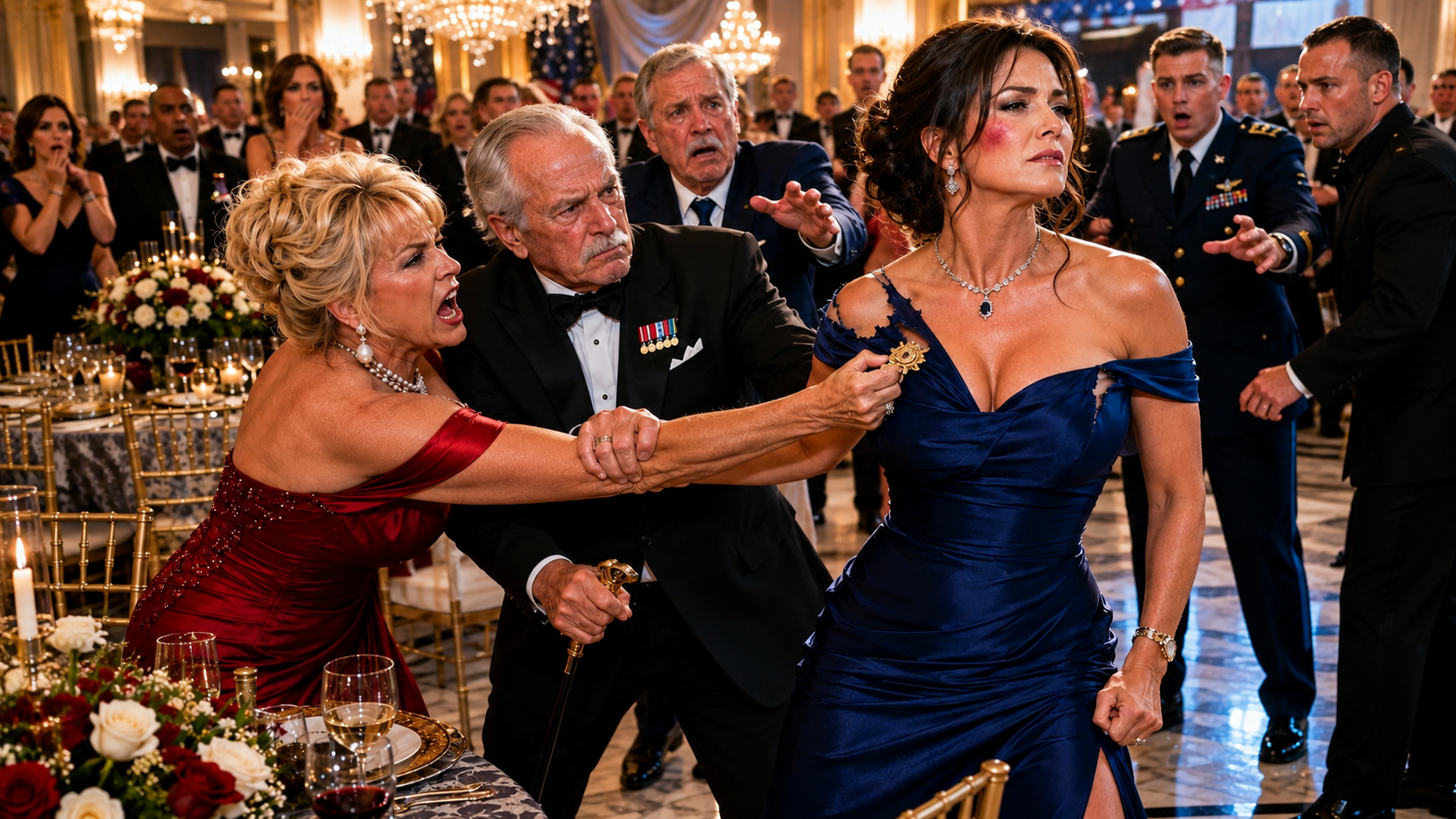
Two hundred guests were standing in a glittering ballroom, applauding my promotion, my service, and my rise from a mechanic’s daughter to one of the highest ranks in the room.
Then my stepmother stood up.
She grabbed the gold pin on my chest.
You May Also Like


The same pin my late mother had left me.
The same pin my father told me to wear whenever I needed courage.
Then she hissed loud enough for everyone to hear:
“Take it off. You don’t get to wear another woman’s treasure and pretend you belong here.”
Before I could answer, she slapped me.
The room went silent.
But then an old veteran with a cane stood up from the back of the ballroom.
His voice shook, but his words cut through everyone.
“Ma’am,” he said, pointing at the pin, “you have no idea what that woman’s family sacrificed for that gold.”
And that was the night my promotion gala became the night a family lie finally died.
Full Story
My name is Caroline Mercer.
I was not born into power.
I was not raised in a mansion.
I did not grow up with polished silverware, private tutors, or a family name that opened doors before I even knocked.
I grew up in Dayton, Ohio, in a small house that smelled like motor oil, black coffee, old books, and laundry soap.
My father, Walter Mercer, was an aircraft mechanic.
His hands were always rough.
His fingernails always carried traces of grease, no matter how hard he scrubbed them.
To most people, he was just a quiet man who repaired engines.
To me, he was the first hero I ever knew.
He could listen to an aircraft engine for three seconds and tell what was wrong.
He could rebuild a carburetor in the rain.
He could fix a broken kitchen chair, a cracked bike chain, or a crying little girl who missed her mother.
My mother, Elaine Mercer, died when I was eight.
I remember pieces of her.
Her perfume.
Her laugh.
The way she hummed while cooking.
The way she kissed my forehead before I went to school.
And the gold pin.
It was small, elegant, and shaped like a pair of wings wrapped around a tiny star.
She wore it on special days.
Church anniversaries.
Family dinners.
School ceremonies.
Once, when I asked her why she wore it, she knelt in front of me and touched my cheek.
“This belongs to people who had courage before us,” she said. “One day, when you need courage, it will belong to you too.”
Three months later, she was gone.
For years, I thought the pin was only jewelry.
Then, on the morning I left for officer training, my father called me into the kitchen.
He had already packed my duffel bag into his old truck.
The sun was barely up.
He stood near the stove, holding a small blue velvet box.
“Caroline,” he said.
His voice was different that morning.
Softer.
He opened the box.
Inside was my mother’s gold pin.
I stared at it.
“Dad…”
He placed it in my hand.
“Your mother wore this when she needed courage.”
My throat tightened.
“I can’t take this.”
“Yes, you can.”
“What if I lose it?”
“Then you’ll find it.”
“What if I don’t deserve it?”
His eyes filled with tears.
“Baby girl, you deserved it before you ever put on a uniform.”
I closed my fingers around the pin.
That was the last morning I felt like a child.
After that, life became a climb.
Training.
Deployments.
Late nights.
Desert heat.
Long flights.
Broken sleep.
Rooms where men twice my age called me “sweetheart” before learning I was their commander.
I learned to speak less and mean more.
I learned to stand straight when people wanted me small.
I learned that respect is not always given.
Sometimes, it is forced into the room by discipline, excellence, and silence.
Years passed.
I earned my commands.
I survived investigations.
I buried friends.
I made mistakes and owned them.
I won battles no one saw.
And finally, at forty-eight years old, I pinned on my first star.
Brigadier General Caroline Mercer.
The mechanic’s daughter.
The motherless girl from Dayton.
The woman nobody expected.
The promotion ceremony happened earlier that day.
But that evening, the Heritage Armed Forces Gala in Arlington held a special dinner in my honor.
The ballroom was beautiful.
Crystal chandeliers.
White tablecloths.
Gold chairs.
A string quartet playing near the entrance.
Veterans in decorated jackets.
Officers in dress uniforms.
Donors.
Families.
Young cadets looking nervous and inspired.
For the first time in years, I allowed myself to feel proud.
My father sat at the front table in a navy-blue suit.
He looked older.
Thinner.
His hair had gone fully white.
But when I looked at him, he smiled with the same proud eyes he had when I graduated from high school.
Beside him sat Lynn Prescott Mercer.
My stepmother.
My father married Lynn when I was sixteen.
She entered our lives wearing soft colors, carrying casseroles, and speaking in a voice that sounded gentle until the door closed.
In public, she called me “our Caroline.”
In private, she called me “your father’s little shadow.”
She hated my mother without ever having to compete with her alive.
She hated the way my father kept Elaine’s photographs.
She hated the way he said my mother’s name.
She hated the gold pin most of all.
“You’re still wearing that old thing?” she had asked me once when I came home from my first overseas assignment.
“It was Mom’s.”
Lynn smiled.
“Yes. I know. That’s the problem.”
I never forgot that.
At the gala, I wore a deep navy evening gown because the event was formal, not military-only.
Pinned carefully over my heart was my mother’s gold pin.
My aide, Captain Reese, noticed it before the ceremony.
“That’s beautiful, ma’am,” she said.
“It was my mother’s.”
“She must be proud.”
I looked across the room at my father.
“I hope so.”
When I gave my speech, I did not talk about myself too much.
I talked about mechanics.
Crew chiefs.
Families waiting at home.
Young airmen who believed their work was invisible.
I looked directly at my father and said:
“Before I ever understood rank, I understood service by watching my father come home with grease on his hands and dignity in his silence.”
The room applauded.
My father wiped his eyes.
Even Lynn smiled.
But her smile did not reach her eyes.
Ten minutes later, everything changed.
I was standing near our table, speaking with a retired colonel and a young captain, when Lynn suddenly rose from her chair.
“Caroline,” she said.
Her voice was sharp.
I turned.
“Yes?”
She stepped closer.
Her eyes were fixed on the pin.
“Take that off.”
The colonel stopped talking.
My father looked up.
“Lynn,” he said quietly.
She ignored him.
“I said take it off.”
I lowered my voice.
“This is not the place.”
She laughed once.
Cold.
“Oh, now you care about the place? Now you care about appearances?”
“Lynn, sit down.”
“No.”
She moved fast.
Before I could step back, her fingers closed around the gold pin on my chest.
Then she yanked.
Fabric tore.
The sound was small, but in that room it felt like thunder.
A sharp rip cut through the music.
My gown pulled hard against my shoulder.
The clasp scraped my skin.
Gasps rose around us.
I grabbed her wrist.
“Let go.”
Her face twisted.
“Give it back.”
“It’s mine.”
“No,” she hissed. “It was Elaine’s. And you don’t get to dress up in someone else’s treasure and pretend you belong here.”
My father stood up so fast his chair nearly fell.
“Lynn, stop!”
She shoved him back with her elbow.
“Don’t defend her, Walt. You always defend her.”
The ballroom began to quiet.
The quartet stopped playing.
A waiter froze beside the table with a tray of glasses.
A young captain lifted her phone, then lowered it, unsure whether to record or intervene.
I kept my voice steady.
“Take your hand off me.”
Lynn leaned closer.
“Or what, General? You’ll court-martial your own family?”
“Lynn.”
“You send money. You give orders. You fly in once a year wearing medals and acting like a queen. Everybody praises Caroline. Everybody bows to Caroline.”
“I never asked anyone to bow.”
“No. You just expect it.”
My father reached for her arm.
“Lynn, please.”
She snapped at him.
“Stay out of this.”
Then she slapped me.
The sound cracked across the ballroom.
For one second, no one moved.
My cheek burned.
My father whispered, “Caroline…”
I raised one hand to stop him.
Not because I was calm.
Because I knew if my father tried to step between us and stumbled, Lynn would become the victim before the night was over.
Lynn reached for the pin again.
That was when a cane struck the marble floor.
Once.
Hard.
The sound echoed like a judge’s gavel.
An old man in a black tuxedo stepped forward from a nearby table.
He was thin.
Bent with age.
His white hair was combed neatly back.
On his chest, miniature medals caught the chandelier light.
His hand trembled around the cane, but his eyes were fierce.
“Ma’am,” he said, “remove your hands from that woman.”
Lynn turned.
“And who are you?”
The old man came closer.
His gaze dropped to the pin still trembling against my torn dress.
Then he looked at Lynn.
“You have no idea what you just put your hands on.”
My father went pale.
“Harlan?”
The old man turned.
“Hello, Walter.”
The name struck me harder than Lynn’s slap.
Colonel Harlan Briggs.
I had heard that name my entire childhood.
Not often.
Only in fragments.
My father mentioned him when he polished old photographs.
When he opened the cedar box in his bedroom.
When he drank coffee alone after my mother’s funeral.
Harlan had served with my great-uncle Daniel Mercer in Europe.
But I had never met him.
Dad said Harlan did not attend public events anymore.
He said Harlan carried too many ghosts.
Yet there he was.
Standing between me and my stepmother.
Lynn pulled her wrist away.
“This is ridiculous,” she snapped. “You people are all acting like I attacked a national treasure.”
Harlan’s voice hardened.
“You attacked a legacy.”
She rolled her eyes.
“It’s a pin.”
“No,” Harlan said. “It is the last private family honor given after Daniel Mercer died near Saint-Lô in 1944.”
The room went silent.
I looked at my father.
His eyes filled with tears.
Harlan continued.
“Daniel carried three wounded men through machine-gun fire. He went back for a fourth and never returned. That pin was made by the families of the men he saved. It was given to his sister. Then to Elaine. And Elaine wanted Caroline to have it.”
My chest tightened.
I knew my mother’s family had military history.
But I did not know this.
Lynn’s face flushed.
“Well, I didn’t know that.”
My father looked at her.
“Yes, you did.”
His voice was quiet.
But it emptied the room.
Lynn stared at him.
“What?”
“You knew.”
“Walt—”
“You read Elaine’s letter.”
Her mouth opened.
Nothing came out.
My father gripped the back of his chair.
“The blue folder,” he said. “The one in the cedar box.”
“I was cleaning.”
“You were searching.”
“I was your wife.”
“You were jealous of a dead woman.”
A murmur moved through the ballroom.
My aide, Captain Reese, stepped closer.
Two security officers began walking toward us from the west entrance.
I looked at Lynn.
“What letter?”
Lynn folded her arms.
“Don’t start acting innocent.”
My father turned to me.
His face looked broken.
“Your mother wrote a letter before she died.”
I could barely breathe.
“To who?”
“Harlan.”
The old veteran lowered his head.
“She asked me to make sure your father preserved Daniel’s history for you,” Harlan said. “She wanted you to know where you came from. She wanted you to know that courage was not something the military gave you. It was already in your blood.”
My throat tightened.
“I never saw that letter.”
No one spoke.
Then my father looked at Lynn.
That silence was louder than the slap.
I turned to Lynn.
“You hid it?”
She gave a brittle laugh.
“I protected your father.”
“From what?”
“From living in the past.”
“That was my mother.”
“And she was dead.”
My father flinched.
The room seemed to inhale.
I took one step closer.
“Say that again.”
Lynn’s eyes glittered.
“She was dead, Caroline. Dead. But somehow I spent thirty years competing with her. Her pictures. Her pin. Her letters. Her perfect memory. And then there was you.”
“Me?”
“Yes, you. Elaine’s little copy. Elaine’s precious daughter. Every time you walked into the house, he looked at you like she had come back.”
My father’s voice shook.
“That is enough.”
“No, Walt. Let’s finally say it.”
Lynn pointed at me.
“She made you feel guilty for loving me.”
I stared at her.
“I was a child.”
“You were a reminder.”
My father slammed his palm onto the table.
Glasses jumped.
“She was my daughter!”
Lynn froze.
He stepped around the chair.
“My daughter called me. You deleted the messages.”
My head snapped toward him.
“What?”
He looked at me with tears in his eyes.
“I thought you were too busy. I thought you stopped calling.”
My hands went cold.
“Dad, I called every week during my first deployment.”
“I know that now.”
Lynn looked away.
I stared at her.
“You told me he needed space.”
“He did.”
“You told me he was tired.”
“He was.”
“You told me not to upset him with calls from overseas.”
“You always brought stress.”
I felt fifteen years of distance collapse in one moment.
The missed birthdays.
The awkward holidays.
The short phone calls.
The strange silence.
The guilt.
All the times I thought my career had made my father feel abandoned.
All the times I sent money instead of visiting because Lynn told me my presence made him sad.
It was her.
All of it.
My voice dropped.
“You kept us apart.”
Lynn’s chin lifted.
“I managed a difficult family.”
“No,” my father said. “You controlled one.”
Security arrived.
Captain Reese whispered, “Ma’am, do you want her removed?”
Lynn heard it and suddenly changed.
Her shoulders softened.
Her eyes filled.
Her voice became fragile.
“Walt,” she whispered. “Tell them I didn’t mean it.”
My father looked at my torn gown.
Then at my red cheek.
Then at the gold pin shaking against my chest.
“No,” he said. “I should have told the truth years ago.”
Lynn’s face changed.
Fear replaced performance.
“Told what truth?” I asked.
My father closed his eyes.
The old veteran bowed his head.
Lynn whispered, “Walter, don’t.”
My father opened his eyes.
“The night your mother died,” he said, “Lynn was there.”
The ballroom disappeared.
The chandeliers.
The tables.
The officers.
The music.
Everything blurred except my father’s face.
“My mother died in a car accident,” I said slowly.
“Yes.”
“A tire blowout.”
“Yes.”
“Outside Dayton.”
“Yes.”
I swallowed.
“What do you mean Lynn was there?”
Lynn stepped backward.
“This has nothing to do with tonight.”
My father looked like the words were cutting him as they came out.
“Elaine and I were separated for six weeks before the accident.”
I felt my heart drop.
“You never told me that.”
“You were eight.”
“Why were you separated?”
He looked at Lynn.
“I met Lynn at the airfield diner. Elaine saw us talking. She thought there was something between us.”
Lynn snapped, “Because you let her think it.”
My father shook his head.
“There was nothing then.”
“But later there was,” I said.
He looked down.
“After your mother died, Lynn kept coming around. Food. Help. Sympathy. I was drowning, Caroline. I thought she was kind.”
Harlan’s voice was soft.
“Elaine wrote to me two days before the accident. She said she was afraid Lynn wanted more than friendship from your father. She said she was coming home to fight for her marriage.”
I gripped the back of a chair.
“She was coming home?”
My father nodded.
“She called me that morning. She said she wanted to talk. She said she had made a mistake leaving. She said she wanted us to start again.”
Lynn’s voice cracked.
“Stop.”
But my father did not stop.
“She went to the diner first.”
“Why?”
“To confront Lynn.”
The whole table froze.
I turned to Lynn.
“You saw my mother the day she died?”
Lynn’s lips trembled.
“She came at me like a madwoman.”
Harlan’s cane struck the floor again.
“Careful.”
Lynn glared at him.
“She accused me of chasing her husband. She waved that stupid letter in my face. She said Caroline would never grow up in a house where I had any place.”
My father whispered, “You told me you never saw her.”
Lynn’s face went pale.
The words had slipped out before she could stop them.
I stepped closer.
“You lied.”
Lynn shook her head.
“I didn’t cause the accident.”
“No one said you did,” I said.
But Harlan looked at her.
“Did you keep the letter?”
She said nothing.
My father’s voice broke.
“Lynn.”
“I was angry.”
“What did you do?”
“She dropped it.”
“What did you do?”
“She dropped it in the parking lot!”
“And?”
Lynn’s eyes filled, but this time the tears looked real.
“I picked it up.”
My hands curled into fists.
“My mother’s letter?”
“She was dead by the time I heard about the crash.”
“And you kept it?”
“She was going to ruin everything.”
My father staggered back like she had struck him.
“There was nothing to ruin.”
Lynn looked at him with decades of bitterness in her face.
“There was always Elaine. Even dead, there was always Elaine.”
Silence swallowed the ballroom.
Then Harlan reached into the inside pocket of his tuxedo.
His hands shook as he pulled out an old envelope sealed in plastic.
“I came tonight because I knew Caroline would be wearing the pin,” he said. “Walter, I should have given this to you years ago. Elaine mailed me a copy of the same letter. I kept it because I didn’t know how to hand a grieving man more pain.”
He turned to me.
“But you deserve the truth.”
He placed the envelope in my hand.
My mother’s handwriting stared back at me.
Caroline, one day, if I am not there to explain this, I want you to know the truth.
My vision blurred.
I could not open it.
Not in that room.
Not with every eye on me.
Not while Lynn stood six feet away breathing hard like a cornered animal.
So I held the letter against my chest.
Then I looked at security.
“Please escort Mrs. Prescott Mercer out.”
Lynn’s face twisted.
“Caroline, don’t you dare.”
I stood taller.
Not because of my rank.
Because of my mother.
“You will not call my office,” I said. “You will not come to my home. You will not speak on my behalf. You will not use my name, my title, my service, or my father’s health to control this family again.”
She turned to my father.
“Walt, tell her.”
My father slowly removed his wedding ring.
He placed it on the table beside a broken champagne flute.
“I’m done letting you punish my daughter for being Elaine’s child.”
Lynn stared at the ring.
Her mouth opened.
No words came.
Security took her gently by the arms.
For the first time in my life, Lynn did not fight.
She only looked small.
Not weak.
Exposed.
There is a difference.
As they led her away, she turned back once.
“You’ll regret this,” she whispered.
I looked at her.
“No, Lynn. I already regret the years I gave you.”
Then she was gone.
The ballroom remained silent.
Two hundred people had seen a family tear open in public.
I could feel their eyes on me.
Some full of pity.
Some full of shock.
Some full of respect.
Captain Reese stepped close.
“General, do you want to leave?”
I wanted to.
I wanted to run.
I wanted to take off the torn gown, wash the heat from my cheek, sit alone in a dark room, and read my mother’s letter until her voice came back to me.
But I looked at the scholarship banners hanging behind the stage.
The event was not only about me.
It was raising money for the children of fallen service members.
Children who knew what it meant to grow up with an empty chair at the table.
So I took a breath.
Then another.
I walked back to the microphone.
The room watched me.
My torn gown shifted against my shoulder.
My cheek still burned.
The gold pin remained over my heart.
I gripped the podium and said:
“Ladies and gentlemen, I apologize for the interruption.”
No one moved.
“My family has carried stories we did not understand. Tonight, some of those stories became painful. But this room is not here to honor pain. It is here to turn sacrifice into opportunity.”
I looked at the young cadets near the back.
“I ask you to continue supporting the scholarship fund. There are children who need to know that loss is not the end of their story.”
Then I paused.
My voice almost broke.
“But I will say this. Courage is not standing untouched. Courage is standing after someone tries to shame you, and refusing to become what they wanted.”
The room rose.
Not slowly.
All at once.
Applause filled the ballroom.
Not polite applause.
Not gala applause.
Something deeper.
My father cried openly.
Harlan stood too, leaning heavily on his cane.
Captain Reese’s eyes shone.
And for the first time that night, I felt my mother near me.
Not as a ghost.
As truth.
Later, in a quiet room behind the ballroom, I opened the letter.
My father sat beside me.
Harlan sat across from us.
For a long moment, I only held the paper.
Then my father whispered, “You don’t have to read it now.”
“Yes,” I said. “I do.”
I unfolded it carefully.
The handwriting was my mother’s.
Soft.
Slanted.
Familiar in a way I could feel but barely remember.
My dearest Caroline,
If you are reading this, then life has carried you somewhere I cannot follow.
I want you to know that you come from people who did not run from hard things.
Your father loves you more than he knows how to say. If pain ever makes him quiet, do not confuse his silence with lack of love.
The gold pin belongs to you when you are ready. Not because of war. Not because of rank. Not because of medals.
Because courage is not how much pain you can carry.
Courage is knowing when to put the burden down.
I pressed my hand to my mouth.
My father covered his face.
The letter continued.
If anyone ever makes you feel like love must be earned by shrinking yourself, walk away.
If anyone uses grief to control you, tell the truth.
If anyone tells you that you are too much, remember that the sky was never offended by wings.
I laughed through tears.
“That sounds like her,” my father whispered.
I kept reading.
I love your father. We have lost our way, but I believe we can find it again. I am going to see him today. I am going to fight for our family.
And Caroline, if I fail, if life is unfair, if someday another woman stands where I should have stood, do not hate her unless she teaches you that love means silence.
You are not born to be silent.
Wear the pin when you need courage.
And when you no longer need it, give courage to someone else.
Love always,
Mom
I held the letter to my chest and wept like I was eight years old again.
My father wept too.
For my mother.
For the years.
For the calls we missed because someone decided grief was easier to control than love.
Harlan bowed his head.
“I’m sorry,” he said.
My father looked at him.
“You carried enough.”
Harlan’s eyes filled.
“So did Elaine.”
In the months that followed, everything changed.
My father filed for divorce.
Lynn sent letters.
The first blamed stress.
The second blamed loneliness.
The third blamed my father.
The fourth blamed me.
The fifth was shorter.
It said:
I should not have touched the pin.
That was the closest she came to honesty.
I never replied.
My father moved into a small house near the air museum.
It had two bedrooms, a tiny kitchen, and a garage that smelled like oil by the second week because he immediately began repairing an old motorcycle he swore he would never ride.
Every Sunday, when I was not traveling, I visited.
We ate diner pie.
We drank terrible coffee.
We talked.
Really talked.
At first, it was awkward.
Years of stolen conversations do not repair themselves in a single apology.
One afternoon, he sat across from me in the diner and said, “I thought you didn’t need me anymore.”
I looked at him.
“Dad, I needed you every day.”
His eyes reddened.
“I thought your world got too big for me.”
“You were my world before I ever saw the rest of it.”
He looked down at his hands.
“I let her make me feel useless.”
I reached across the table.
“You were never useless.”
He squeezed my fingers.
“You became a general.”
“I became your daughter first.”
He cried then.
Quietly.
Into a paper napkin.
The waitress pretended not to see.
I loved her for that.
A year later, Harlan passed away.
He left me his miniature medals and one note.
Caroline,
Your mother was proud of you before the world knew your name.
Do not confuse applause with worth.
Do not confuse rank with identity.
And never let anyone steal your history again.
I kept his medals in my office.
Beside my mother’s letter.
Beside a photograph of my father in his mechanic coveralls holding me on his shoulders at an airshow when I was six.
Years moved forward.
Commands changed.
Bases changed.
My hair collected silver at the temples.
Young officers began calling me “ma’am” with the same nervous respect I once gave to women I admired.
I mentored them differently after that night.
When a captain cried in my office because her family called her selfish for deploying, I did not tell her to toughen up.
I said, “Strength is not letting people hurt you just because they are related to you.”
When a young major apologized for being emotional after losing her father, I said, “Emotion is not weakness. Uncontrolled cruelty is weakness.”
When a colonel told me he had not spoken to his daughter in three years because of pride, I said, “Call her before someone else teaches her your silence means she is unloved.”
Some lessons cost too much to keep private.
Fifteen years after the gala, I received my third star.
Lieutenant General Caroline Mercer.
The ceremony took place at Joint Base Andrews.
My father sat in the front row wearing the same blue suit he had worn to my first commissioning.
It barely fit him now.
He refused to buy a new one.
“This suit has history,” he said.
“It also has a missing button.”
“So do I.”
He grinned.
I laughed.
Pinned to my dress uniform was my mother’s gold pin.
Not on the outside this time.
Inside, over my heart.
Only my father knew.
After the ceremony, guests gathered for photos.
Officers shook my hand.
Old friends embraced me.
Young airmen asked for advice.
My father stood beside me, proud and tired.
Then security shifted near the back row.
I noticed immediately.
A woman stood near the chairs.
Silver hair.
Thin shoulders.
Plain gray dress.
No jewelry.
No heavy perfume.
No perfect smile.
Lynn.
Security moved toward her.
I raised my hand.
“It’s all right.”
My father stiffened beside me.
“You don’t have to speak to her.”
“I know.”
Lynn stopped six feet away.
For once, she did not come closer without permission.
Her eyes moved to my uniform, then my face.
“Caroline.”
“Lynn.”
Her voice was smaller than I remembered.
“I’m not here to ask for a place.”
I said nothing.
She swallowed.
“I’m here because I heard about your promotion.”
My father’s jaw tightened.
Lynn looked at him.
Then back at me.
“I have practiced this for years,” she said. “And every version sounded like an excuse.”
“That sounds familiar.”
She nodded once.
“I was jealous of a dead woman.”
My father looked away.
Lynn continued.
“I was jealous of Elaine. Jealous of the way Walter loved her. Jealous of the way grief kept her beautiful and unreachable. Then I became jealous of you because you were living proof that she had existed.”
Her hands trembled.
“I told myself I was protecting my marriage. I was not. I was punishing a child.”
I did not rescue her from the silence.
She had created too much of it.
She needed to stand inside it.
“I deleted your messages,” she said. “I hid letters. I made your father believe you were too busy for him. I made you believe he needed distance. I touched your mother’s pin because I wanted, for one moment, to make Elaine disappear.”
Her eyes filled.
“But Elaine never disappeared. I only made myself smaller.”
My father whispered, “Why now?”
Lynn looked at him.
“Because I am old. And old age is very quiet when everyone you controlled learns how to live without you.”
No one spoke.
Then she looked at me again.
“I’m sorry for slapping you.”
My face remained still.
“I’m sorry for humiliating you.”
I nodded.
“I’m sorry for keeping your mother’s letter from you.”
My throat tightened.
That one still hurt.
“I’m sorry I tried to make your achievements feel like crimes.”
A long silence passed between us.
Then she said, “I don’t expect forgiveness.”
I looked at my father.
His face was unreadable.
Then I looked back at Lynn.
“I forgive enough to keep bitterness out of my life.”
Hope flickered in her eyes.
I let her feel it for one second.
Then I gave her the truth.
“But I am not reopening a door that took me years to close.”
Her mouth trembled.
Then she nodded.
“That is fair.”
“It is final.”
Another nod.
This time, no performance.
No rage.
No victim mask.
Just consequence.
She looked at my father one last time.
“I did love you, Walt. Badly. Selfishly. But I did.”
My father’s voice was soft.
“I know.”
“I wish I had loved you better.”
“So do I.”
Lynn wiped her cheek.
Then she turned and walked away alone.
Security watched but did not touch her.
My father exhaled slowly.
I took his hand.
“You okay?”
He nodded.
“No. But I’m peaceful.”
I smiled.
“That counts.”
He squeezed my hand.
“Your mother would have liked the woman you became.”
For a moment, I could not speak.
Then I touched the hidden pin beneath my uniform.
“No,” I said softly. “She helped build her.”
That evening, after the ceremony, my father and I sat outside beneath a quiet sky.
No ballroom.
No chandeliers.
No applause.
Just two people who had lost too many years and were grateful for the ones that remained.
He looked at me and said, “Do you ever wish that night never happened?”
I thought about the slap.
The torn gown.
The humiliation.
The silence in the room.
The letter.
The truth.
Then I shook my head.
“No.”
“Why?”
“Because some lies only die when they are dragged into the light.”
He looked toward the runway lights in the distance.
“You were brave.”
I smiled.
“I was angry.”
“Sometimes anger opens the door.”
“And courage decides whether to walk through it.”
He chuckled.
“That sounds like your mother.”
I looked up at the sky.
Maybe it did.
For most of my life, I believed strength meant enduring pain without flinching.
I believed being a good daughter meant understanding everyone else’s wounds while hiding my own.
I believed being a leader meant staying composed even when someone tore at the most sacred part of me.
But I learned something different.
Strength is not silence.
Strength is not letting someone stay in your life just because they have been there a long time.
Strength is not protecting someone’s reputation while they destroy your peace.
A boundary is not cruelty.
A boundary is a locked door after years of warning someone not to break in.
That gold pin was never just gold.
It was my mother’s courage.
My great-uncle’s sacrifice.
My father’s love.
My family’s truth.
And finally, my own permission to stop carrying burdens that never belonged to me.
Lynn tried to tear the pin from my chest because she thought it was the source of my strength.
She was wrong.
The pin did not make me strong.
It only reminded me that I already was.
Powerful Closing Line
At my promotion gala, my stepmother tried to humiliate me in front of everyone.
But she forgot one thing.
You can tear fabric.
You can slap a face.
You can hide letters.
You can steal years.
But you cannot destroy a woman who finally knows where she comes from.