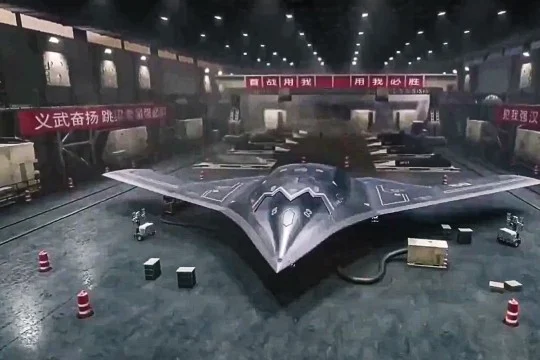
China’s long-rumored Xi’an H-20 stealth bomber has become one of the most watched military aircraft projects in the world.
For years, Beijing has teased the idea of a next-generation strategic bomber capable of giving the People’s Liberation Army Air Force something it has never truly had before: a stealthy, long-range bomber that could threaten targets far beyond China’s coastline.
But the reason the H-20 attracts so much attention is not only because of what it might do.
It is also because of what it appears to resemble.
You May Also Like
From early concept images, state-media hints, and defense analysis, the H-20 is widely expected to follow a tailless flying-wing design, the same basic stealth architecture made famous by America’s B-2 Spirit. That has led many observers to call it China’s attempt at a “B-2-style” bomber—a possible flying-wing duplicate built for China’s own strategic ambitions.
But is the H-20 truly a copy of the B-2?
Or is it something more dangerous: a modern Chinese interpretation of America’s most secretive bomber concept, built decades later with newer materials, newer computers, and a completely different battlefield in mind?
The answer matters because the H-20 could become a major turning point in the Indo-Pacific military balance.
The B-2 Spirit: America’s Original Stealth Bomber Legend
Before discussing China’s H-20, it is important to understand what the B-2 Spirit represents.
The B-2 Spirit is not just another bomber. It is one of the most recognizable and secretive aircraft ever built. With its smooth black flying-wing shape, no vertical tail, and radar-evading design, the B-2 looks less like a traditional airplane and more like something from the future.
But this “future” aircraft was born decades ago.
The B-2 was developed during the Cold War to penetrate heavily defended Soviet airspace and deliver nuclear weapons if necessary. Later, after the Cold War ended, it became one of America’s most powerful conventional strike platforms.
Its mission was simple but terrifying: fly deep into enemy territory, avoid radar detection, and destroy the most important targets on the first night of a war.
The B-2’s design made it revolutionary. Instead of relying on speed like older bombers, it relied on stealth. Instead of flying around air defenses, it was built to slip through them.
That changed modern warfare.
Combat-Proven Power: The B-2 Has Already Been Tested
One of the biggest differences between the American B-2 and China’s H-20 is this: the B-2 has already gone to war.
It has flown real combat missions. It has dropped real weapons. It has been used in major U.S. military operations across multiple decades.
The B-2 was used during the Kosovo War in 1999, proving that stealth bombers could strike heavily defended targets from long distances. It later flew missions in Iraq, Afghanistan, Libya, and other operations. The aircraft became a symbol of America’s ability to hit high-value targets anywhere in the world.
The B-2 is not just a theory.
It is not just a prototype.
It is not just a model under a white sheet in a military parade.
It is a combat-tested aircraft with decades of operational history behind it.
That matters.
A bomber may look impressive on paper, but combat is where technology meets reality. Maintenance problems, stealth coating durability, mission planning, pilot training, weapons integration, and electronic warfare all become brutally important when the aircraft must fly into real danger.
This is where the H-20 still has everything to prove.
China’s H-20: The Secret Bomber Beijing Has Not Fully Revealed
China’s H-20 is believed to be a next-generation strategic bomber under development by Xi’an Aircraft Industrial Corporation. China has described the project as a major step forward for its air force, but it has still not been fully revealed as an operational aircraft.
Unlike the B-2, which has been publicly known for decades, the H-20 remains surrounded by secrecy. Most public understanding of the aircraft comes from official hints, defense reporting, concept images, scale models, and speculation from military analysts.
This mystery has only made the aircraft more interesting.
China has already transformed its air force over the past two decades. It moved from older Soviet-derived designs to modern fighters like the J-20 stealth fighter. It has improved missiles, sensors, drones, warships, and space-based capabilities. The H-20 would be another major step in that modernization.
If it becomes operational, the H-20 could give China a true strategic stealth bomber for the first time.
That would be a serious change.
Today, China’s bomber force still depends heavily on the H-6 family, which traces its roots back to the Soviet Tu-16 design from the 1950s. China has upgraded the H-6 with modern missiles and electronics, but the basic aircraft is not a stealth bomber.
The H-20 would be different.
It would be designed to survive in contested airspace, carry long-range weapons internally, and give Beijing a far more credible long-range strike capability.
A B-2 Duplicate—or a Chinese Stealth Evolution?
The most controversial issue is the design.
The H-20 is widely expected to use a flying-wing stealth shape. That immediately invites comparison with the B-2 Spirit and the newer American B-21 Raider.
A flying wing is ideal for stealth because it reduces radar-reflecting surfaces. Traditional tails, sharp angles, external weapons, and exposed engine features can increase radar signature. A smooth, tailless flying wing can make an aircraft much harder to detect.
This is why the B-2 looks the way it does.
And this is why the H-20 is expected to look similar.
But calling the H-20 a simple “copy” may be too easy. China may have studied the B-2, learned from U.S. stealth aircraft, and benefited from decades of global aerospace research. There have also been long-running Western concerns about Chinese cyber espionage and the theft of sensitive military technology.
However, the H-20 is not expected to be a bolt-for-bolt copy of the B-2. It would likely be built around China’s own needs, weapons, engines, electronics, and mission requirements.
The better description may be this:
The H-20 appears to be China’s answer to the B-2.
It uses a similar stealth philosophy, but it belongs to a different era.
The B-2 was born in the Cold War.
The H-20 is being built for the missile age, the drone age, the satellite age, and the Indo-Pacific power struggle.
The Real Mission: Breaking the Island Chains
China’s military strategy is heavily shaped by geography.
The United States and its allies operate from bases across the Indo-Pacific, including Japan, Guam, South Korea, Australia, and other locations. These bases form part of what analysts often call the “first island chain” and “second island chain.”
For China, these island chains are both a barrier and a battlefield.
A stealth bomber like the H-20 could be designed to push Chinese airpower beyond these barriers. With long range and stealth, it could threaten air bases, ports, radar stations, command centers, and naval forces across the region.
This is where the H-20 could become dangerous.
It may not need to fly directly over Washington, D.C., to change the balance of power. It only needs to make U.S. and allied planners worry about Guam, Okinawa, aircraft carriers, refueling tankers, and logistics hubs.
Modern wars are not only won by destroying enemy fighters.
They are won by destroying the systems that keep those fighters alive.
Tankers. Satellites. Air bases. Fuel storage. Runways. Command posts. Early-warning aircraft.
A stealth bomber armed with long-range cruise missiles could threaten all of these.
Range and Payload: The Big Question
Many reports suggest the H-20 could have an unrefueled range somewhere around 8,500 to 10,000 kilometers, though exact figures remain unconfirmed. Some more ambitious claims put the range even higher, but because the aircraft has not been fully revealed, all H-20 performance numbers should be treated as estimates.
The B-2 Spirit has an unrefueled range of about 6,000 nautical miles, or roughly 11,100 kilometers. With aerial refueling, it can fly global missions. This is one of the reasons the B-2 is so feared: it can launch from the United States and strike targets on the other side of the world.
The H-20’s range may be slightly shorter than the B-2’s in some estimates, but the strategic context is different. China does not necessarily need the H-20 to match the B-2’s global reach on day one. China needs it to cover the Indo-Pacific, threaten U.S. bases, and expand its nuclear and conventional strike options.
That alone would be enough to change military planning.
Payload estimates for the H-20 vary widely. Some claims suggest it could carry a heavier payload than the B-2, while others are more conservative. The B-2 carries more than 40,000 pounds of weapons, including conventional bombs and nuclear weapons.
The H-20 is expected to use internal weapon bays to preserve stealth. These bays could carry cruise missiles, precision-guided bombs, anti-ship weapons, and possibly hypersonic or nuclear-capable weapons in the future.
But again, the key word is expected.
Until China publicly reveals the real aircraft and operational details, the H-20 remains a combination of confirmed ambition and unconfirmed capability.
Why Internal Weapons Matter
A stealth bomber cannot carry weapons the same way older bombers do.
External weapons hanging under the wings would ruin stealth. They create radar reflections, drag, and heat signatures. That is why stealth aircraft carry weapons inside internal bays.
The B-2 does this.
The B-21 will do this.
The H-20 is expected to do the same.
Internal weapons allow a bomber to remain low-observable while entering dangerous airspace. This is extremely important in a modern battlefield filled with long-range radar, surface-to-air missiles, fighter patrols, electronic warfare systems, and satellites.
If the H-20 can carry modern Chinese cruise missiles internally, it may not need to fly directly above its target. It could launch from a standoff distance, forcing defenders to track a stealthy bomber and then deal with incoming missiles.
That is a nightmare scenario for military planners.
Electronic Warfare and Standoff Strike: More Than a Bomb Truck
The H-20 may not be designed only as a classic bomber.
Modern strategic aircraft are increasingly expected to act as sensor platforms, electronic warfare nodes, missile carriers, and command-and-control assets. A stealth bomber can do much more than drop gravity bombs.
China may design the H-20 to support electronic attack, jam enemy radars, launch long-range standoff weapons, and coordinate with other aircraft, drones, satellites, and missile forces.
This would make it a key part of China’s broader anti-access/area-denial strategy.
In simple words, China wants to make it harder for U.S. forces to operate near Chinese territory. Long-range missiles, stealth aircraft, submarines, drones, cyber tools, and space assets all support this goal.
The H-20 could become one more weapon in that system.
And because it may be stealthy, it could create uncertainty. Even if the aircraft is not used immediately, the threat of it could force the United States and its allies to invest more in radar coverage, missile defense, hardened bases, and long-range counterstrike options.
Sometimes a weapon changes strategy before it ever fires a shot.
The B-2’s Weakness: Age and Maintenance
The B-2 remains powerful, but it is not young.
Its first flight took place in 1989, and it entered service in the 1990s. Its design was revolutionary, but stealth aircraft require constant maintenance, especially when it comes to radar-absorbent materials and low-observable coatings.
The B-2 is famous for being expensive and maintenance-intensive. Its stealth skin must be carefully protected and repaired. Its hangars, support crews, and mission systems require specialized care.
This is one reason the U.S. Air Force is now moving toward the B-21 Raider.
The B-21 is expected to be more maintainable, more digitally advanced, and cheaper to operate than the B-2. It is the future of American stealth bombing.
But until the B-21 becomes available in significant numbers, the B-2 remains the United States’ main operational stealth bomber.
That gives China a window of opportunity.
If the H-20 enters service before the B-21 fleet grows large, Beijing may believe it has narrowed an important strategic gap.
The H-20’s Weakness: It Has Not Proved Anything Yet
While the B-2’s weakness is age, the H-20’s weakness is uncertainty.
It has not been publicly shown as a fully operational bomber. It has no public combat history. Its engines, stealth quality, radar-absorbent materials, avionics, weapons integration, and production schedule remain unclear.
This is important because building a stealth bomber is extremely difficult.
A flying-wing aircraft must be stable without a traditional tail. That requires advanced flight-control systems. Its engines must be hidden in ways that reduce radar and infrared signatures. Its surfaces must be built with extreme precision. Its coatings must survive weather, heat, maintenance, and repeated operations.
A stealth bomber is not just a shape.
It is a complete system.
The B-2 proved that system over decades. The H-20 has not.
This does not mean the H-20 will fail. China has made major progress in aerospace technology. But until the aircraft is revealed, tested, produced, and operated, its true capability remains unknown.
Why China Wants a Stealth Bomber So Badly
China’s nuclear triad has historically been weaker than America’s.
The United States has land-based intercontinental ballistic missiles, ballistic missile submarines, and strategic bombers. This gives Washington multiple ways to deliver nuclear weapons and maintain deterrence.
China has been expanding its nuclear forces and improving its missile systems, submarines, and bomber capabilities. The H-20 could give China a stronger airborne nuclear option.
That would matter because bombers are different from missiles.
A missile, once launched, cannot be recalled.
A bomber can be launched, redirected, held in the air, or recalled. That makes it useful for signaling during a crisis. It gives leaders more flexibility.
A stealth bomber also gives China a more credible way to threaten distant targets with conventional weapons. It could be used for deterrence, coercion, or wartime strikes.
In the Indo-Pacific, that could change everything.
America’s Answer: The B-21 Raider
The United States is not standing still.
The B-21 Raider is already in flight testing and is designed to replace both the B-1B Lancer and the B-2 Spirit. It is expected to be smaller, more modern, more maintainable, and more adaptable than the B-2.
If the B-2 was the stealth bomber of the Cold War and post-9/11 era, the B-21 is the stealth bomber of the future.
The B-21 is being built for a world where China is the pacing challenge. It is expected to operate in heavily defended airspace, connect with other platforms, carry future weapons, and remain upgradeable over decades.
That means the H-20 is not entering a world where the B-2 stands alone.
It is entering a world where America is already preparing its next move.
The real competition may not be H-20 versus B-2.
It may be H-20 versus B-21.
Final Verdict: The H-20 Is a Warning, Not Yet a Proven Killer
The H-20 is one of the most mysterious aircraft projects in modern military aviation.
It appears to follow the same stealth logic that made the B-2 famous. It may use a flying-wing design, internal weapons, modern avionics, and long-range strike capability. It may become China’s first true intercontinental stealth bomber.
But it is not yet the B-2.
The B-2 has decades of operational experience, proven combat missions, global reach, and integration into America’s nuclear and conventional strike force.
The H-20 has secrecy, ambition, and potential.
That potential is still enough to worry U.S. planners.
If China successfully fields the H-20, the Indo-Pacific airpower balance will shift. American bases, allied facilities, and naval forces could face a new stealth threat. China would gain a more flexible long-range strike tool and a stronger nuclear deterrent.
The H-20 may look like a Chinese answer to America’s B-2 Spirit.
But the bigger story is not just copying.
The bigger story is China trying to close the gap with U.S. stealth airpower—and possibly build a bomber designed for the next generation of war.
America built the B-2 to penetrate Soviet airspace.
China may be building the H-20 to challenge American power in the Pacific.
And when that aircraft finally appears, the world will not just be looking at a new bomber.
It will be looking at a warning sign that the stealth bomber race has entered a new and dangerous chapter.